

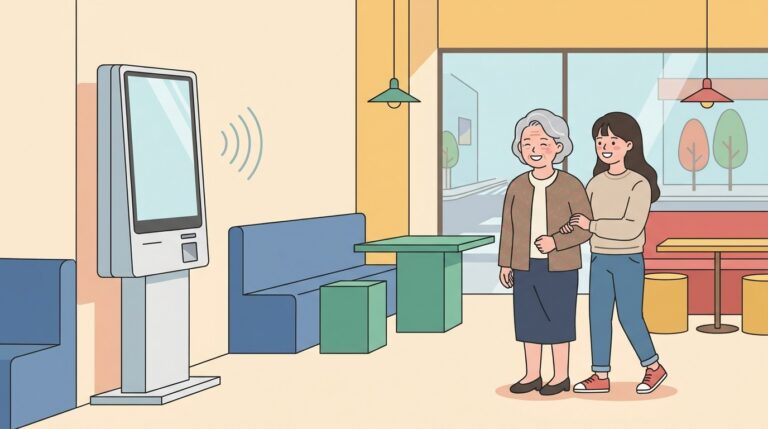
Phase 1: Empathy — Navigating Korea’s Fast-Forward Digital World
안녕하세요! 매일한글 에디터입니다. (Annyeonghaseyo! Maeeil Hangul editeoimnida. — Hello! This is your Daily Hangul Editor.) Picture yourself in a trendy Seoul cafe straight out of a K-Drama, craving an iced Americano. A line forms fast behind you while you tap through a dizzying kiosk screen. Now imagine how overwhelming that feels for older adults in Korea’s ultra-cashless society. Digital convenience is amazing, yet digital exclusion is a real daily hurdle. Thankfully, barrier-free kiosks with large text and voice guidance are expanding across Korea! Based on real feedback from B1 learners eager to discuss social trends naturally, this guide equips you with essential Korean phrases and cultural tips.
Phase 2: Deep Dive Into 3 Essential B1 Expressions
1. 배리어 프리 키오스크가 늘어나고 있어요 (Baerieo peuri kioseukeuga neureonago isseoyo)
- Pronunciation: Baerieo peuri kioseukeuga neureonago isseoyo (Think of “barrier-free” spoken with a gentle Korean rhythm: beh-ree-uh peu-ree, and neureonago sounds like nuh-ruh-nah-go, flowing smoothly without hard pauses.)
- Meaning: Literally “Barrier-free kiosks are increasing.” In natural conversation, it expresses optimism that stores are becoming more accessible and inclusive for everyone.
- K-Culture Moment: You will often hear this phrase on Korean news segments or lifestyle variety shows like You Quiz on the Block when discussing how modern Seoul neighborhoods are adapting for seniors and people with disabilities.
- Editor’s Insight: Using -아/어 가고 있어요 (-a/eo gago isseoyo) or 늘어나고 있어요 (neureonago isseoyo) highlights an ongoing social trend. At the B1 level, showing awareness of gradual change makes your Korean sound thoughtful rather than robotic!
- Situation Spectrum: Casual ⚠️ (Drop the -요/yo with close friends: 늘어나고 있어) / Semi-formal ✅ (Perfect for coworkers or friends) / Formal ✅ (Add -습니다: 늘어나고 있습니다 for presentations)
- 🤔 Think About It: English relies heavily on the loanword “accessibility,” whereas Korean directly adopts “barrier-free” (배리어 프리) as a warm, positive social goal. How does your native language frame public spaces becoming easier for everyone to use?
2. 현금 없는 사회라 편하지만 소외되는 분들도 계세요 (Hyeongeum eomneun sahoera pyeonhajiman soedoeneun bundeuldo gyeseyo)
- Pronunciation: Hyeongeum eomneun sahoera pyeonhajiman soedoeneun bundeuldo gyeseyo (Hyeon-geum sounds like hyuhn-geum with a soft ‘uh’; soedoeneun rhymes smoothly with so-eh-dweh-neun.)
- Meaning: Literally “Because it is a cashless society, it is convenient, yet there are also people who become excluded.” It captures a balanced, empathetic viewpoint on modern tech.
- K-Culture Moment: Picture two characters in a slice-of-life K-Drama like My Liberation Notes or Move to Heaven chatting over tteokbokki about how their neighborhood diner switched to card-only kiosks.
- Editor’s Insight: Notice the honorific noun 분들 (bundeul — respected people) and verb 계세요 (gyeseyo — exist/there are) instead of 사람들 (saramdeul) and 있어요 (isseoyo). When Koreans talk about seniors or vulnerable groups facing digital exclusion, shifting up to honorifics automatically shows genuine respect and social maturity.
- Situation Spectrum: Casual ⚠️ (Replace 분들/계세요 with 사람/있어 among peers) / Semi-formal ✅ (Ideal for discussions and class debates) / Formal ✅ (Change 계세요 to 계십니다 for formal speeches)
- 🤔 Think About It: In Korean, expressing empathy for others often triggers an immediate shift in vocabulary (honorifics). In English, empathy is usually shown through tone of voice rather than changing the verb “to be.” How does that feel when you speak Korean?
3. 큰 글씨 모드나 음성 안내를 이용하면 돼요 (Keun geulssi modeuna eumseong annaereul iyonghamyeon dwaeyo)
- Pronunciation: Keun geulssi modeuna eumseong annaereul iyonghamyeon dwaeyo (Keun sounds like a tight kuhn; eumseong is like eum-sung; dwaeyo sounds like dweh-yo.)
- Meaning: Literally “You just need to use the large text mode or voice guidance.” It is a reassuring, practical tip to help someone feel confident at a kiosk.
- K-Culture Moment: Imagine a kind cafe barista or a helpful young neighbor in a Korean variety show walking a grandmother through a fast-food touchscreen for the very first time.
- Editor’s Insight: The ending -(으)면 돼요 (-(eu)myeon dwaeyo) literally means “if you do X, it works,” which is Koreans’ favorite gentle way of giving instructions without sounding bossy. It translates beautifully to “All you have to do is…”
- Situation Spectrum: Casual ✅ (Drop -요 with close family: 이용하면 돼) / Semi-formal ✅ (Warm and polite for acquaintances or customers) / Formal ⚠️ (Use 이용하시면 됩니다 to customers or elders)
- 🤔 Think About It: Korean relies on conditional phrasing (“if you do this, it’s okay”) to soften advice. Compare that with direct English imperatives like “Press the large text button!” Which feels warmer to you?
Phase 3: Textbook Korean vs. Real Korean
Situation 1: Struggling with a tiny kiosk screen at a restaurant
- 📖 교과서 한국어 (Textbook Korean): 저는 이 기계 사용법이 너무 어렵습니다. (Jeoneun i gigye sayongbeobi neomu eoryeopseumnida. — I find how to use this machine very difficult.)
- 🗣️ 진짜 한국어 (Real Korean): 저기요, 키오스크가 좀 헷갈리는데 큰 글씨로 바꿀 수 있어요? (Jeogiyo, kioseukeuga jom hetgallineunde keun geulssiro bakkul su isseoyo? — Excuse me, this kiosk is a bit confusing; can I switch it to large text?)
- 💡 왜 다를까? (Why is it different?): Textbooks focus on stating facts about difficulty (어렵다), which can sound stiff or like a complaint. Real Koreans use 헷갈리다 (hetgallida — to be confusing/mixed up) to soften the situation and jump straight into a practical request using -는데 (-neunde).
Situation 2: Sharing your thoughts on cashless stores
- 📖 교과서 한국어 (Textbook Korean): 현금을 사용하지 않는 것은 디지털 소외를 야기합니다. (Hyeongeumeul sayonghaji anneun geoseun dijiteol soereul yagihamnida. — Not using cash causes digital exclusion.)
- 🗣️ 진짜 한국어 (Real Korean): 카드만 돼서 편하긴 한데, 어르신들은 좀 막막하실 것 같아요. (Kadeuman dwaeseo pyeonhagin hande, eoreusindeureun jom mangmakhasil geot gatayo. — It’s convenient since it’s card-only, though I think seniors must feel kind of stuck/overwhelmed.)
- 💡 왜 다를까? (Why is it different?): Words like 야기하다 (to cause) belong in academic essays, not coffee shop chats! Using -긴 한데 (-gin hande — it is true that…, but) lets you agree with the convenience first, while 막막하다 (mangmakhada — to feel at a loss) vividly captures the human emotion behind digital exclusion.
Phase 4: K-Culture Deep Dive & Non-Verbal Manners
4-1. 눈치 (Nunchi) & Kiosk Etiquette
Korea is famous for its 빨리빨리 (ppalli-ppalli — hurry-hurry) speed, so standing frozen in front of a kiosk while a line grows behind you can trigger instant panic! Here is the local nunchi (social awareness) secret: nobody expects you to be a human computer. If you need extra time or want to switch to a barrier-free mode, make brief eye contact with the person behind you, offer a polite slight nod, and step slightly aside to look at the menu board first, or tap the 직원 호출 (jigwon hochul — call staff) button. When a staff member comes over to activate voice guidance or large text, bowing your head slightly and saying 감사합니다 (gamsahamnida — thank you) keeps the atmosphere warm and respectful.
4-2. Cultural Code: K-Food Franchises & Inclusive K-Drama Moments
If you watch modern K-Dramas like Extraordinary Attorney Woo, you will notice how Korean society is actively reflecting on barriers in everyday spaces—from revolving doors to confusing public systems. Today, that awareness is transforming K-Food culture! Major burger chains, Korean dessert cafes, and even local gimbap shops are rolling out 배리어 프리 키오스크 (barrier-free kiosks) featuring lower screen heights for wheelchair users, braille keypads, 큰 글씨 (large text) toggles, and earphone jacks for 음성 안내 (voice guidance). Ordering your bulgogi burger or iced latte is finally becoming stress-free for everyone.
Phase 5: Real-Life Interactive Roleplay Scenario
Setting: A sunlit, bustling bakery-cafe in Yeonnam-dong, Seoul. The aroma of fresh salt bread (소금빵) fills the air. There is a sleek new kiosk near the counter.
Characters: Minji (민지), your friendly Korean colleague who volunteers at a local senior center, and You.
- Minji: 와, 이 카페도 드디어 현금 없는 매장이 됐네요. (Wa, i kapedo deudieo hyeongeum eomneun maejangi dwaenneyo. — Wow, this cafe finally became a cashless store too.) `🎭 Minji looks up at the
🎬 Watch Our Daily Videos! (Daily Hangul Official Instagram)
Review the expressions you learned in this article with our fun daily short videos! Check out native pronunciation and real-life nuances in action.
- Instagram @dailyhangul_en
Frequently Asked Questions (FAQ)
Q: What does "배리어 프리 키오스크가 늘어나고 있어요 (Baerieo peuri kioseukeuga neureonago isseoyo)" mean in Korean and how do you pronounce it?
A: In Korean, "배리어 프리 키오스크가 늘어나고 있어요 (Baerieo peuri kioseukeuga neureonago isseoyo)" is pronounced [Baerieo peuri kioseukeuga neureonago isseoyo (Think of "barrier-free" spoken with a gentle Korean rhythm: beh-ree-uh peu-ree, and neureonago sounds like nuh-ruh-nah-go, flowing smoothly without hard pauses.] and means: Literally "Barrier-free kiosks are increasing." In natural conversation, it expresses optimism that stores are becoming more accessible and inclusive for everyone.
Q: What does "큰 글씨 모드나 음성 안내를 이용하면 돼요 (Keun geulssi modeuna eumseong annaereul iyonghamyeon dwaeyo)" mean in Korean and how do you pronounce it?
A: In Korean, "큰 글씨 모드나 음성 안내를 이용하면 돼요 (Keun geulssi modeuna eumseong annaereul iyonghamyeon dwaeyo)" is pronounced [Keun geulssi modeuna eumseong annaereul iyonghamyeon dwaeyo (Keun sounds like a tight kuhn; eumseong is like eum-sung; dwaeyo sounds like dweh-yo.] and means: Literally "You just need to use the large text mode or voice guidance." It is a reassuring, practical tip to help someone feel confident at a kiosk.







