

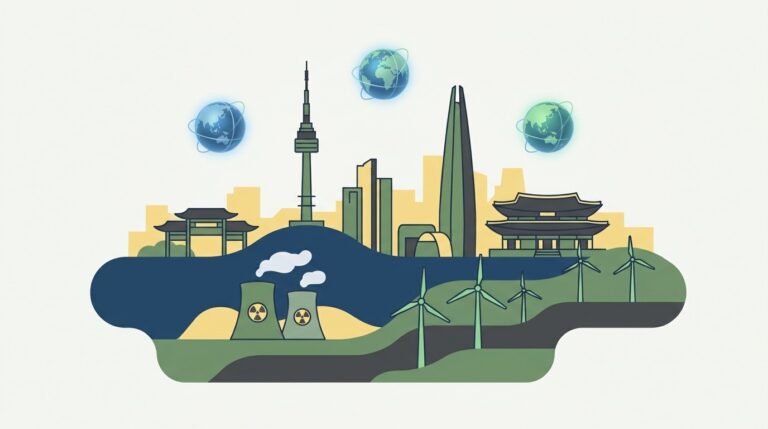
Phase 1: Empathy — Navigating Korea’s High-Stakes Energy Debate
Hello! I’m your Daily Hangul editor (안녕하세요! 매일한글 에디터입니다). Picture yourself in a sleek Yeouido boardroom—or binge-watching a sharp corporate K-Drama like Misaeng—when the conversation pivots to EU CBAM tariffs and Korea’s power grid. You know the policy inside out, yet explaining the tightrope between cheap, carbon-free nuclear baseload power and permanent radioactive waste disposal in natural C1 Korean feels daunting. Honestly, even native speakers sweat over these tongue-twisters! Built on real feedback from advanced learners in Seoul, this guide transforms stiff energy jargon into persuasive, boardroom-ready Korean.
Phase 2: Deep Dive into 3 Essential Expressions
1. 무탄소 기저전원 (Mutanso gijeojeonwon)
- Pronunciation: Mu-tan-so gi-jeo-jeon-won (Think “moo-tahn-so” like a calm cow sigh, followed by “gee-juh-juhn-wuhn”—keep the “eo” vowel relaxed like the “u” in “uh-huh.”)
- Meaning: Literally “carbon-free base power source.” In real Korean discourse, it refers to “reliable carbon-free baseload power”—the steady, 24/7 electricity backbone needed to keep export factories running under CBAM.
- K-Culture Moment: You will hear this exact phrase on Korean business news panels or in corporate dramas when a tech executive defends nuclear energy against volatile renewable supply during a summer heatwave.
- Editor’s Insight: Calling nuclear power just “원자력 (wonjaryeok)” sounds neutral or generic. Framing it as “무탄소 기저전원 (mutanso gijeojeonwon)” immediately signals pro-efficiency, industrial-strategy fluency.
- Situation Spectrum: Casual ⚠️ | Semi-formal ✅ | Formal ✅
- 🤔 Think About It: English separates “carbon-free” and “baseload” casually, whereas Korean policy speech welds them into a single four-syllable-plus-four-syllable compound noun. How does your native language pack complex engineering concepts into persuasive slogans?
2. 고준위 방사성폐기물 영구 처분장 (Gojunwi bangsaseongpyegimul yeonggu cheobunjang)
- Pronunciation: Go-jun-wi bang-sa-seong-pye-gi-mul yeong-gu cheo-bun-jang (Break it into three rhythmic beats: “Go-joon-wee / bahng-sah-sung-pyeh-gee-mool / yung-goo chuh-boon-jahng.”)
- Meaning: Literally “high-level radioactive waste permanent disposal facility.” Practically, it is the elephant in the room whenever nuclear expansion is praised.
- K-Culture Moment: Think of tense town-hall scenes in Korean social-issue films or investigative news documentaries where local mayors clash with central ministry officials over hosting spent nuclear fuel.
- Editor’s Insight: That 14-syllable marathon is a mouthful even for Korean news anchors! Once introduced, native speakers immediately shorten it to 고준위 방폐장 (gojunwi bangpyejang) or simply 방폐장 (bangpyejang). Knowing both the full formal title and the crisp abbreviation marks true C1 mastery.
- Situation Spectrum: Casual 🚫 | Semi-formal ⚠️ | Formal ✅
- 🤔 Think About It: Notice the word “영구 (yeonggu, permanent).” In a densely populated country where land is scarce and fiercely protected, how does the idea of “forever” carry heavier emotional weight than in vast countries?
3. 피할 수 없는 숙제 (Pihal su eomneun sukje)
- Pronunciation: Pi-hal su eom-neun suk-je (Watch the sound change! Eobs-neun glides into eom-neun like “um-nun,” and suk-je snaps cleanly like “sook-jeh.”)
- Meaning: Literally “unavoidable homework.” In nuanced C1 Korean, it means “an inescapable, lingering challenge we must eventually resolve.”
- K-Culture Moment: Classic dialogue from a stressed chaebol vice president in a K-Drama sighing over a late-night whiskey, admitting that green compliance is a hurdle the company can no longer postpone.
- Editor’s Insight: Using “문제 (munje, problem)” can sound accusatory or pessimistic. Calling waste disposal a “숙제 (sukje, homework)” frames it diplomatically as a shared national duty rather than an unsolvable flaw.
- Situation Spectrum: Casual ✅ | Semi-formal ✅ | Formal ✅
- 🤔 Think About It: Why do Korean adults constantly describe billion-dollar corporate and national crises as “homework”? It reflects a lifelong culture of shared accountability and continuous problem-solving!
Phase 3: Textbook Korean vs. Real Korean
Situation 1: Weighing nuclear’s low cost against waste disposal in a strategy meeting
* 📖 Textbook Korean: 원자력은 탄소 배출이 없고 저렴하지만, 폐기물 처리 문제를 해결해야 합니다. (Wonjaryeogeun tanso baechuri eopgo jeoryeomhajiman, pyegimul cheori munjereul haegyeolhaeya hamnida. — Nuclear power has no carbon emissions and is inexpensive, but we must resolve the waste treatment issue.)
* 🗣️ Real Korean: 원전이 단가도 낮고 무탄소 기저전원으로 딱인데, 고준위 방폐장 확보가 영 발목을 잡네요. (Wonjeoni dangado natgo mutanso gijeojeonwoneuro ttaginde, gojunwi bangpyejang hwakboga yeong balmeogeul jamneyo. — Nuclear has low unit costs and fits great as carbon-free baseload power, yet securing a high-level waste site is really holding us back.)
* 💡 Why the difference? Professionals swap textbook 원자력 for punchy 원전 (wonjeon), cite 단가 (danga, unit cost) for business credibility, and use the idiom 발목을 잡다 (balmeogeul japda, to grab one’s ankle) to critique a bottleneck smoothly without sounding harsh.
Situation 2: Discussing urgent CBAM compliance pressure on exporters
* 📖 Textbook Korean: 탄소국경조정제도 때문에 기업들의 전략 수립이 중요해졌습니다. (Tansogukgyeongjojeongjedo ttaemune gieopdeurui jeollyak suribi jungyohaejyeotseumnida. — Due to CBAM, establishing corporate strategies has become important.)
* 🗣️ Real Korean: CBAM 본격 시행 앞두고, 기업들 입장에서는 무탄소 전원 확보가 발등에 불이 떨어졌죠. (CBAM bongyeok sihaeng apdugo, gieopdeul ipjangeseoneun mutanso jeonwon hwakboga baldeunge buri tteoreojyeotjyo. — Ahead of full CBAM implementation, securing carbon-free power has become an urgent fire under companies’ feet.)
* 💡 Why the difference? Saying the full 10-syllable 탄소국경조정제도 five times in one meeting will exhaust your jaw! Native speakers use the acronym CBAM (pronounced carefully as 씨비에이엠) or 탄소국경세 (Carbon Border Tax) paired with vivid idioms like 발등에 불이 떨어지다 (fire falling on the top of one’s foot).
Phase 4: K-Culture Deep Dive & Non-Verbal Manners
4-1. Nunchi (눈치) & Gestures
Discussing radioactive waste disposal (방폐장) in Korea requires sharp 눈치 (nunchi, social awareness) because it triggers passionate regional sensitivity. Never point fingers or dismiss local opposition with a casual wave of the hand. Instead, use an open-palm “weighing scale” gesture with both hands when balancing cost efficiency against safety. Maintain steady, respectful eye contact and nod empathetically (고개를 끄덕이다) whenever someone mentions local resident safety or environmental trust.
4-2. Cultural Code Analysis: K-Drama & Current Affairs
If you love Korean corporate dramas or follow 시사 교양 (sisa gyoyang, current affairs shows), you’ve probably noticed Korea’s intense obsession with energy security. Unlike resource-rich nations, South Korea imports nearly all its fossil fuels while running energy-hungry semiconductor, steel, and auto factories directly exposed to the EU’s CBAM. That is why Korean media frames nuclear power not merely as a climate choice, but as an industrial lifeline—making the search for a permanent waste repository one of the country’s most dramatic socio-political storylines.
Phase 5: Real-Life Roleplay Scenario
Setting: A sunlit 24th-floor conference room in Gangnam overlooking the Han River. You are preparing an executive briefing on Korea’s CBAM strategy with Director Park (박 팀장), a sharp, coffee-loving veteran energy analyst.
- Director Park: 🎭 Sets down two iced Americanos and taps the tablet screen. EU CBAM 전환 기간이 끝나가면서 본사에서도 전력 조달 단가 때문에 걱정이 많아요. (EU CBAM jeonhwan gigani kkeutnagamyeonseo bonsaeseodo jeollyeok jodal danga ttaemune geokjeongi manayo.) — As the EU CBAM transition period ends, HQ is really worried about power procurement unit costs.
- You: 🎭 Leans forward slightly, nodding in agreement. 맞아요, 팀장님. 단기적으로는 원전 비중을 유지해서 저렴한 무탄소 기저전원을 확보하는 게 유리하죠. (Majayo, timjangnim. Dangijeogeuro-neun wonjeon bijungeul yujihaeseo jeoryeomhan mutanso gijeojeonwoneul hwakbohaneun ge yurihajyo.) — True, Director. In the short term, maintaining the nuclear share to secure cheap carbon-free baseload power is advantageous.
- Director Park: 🎭 Raises an eyebrow appreciatively. 오, 핵심을 정확히 짚으셨네요. 그런데 유럽 파트너사들은 지속 가능성 리포트를 꽤 까다롭게 보잖아요? (O, haeksimeul jeonghwakhi jipeusyeonneyo. Geureonde yureop pateuneosadeureun jisok ganeungseong ripoteureul kkwae kkadaropge bojanayo?) — Oh, you nailed the core point. Still, European partners scrutinize sustainability reports pretty strictly, don’t they?
- You: 🎭 Gestures smoothly with an open palm. 네, 바로 그 지점이죠. 원자력이 경제적인 무탄소 전원이긴 하지만, 고준위 방사성폐기물 영구 처분장 확보라는 숙제가 남아 있으니까요. (Ne, baro geu jijeomijyo. Wonjaryeogi gyeongjejeogin mutanso jeonwonigin hajiman, gojunwi bangsaseongpyegimul yeonggu cheobunjang hwakboraneun sukjega nama isseunikka-yo.) — Yes, that’s exactly the point. Even though nuclear is an economical carbon-free power source, the unresolved homework of securing a permanent high-level radioactive waste disposal site remains.
- Director Park: 🎭 Nods slowly while jotting a note. 맞습니다. 당장 부지 선정부터 주민 수용성까지 해결할 게 산더미죠. (Matseumnida. Dangjang buji seonjeongbuteo jumin suyongseongkkaji haegyeolhal ge sandeomijyo.) — Exactly. From site selection to resident acceptance, there is a mountain of issues to resolve.
- You: 🎭 Offers a confident, collaborative smile. 그래서 이번 보고서에는 단가 절감 효과뿐만 아니라, 방폐장 확보와 관련한 중장기 로드맵도 꼭 병기해야 할 것 같아요. (Geuraeseo ibeon bogoseoeneun danga jeolgam hyogwappunman anira, bangpyejang hwakbowa gwallyeonhan jungjanggi rodeumaepdo kkok byeonggihaeya hal geot gatayo.) — That’s why I think this report should include not only cost-reduction effects, but also a mid-to-long-term roadmap regarding waste facility acquisition.
- Director Park: 🎭 Smiles warmly and gives a thumbs-up. 완벽한 균형감각이네요. 그럼 초안 작성은 믿고 맡길게요! (Wanbyeokhan gyunhyeonggamgagineyo. Geureom choan jakseongeun mitgo matgilgeyo!) — That’s a perfect sense of balance. Then I’ll trust you to draft the outline!
- You: 🎭 Bows head slightly. 감사합니다, 팀장님! 오늘 오후까지 정리해서 공유드리겠습니다. (Gamsahamnida, timjangnim! Oneul ohukkaji jeongnihaeseo gongyudeurigetseumnida.) — Thank you, Director! I’ll organize it and share it by this afternoon.
🔀 Interactive Branching Point: How would you pitch the waste issue to skeptical EU stakeholders?
- Option A: “고준위 방폐장 확보는 여전히 무거운 숙제이지만, 투명한 사회적 합의를 통해 단계적으로 풀어나가고 있습니다.” (Gojunwi bangpyejang hwakboneun yeojeonhi mugeoun sukjeijiman, tumyeonghan sahoejeok habuireul tonghae dangyejeogeuro pureonagago itseumnida.)
- Feedback (Best ✅): Brilliant C1 diplomacy! You acknowledge the burden honestly (무거운 숙제) while emphasizing transparency and social consensus (사회적 합의), hitting the exact ESG tone European partners respect.
- Option B: “폐기물은 그냥 나중에 묻으면 되니까, 싼 원전 전기만 신경 쓰시면 됩니다.” (Pyegimureun geunyang najunge mudeumyeon doenikka, ssan wonjeon jeongiman singyeong sseugimyeon doemnida.)
- Feedback (Bad 🚫): Way too blunt and dismissive! Downplaying nuclear waste with casual phrasing (그냥 나중에 묻으면) destroys credibility and violates corporate nunchi.
- Option C: “방폐장 문제는 진짜 골치 아픈데 어쩔 수 없죠 뭐.” (Bangpyejang munjeneun jinjja golchi apeunde eojjeol su eoptjyo mwo.)
- Feedback (Risk ⚠️): Grammatically fine for venting with a close friend over drinks, 골치 아프다 (it’s a headache) and 어쩔 수 없죠 (nothing we can do) sound defeatist and unprofessional in an executive briefing.
Phase 6: 10-Second Emotional Shadowing Drill
Read aloud with the / pause markers and lean into the emotion!
[💼 Confident & Analytical]원자력은 저렴한 무탄소 기저전원이지만, / 고준위 방폐장 확보라는 숙제가 / 아직 남아 있어요. (Wonjaryeogeun jeoryeomhan mutanso gijeojeonwonijiman, / gojunwi bangpyejang hwakboraneun sukjega / ajik nama isseoyo. — Nuclear is a cheap carbon-free baseload power source, / yet the homework of securing a high-level waste site / still remains.)[😟 Concerned yet Diplomatic]CBAM 대응을 위해 / 단가 경쟁력도 중요하지만, / 주민 수용성도 절대 놓칠 수 없죠. (CBAM daeeungeul wihae / danga gyeongjaengnyeokdo jungyohajiman, / jumin suyongseongdo jeoldae nochil su eoptjyo. — To respond to CBAM, / cost competitiveness matters, / yet we can never miss resident acceptance either.)[💡 Determined & Collaborative]결국 사회적 합의를 이끌어내는 게 / 가장 시급한 과제입니다. (Gyeolguk sahoejeok habuireul ikkeureonaeneun ge / gajang sigeuphan gwajeimnida. — Ultimately, drawing out social consensus / is the most urgent task.)
Phase 7: K-Culture Mini Dictionary
- 원전 (Wonjeon) | Nuclear Power Plant | Everyday shorthand for 원자력발전소 (wonjaryeokbaljeonso); used constantly in news headlines, stock forums, and business meetings.
- 님비 현상 (Nimbi hyeonsang) | NIMBY Syndrome | Adapted directly from English “Not In My Back Yard,” this term dominates Korean news whenever permanent disposal sites are proposed.
- CF100 (씨에프백, Ssi-e-peu-baek) | Carbon-Free 100% | Korea’s strategic initiative contrasting with RE100, advocating that nuclear power alongside renewables should count toward 100% carbon-free energy.
- 사회적 합의 (Sahoejeok habui) | Social Consensus | The ultimate diplomatic keyword in Korean policy debates, signaling that major infrastructure needs public trust, not just government decree.
Phase 8: Survival Kit for Travelers
Visiting Seoul for an energy summit, tech expo, or eco-tourism? Keep these three phrases handy!
- 탄소 중립 실천하고 계시나요? (Tanso jungnip silcheonhago gyesinayo? — Are you practicing carbon neutrality?)
- Pro Tip: Great icebreaker at sustainability expos or eco-friendly cafes in Seongsu-dong.
- 이 건물은 친환경 에너지를 쓰나요? (I geonmureun chinhwangyeong eneoji-reul sseunayo? — Does this building use eco-friendly energy?)
- Pro Tip: Useful when touring LEED-certified Korean headquarters or smart buildings in Pangyo.
- 전기차 충전소가 어디에 있어요? (Jeongicha chungjeonsoga eodie isseoyo? — Where is the EV charging station?)
- Pro Tip: Electric vehicles are everywhere in Korea—most underground parking lots have dedicated green zones.
Editor’s Travel Note
Before stepping off the plane at Incheon, prepare your digital toolkit: complete your Naver Map App Download for pinpoint EV charging locations and eco-friendly transit routes, and bookmark the Ministry of Trade, Industry and Energy Official Portal if you are tracking live Korean energy updates. Pro tip: Grab a Climate Card (기후동행카드) or T-money card at any convenience store for unlimited eco-friendly Seoul subway and bus rides, and carry a reusable tumbler—most Korean cafes offer a 300–500 KRW discount!
Phase 9: One Step Deeper
Korea’s breathtaking industrial miracle was famously powered by 빨리빨리 (ppalli-ppalli, hurry-hurry) speed—building bridges, shipyards, and nuclear reactors in record time. Yet the challenge of permanent high-level radioactive waste disposal exposes the exact opposite side of Korean society: you cannot rush trust. In a collectivist culture where honorifics and community harmony (우리, uri) bind neighborhoods tightly, forcing a waste site onto a town without deep dialogue breaks an unwritten social contract. That is why resolving this “homework” requires slowing down from rapid engineering to patient, respectful consensus.
💬 Your Turn: In your home country, how do people debate the trade-off between reliable nuclear energy and waste disposal? Share your thoughts in the comments below!
Phase 10: FAQ & Common Mistakes
Q: Why did my Korean coworker pronounce CBAM like “Ssibam (씨밤)” in a casual chat?
A: Great catch! Some Korean speakers casually read the acronym C-B-A-M phonetically as 씨밤 (Ssi-bam) for speed. However, be super careful—pronounced too fast, it sounds dangerously close to a famous Korean swear word! In formal meetings, always spell it out cleanly as 씨-비-에이-엠 (Ssi-bi-ei-em) or use the official Korean term 탄소국경조정제도 (Tansogukgyeongjojeongjedo).
Q: Is “방폐장 (bangpyejang)” okay to use in a formal business presentation?
A: Yes, once you introduce the full phrase 고준위 방사성폐기물 영구 처분장 on your opening slide or opening sentence, switching to 고준위 방폐장 or 방폐장 is standard professional practice—even in National Assembly hearings.
Q: In Korea, does “무탄소 (carbon-free)” mean the same thing as “재생에너지 (renewable energy)”?
A: No, and confusing them is a classic policy trap! 재생에너지 refers strictly to solar, wind, hydro, etc. (tied to RE100), whereas 무탄소 에너지 (Carbon-Free Energy) intentionally includes nuclear power (tied to Korea’s CF100 push).
🚨 Common Mistakes Warning Board
- Mistake: Saying 싸구려 전기 (ssaguryeo jeongi, cheap/low-quality electricity) instead of 저렴한 기저전원 (jeoryeomhan gijeojeonwon).
- Correct Action: Use 경제적인 (economical) or 단가가 낮은 (low unit cost)—싸구려 implies poor quality!
- Mistake: Saying 쓰레기장 (sseuregijang, garbage dump) for nuclear waste facilities.
- Correct Action: Always use 처분장 (cheobunjang, disposal facility) or 방폐장 (bangpyejang). Calling nuclear waste 쓰레기 sounds shockingly amateurish.
- Mistake: Skipping the distinction between low/intermediate-level waste (중저준위) and high-level waste (고준위).
- Correct Action: Korea already operates a low/intermediate-level facility in Gyeongju! Specify 고준위 (high-level) when discussing the unresolved permanent repository issue.
Phase 11: Action Mission & Engagement
- 🥉 Bronze Mission (Solo Practice): Record yourself shadowing Phase 6 three times until 고준위 방사성폐기물 영구 처분장 rolls off your tongue smoothly without stumbling.
- 🥈 Silver Mission (Share Online): Post one Korean policy idiom you learned today—like 발목을 잡다 or 피할 수 없는 숙제—on LinkedIn or X with an example sentence.
- 🥇 Gold Mission (Real-World Use): Drop 무탄소 기저전원 or 사회적 합의 naturally into your next conversation with a Korean colleague or language exchange partner.
- 🎮 K-Culture Mission: Search YouTube Korea for a 2-minute news clip on “고준위 방폐장” or “CF100” and see how many times anchors use the exact shortcuts from Phase 7!
Phase 12: Interactive Quiz Challenge
1. Situational Judgment: Your Korean client says, “원전이 무탄소 전원이라 CBAM 대응에 좋긴 한데…” (Nuclear is great for CBAM as a carbon-free power source, but…) and trails off awkwardly. Which response shows the best C1 nunchi?
* A) “그러니까 무조건 원전을 많이 지어야죠!” (So we just have to build tons of nuclear plants!)
* B) “맞아요, 다만 고준위 방폐장 확보라는 숙제가 남아 있어서 사회적 합의가 중요하죠.” (True, though the unresolved challenge of securing a high-level waste site remains, so social consensus is vital.)
* C) “그냥 쓰레기장에 버리면 되지 않나요?” (Can’t we just throw it in a garbage dump?)
Check Answer & Explanation
Correct Answer: B! Option B validates your client’s point while gracefully addressing the waste repository bottleneck with mature C1 phrasing. Option A ignores the client’s hesitation (nunchi fail), and Option C uses the inappropriate word 쓰레기장 while oversimplifying nuclear safety.
2. Fill in the Blank: Complete the real-Korean business sentence: “고준위 방폐장 부지 선정 지연이 전체 에너지 전환 속도의 ________ 있어요.” (Delays in selecting a high-level waste site are holding back the pace of the entire energy transition.)
* Hint: Think of the ankle-grabbing idiom from Phase 3!
Check Answer & Explanation
Correct Answer: 발목을 잡고 (balmeogeul japgo) — Full phrase: 발목을 잡고 있어요. Literally “grabbing the ankle,” this idiom is the go-to C1 expression in Korean business news for describing bottlenecks holding back progress.
3. True or False Cultural Quiz: In Korean business meetings, “RE100” and “무탄소 기저전원 (CF100)” are interchangeable terms that both exclude nuclear energy.
Check Answer & Explanation
Correct Answer: False! While RE100 focuses strictly on renewable energy (solar, wind, etc.), Korea actively champions Carbon-Free Energy (CF100) and 무탄소 기저전원 specifically to include reliable nuclear power alongside renewables when responding to CBAM.
🎬 Watch Our Daily Videos! (Daily Hangul Official Instagram)
Review the expressions you learned in this article with our fun daily short videos! Check out native pronunciation and real-life nuances in action.
- Instagram @dailyhangul_en






