

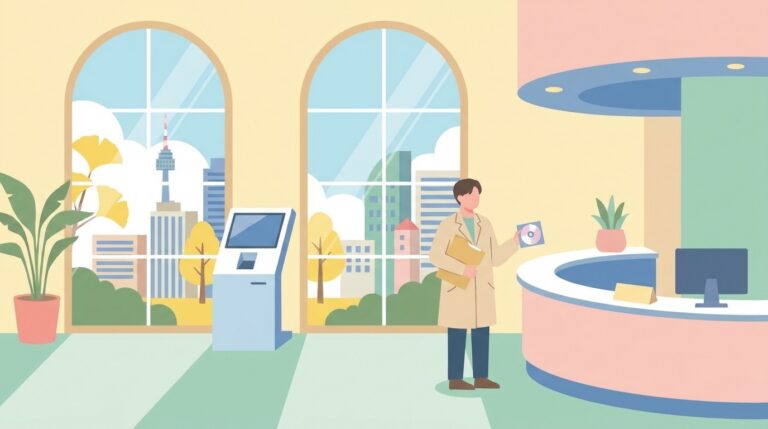
Phase 1: Why Korean Hospital Lobbies Feel Like K-Drama Boss Levels
안녕하세요! 매일한글 에디터입니다. (Annyeonghaseyo! Maeil Hangeul editeo-imnida. — Hello! I’m the Daily Hangul editor.) If you have ever watched Hospital Playlist, Korean university hospitals look effortlessly calm and cozy. In real life, stepping into a massive Seoul tertiary hospital clutching a clinic referral letter and an imaging CD can feel like a puzzle—especially when walls of self-service kiosks blink at you! Your biggest worry is making sure your MRI or CT scans load into the system before your consultation starts. Crafted from real learner feedback, this B2 survival guide equips you with natural Korean phrases to breeze through the First-Visit Desk like a local.
Phase 2: 3 Must-Know Expressions at the First-Visit Desk
1. 진료의뢰서랑 외부 영상 CD 좀 등록하려고요. (Jillyouiroeseorang oebu yeongsang CD jom deungnokharyeogoyo. — I’m here to register my referral letter and outside imaging CD.)
- Pronunciation: Jil-lyo-ui-roe-seo-rang oe-bu yeong-sang see-dee jom deung-no-ka-ryeo-go-yo. Think of
진료(jillyo) like “jeal-yo,” and blend등록하려고요smoothly into “deung-no-ka-ryeo-go-yo” (the k and h merge into a crisp k sound, like “cottage”).- Meaning: Literally “I intend to register my medical treatment request form and external video CD a little.” In real life, it simply means “I’d like to get my referral and outside scans registered.”
- K-Culture Moment: Just like when a patient transfers from a regional clinic to Yulje Medical Center in Hospital Playlist, staff immediately need the paper referral and disc before any specialist can open the chart.
- Editor’s Insight: Adding
-려고요(-ryeogoyo, “I’m intending to…”) plus좀(jom, literally “a little”) is pure B2 magic. Without좀, it can sound like a blunt order; with it, you sound polite, cooperative, and fluent!- Situation Spectrum: Casual 🚫 | Semi-formal ✅ | Formal ⚠️ (Use
등록하고자 합니다/ deungnokhagoja hamnida in ultra-formal announcements, though-려고요is the gold standard at hospital counters.)- 🤔 Think About It: Why do Koreans sprinkle
좀(“a little”) into requests that aren’t small at all? Compare how your native language softens requests at a busy service counter.2. 진료 전에 전산에 미리 올라갈 수 있을까요? (Jillyo jeone jeonsane miri ollagal su isseulkkayo? — Could they be uploaded into the system before my consult?)
- Pronunciation: Jil-lyo jeo-ne jeon-sa-ne mi-ri ol-la-gal su i-sseul-kka-yo? Notice
전산에(jeon-sa-ne) flows together like “John-sah-neh,” and있을까요(i-sseul-kka-yo) has a bouncy double-k sound like “ska” in “sky.”- Meaning: Literally “Can it go up onto the computer network in advance before medical treatment?” Practically, you are confirming the doctor won’t waste your 5-minute consult waiting for the CD to load.
- K-Culture Moment: In Korean medical dramas like Dr. Romantic, doctors click straight onto massive monitors expecting every CT slice to appear instantly—because nurses and desk coordinators uploaded it beforehand.
- Editor’s Insight:
전산에 올라가다(jeonsane ollagada) is a go-to workplace and hospital idiom meaning “to be registered/uploaded in the digital system.” Using미리(miri, in advance) shows sharp cultural awareness of Korea’s fast-paced appointments.- Situation Spectrum: Casual 🚫 | Semi-formal ✅ | Formal ✅
- 🤔 Think About It: English says “load into” a system, while Korean says “go up onto” (
올라가다/ ollagada) the system. How does visualizing data “going up” reflect how your language pictures digital networks?3. 첫 방문 고객 창구가 무인 수납기 옆에 있나요? (Cheot bangmun gogaek changguga muin sunapgi yeope innayo? — Is the First-Visit Desk next to the self-payment kiosk?)
- Pronunciation: Cheot bang-mun go-gaek chang-gu-ga mu-in su-nap-kki yeo-pe in-na-yo? Watch out for
수납기(su-nap-kki): the기tightens into a hard “key” sound right after the “p”!- Meaning: Asking a lobby volunteer or security guard to point you toward the dedicated newcomer desk beside the automated payment machines.
- K-Culture Moment: Think of the bustling lobbies in Daily Dose of Sunshine or Ghost Doctor, where helpful red-vested hospital volunteers guide bewildered visitors past rows of glowing kiosks.
- Editor’s Insight: Calling it
첫 방문 고객 창구(cheot bangmun gogaek changgu, First-Visit Customer Counter) instead of just접수처(jeopsucheo, reception) instantly tells staff you are a brand-new patient with outside paperwork.- Situation Spectrum: Casual 🚫 | Semi-formal ✅ | Formal ✅
- 🤔 Think About It: Korean hospitals call patients
고객(gogaek, customers/guests) at the registration desk. How do you feel about blending hospitality language with medical care compared to your home country?
Phase 3: Textbook Korean vs. Real Korean
Situation 1: Handing over your outside MRI/CT disc
- 📖 Textbook Korean: 다른 병원에서 찍은 CD를 가져왔습니다. (
Dareun byeongwoneseo jjigeun CD-reul gajyeowatseumnida.— I brought a CD taken at another hospital.) - 🗣️ Real Korean: 타 병원에서 찍어 온 영상인데, 진료 전에 미리 좀 넣어주시겠어요? (
Ta byeongwoneseo jjigeo on yeongsanginde, jillyo jeone miri jom neoeojusigesseoyo?— These are scans taken at an external hospital; could you please put them in before my consult?) - 💡 Why the difference? Using
타 병원(ta byeongwon, external hospital) and-아/어 오다(jjigeo on, taken and brought over) sounds crisp and professional. Plus,-인데(-inde) smoothly sets up the context before asking a favor!
Situation 2: Checking if the doctor can see the images
- 📖 Textbook Korean: 의사 선생님이 컴퓨터로 볼 수 있습니까? (
Uisa seonsaengnimi keompyuteoro bol su itseumnikka?— Can the doctor look at it on the computer?) - 🗣️ Real Korean: 이거 지금 등록하면 진료실에서도 바로 뜨나요? (
Igeo jigeum deungnokhamyeon jillyosireseo-do baro tteunayo?— If I register this now, will it pop right up in the consultation room too?) - 💡 Why the difference? Koreans use the verb
뜨다(tteuda, to float/pop up) for anything appearing on a digital screen. Asking바로 뜨나요?(baro tteunayo?) makes you sound like you have navigated Seoul clinics for years!
Phase 4: K-Culture Deep Dive & Non-Verbal Manners
4-1. Nunchi (눈치) & Gestures at the Desk
When you step up to the 첫 방문 고객 창구 (cheot bangmun gogaek changgu) next to the 무인 수납기 (muin sunapgi), your body language speaks before your Korean does:
* Grab a ticket first: Almost every Korean hospital desk has a 번호표 (beonhopyo, queue number ticket) dispenser right beside it. Pulling a ticket quietly before approaching prevents awkward cut-ins.
* Two-handed handoff: Present your passport/ARC, 진료의뢰서 (jillyouiroeseo), and imaging CD with both hands (or lightly support your right wrist with your left hand) paired with a gentle 목례 (mongnye, slight head nod).
* Respect the waiting line: Stand behind the yellow privacy floor strip (대기선 / daegiseon) until your number chimes on the overhead monitor.
4-2. Cultural Code: Hyper-Digital Hospitals Meet Physical CDs
Here is a fun cultural paradox you see across Korean medical dramas like The Trauma Code and Hospital Playlist: Korea boasts some of the fastest hospital IT networks in the world, where test results hit your phone app within hours. Yet, because of strict patient privacy laws (개인정보보호법 / gaeanjeongbo bohobeop) between independent local clinics (1차 병원) and massive tertiary university hospitals (상급종합병원), hospitals don’t freely share raw MRI/CT files over open networks. That’s why your local clinic hands you a physical CD—and why registering it at the First-Visit Desk before seeing the professor saves your entire appointment!
Phase 5: Interactive Roleplay Scenario
Setting: Tuesday, 8:40 AM at Hankuk University Hospital. The sunlit atrium hums with elevator chimes and soft kiosk beeps. You’re holding your referral envelope and CD case, approaching Coordinator Ji-eun at the First-Visit Desk right beside the row of kiosks.
- You: 🎭 (Pulls a queue ticket, steps up when called, and holds out the documents with both hands) 저기요, 처음 방문했는데 진료의뢰서랑 외부 영상 CD 좀 등록하려고요. (
Jeogiyo, cheoeum bangmunhaenneunde jillyouiroeseorang oebu yeongsang CD jom deungnokharyeogoyo.— Excuse me, it’s my first visit, and I’d like to register my referral letter and outside imaging CD.) - Coordinator Ji-eun: 🎭 (Smiles warmly while gesturing toward the scanner tray) 네, 어서 오세요! 신분증이랑 의뢰서, CD 같이 주시겠어요? (
Ne, eoseo oseyo! Sinbunjeungirang uiroeseo, CD gachi jusigesseoyo?— Yes, welcome! Could you hand me your ID, referral letter, and CD together?) - You: 🎭 (Passes over your ARC and CD sleeve) 여기 있습니다. 아홉 시 반에 신경외과 예약인데, 진료 전에 전산에 미리 올라갈 수 있을까요? (
Yeogi itseumnida. Ahop si bane singyeongoegwa yeyaginde, jillyo jeone jeonsane miri ollagal su isseulkkayo?— Here you go. I have a neurosurgery appointment at 9:30; could they be uploaded into the system before my consult?) - Coordinator Ji-eun: 🎭 (Inserts the CD into the drive and clicks rapidly) 네, 지금 바로 올려드릴게요. 파일 용량이 커서 전산에 뜨는 데 한 십 분 정도 걸릴 거예요. (
Ne, jigeum baro ollyeodeurilgeyo. Pail yongnyangi keoseo jeonsane tteuneun de han sip bun jeongdo geollil geoyeyo.— Yes, I’ll upload it right now. Since the file size is large, it’ll take about ten minutes to show up in the system.) - You: 🎭 (Nods gratefully) 아, 다행이네요. 혹시 등록 끝나면 제가 따로 할 게 있나요? (
A, dahaeng-ineyo. Hoksi deungnok kkeunnamyeon jega ttaro hal ge innayo?— Oh, that’s a relief. By any chance, is there anything else I need to do once registration finishes?) - Coordinator Ji-eun: 🎭 (Hands back your CD and attaches a barcode sticker to your receipt) 아니요, 올라가셔서 진료실 앞 무인 접수기에 바코드만 찍으시면 돼요! (
Aniyo, ollagasyeoseo jillyosil ap muin jeopsugie bakodeuman jjigeusimyeon dwaeyo!— No, just head upstairs and scan this barcode at the check-in kiosk in front of the clinic room!) - You: 🎭 (Glances toward the elevators) 신경외과가 몇 층인지 혹시 알려주실 수 있나요? (
Singyeongoegwaga myeot cheung-inji hoksi allyeojusil su innayo?— Could you possibly tell me which floor neurosurgery is on?) - Coordinator Ji-eun: 🎭 (Points past the self-payment kiosks) 무인 수납기 지나서 오른쪽 엘리베이터 타고 삼 층으로 가시면 됩니다. (
Muin sunapgi jinaseo oreunjjok ellibeiteo tago sam cheungeuro gasimyeon doemnida.— Walk past the self-payment kiosks, take the elevator on the right, and head to the third floor.)
🔀 Interactive Branching Point: What’s Your Next Move?
The coordinator hands back your CD, and your 9:30 consult is in 40 minutes. How do you confirm everything is safely loaded?
- Choice A: “감사합니다! 그럼 십 분 뒤에 전산에 잘 올라갔는지 여기서 확인하고 갈게요.” (
Gamsahamnida! Geureom sip bun dwie jeonsane jal ollaganneunji yeogiseo hwaginhago galgeyo.— “Thank you! Then I’ll wait ten minutes and confirm right here that it uploaded properly before heading up.”)- Feedback (Best!): Smart and respectful! You politely thank her while ensuring the MRI/CT upload completes without glitches before leaving the lobby.
- Choice B: “야, 빨리 해 줘요! 나 바빠요.” (
Ya, ppalli hae jwoyo! Na bappayo.— “Hey, hurry up! I’m busy.”)- Feedback (Bad!): Major cultural faux pas! Using
야(ya, “hey”) and commanding빨리(ppalli) to hospital staff breaks basic Korean respect norms and creates immediate tension.
- Feedback (Bad!): Major cultural faux pas! Using
- Choice C: (Quietly leaves the CD on the desk without saying anything and walks straight to the elevator)
- Feedback (Risk!): High risk! If the CD is scratched, password-locked, or still uploading, you’ll leave your physical disc behind and miss your chance to verify compatibility!
Phase 6: 10-Second Emotion Shadowing Drill
Read aloud while matching the emotion tags and pausing naturally at every /!
- [😊 Warm & polite, slightly leaning forward]
저기요, / 진료의뢰서랑 외부 영상 CD 좀 / 등록하려고요.
(Jeogiyo, / jillyouiroeseorang oebu yeongsang CD jom / deungnokharyeogoyo. — Excuse me, / I’d like to register my referral letter and outside imaging CD.) -
[😟 Slightly concerned, raising your pitch at the end]
진료 전에 / 전산에 미리 올라갈 수 / 있을까요?
(Jillyo jeone / jeonsane miri ollagal su / isseulkkayo? — Before the consult, / could it be uploaded into the system / in advance?) -
[😌 Relieved & genuinely grateful]
바코드만 찍으면 / 되는 거군요! / 감사합니다!
(Bakodeuman jjigeumyeon / doeneun gogunyoo! / Gamsahamnida! — So I just need to scan the barcode! / Thank you!)
Phase 7: K-Culture Mini Dictionary (4 Core Keywords)
- 진료의뢰서 (
jillyouiroeseo) | Medical Referral Letter | Required official document from a primary/secondary clinic (1·2차 병원) so a university hospital covers your visit under Korean National Health Insurance (건강보험). - 상급종합병원 (
sanggeup jonghapbyeongwon) | Tertiary University Hospital | Korea’s top-tier specialized hospitals (like SNUH, Severance, Asan) handling complex conditions, surgeries, and high-end MRI/CT diagnostics. - 무인 수납기 (
muin sunapgi) | Self-Payment Kiosk | Automated touchscreens lined up in Korean hospital lobbies for paying fees, printing receipts, and checking prescriptions—often right next to the First-Visit Desk. - 전산 등록 (
jeonsan deungnok) | Electronic System Registration | Entering external medical records or CD scans into the hospital’s internal server so specialists can pull up images instantly during consultation.
Phase 8: Survival Kit for Travelers & Expats
Top 3 Survival Phrases
- 번호표 어디서 뽑아요? (
Beonhopyo eodiseo ppobayo?— Where do I pull a queue ticket?)- Pro Tip:
뽑다(ppopda, to pull/draw) is the exact natural verb Koreans use for pulling paper queue tickets.
- Pro Tip:
- CD가 혹시 안 읽히나요? (
CD-ga hoksi an ilkhinayo?— By any chance, isn’t the CD reading?)- Pro Tip: Pronounced an il-ki-na-yo. Crucial if the desk staff looks puzzled at their monitor!
- 영문 진단서도 발급되나요? (
Yeongmun jindanseodo balgeupdoenayo?— Can an English medical certificate also be issued?)- Pro Tip: Great for travel insurance claims back home.
Editor’s Travel Note
Before heading to a Korean university hospital, prepare your phone! Get the Naver Map App Download for Hospital Transit to locate the exact hospital wing and shuttle bus stops, and keep the Kakao T App Download for Door-to-Door Taxi ready in case you feel too unwell for the subway after fasting for an MRI. Also, bring your physical passport or ARC (외국인등록증 / oegugin deungnokjeung) plus a Korean-issued debit/credit card or international Visa/Mastercard—kiosks rarely accept cash (현금 / hyeongeum) for hospital bills!
Phase 9: One Step Deeper — Why Kiosks and Care Coexist
At first glance, seeing rows of glowing 무인 수납기 (muin sunapgi, self-payment kiosks) inside a Korean hospital can feel cold, like Korea’s famous 빨리빨리 (ppalli-ppalli, hurry-hurry) efficiency took over healthcare. Yet right beside those machines sits the 첫 방문 고객 창구 (cheot bangmun gogaek changgu, First-Visit Desk), staffed by coordinators ready to patiently decode your referral and upload your CD before you ever meet the doctor. In Korean culture, automation isn’t meant to replace human care—it clears away routine traffic so staff can focus real 정 (jeong, warm human connection) on newcomers and complex cases. And by softening your Korean with -려고요 and 좀, you step right into that cooperative rhythm.
💬 Your Turn: Have you ever visited a clinic or hospital in Korea (or noticed something surprising in a K-drama hospital scene)? Drop a comment below and tell us how it went!
Phase 10: FAQ & Common Mistakes
Q: Can I walk into a Korean university hospital (상급종합병원) for an MRI without a referral letter (진료의뢰서)?
A: Usually, no—or it will cost you full out-of-pocket fees without National Health Insurance (건강보험) discounts. Under Korea’s tiered referral system, you first visit a local neighborhood clinic (의원 / uiwon) to get a 진료의뢰서 (jillyouiroeseo) before booking at a tertiary university hospital.
Q: When should I register my outside MRI/CT CD (외부 영상 CD)?
A: Arrive at least 30 to 40 minutes early and go straight to the 첫 방문 고객 창구 (cheot bangmun gogaek changgu) next to the kiosks before heading up to your department. Large high-resolution MRI/CT files take 10–20 minutes to finish 전산 등록 (jeonsan deungnok).
Q: Do I keep my original imaging CD after it is uploaded?
A: Yes! The coordinator simply copies the DICOM files from your CD into the hospital’s internal server and hands your physical CD right back to you.
🚨 Common Mistakes Warning Board
- Mistake: Heading straight to the consultation floor with an unregistered CD in your bag. -> Correct Action: Register both your
진료의뢰서(jillyouiroeseo) and외부 영상 CD(oebu yeongsang CD) at the lobby’s First-Visit Desk first! - Mistake: Saying
나는 첫 손님이에요(Naneun cheot sonnim-ieyo, “I am the first customer/guest”). -> Correct Action: Say오늘 처음 방문했어요(Oneul cheoeum bangmunhaesseoyo, “It’s my first time visiting today”) or ask for첫 방문 고객 창구(cheot bangmun gogaek changgu). - Mistake: Asking for a
레터(reteo, “letter”) instead of의뢰서(uiroeseo). -> Correct Action: Always use진료의뢰서(jillyouiroeseo)—it is the exact legal medical term staff recognize instantly.
Phase 11: Action Mission & K-Culture Challenge
- 🥉 Bronze Mission (Solo Practice): Record a 15-second voice memo saying all 3 Phase 2 expressions while picturing yourself standing next to a hospital kiosk holding a CD.
- 🥈 Silver Mission (Share the Wisdom): Share your favorite phrase from today’s guide on Instagram Stories or Threads with
#DailyHanguland tag a friend living in Korea. - 🥇 Gold Mission (Real-World Action): Next time you visit any Korean clinic or pharmacy, use
-려고요(-ryeogoyo) and좀(jom) when stating your purpose at the desk!
🎮 K-Culture Mission: Rewatch an episode of Hospital Playlist or Dr. Romantic (or search “대학병원 접수 방법” / daehakbyeongwon jeopsu bangbeop on YouTube) and spot the 무인 수납기 (muin sunapgi) and 번호표 (beonhopyo) machines in the background!
Phase 12: Interactive Quiz Challenge
1. [Situation Judgment] You arrive at Seoul National University Hospital with a clinic referral and an outside MRI CD, and you want to make sure the doctor can view your scans right away. Which sentence is the most natural?
A. 의사 선생님한테 CD를 직접 주세요. (Uisa seonsaengnimhante CD-reul jikjeop juseyo.)
B. 진료 전에 전산에 미리 올라갈 수 있을까요? (Jillyo jeone jeonsane miri ollagal su isseulkkayo?)
C. 야, 컴퓨터 빨리 켜 봐요! (Ya, keompyuteo ppalli kyeo bwayo!)
Click to check Answer & Feedback for Quiz 1
- Answer: B (
진료 전에 전산에 미리 올라갈 수 있을까요?) - Why: Option B politely asks if the files can be uploaded into the hospital system before your appointment. Why others fail: Option A asks the staff to physically hand the CD to the doctor (doctors view uploaded PACS files, not raw discs during consults), and Option C uses rude casual speech (
야,빨리).
2. [Fill in the Blank] Complete the polite B2 request at the First-Visit Desk:
“진료의뢰서랑 외부 영상 CD 좀 ( _______ ).” (I’d like to register my referral letter and outside imaging CD.)
Click to check Answer & Explanation for Quiz 2
- Answer:
등록하려고요(deungnokharyeogoyo) - Explanation: Combining
등록하다(to register) with-려고요(stating polite intention) tells the coordinator smoothly why you are at the desk without sounding demanding.
3. [True / False Cultural Quiz] In Korea, once your outside MRI CD is uploaded into a tertiary hospital’s system (전산 등록), the desk coordinator keeps your CD permanently.
Click to check Answer & Explanation for Quiz 3
- Answer: False!
- Explanation: The staff only copies the scan data onto the hospital’s internal server and returns your physical CD immediately so you can keep it for future consultations elsewhere.
🎬 Watch Our Daily Videos! (Daily Hangul Official Instagram)
Review the expressions you learned in this article with our fun daily short videos! Check out native pronunciation and real-life nuances in action.
- Instagram @dailyhangul_en







