

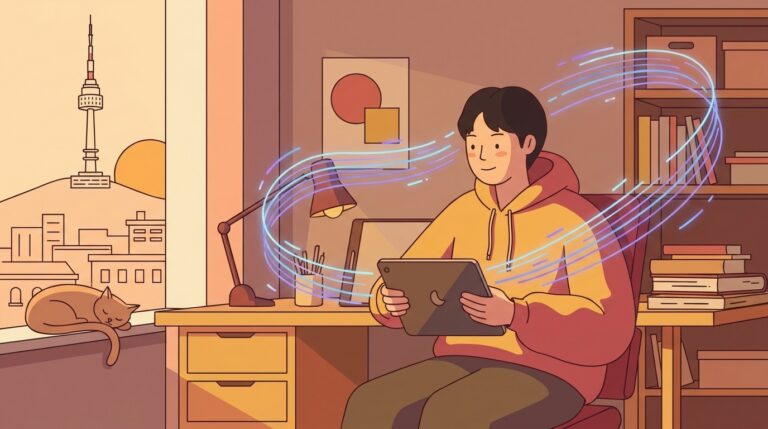
Phase 1: Why Creator Rights Matter in Korea’s AI Boom
“안녕하세요! 매일한글 에디터입니다.” (Annyeonghaseyo! Maeil Hangul Editeo-imnida. — Hello! I’m your Daily Hangul Editor.) Picture this: you’re at a packed K-Webtoon creator forum in Seoul’s Seongsu-dong. A veteran illustrator sighs over her iced Americano as an AI startup presenter mentions “fair use” for training models on webtoon art. Even advanced C1 learners freeze when legal nuance meets cultural passion here! Based on real feedback from learners working in Korean tech and media, mastering how Koreans articulate creator rights, compensation, and mutual growth unlocks instant credibility. Let’s dive into how respecting human sweat sustains the AI ecosystem!
Phase 2: Deep Dive into 3 Essential C1 Expressions
1. 정당한 대가 (Jeongdanghan daega)
- Pronunciation: [jeong-dang-han dae-ga] — Think of “jung-dang-hahn” (like “jungle” + “dang”) + “deh-gah” (like “day-gah” with a crisp, non-aspirated ‘d’).
- Meaning: Literally “legitimate/just price,” but in policy and creative debates it carries the weighty nuance of “fair, rightful compensation” earned through genuine labor.
- K-Culture Moment: You’ll hear this constantly in Korean news panels or YouTube documentaries covering K-Pop composers and webtoon artists demanding royalties when generative AI mimics their signature styles.
- Editor’s Insight: While 보상 (bosang — compensation/reparation) can sound like fixing a mistake or paying damages, 정당한 대가 (jeongdanghan daega) frames payment as an ethical right and social respect for effort.
- Situation Spectrum: Casual ⚠️ (sounds slightly formal among close friends unless debating news) / Semi-formal ✅ / Formal ✅
- 🤔 Think About It: In English, “fair compensation” sounds quite transactional and legalistic. Why do you think Korean places 정당한 (just/righteous) right alongside 대가 (price/return), blending ethics with economics?
2. 창작자의 땀방울 (Changjakjaui ttambangul)
- Pronunciation: [chang-jak-ja-ui ttam-bang-ul] — “chang-jahk-jah-eh” + “ttahm-bahng-ool” (the double ‘tt’ sounds like a sharp, tense ‘t’ in “stop,” without a puff of air).
- Meaning: Literally “beads of sweat of the creator.” Nuance: The irreplaceable human grit, sleepless nights, and emotional investment embedded in original art.
- K-Culture Moment: Imagine a K-Drama scene like Misaeng or Navillera where a mentor holds up a worn-out sketchbook or lyric sheet, reminding a corporate exec that data isn’t born in a vacuum—it comes from human passion.
- Editor’s Insight: Using physical metaphors like 땀방울 (ttambangul — sweat drops) in formal Korean speeches isn’t cheesy at all; at a C1 level, it’s a powerful rhetorical tool that wins emotional empathy in boardrooms and debates.
- Situation Spectrum: Casual ⚠️ (poetic in daily chat) / Semi-formal ✅ / Formal ✅
- 🤔 Think About It: Does your native language lean toward cold technical terms like “intellectual property” in AI debates, or does it also embrace visceral imagery like “sweat” to defend artists?
3. 상생하는 생태계 (Sangsaenghaneun saengtaegye)
- Pronunciation: [sang-saeng-ha-neun saeng-tae-gye] — “sahng-sehng-hah-neun” + “sehng-teh-gyeh” (like “sang” + “sayng” + “geh” in “get”).
- Meaning: Literally “a co-living ecosystem.” Nuance: A sustainable, win-win industry environment where AI developers and human creators thrive together rather than cannibalizing each other.
- K-Culture Moment: Frequently cited by tech CEOs and Ministry of Culture officials in Seoul during AI copyright summits to signal that innovation shouldn’t destroy the creative pipeline.
- Editor’s Insight: 상생 (sangsaeng — mutual survival/co-prosperity) is one of Korea’s ultimate corporate and social buzzwords. Dropping this shows you understand Korea’s collective harmony mindset, not just Western adversarial law.
- Situation Spectrum: Casual 🚫 (too stiff for brunch chat) / Semi-formal ✅ / Formal ✅
- 🤔 Think About It: Western copyright clashes often look like a zero-sum courtroom battle. How does framing the issue around 상생 (co-prosperity) shift the goal of the conversation?
Phase 3: Textbook Korean vs. Real Korean
Situation 1: Arguing that scraping data without permission hurts future AI quality
- 📖 교과서 한국어 (Textbook Korean): AI 학습을 위해 저작물을 무단으로 사용하면 창작 의욕이 저하될 것입니다. (AI hakseubeul wihae jeojangmureul mudaneuro sayonghamyeon changjak uiyogi jeohadoel geosimnida. — Using copyrighted works without permission for AI training will lower creative motivation.)
- 🗣️ 진짜 한국어 (Real Korean): 원작자 허락 없이 막 긁어가면, 결국 양질의 데이터도 씨가 마를 수밖에 없어요. (Wonjakja heorak eopsi mak geulgeogamyeon, gyeolguk yangjirui deiteodo ssiga mareul subakke eopseoyo. — If you just scrape things without the original creator’s permission, high-quality data will inevitably dry up too.)
- 💡 왜 다를까? (Why is it different?): Native speakers at work swap stiff nouns like 무단 사용 (unauthorized use) for vivid verbs like 긁어가다 (scrape away) and the idiom 씨가 마르다 (for the seeds to dry up), making the long-term consequence crystal clear.
Situation 2: Questioning whether AI training qualifies as “fair use”
- 📖 교과서 한국어 (Textbook Korean): 생성형 AI의 데이터 학습이 공정 이용에 해당하는지 법적 검토가 필요합니다. (Saengseonghyeong AI-ui deiteo hakseubi gongjeong iyong-e haedanghaneunji beopjeok geomtoga piryohamnida. — Legal review is needed on whether generative AI data training qualifies as fair use.)
- 🗣️ 진짜 한국어 (Real Korean): 이걸 과연 ‘공정 이용’이라는 틀 안에 다 우겨넣을 수 있을지 의문이에요. (Igeol gwayeon ‘gongjeong iyong’-iraneun teul ane da ugyeoneoheul su isseulji uimunieyo. — I doubt we can just cram all of this into the box called ‘fair use.’)
- 💡 왜 다를까? (Why is it different?): Even in serious C1 policy discussions, Koreans love tactile expressions like 틀 안에 우겨넣다 (to force/cram into a frame) to express skepticism toward overly broad legal loopholes.
Phase 4: K-Culture Deep Dive & Non-Verbal Manners
4-1. Nunchi & Gestures in Sensitive Debates
When discussing copyright clashes between tech firms and artists in Korea, sharp finger-pointing or aggressive interruptions can instantly shut down dialogue. Instead, Koreans rely heavily on 눈치 (nunchi — social awareness). Nod gently while the other side explains their stance, and before countering, soften your transition with a slight bow of the head and a phrase like “그 말씀도 일리가 있지만…” (Geu malsseumdo illiga itjiman… — That point makes sense too, however…). Maintain steady, respectful eye contact without glaring, and keep your palms open rather than gesturing rigidly.
4-2. Cultural Code Analysis: K-Webtoon & K-Pop on the Frontlines
Korea’s creative exports—especially K-Webtoon and K-Pop—are uniquely vulnerable and vocal in the AI fair use debate. Because Korean webtoonists operate on grueling weekly deadlines, some artists experimented with AI assistants to ease workloads, only to face fierce backlash from fans who value human artistry. Meanwhile, K-Pop agencies are actively building ethical voice-synthesis partnerships with singers, proving that Korea’s fandoms and creators will fiercely boycott unconsented AI cloning while welcoming tech that genuinely respects and pays artists.
Phase 5: Interactive Roleplay Scenario
Setting: A sunlit café near Hongdae after a Creative Tech & Copyright Panel. Rain taps softly against the glass as coffee machines hum.
NPC: Min-jun (민준), a sharp yet approachable AI startup policy lead in his early 30s, adjusting his tortoiseshell glasses.
- Min-jun: 🎭 (slides a warm oat latte across the table) 오늘 패널 토론에서 질문 정말 날카로우셨어요. 창작자 입장에선 AI 학습이 그렇게 위협적으로 느껴지나요? (Oneul paeneol toroneseo jilmun jeongmal nalkarousyeosseoyo. Changjakja ipjangeseon AI hakseubi geureoke wihyeopjeogeuro neukkyeojinayo? — Your question at today’s panel was really sharp. From a creator’s perspective, does AI training really feel that threatening?)
- You: 🎭 (takes a thoughtful sip and leans forward slightly) 위협이라기보다 기준이 모호한 게 문제죠. AI가 학습하는 데이터 뒤에는 창작자의 땀방울이 서려 있잖아요. (Wihyeobiragiboda gijuni mohohan ge munjejyo. AI-ga hakseuphaneun deiteo dwieneun changjakjaui ttambanguri seoryeo itjanayo. — Rather than a threat, the issue is vague standards. Behind the data AI trains on, there’s the sweat and toil of creators.)
- Min-jun: 🎭 (nods slowly, resting his chin on his hand) 맞아요. 하지만 법적으로 보면 변형적 이용, 즉 ‘공정 이용’에 해당한다는 시각도 만만치 않거든요. (Majayo. Hajiman beopjeogeuro bomyeon byeonhyeongjeok iyong, jeuk ‘gongjeong iyong’-e haedanghandaneun sigakdo manmanchi ankeodeunyo. — True. Yet legally speaking, the view that it falls under transformative use, or ‘fair use,’ is also quite strong.)
- You: 🎭 (gestures calmly with open palms) 물론 기술 발전도 중요하지만, 기존 작품을 무단으로 긁어가면서까지 공정 이용을 주장하긴 어렵지 않을까요? (Mullon gisul baljeondo jungyohajiman, gijon jakpumeul mudaneuro geulgeogamyeonseokkaji gongjeong iyong-eul jujanghagin eoryeopji aneulkkayo? — Of course tech progress matters, but isn’t it hard to claim fair use while scraping existing works without permission?)
- Min-jun: 🎭 (sighs softly with a wry smile) 사실 저희도 양질의 데이터가 고갈될까 봐 고민이 많긴 해요. AI가 AI 그림만 먹고 자라면 품질이 떨어지니까요. (Sasil jeohuido yangjirui deiteoga gogaldoelkka bwa gomini mankin haeyo. AI-ga AI geurimman meokgo jaramyeon pumjiri tteoreojinikkayo. — Honestly, we worry a lot about high-quality data running dry too. If AI grows up only eating AI art, quality drops.)
- You: 🎭 (eyes lighting up with agreement) 바로 그거예요! 결국 인간 창작자에게 정당한 대가가 돌아가야 AI 생태계도 계속 발전할 수 있는 거죠. (Baro geugeoyeyo! Gyeolguk ingan changjakjaege jeongdanghan daegaga doragaya AI saengtaegye-do gyesok baljeonhal su inneun geojyo. — That’s exactly it! Ultimately, only when fair compensation goes back to human creators can the AI ecosystem keep advancing too.)
- Min-jun: 🎭 (taps his notebook pen thoughtfully) 듣고 보니 일리가 있네요. 단순한 갈등이 아니라 지속 가능한 라이선스 모델이 필요하겠어요. (Deutgo boni illiga inneyo. Dansunhan galdeung-i anira jisok ganeunghan laiseonseu modeli piryohagesseoyo. — Hearing you put it that way makes sense. Rather than a simple clash, we need a sustainable licensing model.)
- You: 🎭 (smiles warmly) 네, 서로 상생하는 생태계를 만들 때 비로소 기술도 예술도 빛나지 않을까요? (Ne, seoro sangsaenghaneun saengtaegyereul mandeul ttae biroso gisuldo yesuldo binnaji aneulkkayo? — Yes, isn’t it when we build a mutually thriving ecosystem that both technology and art truly shine?)
🔀 Interactive Branching Point: How would you close this conversation to propose a real collaboration?
- A) “당장 불법 데이터셋부터 다 폐기하고 사과하세요!” (Dangjang bulbeop deiteosetbuteo da pyegihago sagwahaseyo! — Scrap all illegal datasets immediately and apologize!)
- B) “저희 작가 협회와 파일럿 라이선스 계약을 함께 논의해 보실래요?” (Jeohui jakga hyeophoewa pailleot laiseonseu gyeyageul hamkke nonuihae bosillaeyo? — Would you like to discuss a pilot licensing agreement together with our creators’ association?)
- C) “어차피 법원에서 다 가려줄 테니 저희는 소송만 준비할게요.” (Eochapi beopwoneseo da garyeojul teni jeohuineun sosongman junbihalgeyo. — The courts will sort it all out anyway, so we’ll just prepare our lawsuit.)
Feedback on Your Choice:
* Choice B (Best): Brilliant C1 diplomacy! Proposing a pilot licensing model (파일럿 라이선스 계약) bridges the legal gap and embodies 상생 (co-prosperity), turning a debate into a concrete partnership.
* Choice A (Bad): Too confrontational for a networking coffee chat. Demanding immediate apologies shuts down constructive problem-solving and breaks Korean conversational harmony.
* Choice C (Risk): Mentioning litigation (소송) abruptly freezes warm rapport. While legally realistic, saving it for official legal channels keeps personal bridges intact.
Phase 6: 10-Second Emotional Shadowing Drill
Practice reading these aloud, pausing briefly at / and channeling the emotion tag:
[🧐 Analytical & Firm]공정 이용이라는 말로 / 창작자의 권리를 / 덮어버려선 안 됩니다. (Gongjeong iyong-iraneun mallo / changjakjaui gwollireul / deopeobeoryeoseon an doemnida. — We must not cover up creators’ rights with the term ‘fair use.’)[🥹 Empathetic & Sincere]그 작품 하나에는 / 밤새워 그린 / 창작자의 땀방울이 / 고스란히 담겨 있어요. (Geu jakpum hanaeneun / bamsaewo geurin / changjakjaui ttambanguri / goseuranhi damgyeo isseoyo. — In that single work, the creator’s sweat from drawing all night is fully captured.)[😊 Hopeful & Inspiring]정당한 보상이 이루어질 때 / AI와 인간이 / 상생하는 생태계가 / 열립니다. (Jeongdanghan bosang-i irueojil ttae / AI-wa ingani / sangsaenghaneun saengtaegyega / yeollimnida. — When fair compensation happens, an ecosystem where AI and humans thrive together opens up.)
Phase 7: K-Culture Mini Dictionary
- 지식재산권 (Jisikjaesangwon) | Intellectual Property (IP) | Used constantly in K-Pop, K-Drama, and tech news when companies defend characters, music, and original stories.
- 학습 데이터 (Hakseup deiteo) | Training Data | The core buzzword in Korean AI policy forums referring to text, art, and audio fed into generative models.
- 무단 도용 (Mudan doyong) | Unauthorized Appropriation / Theft | Stronger and more accusing than simple “use,” commonly seen in artist statements against AI scraping.
- 지속 가능성 (Jisok ganeungseong) | Sustainability | Used not just for eco-friendly initiatives, but also for keeping creative industries and AI data pipelines healthy long-term.
Phase 8: Survival Kit for Travelers
Heading to Seoul for a creative forum, tech expo, or indie art market? Keep these three phrases handy:
- 출처를 꼭 밝혀 주세요. (Chulcheoreul kkok balkyeo juseyo. — Please be sure to credit the source.) | Pro Tip: Essential when sharing indie art from Seongsu or Hongdae pop-ups on social media.
- 상업적 이용은 안 됩니다. (Sangeopjeok iyong-eun an doemnida. — Commercial use is not permitted.) | Pro Tip: You’ll spot this on museum signs and creator goods booths—great to confirm licensing rules.
- 저작권 보호를 존중해요. (Jeojakgwon bohoreul jonjunghaeyo. — I respect copyright protection.) | Pro Tip: A quick phrase that earns instant warm smiles from Korean indie illustrators and musicians.
Editor’s Travel Note: Before heading to creative hubs like Seoul’s Seongsu-dong or COEX tech expos, be sure to Download the Naver Map App for Accurate Seoul Transit since global map apps often miss exact pedestrian routes in Korea. Also grab a climate card or T-money card at any convenience store (GS25 or CU) so you can zip seamlessly between exhibitions and indie bookstores without fumbling for tickets!
Phase 9: One Step Deeper — Harmony vs. Ownership
In Western legal traditions, copyright clashes often center on individual property rights—drawing rigid fences around what belongs to whom. In Korea, while intellectual property laws are equally strict, public sentiment is deeply colored by the Confucian-rooted ideal of 상생 (sangsaeng — mutual flourishing) and 예의 (yeui — moral respect for one’s craft). Koreans recognize that a single masterpiece rarely thrives without community inspiration, yet society collapses if the person who poured their soul into the work isn’t honored. Respecting human creators isn’t just about avoiding lawsuits; it’s about preserving the very cultural soil that allows future AI to grow.
💬 Your Turn: In your country, how are artists and tech companies debating AI fair use? Drop a comment below using one of today’s Korean phrases!
Phase 10: FAQ & Common Mistakes
Q: Is “공정 이용 (gongjeong iyong)” used identically to American “fair use” in Korean?
A: Legally, Korea’s Copyright Act includes a fair use clause (Article 35-5) modeled similarly to U.S. law, so the term maps closely. However, in everyday Korean media debates, people often interpret 공정 (fair) through an ethical lens—asking whether an action is socially just, not merely technically legal.
Q: Can I use “대가 (daega)” in casual conversations about paying back a friend?
A: Avoid it for casual favors! 대가 (daega) carries a serious, formal weight—like payment for professional labor or consequences for an action. For splitting dinner or paying a friend back, simply say 밥값 (bapgap — meal cost) or 돈 (don — money).
Q: Why do Korean articles use “생태계 (saengtaegye — ecosystem)” so much when talking about AI?
A: In Korean business and tech journalism, 생태계 describes any interconnected industry network (like the K-Pop ecosystem or startup ecosystem). It emphasizes that harming one group—human creators—eventually starves the entire system.
🚨 Common Mistakes to Avoid
- Confusing 저작권 (jeojakgwon — copyright) with 초상권 (chosanggwon — portrait/publicity rights): Using 초상권 when talking about AI stealing a drawing style confuses listeners. Correct Action: Use 저작권 (jeojakgwon) for artworks, music, and text, and 초상권 (chosanggwon) specifically for someone’s face or likeness.
- Overusing 공짜 (gongjja — freebie) in policy debates: Saying “AI wants data for free” using 공짜 sounds overly colloquial in a C1 presentation. Correct Action: Say 대가 없이 (daega eopsi — without compensation) or 무료로 (muryoro — free of charge).
- Mispronouncing 땀방울 (ttambangul) as 담방울 (dambangul): Dropping the tense ‘tt’ changes the feel and makes it harder to catch. Correct Action: Hold your breath briefly before releasing the ‘t’ in 땀 (ttam) so it pops crisply without extra air.
Phase 11: Action Mission & Engagement
- 🥉 Bronze Mission (Solo Practice): Record yourself reading the 3 sentences in Phase 6 on your phone and check if your pauses at
/sound natural and persuasive. - 🥈 Silver Mission (Social Share): Post a story or tweet about your favorite K-Webtoon or K-Pop artist with the Korean tag #창작자의땀방울 (#SweatOfTheCreator) and #상생생태계 (#CoProsperingEcosystem).
- 🥇 Gold Mission (Real-World Use): Next time you chat with a Korean friend or language partner about ChatGPT or AI art, smoothly drop “정당한 대가 (jeongdanghan daega)” into your opinion!
🎮 K-Culture Mission: Head over to Naver News or YouTube Korea and search “생성형 AI 저작권 공정 이용” (Generative AI copyright fair use). Skim one video’s comment section and spot how many times words like 대가 (daega), 무단 (mudan), or 상생 (sangsaeng) appear in real Korean comments!
Phase 12: Interactive Quiz Challenge
1. Situation Judgment: You’re in a Korean startup meeting discussing licensing artwork from indie illustrators for an AI model. Which sentence best expresses that paying creators helps your own AI product stay high quality?
* A) 창작자들한테 공짜로 달라고 하면 기분 나빠할 거예요.
* B) 창작자에게 정당한 대가를 지불해야 우리 AI 생태계도 고품질 데이터를 바탕으로 지속 발전할 수 있습니다.
* C) 어차피 AI가 알아서 다 그릴 테니 인간 작가는 필요 없어요.
Check Answer & Explanation (Quiz 1)
Answer: B
* Why B works: It uses polished C1 vocabulary—정당한 대가 (fair compensation), 고품질 데이터 (high-quality data), and 지속 발전 (sustainable development)—to build a persuasive business case.
* Why A fails: 공짜 (freebie) and 기분 나빠하다 (feel bad) are far too casual for a professional strategy meeting.
* Why C fails: Dismissing human creators ignores both ethical responsibility and the data-quality reality discussed today.
2. Fill in the Blank: Complete this C1 sentence expressing that real human effort sits behind AI training data.
“화려한 AI 결과물 뒤에는 밤낮없이 고민한 _________이/가 숨어 있습니다.” (Behind flashy AI results hides _________ who agonized day and night.)
* Hint: Combine “creator’s” + “beads of sweat” (Remember to adjust the subject particle if needed, or choose the exact noun phrase).
Check Answer & Explanation (Quiz 2)
Answer: 창작자의 땀방울 (changjakjaui ttambangul)
* Because 땀방울 ends in a consonant (ㄹ), it takes the subject particle 이 -> 창작자의 땀방울이 숨어 있습니다 (the creator’s sweat is hidden).
3. True or False Cultural Quiz: In Korea, using physical or emotional metaphors like “땀방울 (beads of sweat)” during a serious legal or corporate presentation about AI copyright is considered unprofessional and childish.
* True / False
Check Answer & Explanation (Quiz 3)
Answer: False!
* In Korean rhetoric, weaving human warmth and sensory expressions like 창작자의 땀방울 (creator’s sweat) into formal policy or business speeches is a respected way to appeal to empathy and ethical responsibility (명분, myeongbun).
🎬 Watch Our Daily Videos! (Daily Hangul Official Instagram)
Review the expressions you learned in this article with our fun daily short videos! Check out native pronunciation and real-life nuances in action.
- Instagram @dailyhangul_en






