

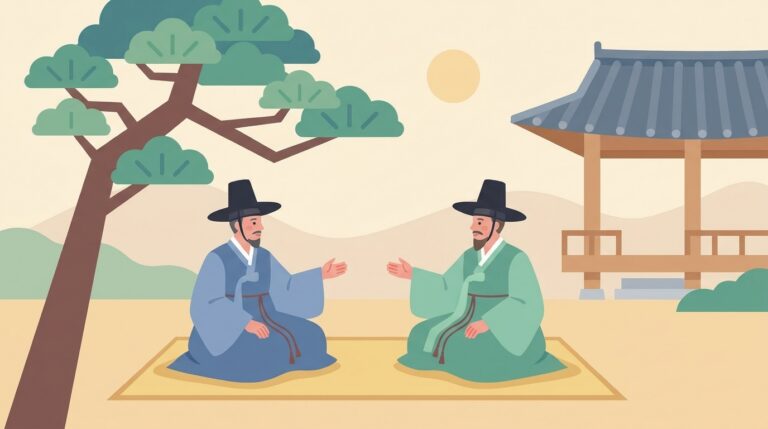
Phase 1: Empathy Opening — When Joseon Philosophy Crashes Your Makgeolli Night
안녕하세요! 매일한글 에디터입니다. (Annyeonghaseyo! Maeil Hangeul Editeo-imnida. / Hello! I’m the Daily Hangul Editor.) Picture this: you’re sipping makgeolli in a Jongno hanok pub after watching a historical K-drama, and your Korean friends start debating why heroes choose duty over desire. Suddenly, someone mentions 사단칠정 (Sadan Chiljeong) and points at Toegye Yi Hwang on a 1,000-won bill. Even with C2 Korean, your brain freezes! Guiding advanced learners for ten years, I hear this exact pain point constantly: you’ve mastered grammar, yet 16th-century Joseon philosophy feels locked away. Built from real student feedback, this guide unlocks Toegye and Gobong’s Four-Seven Debate so you can discuss human nature like a native.
Phase 2: Deep Dive into 3 Core C2 Expressions
1. 사단칠정 (Sadan Chiljeong)
- Pronunciation: Sa-dan Chil-jeong (Sounds like SAH-dahn + cheel-jung, with a crisp ‘ch’ like ‘cheese’ and a soft ‘ung’ like ‘sung’.)
- Meaning: Literally “The Four Beginnings and Seven Emotions.” In actual C2 usage, it serves as cultural shorthand for the eternal tension between innate moral intuition (compassion, shame, courtesy, discernment) and raw human passions (joy, anger, grief, fear, love, hate, desire).
- K-Culture Moment: Think of tense palace council scenes in historical dramas like The Red Sleeve or Tree with Deep Roots, where scholars agonize over whether a king’s decision stems from righteous duty or personal wrath. Intellectual variety shows like AlSseulSinJab (알쓸신잡) also drop this term when unpacking human psychology.
- Editor’s Insight: Unlike Western dualisms that cleanly separate “reason” and “emotion,” Koreans use 사단칠정 (Sadan Chiljeong) to explore how moral awareness and visceral feeling coexist inside a single heart-mind (마음, maeum). Dropping this in a deep late-night chat signals genuine cultural fluency.
- Situation Spectrum: Casual ⚠️ (Only among history/philosophy nerds) | Semi-formal ✅ (Book clubs, university cafés) | Formal ✅ (Lectures, essays, broadcasts)
- 🤔 Think About It: In English, we often pit “head vs. heart.” How does your native culture categorize moral impulses like empathy compared to raw impulses like anger?
2. 주리론과 주기론 (Juriron-gwa Jugiron)
- Pronunciation: Ju-ri-ron-gwa Ju-gi-ron (Sounds like joo-ree-rohn-gwah + joo-gee-rohn, rolling the ‘r’ lightly like the ‘tt’ in American English ‘butter’.)
- Meaning: Literally “The School of Principle (Li) and the School of Material Force (Qi).” Practically, it represents the grand 16th-century divide between Toegye’s idealism—prioritizing universal moral principle (이, I/Li)—and the later materialist/pragmatic emphasis on tangible energy and reality (기, Gi/Qi).
- K-Culture Moment: Whenever Korean documentaries or historical webtoons depict factional debates at Joseon’s royal court, this ideological split sits in the background. Today, Korean columnists even borrow 주리론적 태도 (Jurironjeok taedo / principled stance) vs. 주기론적 현실주의 (Jugironjeok hyeonsiljuui / pragmatic realism) in political commentary.
- Editor’s Insight: Don’t treat these as dry textbook labels. Calling a friend’s stubborn idealism “완전 주리론자네 (Wanjeon jurironjane / What a total Li-theorist!)” is top-tier C2 intellectual banter.
- Situation Spectrum: Casual ⚠️ (Witty academic banter only) | Semi-formal ✅ (Seminars, debates) | Formal ✅ (Academic papers, editorials)
- 🤔 Think About It: Does your language have historical philosophical schools whose names still sneak into modern political or personal arguments?
3. 이발기수 (Ibalgisu)
- Pronunciation: I-bal-gi-su (Sounds like ee-bahl-gee-soo, keeping ‘ee’ short and bright like ‘ski’.)
- Meaning: Literally “Principle (Li) initiates, and Material Force (Qi) follows.” It encapsulates Toegye Yi Hwang’s signature thesis that our Four Moral Beginnings arise directly from pure moral principle, while material energy merely rides along as its vehicle.
- K-Culture Moment: In biographical dramas and museum audio guides at Dosan Seowon, narrators use 이발기수 (Ibalgisu) to explain Toegye’s lifelong conviction that human beings are fundamentally capable of self-directed moral goodness, inspiring generations of Korean reformers.
- Editor’s Insight: Gobong Gi Dae-seung famously challenged this exact four-syllable phrase, arguing that principle has no will of its own without material force to manifest it. Knowing 이발기수 (Ibalgisu) lets you pinpoint the exact pivot of East Asia’s greatest eight-year debate.
- Situation Spectrum: Casual 🚫 (Too arcane for small talk) | Semi-formal ⚠️ (Philosophy meetups) | Formal ✅ (Humanities lectures, museum tours)
- 🤔 Think About It: Do you believe moral goodness initiates action on its own, or does it always need emotional energy to push it into the world?
Phase 3: Textbook Korean vs. Real Korean
Even C2 learners sometimes sound like a dusty encyclopedia when discussing history. Let’s upgrade your delivery so you sound sharp, natural, and effortlessly Korean.
Situation 1: Explaining the 8-Year Debate Between Toegye and Gobong
- 📖 교과서 한국어 (Textbook Korean): “이황 선생과 기대승 선생은 사단과 칠정의 기원에 대하여 팔 년간 서신으로 논쟁하였습니다.” (Ihwang seonsaeng-gwa Gidaeseung seonsaeng-eun sadan-gwa chiljeong-ui giwon-e daehayeo pal nyeon-gan seosin-euro nonjaenghayeotseumnida. / Master Yi Hwang and Master Gi Dae-seung debated the origin of the Four Beginnings and Seven Emotions by letter for eight years.)
- 🗣️ 진짜 한국어 (Real Korean): “퇴계랑 고봉이 무려 8년 동안 편지로 ‘인간 본성’ 배틀을 떴다니까요?” (Toegyerang Gobong-i muryeo pal-nyeon dongan pyeonjiro ‘in-gan bonseong’ baeteureul tteotdanikkayo? / Seriously, Toegye and Gobong basically had an eight-year pen-pal battle over human nature!)
- 💡 왜 다를까? (Why the Difference?): In real C2 conversation, Koreans affectionately use scholars’ pen names (호, ho) like 퇴계 (Toegye) and 고봉 (Gobong) paired with playful modern loanwords like 배틀을 뜨다 (baeteureul tteuda / to battle it out) to make heavy history relatable.
Situation 2: Describing Pure Empathy vs. Ego-Driven Emotion
- 📖 교과서 한국어 (Textbook Korean): “그 행동은 개인의 감정이 아니라 도덕적 본성에서 우러나온 연민입니다.” (Geu haengdong-eun gaein-ui gamjeong-i anira dodeokjeok bonseong-eseo ureonaon yeonmin-imnida. / That action is compassion arising from moral nature rather than personal emotion.)
- 🗣️ 진짜 한국어 (Real Korean): “그건 사사로운 감정이 아니라, 사람이라면 누구나 솟아나는 측은지심이지.” (Geugeon sasaroun gamjeong-i anira, saramiramyeon nuguna sosananeun cheugeunjisim-iji. / That isn’t petty personal feeling; it’s the innate compassion that wells up in anyone human.)
- 💡 왜 다를까? (Why the Difference?): Native speakers rarely say “도덕적 본성에서 우러나온 연민” aloud; instead, they reach for the vivid four-character idiom 측은지심 (cheugeunjisim)—the first of Mencius’s Four Beginnings—to evoke shared humanity immediately.
Phase 4: K-Culture Deep Dive & Non-Verbal Manners
4-1. 눈치 (Nunchi) & Gestures in Korean Intellectual Debate
Imagine a 32-year-old rising scholar telling a revered 58-year-old master, “Respectfully, your metaphysics has a flaw.” In 1559 Joseon, Gobong Gi Dae-seung did exactly that—and Toegye Yi Hwang didn’t pull rank! Why did it work? Through impeccable 예의 (yeui / courtesy) and 눈치 (nunchi / social attunement). In Korea, even today, fierce intellectual critique requires soft physical cues: clasping hands modestly (공수, gongsu) or leaning slightly forward with open palms rather than pointing, maintaining steady yet deferential eye contact, and padding counterarguments with phrases like “제가 감히 여쭙건대 (Jega gamhi yeojjupgeondae / If I may dare ask)”. Mastering this calm, respectful posture earns instant respect in Korean boardrooms and graduate seminars alike.
4-2. Cultural Code Analysis: Sageuk Dramas & Your Wallet
Have you ever noticed Toegye Yi Hwang staring back at you from the emerald-blue 1,000-won banknote? On the back sits Dosan Seowon (도산서원), his Confucian academy in Andong. Meanwhile, modern sageuk K-dramas constantly dramatize the Four-Seven dilemma: the righteous scholar torn between 칠정 (chiljeong)—grief, fury, romantic longing—and 사단 (sadan)—unyielding compassion for the common people. That tension isn’t medieval trivia; it is the emotional engine of Korean storytelling.
Phase 5: Real-World Roleplay Scenario
Setting: A quiet, rain-streaked traditional tea house in Bukchon Hanok Village, Seoul. Scent of roasted mugwort tea in the air. NPC: Min-jun (민준), a witty Seoul National University philosophy grad student wearing round glasses and a linen jacket.
- Min-jun: 🎭 (Places a 1,000-won bill beside his teacup with a wry smile) 이 지폐 속 퇴계 선생님이 16세기에 어떤 논쟁을 하셨는지 혹시 아세요? (I jipye sok Toegye seonsaengnim-i simnyuksegi-e eotteon nonjaeng-eul hasyeonneunji hoksi aseyo? / By any chance, do you know what debate Master Toegye on this bill had in the 16th century?)
- You: 🎭 (Takes a slow sip of tea, eyes lighting up) 당연하죠! 고봉 기대승 선생과 벌인 그 유명한 ‘사단칠정’ 논쟁 말씀이시죠? (Dangyeonhajyo! Gobong Gidaeseung seonsaeng-gwa beorin geu yumyeonghan ‘Sadan Chiljeong’ nonjaeng malsseumisijyo? / Of course! You mean the famous ‘Four-Seven’ debate with Master Gobong Gi Dae-seung, right?)
- Min-jun: 🎭 (Raises eyebrows, genuinely impressed) 와, 한국어 실력만큼이나 인문학적 내공이 엄청나시네요! 어느 쪽 입장에 더 공감하세요? (Wa, Hangugeo sillyeongmankeumina inmunhakjeok naegong-i eomcheongnasineyo! Eoneu jjok ipjang-e deo gonggamhaseyo? / Whoa, your humanities depth matches your Korean! Which side do you resonate with more?)
- You: 🎭 (Taps chin thoughtfully) 퇴계 선생의 ‘이발기수’도 숭고하지만, 저는 이(理)와 기(氣)가 함께 작동한다는 고봉의 통찰도 설득력 있다고 봐요. (Toegye seonsaeng-ui ‘ibalgisu’-do sunggohajiman, jeoneun i-wa gi-ga hamkke jakdonghandaneun Gobong-ui tongchaldo seoldeungnyeok itdago bwayo. / Master Toegye’s ‘Principle initiates, Material Force follows’ is noble, yet I also find Gobong’s insight that Li and Qi operate together persuasive.)
- Min-jun: 🎭 (Nods enthusiastically, leaning in) 맞아요! 고봉은 현실의 구체적인 감정 속에서 도덕이 발현된다고 본 거죠. 요즘 말로 하면 아주 현실 감각이 뛰어났달까요? (Majayo! Gobong-eun hyeonsir-ui guchejeogin gamjeong sogeseo dodeog-i balhyeondoendago bon geojyo. Yojeum mallo hamyeon aju hyeonsil gamgag-i ttwieonatdalkkayo? / Exactly! Gobong saw morality manifesting within concrete, real-world emotions. In modern terms, he had a sharp sense of reality.)
- You: 🎭 (Smiles warmly) 그럼에도 26살이나 어린 제자의 반론을 8년간 경청한 퇴계 선생의 태도가 진짜 감동적이죠. (Geureomedo seumul-yeoseot sarina eorin jeja-ui balloneul pal-nyeon-gan gyeongcheonghan Toegye seonsaeng-ui taedoga jinjja gamdongjeogijyo. / Still, Master Toegye’s attitude—listening for eight years to a junior scholar 26 years younger—is what’s truly moving.)
- Min-jun: 🎭 (Pours more tea respectfully) 인정합니다. 그게 바로 조선 성리학이 동아시아 철학의 정점에 오른 이유니까요. (Injeonghamnida. Geuge baro Joseon seongnihag-i Dongasia cheorhag-ui jeongjeom-e oreun iyunikka-yo. / Agreed. That’s precisely why Joseon Neo-Confucianism reached the pinnacle of East Asian philosophy.)
- You: 🎭 (Raises teacup in a playful toast) 오늘 밤은 우리가 그 지적인 대화를 이어가는 셈이네요! (Oneul bam-eun uriga geu jijeogin daehwareul ieoganeun semineyo! / Tonight, I suppose we’re carrying on that intellectual dialogue ourselves!)
🔀 Interactive Branching Point
Min-jun asks you why Toegye feared merging the Four Beginnings and Seven Emotions into one category. How do you respond?
* A) “도덕적 가치의 순수성이 흔들릴까 봐 염려하셨던 거죠.” (Dodeokjeok gachi-ui sunsu-seong-i heundeullilkka bwa yeomnyeohasyeotdeon geojyo. / He worried the purity of moral value might be shaken.)
* B) “그냥 고봉이 어린데 자꾸 따지니까 기분이 나쁘셨나 봐요.” (Geunyang Gobong-i eorinde jakku ttajinikka gibun-i nappeusyeonna bwayo. / Maybe he just felt annoyed because Gobong was young and kept arguing.)
* C) “솔직히 이(理)와 기(氣)가 다른 건 사실이니까, 논리적으로는 퇴계가 완벽히 맞죠.” (Soljikhi i-wa gi-ga dareun geon sasirinikka, nollijeogeuro-neun Toegyega wanbyeokhi matjyo. / Honestly, since Li and Qi are different, Toegye is logically 100% right.)
- Feedback:
- A (Best!): Spot-on! You captured Toegye’s core anxiety—if moral compassion is reduced to ordinary physical impulse, ethics loses its unconditional anchor. Elegant C2 phrasing with 염려하다 (yeomnyeohada).
- B (Bad!): Careful! Dismissing Toegye as petty misses the entire cultural triumph of the debate—his extraordinary humility toward a junior scholar.
- C (Risk!): Bold claim! In a seminar, declaring one side “100% logically right” skips Gobong’s equally famous counterargument that Li cannot act independently without Qi. Better to frame it as “From a Juriron perspective…”!
Phase 6: 10-Second Emotion Shadowing Drill
Read aloud at natural C2 cadence, pausing briefly at each / and leaning into the emotion!
- [🤔 Thoughtfully and intensely]
인간의 선한 마음은 / 과연 어디에서 / 비롯되는 걸까요? (In-gan-ui seonhan maeumeun / gwayeon eodieseo / birotdoeneun geolkkayo? / Where on earth does the good human heart originate?) -
[😊 Warmly and admiringly]
스물여섯 살의 나이 차를 넘어 / 학문으로 소통한 두 거장의 모습은 / 지금 봐도 경이롭죠. (Seumul-yeoseot sar-ui nai chareul neomeo / hangmuneuro sotonghan du geojang-ui moseubeun / jigeum bwado gyeongirobjyo. / Seeing two masters communicate across a 26-year age gap through scholarship is awe-inspiring even today.) -
[😌 Calmly and persuasively]
이성적 원칙도 중요하지만 / 살아 움직이는 감정의 결을 / 놓쳐서는 안 됩니다. (Iseongjeok wonchikdo jungyohajiman / sara umjigineun gamjeong-ui gyeoreul / nochyeoseoneun an doemnida. / Rational principle matters, yet we must never miss the texture of living, breathing emotion.)
Phase 7: K-Culture Mini Dictionary (4 Core Keywords)
- 측은지심 (Cheugeunjisim) | Translation: Innate sense of compassion (one of the Four Beginnings) | Usage: Used constantly in daily news, K-dramas, and heartfelt conversations whenever someone acts out of pure human empathy rather than self-interest.
- 이기호발설 (Igi Hobalseol) | Translation: Theory of Mutual Issuance of Li and Qi | Usage: Key academic term in humanities lectures, museum exhibitions, and essays summarizing Toegye’s dual-source view of moral and physical emotions.
- 기질지성 (Gijiljiseong) | Translation: Physical/temperamental nature | Usage: Contrasted with 본연지성 (bonyeonjiseong / original pure nature); in advanced leadership talks or self-help essays, Koreans use it to discuss overcoming innate flaws and habits.
- 서원 (Seowon) | Translation: Joseon-era private Confucian academy | Usage: Essential travel and cultural term (several, like Dosan Seowon, are UNESCO World Heritage sites) used when discussing classical Korean education and retreat culture.
Phase 8: Survival Kit for Travelers
Heading to Andong’s Dosan Seowon or Seoul’s Sungkyunkwan? Pack these C2-ready cultural phrases:
- 퇴계 선생의 유물이나 친필 서신이 전시된 곳이 어디인가요? (Toegye seonsaeng-ui yumurina chinpil seosin-i jeonsidoen gosi eodiingayo? / Where are Master Toegye’s artifacts or handwritten letters exhibited?) Pro Tip: Museum curators light up when you say 친필 서신 (chinpil seosin / handwritten letters)!
- 이 서원의 강학 공간과 제향 공간의 배치가 참 인상적이네요. (I seowon-ui ganghak gonggan-gwa jehyang gonggan-ui baechiga cham insangjeogineyo. / The layout of the lecture hall and memorial shrine at this academy is truly impressive.) Pro Tip: Traditional academies separate learning spaces (앞, front) from ancestral shrines (뒤, back)—mentioning this shows insider savvy.
- 여기 사단칠정 논쟁에 대한 심화 해설 프로그램이 있나요? (Yeogi Sadan Chiljeong nonjaeng-e daehan simhwa haeseol peurogeuraem-i innayo? / Is there an in-depth guided commentary program on the Four-Seven Debate here?) Pro Tip: Look for 문화관광해설사 (munhwa gwangwang haeseolsa / heritage docents) at major heritage gates.
Editor’s Travel Note: Before hopping on the KTX-Eum train from Cheongnyangni Station to Andong (under 2 hours!), make sure you complete your Naver Map download for navigating rural Andong bus routes and load your T-money card at any convenience store. Many heritage shops near Dosan Seowon take cards, but keeping a crisp 1,000-won bill handy makes the best photo op right in front of the academy!
Phase 9: One Step Deeper — Why 16th-Century Letters Still Shape Modern Korea
In an era obsessed with hierarchy, how did a 58-year-old master and a 32-year-old prodigy sustain a respectful, razor-sharp debate for eight years? The secret lies in Joseon’s belief that 진리 (jilli / truth) outranks social status, provided both sides honor 예 (ye / ritual courtesy). Rather than silencing Gobong with seniority, Toegye repeatedly revised his own charts and thanked his young challenger for sharpening his mind. That cultural DNA still pulses beneath Korean society today: behind strict honorifics lies a fierce, communal hunger for ethical clarity and mutual accountability.
💬 Your Turn: Have you ever had a passionate disagreement with a mentor or elder that actually brought you closer together? Drop your story—and try using one Korean keyword from Phase 7—in the comments!
Phase 10: FAQ & Myth Busting
Q: Are the “Four Beginnings” (사단) completely separate from the “Seven Emotions” (칠정) in Toegye’s view?
A: Not as separate rooms in a house, no! Toegye agreed they exist in the same human mind, but insisted their metaphysical origin differs: the Four Beginnings stem directly from pure moral principle (이, Li), whereas the Seven Emotions are sparked by fluctuating material energy (기, Qi).
Q: Why did Gobong Gi Dae-seung disagree with Toegye if he respected him so much?
A: Gobong feared that splitting moral feelings from everyday emotions would make morality feel abstract and detached from real life. He argued via 이기일원론적 관점 (a holistic Li-Qi lens) that the Four Beginnings are simply the purest expressions within the Seven Emotions, not a separate species.
Q: Can I actually use words like 사단칠정 (Sadan Chiljeong) or 주리론 (Juriron) in modern Korean conversation?
A: Yes, at a C2 level! While you wouldn’t drop them while ordering iced Americano, they appear frequently in Korean newspaper columns, university discussions, book clubs, and thoughtful conversations about ethics, politics, and K-dramas.
🚨 Common Mistakes Warning Board
- Mistake: Pronouncing 이(理) in 주리론 (Juriron) as “Lee” and 기(氣) as “Chi” (Chinese Mandarin style) inside a Korean sentence. -> Correct Action: Use Korean Sino-Korean readings: Ju-ri-ron and Ju-gi-ron (and I-bal-gi-su, where initial ‘이’ drops the ‘r’ sound!).
- Mistake: Calling Toegye and Gobong “enemies” or “rivals” (라이벌). -> Correct Action: Frame them as intellectual partners or senior-junior mentors (사제지간처럼 서로를 아낀 학문적 도반 / scholarly companions who cherished each other).
- Mistake: Translating 칠정 (Seven Emotions) as “bad emotions.” -> Correct Action: Remember that joy, grief, and love are morally neutral—they only become problematic when excessive or unbalanced!
Phase 11: Action Mission & Engagement
- 🥉 Bronze Mission (Solo Practice): Record yourself performing Phase 6’s three shadowing sentences twice—focusing on the
/pauses and emotional shifts. - 🥈 Silver Mission (Share Online): Snap a photo of a Korean 1,000-won bill (or look one up) and post one takeaway about Toegye’s 8-year debate on your SNS with
#DailyHanguland#SadanChiljeong. - 🥇 Gold Mission (Real-World Use): Next time you talk with a Korean friend about a moral dilemma in a movie or K-drama, slip in “측은지심 (cheugeunjisim)” or “고봉의 현실 감각 (Gobong-ui hyeonsil gamgak)” naturally!
- 🎮 K-Culture Mission: Watch an episode of a historical K-drama tonight and spot one scene where a character battles 칠정 (personal rage or longing) to protect 사단 (moral compassion for the weak).
Phase 12: Interactive Quiz Challenge
1. Situational Judgment: Your Korean professor says, “도덕적 감정은 결국 우리가 느끼는 일상적 감정 안에 깃들어 있는 것 아닐까요?” (Dodeokjeok gamjeong-eun gyeolguk uriga neukkineun ilsangjeok gamjeong ane gitdeureo inneun geot anilkkayo? / Isn’t moral feeling ultimately nestled inside the everyday emotions we feel?). Which scholar’s view is she echoing?
* A) Toegye Yi Hwang (퇴계 이황)
* B) Gobong Gi Dae-seung (고봉 기대승)
Click to reveal Answer & Explanation
Answer: B) Gobong Gi Dae-seung. If you picked A, watch out! Toegye emphasized distinguishing the moral origin (Li) of the Four Beginnings from everyday Qi-driven emotions, whereas Gobong famously argued that the Four Beginnings exist within the Seven Emotions as their finest, unclouded manifestations.
2. Fill in the Blank: In Toegye’s famous four-character formula, moral principle initiates and material force follows: ____기수 (____gisu).
Click to reveal Answer & Explanation
Answer: 이발 (Ibal) → 이발기수 (Ibalgisu). Remember: 이(理) = Principle, 발(發) = initiates/issues forth, 기(氣) = Material Force, 수(隨) = follows!
3. True or False (Cultural Quiz): Because Toegye Yi Hwang was 26 years older than Gobong Gi Dae-seung, Toegye refused to alter any of his theories during their eight-year correspondence. (True / False)
Click to reveal Answer & Explanation
Answer: False! Toegye actually revised his phrasing multiple times thanks to Gobong’s sharp critiques, famously moving from ‘Li alone initiates’ toward ‘mutual issuance of Li and Qi’ (이기호발설). Their mutual humility is why Koreans still revere this debate today.
🎬 Watch Our Daily Videos! (Daily Hangul Official Instagram)
Review the expressions you learned in this article with our fun daily short videos! Check out native pronunciation and real-life nuances in action.
- Instagram @dailyhangul_en







