

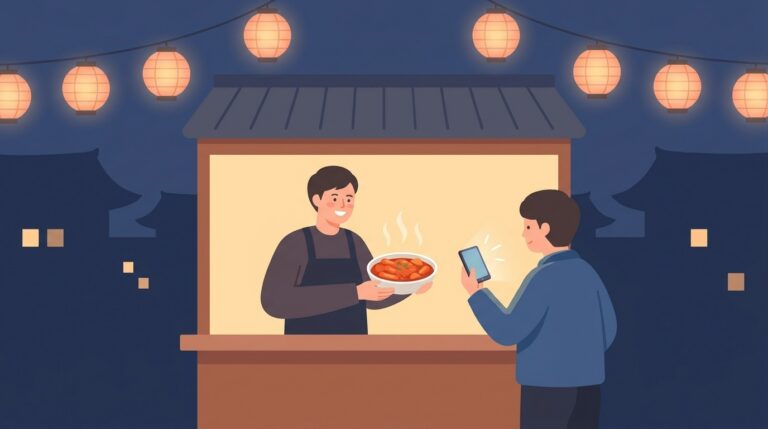
Phase 1: Why Street Snacks Don’t Always Take Cards
안녕하세요! 매일한글 에디터입니다. (Annyeonghaseyo! Maeil Hangeul editeo-imnida. — Hello! I’m your Daily Hangul editor.) Imagine standing under a glowing orange pojangmacha tent in Seoul on a chilly evening. The spicy scent of tteokbokki fills the air, and you order happily—until you reach for your wallet and realize you have zero cash, and there’s no card machine! That sinking feeling happens to travelers all the time in Korea. While Korea is famous for cashless payments, street stalls often rely on quick bank transfers instead. Based on real feedback from over 100 A1 beginners, mastering just three simple phrases will save your snack night and help you order like a local!
📌 30-Second Cheat Sheet for Tonight’s Snack Run
* Ask to transfer: 계좌이체 되나요? (Gyejwaiche doenayo? — Can I pay by bank transfer?)
* Get the number: 계좌번호 알려주세요 (Gyejwabeonho allyeojuseyo — Please share your account number)
* Confirm payment: 확인해 주세요 (Hwaginhae juseyo — Please check the transfer)
Phase 2: Top 3 Essential Expressions (Deep Dive)
1. 계좌이체 되나요? (Gyejwaiche doenayo?)
- Pronunciation: Gye-jwa-i-che doe-na-yo? (Say “Gye-jwa” like “gyeh-jwah”, “i-che” like “ee-cheh”, and “doe-na-yo” like “dway-nah-yo”.)
- Meaning: Literally “Does bank account transfer work?” / Real nuance: “Can I pay by bank transfer?”
- K-Culture Moment: In popular K-Travel vlogs and shows like I Live Alone, locals walk up to bustling traditional markets or food trucks and casually drop this line with their phone already unlocked.
- Editor’s Insight: Look at the ending 되나요? (doenayo?). It is your ultimate A1 magic wand! Whenever you want to ask if anything is possible or allowed in Korea, attach this polite ending.
- Situation Spectrum: Casual ⚠️ | Semi-formal ✅ | Formal ✅
- 🤔 Think About It: Notice how English asks “Can I pay?”, while Korean asks “Does the transfer work?” Korean often skips “I” and focuses on whether the situation works smoothly. How does your native language frame polite requests like this?
2. 계좌번호 알려주세요 (Gyejwabeonho allyeojuseyo)
- Pronunciation: Gye-jwa-beo-nho al-lyeo-ju-se-yo (Think “beon-ho” like “buhn-ho”, “al-lyeo” flowing softly like “ahl-lyuh”, and “ju-se-yo” like “joo-seh-yo”.)
- Meaning: Literally “Please let me know the account number” / Real nuance: “Could you tell/show me your bank account number?”
- K-Culture Moment: At busy bunsik carts in Myeongdong or Hongdae, vendors rarely have time to type it out. Once you say this, they will happily point to a small laminated sign taped right next to the steaming fishcake pot!
- Editor’s Insight: Adding 알려주세요 (allyeojuseyo — please let me know) makes you sound warm and respectful, rather than demanding “Give me your number!”
- Situation Spectrum: Casual ⚠️ | Semi-formal ✅ | Formal ✅
- 🤔 Think About It: In Korea, small shops openly display their bank name and account number on signs for fast transfers. How would people in your country react to seeing a shop owner’s bank number taped to a food cart?
3. 확인해 주세요 (Hwaginhae juseyo)
- Pronunciation: Hwa-gin-hae ju-se-yo (Say “Hwa” like “hwah”, “gin” like “geen” with a hard ‘g’, and “hae” like “heh”.)
- Meaning: Literally “Please do confirmation” / Real nuance: “Please check that the transfer went through.”
- K-Culture Moment: Right after hitting “Send” on a Korean banking app, locals turn their phone screen toward the vendor with a bright smile so the vendor can glance at the amount and name.
- Editor’s Insight: Never walk away silently after sending money! Showing your screen and saying this short phrase builds instant trust (jeong) with busy street vendors.
- Situation Spectrum: Casual 🚫 | Semi-formal ✅ | Formal ✅
- 🤔 Think About It: Your phone screen acts as an instant paperless receipt in Korea. How do speed and mutual trust shape everyday shopping in your culture?
Phase 3: Textbook Korean vs. Real Korean
Situation 1: Asking if you can pay by transfer
- 📖 Textbook Korean: 은행 계좌로 돈을 보내도 됩니까? (Eunhaeng gyejwaro doneul bonaedo doemnikka? — May I send money to your bank account?)
- 🗣️ Real Korean: 계좌이체 돼요? (Gyejwaiche dwaeyo? — Bank transfer okay?)
- 💡 Why is it different? Street stalls are loud, steamy, and fast-paced! Real speakers drop long words like “bank” and “money” and use the crisp phrase gyejwaiche dwaeyo?—super short and easy for A1 learners.
Situation 2: Telling the vendor you sent the money
- 📖 Textbook Korean: 제가 방금 송금했습니다. (Jega banggeum songgeumhaetseumnida. — I have just remitted the payment.)
- 🗣️ Real Korean: 보냈어요! (Bonaesseoyo! — Sent it!)
- 💡 Why is it different? Songgeum sounds like a formal bank teller speaking. At a cozy pojangmacha, a cheerful Bonaesseoyo! while tilting your phone screen feels friendly, natural, and authentic.
Phase 4: K-Culture Deep Dive & Non-Verbal Manners
4-1. Nunchi (Social Awareness) & Gestures
When paying by bank transfer at a street cart, body language does half the talking. First, use your eyes (nunchi) to scan the cart before speaking—90% of the time, the bank name and account number are already taped near the menu! When your transfer finishes, hold your smartphone with two hands (or support your phone hand lightly at the wrist with your other hand) and tilt the screen toward the vendor. Make brief eye contact, give a small nod, and wait for their cheerful “네! (Ne! — Yes!)” before grabbing your snack cup.
4-2. Culture Code: K-Food & K-Travel
Bunsik (affordable comfort snacks like tteokbokki, sundae, and twigim) and pojangmacha street tents are the heart of Korea’s quick, social food scene. Because street carts move around and pay high card-terminal fees, many skip credit card machines. Instead, Korea’s ultra-fast banking culture stepped in—allowing locals to send 4,000 KRW in three seconds flat without pulling out a wallet!
Phase 5: Real-Life Roleplay Scenario
Setting: A breezy Friday night in Euljiro, Seoul. Raindrops tap on the bright orange tarp of a bustling pojangmacha. Steam rises from bright red tteokbokki sauce.
NPC: Auntie Park (박 이모, Park Imo) — A warm-hearted bunsik veteran in a floral apron who talks fast but secretly slips extra fishcake into polite travelers’ cups.
- You: 🎭 (Walking up excitedly to the steaming cart)
저기요! 떡볶이 하나 주세요. (Jeogiyo! Tteokbokki hana juseyo. — Excuse me! One tteokbokki, please.) - Auntie Park: 🎭 (Scooping glossy red rice cakes into a paper cup)
네, 사천 원이에요! (Ne, sacheon won-ieyo! — Yes, it’s 4,000 won!) - You: 🎭 (Patting your empty pockets and smiling apologetically)
혹시 계좌이체 되나요? (Hoksi gyejwaiche doenayo? — By any chance, can I pay by bank transfer?) - Auntie Park: 🎭 (Nodding briskly while wiping the counter)
네, 돼요! (Ne, dwaeyo! — Yes, it works!) - You: 🎭 (Opening your banking app on your phone)
계좌번호 알려주세요. (Gyejwabeonho allyeojuseyo. — Please share your account number.) - Auntie Park: 🎭 (Pointing to a laminated card taped right below the menu)
여기 위에 있어요! (Yeogi wie isseoyo! — It’s right up here!) - You: 🎭 (Typing the numbers, hitting send, and tilting your phone screen toward her with both hands)
보냈어요! 확인해 주세요. (Bonaesseoyo! Hwaginhae juseyo. — I sent it! Please check.) - Auntie Park: 🎭 (Glancing at your screen with a big smile and handing you an extra fishcake skewer)
네, 확인했어요! 맛있게 드세요! (Ne, hwaginhaesseoyo! Masitge deuseyo! — Yes, I checked! Enjoy your meal!)
🔀 Interactive Branching Point: What do you do right after sending the money?
- A) Turn your phone screen toward Auntie Park with two hands and say, “확인해 주세요! (Hwaginhae juseyo!)”
- Feedback (Best! ✅): Nailed it! Showing the screen politely builds instant trust, and Auntie Park knows for sure the payment is yours.
- B) Just put your phone back in your pocket, grab your cup, and walk away silently.
- Feedback (Bad! ❌): Uh-oh! Auntie Park might think you didn’t pay and chase after you! Always show the confirmation screen first.
- C) Shout “끝! (Kkeut! — Done!)” loudly while waving your phone from far away.
- Feedback (Risk! ⚠️): A bit too abrupt and casual for an older vendor! Stick to polite -요 (-yo) endings like Bonaesseoyo! to keep the vibe warm.
Phase 6: 10-Second Emotion Shadowing Drill
Read these aloud! Pause briefly at each / and match the emotion tag:
[😅 Slightly flustered, polite smile]저기요, / 계좌이체 / 되나요? (Jeogiyo, / gyejwaiche / doenayo? — Excuse me, does bank transfer work?)[😊 Cheerful & eager]계좌번호 / 알려주세요! (Gyejwabeonho / allyeojuseyo! — Please tell me your account number!)[✨ Proud & relieved]보냈어요! / 확인해 / 주세요. (Bonaesseoyo! / Hwaginhae / juseyo. — Sent it! Please check.)
Phase 7: K-Culture Mini Dictionary (4 Keywords)
- 분식 (Bunsik) | Flour-based street snacks | Everyday Korean term for cheap, beloved comfort dishes like tteokbokki, gimbap, and ramyeon.
- 포장마차 (Pojangmacha) | Street tent stall | Iconic orange-covered food tents famous in K-Dramas for late-night snacks and cozy vibes.
- 계좌이체 (Gyejwaiche) | Bank transfer | Used everywhere in Korea—not just at street stalls, but also when splitting dinner bills with friends!
- 현금 (Hyeongeum) | Cash | Good to recognize on signs saying “현금만 가능 (Hyeongeumman ganeung — Cash only),” which usually means cash or bank transfer.
Phase 8: Traveler’s Survival Kit
Top 3 Survival Phrases
- 카드 돼요? (Kadeu dwaeyo?) — “Do you take cards?” (Pro Tip: Always ask this first if you don’t have a Korean bank app!)
- 얼마예요? (Eolmayeyo?) — “How much is it?” (Pro Tip: Listen for simple numbers like 삼천 원 [3,000 won] or 사천 원 [4,000 won].)
- 현금 없어요 (Hyeongeum eopseoyo) — “I don’t have cash.” (Pro Tip: Say this gently with an apologetic smile if you need to ask about cards or transfers.)
Editor’s Travel Note
Important Reality Check for Travelers: Instant Korean bank transfers (gyejwaiche) usually require a Korean bank account (like KakaoBank, Toss, or KB). Foreign credit cards and overseas banking apps cannot do instant local transfers! Always keep a few 10,000 KRW bills in your pocket just in case, or travel with a Korean friend who can transfer while you pay them back.
To find the best bunsik alleys and check cashless travel tools before your trip, check out the Download the Naver Map App for Korean Street Stalls and explore the WOWPASS Prepaid Card Official Guide for Foreign Travelers for easy T-money transit and card payments.
Phase 9: One Step Deeper
In Korea, ppalli-ppalli (hurry-hurry) speed meets jeong (warm human trust). Standing at a pojangmacha, there are no paper receipts or barcode scanners for a 4,000-won snack—just a quick glance at your phone screen and a shared nod. Even in a hyper-digital city like Seoul, that brief moment of showing your screen reminds you that street food is still a warm, face-to-face connection between people.
💬 Your Turn: What is the VERY FIRST Korean street snack you want to order under a pojangmacha tent—spicy tteokbokki, crispy twigim, or warm odeng broth? Drop your pick in the comments!
Phase 10: FAQ & Common Mistakes
Q: Can tourists pay by Korean bank transfer using an overseas bank app?
A: Usually, no. Korean instant transfers (gyejwaiche) work between local Korean bank accounts (like Toss, KakaoBank, or Shinhan). If you are visiting short-term without a local account, carry a small amount of Korean cash (hyeongeum) for street carts or ask 카드 돼요? (Kadeu dwaeyo? — Do you take cards?) first.
Q: Is it rude to ask “계좌이체 되나요?” at a busy street stall?
A: Not at all! Locals ask this every single day. As long as you use the polite -요 (-yo) ending and smile, vendors will happily point you to their account sign.
Q: What if I can’t read the Korean bank name on the stall’s sign?
A: No stress! Simply ask 은행 이름이 뭐예요? (Eunhaeng ireumi mwoyeyo? — What is the bank name?) or snap a quick photo of the sign and use a translation app’s camera feature.
🚨 Common Mistakes TOP 3
- Walking away without showing your screen: Vendors don’t check their phones every second while cooking. Correct Action: Always tilt your screen toward them and say
확인해 주세요 (Hwaginhae juseyo). - Forgetting the polite
-요 (-yo)ending: Saying계좌이체 돼? (Gyejwaiche dwae?)sounds way too casual to a stranger. Correct Action: Keep it friendly and polite with계좌이체 돼요? (Gyejwaiche dwaeyo?). - Saying “Transfer” in English only: Many street vendors may not recognize the English word “bank transfer.” Correct Action: Use the Korean keyword
계좌이체 (Gyejwaiche)clearly!
Phase 11: Action Mission & Engagement
- 🥉 Bronze Mission (Solo Practice): Stand in front of your mirror with your phone, tilt it forward with two hands, and say
계좌이체 되나요? (Gyejwaiche doenayo?)and확인해 주세요 (Hwaginhae juseyo)out loud three times! - 🥈 Silver Mission (Share It): Save this guide or share your favorite phrase from Phase 2 on social media with a friend you want to visit Seoul with.
- 🥇 Gold Mission (Real-World Action): Next time you visit a Korean market or local pop-up in Korea, scan for the bank sign and try using
계좌이체 되나요?—or practice카드 돼요? (Kadeu dwaeyo?)at your local Korean restaurant! - 🎮 K-Culture Mission: Watch a Korean street food vlog on YouTube and try to spot the laminated bank account sign taped to a pojangmacha or market cart!
Phase 12: Interactive Quiz Challenge
1. Situation Judgment: You just finished transferring 5,000 KRW on your phone at a busy bunsik stall. What is the BEST thing to say while showing your screen?
* A) 안녕히 가세요! (Annyeonghi gaseyo! — Goodbye!)
* B) 확인해 주세요! (Hwaginhae juseyo! — Please check!)
* C) 얼마예요? (Eolmayeyo? — How much is it?)
Click to see the Answer & Explanation for Q1
Correct Answer: B) 확인해 주세요! (Hwaginhae juseyo!)
If you pick A, the vendor doesn’t know you finished paying yet! If you pick C, you’re asking the price again after already paying. Always show your screen and ask them to check politely.
2. Fill in the Blank: Complete the polite phrase to ask for a vendor’s bank account number:
계좌번호 ________. (Gyejwabeonho ________. — Please let me know your account number.)
Click to see the Answer & Explanation for Q2
Correct Answer: 알려주세요 (allyeojuseyo)
Full phrase: 계좌번호 알려주세요 (Gyejwabeonho allyeojuseyo). It’s the warmest, most natural way to ask for someone’s account number!
3. True or False (Culture Quiz): In Korea, it is considered super rude and suspicious to ask a street vendor for their bank account number to pay for snacks.
Click to see the Answer & Explanation for Q3
Correct Answer: False!
It’s completely normal in Korea! Most street food stalls even tape their bank name and account number right onto the cart for fast, convenient transfers.
🎬 Watch Our Daily Videos! (Daily Hangul Official Instagram)
Review the expressions you learned in this article with our fun daily short videos! Check out native pronunciation and real-life nuances in action.
- Instagram @dailyhangul_en






