

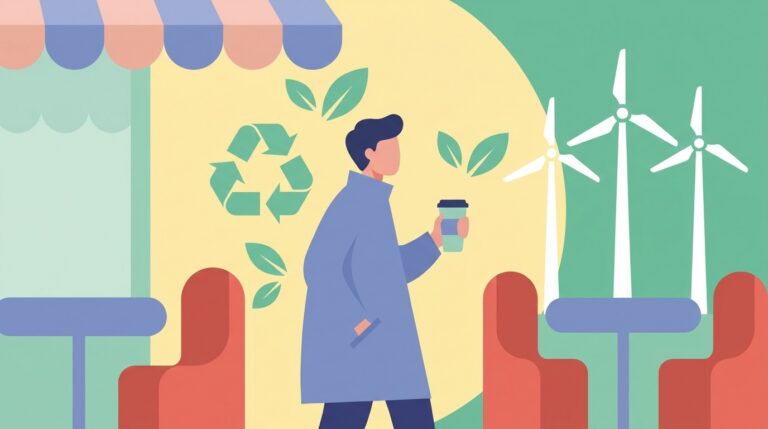
Phase 1: The Eco-Consumption Dilemma in Seoul
안녕하세요! 매일한글 에디터입니다. (Annyeonghaseyo! Maeil Hangeul editeoimnida.) Have you ever felt proud carrying your canvas tote bag into a Seoul cafe and meticulously sorting your trash at a recycling station, only to unbox a snack wrapped in four layers of plastic? It is the classic eco-consumption dilemma! When chatting with Korean friends about climate policies, many B2 learners struggle to move beyond basic words like “recycling” to express that corporate over-packaging and renewable energy shifts must happen alongside personal habits. Built from real feedback from intermediate students navigating Korean social debates, this guide equips you to voice nuanced opinions naturally—without sounding like a stiff news anchor.
Phase 2: Deep Dive into 3 Essential B2 Expressions
1. 개인의 실천도 소중하지만 구조적 변화가 병행되어야 해요 (Gae-in-ui silcheondo sojunghajiman gujojeok byeonhwaga byeonghaengdoeeoya haeyo)
- Pronunciation: Gae-in-ui sil-cheon-do so-jung-ha-ji-man gu-jo-jeok byeon-hwa-ga byeong-haeng-doe-eo-ya hae-yo. (Sound tip: Pronounce 실천 [sil-cheon] like “seal” + “chuhn” as in “chunk” without the k, and 병행 [byeong-haeng] like “byung” + “hang” with a soft nasal ending.)
- Meaning: Literally “Individual practice is also precious, but structural change must be carried out side-by-side.” In natural conversation, it means “Personal efforts matter, yet systemic reform has to happen in parallel.”
- K-Culture Moment: Picture a heated yet thoughtful panel on a Korean current affairs talk show like JTBC Non-Summit or a climate documentary special where an activist validates citizens’ daily habits before pivoting to government accountability.
- Editor’s Insight: Using 소중하지만 (sojunghajiman — valuable, yet) instead of simply saying 중요하지만 (jungyohajiman — important, yet) adds emotional warmth. It prevents you from sounding dismissive of your listener’s personal recycling efforts!
- Situation Spectrum: Casual ⚠️ (a bit wordy for casual slang, use shorter clauses) | Semi-formal ✅ | Formal ✅
- 🤔 Think About It: Notice the verb 병행되다 (byeonghaengdoeda — to go side-by-side). Why do you think Korean climate discussions frequently emphasize collective harmony and parallel progress rather than an “all-or-nothing” individual vs. corporate blame game compared to English debates?
2. 과대포장을 줄이는 게 급선무예요 (Gwadaepojang-eul jurineun ge geupseonmuyeyo)
- Pronunciation: Gwa-dae-po-jang-eul ju-ri-neun ge geup-seon-mu-ye-yo. (Sound tip: 급선무 [geup-seon-mu] flows like “gup” [short u as in “cup”] + “sun” + “moo”—snappy and decisive!)
- Meaning: Literally “Reducing over-packaging is the urgent prior task.” Real nuance: “Cutting down on excessive packaging is our top priority right now.”
- K-Culture Moment: Imagine unboxing a popular K-Beauty skincare set or a holiday Chuseok gift box in a Korean YouTube vlog, only to sigh at the mountain of bubble wrap and plastic trays inside.
- Editor’s Insight: 급선무 (geupseonmu) is a Sino-Korean B2 powerhouse word. Dropping it into a coffee chat signals high fluency without sounding robotic, showing you grasp the urgency of corporate waste policies.
- Situation Spectrum: Casual ✅ (when discussing social issues with friends) | Semi-formal ✅ | Formal ✅
- 🤔 Think About It: Gift-giving in Korea traditionally valued abundant, layered wrapping as a sign of respect (성의를 보이다, seong-uireul boida). How does your native culture balance aesthetic presentation with zero-waste expectations?
3. 근본적인 대책 없이는 한계가 있어요 (Geunbonjeogin daechaek eopsineun hangyega isseoyo)
- Pronunciation: Geun-bon-jeog-in dae-chaek eop-si-neun han-gye-ga iss-eo-yo. (Sound tip: Link 근본적인 [geun-bon-jeog-in] smoothly as “geun-bon-juh-gin” and 없이는 [eop-si-neun] like “up-she-neun” with a crisp silent p.)
- Meaning: Literally “Without fundamental countermeasures, there is a limit.” Real nuance: “Individual eco-habits hit a wall unless we tackle the root causes.”
- K-Culture Moment: A scene in an office K-Drama where a young sustainability planner pushes back politely against a manager’s superficial “bring-your-own-cup” campaign, arguing for real renewable energy transitions.
- Editor’s Insight: Koreans love the phrase 한계가 있다 (hangyega itda — there are limits) because it politely critiques an idea without attacking the person proposing it.
- Situation Spectrum: Casual ⚠️ | Semi-formal ✅ | Formal ✅
- 🤔 Think About It: Saying “there is a limit” softens disagreement compared to saying “that won’t work.” How do you soften critique in your first language when talking about policy?
Phase 3: Textbook Korean vs. Real Korean
Situation 1: Expressing frustration over excessive plastic in delivery food
- 📖 Textbook Korean: 기업의 과대포장 문제가 매우 심각하다고 생각합니다. (Gieob-ui gwadaepojang munjega maeu simgakadago saenggakamnida.) — “I think the corporate over-packaging problem is very serious.”
- 🗣️ Real Korean: 솔직히 개인이 장바구니 들고 다녀봤자 기업이 포장재 줄이지 않으면 말짱 도루묵이죠. (Soljiki gae-ini jangbaguni deulgo danyeobwatja gieobi pojangjae juriji aneumyeon maljjang dorumugijyo.) — “Honestly, even if individuals carry tote bags around, if companies don’t cut packaging, it’s all back to square one.”
- 💡 Why the difference? At the B2 level, idioms like 말짱 도루묵 (maljjang dorumuk — all for nothing / back to square one) and the conditional -아/어 봤자 (-a/eo bwatja — even if you try) instantly convey relatable exasperation rather than a stiff essay tone.
Situation 2: Talking about the dilemma of eco-friendly consumption
- 📖 Textbook Korean: 친환경 제품을 소비하는 것은 비용이 많이 들어서 어렵습니다. (Chinhwangyeong jepumeul sobihaneun geoseun biyong-i mani deureoseo eoryeopseumnida.) — “Consuming eco-friendly products is difficult because it costs a lot.”
- 🗣️ Real Korean: 제로 웨이스트 실천하고 싶어도 친환경 제품이 은근히 가격대가 있어서 매번 고르기가 쉽지 않더라고요. (Jero weiseuteu silcheonhago sipeodo chinhwangyeong jepumi eungeunhi gagyeokdaega isseoseo maebeon goreugiga swipji anteoragoyo.) — “Even when I want to practice zero waste, eco-friendly items tend to be surprisingly pricey, so I’ve noticed it’s not easy to pick them every time.”
- 💡 Why the difference? Real speakers use Konglish terms like 제로 웨이스트 (jero weiseuteu), softeners like 은근히 (eungeunhi — subtly/surprisingly), and -더라고요 (-deoragoyo) to share personal, lived experience.
Phase 4: K-Culture Deep Dive & Non-Verbal Manners
4-1. Nunchi (눈치) & Gestures in Eco-Debates
In Korea, climate and recycling habits are deeply tied to 눈치 (nunchi — social awareness). If your Korean friend grabs a disposable plastic cup on a rushed morning, lecturing them directly feels awkward. Instead, Koreans maintain warm eye contact, nod sympathetically to validate the other person’s busy reality, and use open-handed gestures when shifting the subject toward “structural issues”—signaling “I’m critiquing the system, not judging you!” Also, when sorting trash at a cafe’s recycling station, pausing briefly to read the picture labels shows thoughtful 배려 (baeryeo — consideration) for the part-time staff who would otherwise have to re-sort it.
4-2. Cultural Code: K-Food Delivery & The “Brave Container” Movement
South Korea boasts the world’s fastest food delivery (배달 문화, baedal munhwa), which unfortunately created an explosion of single-use plastic containers during the pandemic. In response, a grassroots trend called 용기내 챌린지 (Yongginaebwa / Yongginae Chaellinji)—a clever pun on 용기 (yonggi), meaning both “courage” and “container”—went viral across Korean variety shows like I Live Alone and social media. Citizens proudly brought reusable glass pots directly to tteokbokki or banchan (side dish) shops! Still, Korean consumers openly debate the limits of personal courage when major conglomerates lag behind in adopting 재생에너지 (jaesaeng-eneoji — renewable energy) and biodegradable packaging.
Phase 5: Real-Life Roleplay Scenario
Setting: A sunlit zero-waste refill shop and cafe in Yeonnam-dong, Seoul. The faint hum of a coffee grinder mixes with acoustic indie music as you and Minjun (a thoughtful 29-year-old Korean friend who works in sustainable brand marketing) inspect bamboo toothbrushes and refillable detergent jars.
- Minjun: 🎭 holding a glass bottle of eco-detergent, smiling 요즘 이런 제로 웨이스트 숍이 꽤 많이 생긴 것 같지 않아요? (Yojeum ireon jero weiseuteu syobi kkwae mani saenggin geot gatji anayo?) — “Don’t you think quite a few zero-waste shops like this have popped up lately?”
- You: 🎭 nodding while examining a paper-wrapped soap bar 맞아요, 저도 장바구니 챙기고 분리배출도 열심히 하려고 해요. (Majayo, jeodo jangbaguni chaenggigo bunribaechuldo yeolsimhi haryeogo haeyo.) — “Yes, I also try to bring my tote bag and do recycling diligently.”
- Minjun: 🎭 sighing slightly as he looks at a nearby convenience store across the street 근데 가끔 마트 가면 채소 하나까지 비닐로 겹겹이 싸여 있어서 허무할 때가 있어요. (Geunde gakkeum mateu gamyeon chaeso hanakkaji binillo gyeopgyeobi ssayeo isseoseo heomuhal ttaega isseoyo.) — “But sometimes when I go to the mart, even a single vegetable is wrapped in layers of plastic, so I feel discouraged.”
- You: 🎭 making empathetic eye contact 저도요! 개인의 실천도 소중하지만 근본적으로는 기업의 과대포장 감축이 병행되어야 해요. (Jeodoyo! Gae-in-ui silcheondo sojunghajiman geunbonjeogeuroneun gieob-ui gwadaepojang gamchugi byeonghaengdoeeoya haeyo.) — “Me too! While individual action matters, corporate reduction of over-packaging fundamentally has to happen alongside it.”
- Minjun: 🎭 snapping his fingers lightly in agreement 정확해요. 일회용품 규제 정책도 카페 손님한테만 부담을 주면 반발이 생길 수밖에 없거든요. (Jeonghwakaeyo. Ilhoeyongpum gyuje jeongchaekdo kape sonnimhanteman budameul jumyeon banbari saenggil subakke eopgeodeunyo.) — “Spot on. Even disposable item regulations are bound to face backlash if they only put the burden on cafe customers.”
- You: 🎭 gesturing toward the rooftop solar panels visible outside 맞아요. 생산 단계부터 재생에너지로 전환하는 구조적 변화가 급선무인 것 같아요. (Majayo. Saengsan dangyebuteo jaesaeng-eneojiro jeonhwanhaneun gujojeok byeonhwaga geupseonmu-in geot gatayo.) — “Right. Shifting to renewable energy from the production stage seems like the urgent priority.”
- Minjun: 🎭 picking up two reusable tumblers and heading to the counter 그래도 우리가 이렇게 목소리를 내는 것 자체가 변화의 시작이겠죠! 오늘은 텀블러 할인받아서 커피 마셔요. (Geuraedo uriga ireoke moksorireul naeneun geot jachega byeonhwa-ui sijagigetjyo! Oneureun teombeulleo harinbadaseo keopi masyeoyo.) — “Still, just raising our voices like this must be the start of change! Today, let’s get a tumbler discount and drink coffee.”
- You: 🎭 laughing warmly 좋아요! 환경도 지키고 커피값도 아끼고 일석이조네요! (Joayo! Hwangyeongdo jikigo keopigatdo akkigo ilseogijoneyo!) — “Sounds great! Protecting the environment and saving on coffee—two birds with one stone!”
🔀 Interactive Decision Point: How would you keep the conversation going?
- Option A: “그렇죠, 정부 정책과 기업 책임에 대한 소비자의 꾸준한 관심이 진짜 중요한 것 같아요.” (Geureotjyo, jeongbu jeongchaekgwa gieop chaegime daehan sobija-ui kkujunhan gwansimi jinjja jungyohan geot gatayo.) — “Right, steady consumer interest in government policy and corporate responsibility seems truly vital.” -> Best! Balances individual consumer power with systemic accountability, matching the B2 tone seamlessly.
- Option B: “솔직히 개인이 분리배출해 봤자 아무 의미 없으니까 이제 안 하려고요.” (Soljiki gae-ini bunribaechulhae bwatja amu uimi eopseunikka ije an haryeogoyo.) — “Honestly, personal recycling is meaningless, so I’m just going to stop doing it.” -> Bad! Sounds cynical and dismisses the social effort Koreans take great pride in, killing the warm mood.
- Option C: “한국 기업들은 왜 이렇게 환경에 신경을 안 써요?” (Hanguk gieopdeureun wae ireoke hwangyeong-e singyeong-eul an sseoyo?) — “Why do Korean companies care so little about the environment?” -> Risk! Generalizing all Korean companies as careless can come across as confrontational rather than constructive.
Phase 6: 10-Second Emotion Shadowing Drill
Read aloud following the / pause markers and emotion cues to sound completely natural!
[😔 Thoughtful & Empathetic]
개인의 장바구니 실천도 / 정말 소중하지만, / 한계는 분명히 있어요. (Gae-in-ui jangbaguni silcheondo / jeongmal sojunghajiman, / hangyeneun bunmyeonghi isseoyo.) — “Personal eco-bag habits are truly valuable, yet there are clear limits.”-
[😤 Mildly Frustrated yet Articulated]
과대포장부터 줄이는 게 / 지금 당장 / 급선무 아니에요? (Gwadaepojangbuteo jurineun ge / jigeum dangjang / geupseonmu anieyo?) — “Isn’t cutting down over-packaging the urgent priority right now?” -
[💡 Determined & Hopeful]
기업의 재생에너지 전환이 / 반드시 / 병행되어야 해요! (Gieob-ui jaesaeng-eneoji jeonhwani / bandeusi / byeonghaengdoeeoya haeyo!) — “Corporate transition to renewable energy must definitely go hand-in-hand!”
Phase 7: K-Culture Mini Dictionary
- 분리배출 (bunribaechul) | Separate waste disposal / Recycling | Unlike generic “recycling” (재활용, jaehwaryong), Koreans almost always use 분리배출 in daily apartment rules and cafe signs to mean sorting plastics, vinyl, cans, and food waste strictly.
- 과대포장 (gwadaepojang) | Over-packaging | Used heavily in consumer complaints, news headlines, and delivery app reviews when snacks or cosmetics come in needlessly huge boxes.
- 탄소 중립 (tanso jungnip) | Carbon neutrality | Essential in ESG business meetings, government policy briefings, and eco-campaign slogans across Seoul.
- 재생에너지 (jaesaeng-eneoji) | Renewable energy | Appears frequently in debates about industrial electricity, solar panels, and corporate sustainability pledges.
Phase 8: Traveler’s Survival Kit
Top 3 Survival Phrases
- 1. 텀블러에 담아 주시겠어요? (Teombeulleoe dama jusigesseoyo?) — “Could you put it in my tumbler?” Pro Tip: Most Korean cafes offer a 300–500 KRW discount (텀블러 할인, teombeulleo harin) when you hand over your reusable cup before ordering!
- 2. 봉투는 괜찮아요, 장바구니 있어요. (Bongtuneun gwaenchanayo, jangbaguni isseoyo.) — “No bag needed, I have my own tote.” Pro Tip: Convenience stores charge for plastic bags or only sell biodegradable/paid trash bags (종량제 봉투, jongnyangje bongtu), so say this at checkout!
- 3. 일회용 수저는 빼 주세요. (Ilhoeyong sujeoneun ppae juseyo.) — “Please leave out disposable utensils.” Pro Tip: When ordering food or eating takeout, this phrase saves mountains of wrapped plastic forks.
Editor’s Travel Note
Navigating Korea’s strict recycling and eco-friendly spots is effortless once you have the right local tools. Before your trip, Download the Naver Map App and search 제로 웨이스트 숍 (jero weiseuteu syop) to discover refill stations and eco-cafes in neighborhoods like Mangwon-dong and Seongsu-dong. For sorting trash at your Airbnb without getting fined, Read the Seoul Metropolitan Government Waste Disposal Guide to learn how Korea separates general waste, food waste (음식물 쓰레기, eumsingmul sseuregi), and recyclables. Finally, if you use a delivery app or kiosk, always watch for the checkbox labeled 일회용품 안 받기 (ilhoeyongpum an batgi — opt out of disposables)!
Phase 9: Go One Step Deeper
In Korean society, the collective spirit of 우리 (uri — we/our) has made South Korea one of the world’s highest-performing nations in household recycling. At the same time, younger Koreans are pushing back against 그린워싱 (geurinwosing — greenwashing), arguing that blaming everyday consumers for climate change distracts from industrial emissions and corporate over-packaging. Understanding this cultural shift lets you see why Koreans fiercely sort every plastic bottle cap and fiercely demand systemic policy change at the exact same time. Both responsibility and critique coexist in modern Korea.
💬 Your Turn: Does your hometown focus more on individual recycling habits or corporate regulations? Tell us in the comments—and try writing one sentence using 병행되어야 해요 (byeonghaengdoeeoya haeyo)!
Phase 10: FAQ & Common Mistakes
Q: What is the difference between 재활용 (jaehwaryong) and 분리배출 (bunribaechul)?
A: 재활용 (jaehwaryong) refers to the actual industrial process of turning waste into new materials, whereas 분리배출 (bunribaechul) means the act of separating and disposing of trash by category at home or in a cafe. When asking “Where do I recycle this?” in Korea, locals look for the 분리배출함 (bunribaechulham).
Q: Are plastic straws banned in Korean cafes right now?
A: Korea’s disposable regulations have evolved rapidly and sparked public debate, with many major chains switching to paper straws or strawless lids, while policy enforcement periods have occasionally been adjusted to support small business owners. Always check the cafe counter—or better yet, bring your own reusable straw!
Q: Can I use the word 딜레마 (dillema) naturally in B2 Korean?
A: Yes! 딜레마 (dillema) is widely used in Korean news, podcasts, and everyday conversations to describe tricky conflicts like convenience vs. sustainability (친환경 소비의 딜레마, chinhwangyeong sobi-ui dillema).
🚨 Common Mistakes TOP 3
- Mistake: Saying “개인의 노력이 필요 없어요” (gae-in-ui noryeogi piryo eopseoyo — Individual effort is unnecessary) when you mean corporations should do more. -> Correct Action: Use 개인의 노력도 중요하지만 (gae-in-ui noryeokdo jungyohajiman — individual effort is also important, yet…) first so you don’t sound insensitive.
- Mistake: Putting contaminated food wrappers into the 플라스틱 (peullaseutik) bin. -> Correct Action: Rinse food off plastics first; dirty vinyl or foil-lined wrappers belong in general waste (일반 쓰레기, ilban sseuregi).
- Mistake: Using 바꾸다 (bakkuda) for large-scale energy shifts (e.g., 재생에너지로 바꾸다). -> Correct Action: At the B2 level, pair policy nouns with 전환하다 (jeonhwanhada — to transition) for natural, authoritative phrasing.
Phase 11: Action Missions
- 🥉 Bronze (Solo Practice): Look at three packaged items in your kitchen today and describe their packaging out loud in Korean using 과대포장 (gwadaepojang).
- 🥈 Silver (Share Online): Snap a photo of your reusable tumbler or eco-bag and post it on social media with the caption: 작은 실천과 구조적 변화가 함께 가야 해요! (Jageun silcheongwa gujojeok byeonhwaga hamkke gaya haeyo!)
- 🥇 Gold (Real-World Use): Next time you visit a Korean restaurant, grocery store, or language exchange meetup, use 장바구니 있어요 (jangbaguni isseoyo) or discuss eco-packaging with a Korean tutor or friend.
- 🎮 K-Culture Mission: Watch an episode of a Korean lifestyle vlog or I Live Alone on YouTube and spot how celebrities sort their 분리배출 (bunribaechul) or react to delivery packaging—see if you catch the phrase 과대포장 in the Korean subtitles!
Phase 12: Interactive Quiz Challenge
Quiz 1: Situational Judgment
Your Korean coworker sighs about sorting takeout containers and asks if personal recycling even matters when big factories emit so much carbon. Which B2 response is the most natural and constructive?
A) 그니까요, 저도 이제 귀찮아서 그냥 일반 쓰레기에 버려요.
B) 개인의 실천도 소중하지만 근본적으로는 기업의 구조적 변화가 병행되어야 하긴 하죠.
C) 환경 보호는 법으로 금지해야 해요.
Check Answer & Explanation
Correct Answer: B
Explanation: Option B validates your coworker’s effort while gracefully agreeing that systemic corporate change must happen alongside individual habits. Option A gives up on recycling completely (bad etiquette in Korea), and Option C weirdly says “protecting the environment should be banned by law.”
Quiz 2: Fill in the Blank
Complete the sentence to mean “Reducing corporate over-packaging is the urgent top priority”:
“기업의 __________을/를 줄이는 게 __________예요.”
Check Answer & Explanation
Correct Answer: 과대포장 (gwadaepojang) / 급선무 (geupseonmu)
Full Sentence: 기업의 과대포장을 줄이는 게 급선무예요. (Gieob-ui gwadaepojang-eul jurineun ge geupseonmuyeyo.)
Quiz 3: True or False Culture Quiz
True or False: In Korea, calling someone out harshly in public for holding a disposable plastic cup is considered polite eco-activism.
Check Answer & Explanation
Correct Answer: False
Explanation: Korean communication relies heavily on 눈치 (nunchi) and mutual respect. People generally prefer leading by example (like using a tumbler discount) and critiquing structural policies rather than lecturing strangers or friends directly.
🎬 Watch Our Daily Videos! (Daily Hangul Official Instagram)
Review the expressions you learned in this article with our fun daily short videos! Check out native pronunciation and real-life nuances in action.
- Instagram @dailyhangul_en







