

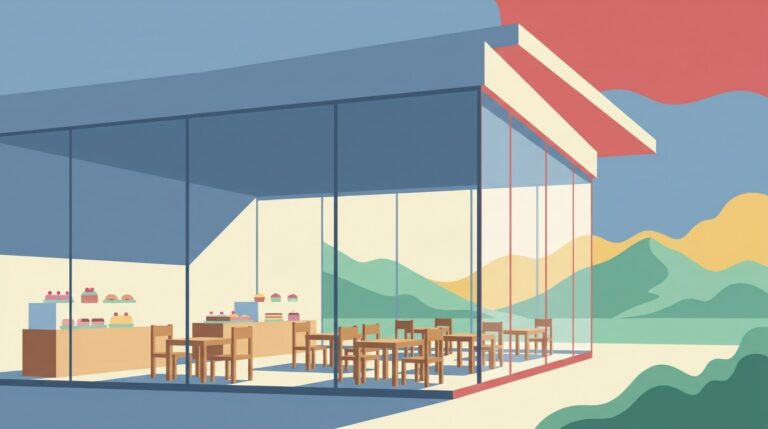
Weekend Escape: Navigating Korea’s Massive Suburban Bakery Cafes
Phase 1: Empathy & Story Intro
안녕하세요! This is your Daily Hangul editor and weekend culture navigator.
Imagine this: It is Saturday morning in Seoul. Your Korean friend calls you and excitedly says, “Let’s go for a drive to Paju! I know this amazing cafe.” You picture a cozy corner spot with soft acoustic music and a few wooden tables. But after an hour’s drive along the Han River, your friend pulls into a parking lot resembling an airport terminal. You look up and see a four-story architectural marvel spanning several acres—complete with an indoor botanical garden, escalators, a full bakery lineup, and hundreds of visitors.
Welcome to Korea’s iconic 대형 베이커리 카페 (mega bakery cafe) phenomenon! In sprawling suburbs like Paju, Gimpo, Namyangju, and Yongin, these venues are far more than places to grab caffeine; they are premier weekend getaway destinations. However, for many international visitors and intermediate Korean learners, stepping into one can trigger instant sensory overload. How do you secure a table among 300 guests? Where do you warm up your pastries? What do you say when the cashier asks about drinks versus baked goods?
Don’t worry. This guide draws from real classroom feedback and authentic weekend outings to equip you with practical B1-level expressions, non-verbal social etiquette (nunchi), and insider cultural insights so you can stroll into any suburban mega cafe with total confidence.
Phase 2: Top 3 Core Expressions
Here are three must-have expressions that will make your suburban cafe adventure completely smooth.
1. 자리 먼저 잡고 올게요 (Jari meonjeo japgo olgeyo)
- Pronunciation: [Jari meon-jeo jap-ko ol-ge-yo] (Sounds like: Jah-ree mun-juh jahp-goh ohl-geh-yoh)
- Meaning: Literal: “I will catch a seat first and come back.” / Nuance: “I’ll go secure our seats before we order.”
- K-Culture Moment: You often see this in weekend lifestyle vlogs or weekend drama outings where characters enter a packed suburban hotspot and immediately split duties—one guards the table while the other lines up for pastries.
- Editor’s Insight: In Korean mega cafes, ordering before finding a table is a rookie mistake. With hundreds of seats spread across multiple floors, you could be left wandering with a heavy tray of iced drinks and pastries. Using this phrase lets your companion know you have the strategy under control.
- Situation Spectrum:
- Casual (Friends): 자리 먼저 잡고 올게! (✅)
- Semi-formal (Polite default): 자리 먼저 잡고 올게요. (✅)
- Formal (Business/Elders): 제가 먼저 자리를 확인하고 오겠습니다. (⚠️ – overly rigid for a weekend cafe)
- 🤔 Think About It: In many Western countries, sitting down before ordering at a counter cafe feels unusual. Why do you think Korean mega cafe culture actively encourages “reserving” your spot with personal belongings first?
2. 여기서 제일 잘나가는 빵이 뭐예요? (Yeogiseo jeil jalnaganeun ppangi mwoyeyo?)
- Pronunciation: [Yeo-gi-seo je-il jal-na-ga-neun ppang-i mwo-ye-yo?] (Sounds like: Yaw-gee-suh jay-eel jal-nah-gah-neun ppahng-ee mwoh-yeh-yoh?)
- Meaning: Literal: “What bread leaves/sells best here?” / Nuance: “What is your signature best-seller?”
- K-Culture Moment: Seen on foodie variety shows like Amazing Saturday or food influencer reels whenever a host faces an overwhelming display of 50 different artisanal breads.
- Editor’s Insight: While textbook Korean teaches “가장 인기 있는 빵이 무엇입니까?”, native speakers naturally use 잘나가다 (to sell well / to be popular). It sounds warm, natural, and immediately prompts the staff to point out the tray that just came fresh out of the oven.
- Situation Spectrum:
- Casual: 여기서 뭐가 제일 잘나가? (✅)
- Semi-formal: 여기서 제일 잘나가는 빵이 뭐예요? (✅)
- Formal: 가장 대표적인 시그니처 메뉴는 무엇인가요? (✅)
- 🤔 Think About It: Notice the expression “잘나가다” (literally: to go out well). How does your native language describe hot-selling items? Does it focus on the item leaving the shelf or the customer buying it?
3. 남은 거 포장해 갈 수 있나요? (Nameun geo pojanghae gal su innayo?)
- Pronunciation: [Na-meun geo po-jang-hae gal su in-na-yo?] (Sounds like: Nah-meun guh poh-jahng-heh gahl soo een-nah-yoh?)
- Meaning: Literal: “Can I pack up what is left and go?” / Nuance: “Can I pack up our leftovers to take home?”
- K-Culture Moment: A classic scene in family-themed K-Dramas where visitors over-order massive salt breads (소금빵) and garlic baguettes, then pack them up for the drive back.
- Editor’s Insight: Suburban mega bakery cafes pride themselves on oversized portions. Most venues have a dedicated 자율 포장대 (self-packaging counter) with wax paper, plastic bags, and twist ties. Asking this will prompt the staff to either direct you to the self-bar or pack delicate cream pastries for you.
- Situation Spectrum:
- Casual: 남은 거 포장해가도 돼? (✅)
- Semi-formal: 남은 거 포장해 갈 수 있나요? (✅)
- Formal: 남은 빵 포장이 가능할까요? (✅)
- 🤔 Think About It: Packing leftovers is standard practice in Korea’s mega bakery cafes without any awkwardness. What is the social perception of asking for a to-go box for baked goods in your culture?
Phase 3: Textbook Korean vs. Real Korean
| Situation | 📖 Textbook Korean | 🗣️ Real Korean | 💡 Why the Difference? |
|---|---|---|---|
| 1. Searching for seats on upper floors | 빈 자리가 있습니까? (Bin jariga itsseumnikka?) | 저기 혹시 자리 있나요? (Jeogi hoksi jari innayo?) | Textbook forms sound like an official survey. Adding 혹시 (by any chance) softens your inquiry when approaching someone sitting near a seemingly vacant chair. |
| 2. Asking to heat up bread | 빵을 데워 주시겠습니까? (Ppangeul dewo jusigesseumnikka?) | 이거 전자레인지에 데워 먹으면 돼요? (Igeo jeonjareinjie dewo meogeumyeon dwaeyo?) | Most mega cafes operate self-service microwave stations. Instead of asking staff to heat it, locals ask if heating it in the microwave is recommended. |
Phase 4: K-Culture Deep Dive & Non-Verbal Manners
4-1. Nunchi & Cafe Etiquette: The “Personal Belongings” Code
When you enter a 500-seat mega cafe in Namyangju on a Sunday afternoon, the first challenge is finding a table. You will witness a scene that shocks many international visitors: laptops, coats, and even expensive smartphones left completely unattended on tables!
* The Strategy: This is standard Korean cafe protocol. Drop a personal, non-valuable item (like a water bottle, umbrella, or a notebook) on an empty table to claim it before heading downstairs to select your bread.
* The Gesture: If you see an empty chair near an occupied table, make brief eye contact, lightly point with an open hand (never a single finger), and ask softly: “이 자리 쓰시나요?” (Are you using this seat?). A gentle nod or head shake is your cue.
4-2. Cultural Analysis: The “Suburban Drive” Healing Sanctuary
Why do millions of Seoulites willingly sit through weekend highway traffic just to visit a bakery cafe in Gyeonggi-do?
* Spatial Psychology: Apartments in Seoul are compact, and urban neighborhood cafes are often filled with 카공족 (people studying in cafes) where silence is expected. Mega bakery cafes offer double-height ceilings, glass walls facing green forests or rivers, and lively ambient white noise.
* K-Travel Phenomenon: A “cafe drive” (드라이브 코스) has replaced traditional picnics. It combines scenic driving, photography for social feeds, dessert tasting, and outdoor relaxation into one seamless half-day ritual.
Phase 5: Interactive Role-Play Scenario
- Setting: A grand 3-story bakery cafe in Paju overlooking a pine garden.
- Characters:
- 민지 (Minji): Your enthusiastic Korean friend who drove you here.
- Alex (You): Visiting a Korean mega cafe for the first time.
민지: 와, 주말이라 사람 진짜 많다! 알렉스, 3층 루프탑에 자리 있는지 보고 올래?
Minji: Wa, jumal-ira saram jinjja manta! Alex, sam-cheung rupeutabe jari inneunji bogo ollae?
(Minji: Wow, there are so many people since it's the weekend! Alex, can you go check if there are seats on the 3rd floor rooftop?)
🎭 [Staring at the winding staircase with determination]

Alex: 응, 내가 자리 먼저 잡고 올게! 주문 천천히 하고 있어.
Alex: Eung, naega jari meonjeo japgo olge! Jumun cheoncheonhi hago isseo.
(Alex: Yeah, I'll go grab a seat first! Take your time ordering.)
🎭 [Gives a quick thumbs up and heads up to scout a window seat]

[5 minutes later at the bakery showcase]

민지: 자리 잡았어? 여기 소금빵이랑 대파 크림치즈 베이글이 시그니처래!
Minji: Jari jabasseo? Yeogi sogeumppang-irang daepa keurimchijeu beigeor-i sigeunicheorae!
(Minji: Did you find a spot? They say the salt bread and scallion cream cheese bagel are their signatures!)
🎭 [Holding a heavy tray stacked with pastries]

Alex: 응, 창가 쪽 잡았어! 근데 빵이 너무 커서 다 못 먹을 것 같아.
Alex: Eung, changga jjok jabasseo! Geunde ppangi neomu keoseo da mot meogeul geot gata.
(Alex: Yeah, I got a spot by the window! But these breads are huge, I don't think we can finish them all.)
🎭 [Eyes widening at the sheer portion sizes]

민지: 걱정 마, 남은 건 자율 포장대에서 싸 가면 돼. 음료는 아메리카노 마실래?
Minji: Geokjeong ma, nameun geon jayul pojangdaeeseo ssa gamyeon dwae. Eumryoneun amerikano masillae?
(Minji: Don't worry, we can pack up leftovers at the self-bar. For drinks, do you want an Americano?)
🎭 [Handing the buzzer pager to Alex]

Alex: 좋아! 진동벨 울리면 내가 가지러 갈게.
Alex: Joa! Jindongbel ullimyeon naega gajireo galge.
(Alex: Sounds good! When the buzzer rings, I'll go pick up the tray.)
🎭 [Carefully pocketing the vibrating buzzer]

민지: 고마워! 빵은 먼저 가져가서 먹고 있자. 나이프랑 포크 챙겼지?
Minji: Gomawo! Ppangeun meonjeo gajyeogaseo meoggo itja. Naipeurang pokeu chaenggyeotji?
(Minji: Thanks! Let's take the bread up first and start eating. Did you grab knives and forks?)
🎭 [Smiling while pointing to the cutlery stand]

Alex: 그럼! 물티슈까지 완벽하게 챙겼지. 얼른 올라가자!
Alex: Geureom! Multtisyukkaji wanbyeokhage chaenggyeotji. Eolleun ollagaja!
(Alex: Of course! I even grabbed wet wipes. Let's head right up!)
🎭 [Balancing the bread tray with confidence]
🔀 Interactive Choice Point
You reach the 3rd floor, but all the regular tables are taken. A couple is getting up from a premium sofa seat, but someone else from across the room is walking briskly toward it. What do you do?
- Choice A: Walk up calmly, make eye contact with the departing guest, and ask: “혹시 나가시는 자리인가요? 제가 앉아도 될까요?” (Is this table opening up? May I sit here?)
- Choice B: Toss your jacket from 3 meters away onto the sofa seat while shouting “내 자리!” (My seat!)
- Choice C: Stand awkwardly behind the sofa in complete silence, avoiding eye contact and hoping the other person backs down.
[Feedback]
* Choice A (Best): Polite, direct, and culturally spot-on. Asking the departing customer confirms the table is free and clearly establishes your presence without any hostility.
* Choice B (Bad): Rude and disruptive. While saving seats with personal items is normal, throwing items across guests causes discomfort and breaks public decorum.
* Choice C (Risk): You will likely lose the seat to someone with more assertive cafe nunchi.
Phase 6: 10-Second Emotion Shadowing Drill
Read these real-life cafe lines out loud. Match the indicated mood and pause at each / mark.
[😊 Confident & Helpful]- 내가 / 2층 가서 / 자리 먼저 잡고 올게! / 너는 천천히 골라.
(Naega / i-cheung gaseo / jari meonjeo japgo olge! / Neoneun cheoncheonhi golla.) - “I will go to the 2nd floor / grab a seat first! / You take your time choosing.”
- 내가 / 2층 가서 / 자리 먼저 잡고 올게! / 너는 천천히 골라.
[👀 Inquiring & Polite]- 실례지만, / 혹시 / 여기 남은 빵 포장해 갈 / 봉투 있나요?
(Sillyejiman, / hoksi / yeogi nameun ppang pojanghae gal / bongtu innayo?) - “Excuse me, / by any chance / do you have a bag / to pack up leftover bread?”
- 실례지만, / 혹시 / 여기 남은 빵 포장해 갈 / 봉투 있나요?
[🤩 Amazed & Excited]- 와, / 통유리 창문 밖으로 / 마운틴 뷰가 / 진짜 시원하게 보인다!
(Wa, / tongyuri changmun bakkeuro / mauntin byuga / jinjja siwonhage boinda!) - “Wow, / through this full glass window / the mountain view / looks so refreshing!”
- 와, / 통유리 창문 밖으로 / 마운틴 뷰가 / 진짜 시원하게 보인다!
Phase 7: K-Culture Mini Dictionary
- 대형 카페 (Dae-hyeong kape)
- Meaning: Massive multi-story cafe.
- Real-world Usage: Refers specifically to architectural suburban cafes outside Seoul that feature large gardens, bakeries, and several parking lots. Used when planning weekend driving dates.
- 카공족 (Ka-gong-jok)
- Meaning: People who study or work on laptops in cafes for hours.
- Real-world Usage: While common in university neighborhoods in Seoul, mega bakery cafes are largely free of kagongjok because they are built for social outings, loud chats, and family trips.
- 자율 포장대 (Ja-yul po-jang-dae)
- Meaning: Self-service packaging station.
- Real-world Usage: Found near the pickup counter in bakery cafes. Stocked with vinyl bags, scissors, napkins, paper boxes, and ties so guests can independently package unconsumed bread.
- 뷰 맛집 (Byu mat-jip)
- Meaning: A venue with an incredible scenic view.
- Real-world Usage: A playful combination of “view” and “matjip” (famous restaurant). You describe a suburban cafe as a “리버 뷰 맛집” (river view hotspot) or “숲 뷰 맛집” (forest view hotspot).
Phase 8: Traveler’s Survival Kit
Survival Expressions TOP 3
- 진동벨 울리면 어디로 가면 돼요? (Jindongbel ullimyeon eodiro gamyeon dwaeyo?)
- Meaning: Where should I go when the buzzer rings?
- Pro Tip: In massive cafes, bread is picked up immediately at the bakery counter, while espresso drinks come from a separate beverage bar. Confirming pickup locations avoids confusion.
- 전자레인지 30초만 돌리면 되나요? (Jeonjareinji samsip-choman dollimyeon dwaenayo?)
- Meaning: Should I just microwave this for 30 seconds?
- Pro Tip: Croissants and garlic breads taste ten times better warm. Check the note stuck on the microwave; it usually recommends 20–30 seconds for pastries.
- 주차 정산은 어디서 하나요? (Jucha jeongsaneun eodiseo hanayo?)
- Meaning: Where do I validate my parking?
- Pro Tip: Suburban cafes offer 2 to 3 hours of free parking. Show your receipt to the cashier or scan your receipt barcode at the automated kiosk near the exit.
Editor’s Travel Note
- Navigation Guide: Public transit rarely reaches suburban mega cafes conveniently. If you don’t have a car, book a shared green car rental or check bus connections beforehand using the Naver Map app route guide for Paju and Namyangju.
- Peak Hours: Between 1:30 PM and 4:30 PM on Sundays, parking lots can jam. Arrive before 11:30 AM for a peaceful brunch experience or after 5:30 PM to catch sunset views.
Phase 9: “One Step Deeper” (Reflective Question)
In South Korea’s high-density urban environment, living spaces are often compact, and privacy can feel limited. Mega bakery cafes function as extended public living rooms—luxurious, open, and surrounded by nature. By spending the price of a single coffee and a pastry, visitors rent an immersive spatial experience that provides mental release from high-pressure city routines.
💬 Your Turn: Does your home country have large gathering spaces where people spend hours just enjoying the architecture and landscape? How do people in your culture “escape” urban pressure on the weekend? Share your thoughts below!
Phase 10: FAQ & Common Mistakes
Q: Can I visit these mega cafes alone to read or work on my laptop?
A: You certainly can, but keep in mind that mega cafes are loud, lively, and family-oriented. Unlike quiet downtown Seoul cafes where whispers reign, children, couples, and tour groups frequent these spots. If you need intense focus, a neighborhood cafe or study cafe (스터디 카페) is a much better choice.
Q: Do I pay for bread and coffee together or separately?
A: In almost all bakery cafes, you grab a tray and tongs at the entrance, pick out your breads, and carry the tray to the checkout register. There, the staff tallies your baked goods, takes your drink order, and charges everything on one receipt. You take the bread immediately and receive a buzzer for your drinks.
Q: Are dogs allowed in these suburban cafes?
A: Many suburban mega cafes have spacious outdoor pet zones (애견 동반 구역), but indoor spaces are often restricted to service animals. Look for signs marked 반려견 동반 가능 (Pet-friendly) near the garden entrance.
🚨 Common Mistakes
- Mistake 1: Waiting in the pastry line before finding a table on busy weekends.
- Correct Action: Send one person upstairs to claim a seat while you browse the pastries.
- Mistake 2: Asking the staff behind the busy counter to pack two leftover pastry slices.
- Correct Action: Locate the 자율 포장대 (self-packaging counter), grab wax paper and a bag, and package it yourself.
- Mistake 3: Forgetting to register your car license plate at the counter.
- Correct Action: Always ask “주차 등록해 주세요” (Please register my parking) when paying for your order.
Phase 11: Action Mission & Engagement
- 🥉 Bronze Level: Stand in front of your mirror and practice saying: “내가 자리 먼저 잡고 올게!” smoothly in under 3 seconds.
- 🥈 Silver Level: Next time you visit any cafe, take a picture of a pastry and post a story using the hashtag #뷰맛집 or write: “여기 시그니처 빵 진짜 맛있다!”
- 🥇 Gold Level: During your next trip to Korea, rent a car or take a suburban taxi to Namyangju or Paju, secure a window seat, and order signature pastries completely in Korean!
🎮 K-Culture Mission: Watch a recent Korean lifestyle YouTube vlog about a weekend road trip. Listen closely: can you spot when they say “잘나가다” or “시그니처” when choosing desserts?
Phase 12: Interactive Quiz Challenge
Test your suburban cafe survival skills with these three quick questions!
Q1. Situational Judgment
You are standing in front of a counter with 30 types of bread, unsure what to pick. Which sentence sounds most natural to ask the staff?
* A) 어떤 빵이 제일 잘나가요? (Eotteon ppangi jeil jalnagayo?)
* B) 빵을 내게 파십시오. (Ppangeul naege pasipsio.)
* C) 빈 빵이 있습니까? (Bin ppangi itsseumnikka?)
Q2. Fill in the Blank
Complete the sentence used when packing leftover pastries yourself:
* “남은 빵은 ( )에서 직접 포장하시면 됩니다.”
* Hint: Self-service packaging station.
Q3. True or False
In Korean mega bakery cafes, leaving a notebook or jacket on an empty table to reserve it while ordering is considered unacceptable and illegal.
* [True / False]
🔍 Click here to reveal the answers and explanations!
- Q1 Answer: A
- Explanation: “어떤 빵이 제일 잘나가요?” naturally asks what sells best. Option B is overly dramatic historical textbook phrasing, and C makes no sense contextually.
- Q2 Answer: 자율 포장대 (Jayul pojangdae)
- Explanation: Most mega cafes feature a self-service table labeled “자율 포장대” with bags, scissors, and boxes.
- Q3 Answer: False
- Explanation: Reserving seats with personal items before ordering is standard, widely accepted etiquette in large Korean cafes.
- Explanation: Reserving seats with personal items before ordering is standard, widely accepted etiquette in large Korean cafes.
🎬 Watch Our Daily Videos! (Daily Hangul Official Instagram)
Review the expressions you learned in this article with our fun daily short videos! Check out native pronunciation and real-life nuances in action.
- Instagram @dailyhangul_en







