

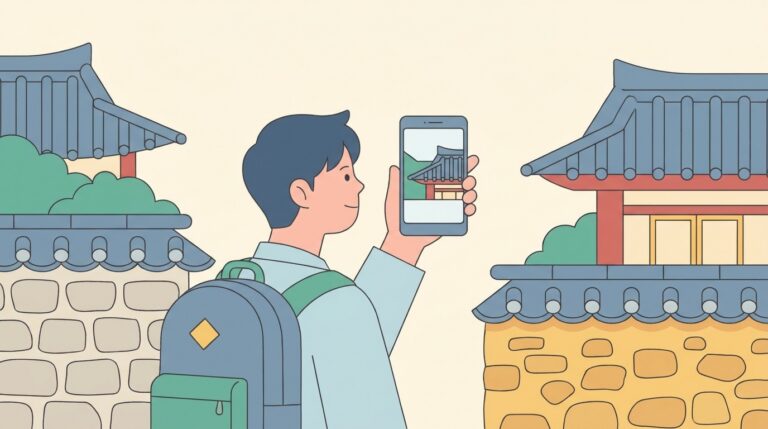
Take Perfect Korean Aesthetic Photos: Erase Photobombers Like a Local
Phase 1: Empathy (Story-Driven Opening)
안녕하세요! (Annyeonghaseyo!) I’m your Daily Hangul editor.
Picture this: You are standing in the middle of a dreamy, sunlit alleyway in Ikseon-dong or in front of a chic industrial cafe in Seongsu-dong. The golden hour light hits your outfit just right, your iced Americano looks like something out of a magazine, and you finally snap the photo of the trip. But when you check your camera roll, your heart sinks. Right behind your shoulder stands an accidental photobomber carrying a fluorescent plastic bag, and right beside your vintage chair sits a bright orange curbside trash can.
In the past, you might have sighed and archived the photo forever. But in Korea, where cafe aesthetics (gam-seong) and sleek Instagram feeds are an art form, nobody gives up on a great shot that easily! With a quick tap on the built-in smartphone AI eraser tool, you can make unwanted passersby and stray trash cans vanish in two seconds flat.
When you share that polished shot with your Korean friends, saying: “배경에 찍힌 지나가는 행인이나 쓰레기통은 AI 지우개 기능으로 깔끔하게 지웠어요” (I cleanly erased passersby and trash cans in the background using the AI eraser tool), their eyes will light up. You will instantly move beyond textbook robot-talk and sound like a savvy local who truly understands modern Korean photo culture. Let’s master this practical, beginner-friendly skill together!
Phase 2: Core Expressions Deep Dive
Let’s break down the three most natural Korean expressions you need for this exact moment.
1. 지웠어요 (Jiwosseoyo)
- Pronunciation: [Jiwosseoyo] (Sounds like “Gee-woh-ssuh-yo”—think of saying “Gee, water!” quickly with a soft “ssuh-yo” at the end)
- Meaning: Literal: “Erased” / Actual Nuance: “I wiped it out / removed it cleanly from the image.”
- K-Culture Moment: Seen constantly in Korean YouTube beauty vlogs or phone review reels when creators demonstrate touch-ups.
- Editor’s Insight: The root verb is ji-u-da (지우다, to erase). While beginners often search for technical English loanwords like ri-mu-beu (리무브), native Koreans stick to the simple, warm native verb ji-u-da for both pencil marks and high-tech digital objects!
- Situation Spectrum: Casual: ✅ | Semi-formal: ✅ | Formal: ⚠️
- 🤔 Think About It: In English, we often say “I edited them out” or “I Photoshopped it.” Why do you think Korean speakers prefer the tactile metaphor of physically erasing (지우다) something away?
2. 깔끔하게 나왔어요 (Kkal-kkeum-ha-ge nawasseoyo)
- Pronunciation: [Kkal-kkeum-ha-ge na-wa-sseo-yo] (Start with a crisp “Kkal” as in “calm”, followed by “kkeum”, “ha-ge”, and “na-wa-ssuh-yo”)
- Meaning: Literal: “It came out neatly” / Actual Nuance: “The photo looks so clean, crisp, and uncluttered!”
- K-Culture Moment: When K-pop idols check their monitor screens behind the scenes of a music video shoot, they smile and say this to the photographer.
- Editor’s Insight: Kkal-kkeum-hada means clean and tidy. In Korean visual culture, a photo without clutter or visual noise is the ultimate compliment.
- Situation Spectrum: Casual: ✅ | Semi-formal: ✅ | Formal: ✅
- 🤔 Think About It: What does the emphasis on “neatness” (kkalkkeum) tell us about Korean visual preferences compared to casual, candid “photo dumps” in Western trends?
3. 감성 사진 건졌어요 (Gam-seong sa-jin geon-jyeo-sseo-yo)
- Pronunciation: [Gam-seong sa-jin geon-jyeo-sseo-yo] (Gam as in “gummy”, seong as in “song”, sa-jin, and geon-jyeo-ssuh-yo)
- Meaning: Literal: “I fished out an emotional aesthetic photo” / Actual Nuance: “I managed to snag an absolute aesthetic gem for my feed!”
- K-Culture Moment: Heard at every popular cafe in Seoul when friends scroll through hundreds of shots to pick the single winning picture.
- Editor’s Insight: The verb geon-ji-da (건지다) literally means to scoop or rescue something out of water. Koreans use it metaphorically to celebrate rescuing one perfect picture from a sea of mediocre burst shots.
- Situation Spectrum: Casual: ✅ | Semi-formal: ✅ | Formal: 🚫
- 🤔 Think About It: How does viewing photo-taking as “rescuing a gem” change the fun and patience you have when taking pictures for friends?
Phase 3: Textbook Korean vs. Real-Life Korean
Situation 1: Talking about removing someone from the frame
- 📖 교과서 한국어 (Textbook):
사진에서 사람을 삭제했습니다.
(Sajin-eseo sarameul sakjehaess-seumnida. / “I deleted the human from the photograph.”) - 🗣️ 진짜 한국어 (Real-Life):
AI 지우개로 쓱 지웠어요!
(AI ji-u-gae-ro sseuk jiwosseoyo! / “I swiped them right off with the AI eraser!”) - 💡 Why the difference? Sakje (삭제) sounds like you are purging a confidential database file at an office. In everyday conversation, Koreans use the lively mimetic word sseuk (쓱 – smoothly/swiftly) and the friendly tool name AI ji-u-gae.
Situation 2: Praising a successful photo outcome
- 📖 교과서 한국어 (Textbook):
마음에 드는 좋은 사진을 찍었습니다.
(Maeume deuneun joeun sajineul jjieosseumnida. / “I took a satisfactory, good picture.”) - 🗣️ 진짜 한국어 (Real-Life):
완전 인생샷 건졌어요!
(Wanjeon insaeng-syat geon-jyeosseoyo! / “I totally scored a once-in-a-lifetime shot!”) - 💡 Why the difference? Textbook phrases lack emotion. Modern Koreans combine wanjeon (완전 – totally) with insaeng-syat (인생샷 – life-shot) to express pure excitement.
Phase 4: K-Culture Deep Dive & Non-Verbal Manners
4-1. Nunchi & Gestures: The Courtesy of Before-and-After
When you show off your photo editing skills in Korea, avoid bluntly saying, “Look how bad this person looked before.” Instead, practice Nunchi (눈치)—social tact. Hold your phone with both thumbs, show the final result first, and if your friend asks how you took it, gently press and hold the screen to reveal the “Before/After” transition with a modest chuckle.
Also, keep in mind Korea’s strict privacy norms regarding portrait rights (초상권, chosang-gwon). Erasing strangers from your public social media posts is not just about making your photo look pretty—it is actually considered thoughtful digital manners so strangers aren’t accidentally exposed online without consent!
4-2. Cultural Code: The Cafe Photo Ritual
If you step into any trendy neighborhood in Seoul—like Hannam-dong or Yeonnam-dong—you will notice an unwritten rule: friends will happily spend 10 minutes taking 50 photos of each other from low angles to elongate legs. The post-processing stage is collaborative. Sitting side-by-side, sharing tips on AI tools, lighting sliders, and tone adjustments is a primary bonding ritual among Korean Gen Z and millennials.
Phase 5: Real-Life Roleplay Scenario
Setting: A sun-drenched rooftop cafe overlooking traditional Hanok tile roofs in Bukchon.
Characters:
* You: An enthusiastic traveler and beginner Korean learner.
* Minji (민지): Your Korean college buddy and self-proclaimed smartphone photography guru.
Minji: 와, 오늘 날씨 진짜 좋다! 사진 찍어줄까?
(Wa, oneul nalssi jinjja jota! Sajin jjigeojulkka?)
🎭 [Eyes twinkling, holding up her phone at eye level]
“Wow, the weather is amazing today! Want me to take your photo?”
You: 네, 좋아요! 예쁘게 부탁해요.
(Ne, jo-a-yo! Yeppeuge bu-tak-hae-yo.)
🎭 [Smooths down shirt and strikes a relaxed pose against the wooden railing]
“Yes, please! Make me look good!”
Minji: 하나, 둘, 셋! 찰칵! 오… 구도는 좋은데 뒤에 쓰레기통이 나왔네.
(Hana, dul, set! Chalgak! O… gudo-neun joeunde dwie sseuregitong-i nawanne.)
🎭 [Tilts head with a slight pout while reviewing the screen]
“One, two, three! Click! Oh… the composition is great, but a trash can got caught in the back.”
You: 아, 걱정 마요. AI 지우개로 지우면 돼요.
(A, geok-jeong ma-yo. AI ji-u-gae-ro ji-u-myeon dwae-yo.)
🎭 [Smiles reassuringly, reaching out to look at the screen]
“Ah, don’t worry. We can just erase it with the AI eraser.”
Minji: 오, 그런 기능도 알아? 한번 해봐!
(O, geureon gineung-do ara? Hanbeon haebwa!)
🎭 [Hands the phone over with curiosity]
“Oh, you know about that feature too? Try it!”
You: 짠! 배경에 행인이랑 쓰레기통 깔끔하게 지웠어요.
(Jjan! Bae-gyeong-e haeng-in-i-rang sseu-re-gi-tong kkal-kkeum-ha-ge ji-woss-eo-yo.)
🎭 [Taps screen twice with a proud flourish and shows the result]
“Ta-da! I cleanly erased the passerby and the trash can in the background.”
Minji: 대박! 진짜 흔적도 없이 사라졌다! 감성 사진 제대로 건졌네!
(Daebak! Jinjja heunjeokdo eopsi sarajyeotda! Gamseong sajin jedaero geonjyeonne!)
🎭 [Claps hands together in genuine amazement]
“Awesome! It vanished without a trace! You really bagged an aesthetic gem!”
You: 고마워요! 민지 씨 덕분이에요.
(Gomawoyo! Minji ssi deokbun-ieyo.)
🎭 [Laughs warmly]
“Thank you! It’s all thanks to you, Minji.”
🔀 Interactive Branch Point: How would you react next?
Minji asks if she should post the photo right now to her Instagram story and tag you. How do you respond?
- Option A: “지금 바로 올려요! 태그도 해주세요!” (Post it right now! Tag me too!)
- Option B: “사람을 삭제했으니까 올리면 안 돼요.” (Because we deleted a human, we shouldn’t post it.)
- Option C: “사진이 마음에 안 드니까 다시 찍어요.” (I don’t like the photo, let’s retake it.)
Feedback:
* Option A (Best): Friendly, enthusiastic, and matches the upbeat vibe! You’ll deepen your friendship instantly.
* Option B (Risk): Grammatically fine, but using sakje (deleted) sounds overly dramatic and moralistic, which might confuse your friend.
* Option C (Bad): Blunt and unappreciative after your friend tried hard to take a great photo for you.
Phase 6: 10-Second Emotion Shadowing Drill
Read aloud with a brief breath pause at / and match each emotional cue:
[🥺 Slightly disappointed]
구도는 너무 좋은데 / 뒤에 사람이 걸렸어요.
(Gudo-neun neomu joeunde / dwie sarami geollyeosseoyo.)
“The composition is so good, / but someone got caught in the back.”-
[💡 Confident and reassuring]
걱정 마요! / AI 지우개 쓰면 돼요.
(Geokjeong mayo! / AI jiugae sseumyeon dwaeyo.)
“Don’t worry! / We can just use the AI eraser.” -
[😆 Proud and beaming]
보세요! / 쓰레기통 깔끔하게 지웠어요!
(Boseyo! / Sseuregitong kkalkkeumhage jiwosseoyo!)
“Look! / I cleanly erased the trash can!”
Phase 7: K-Culture Mini Dictionary
- 인생샷 (Insaeng-syat) | Once-in-a-lifetime shot | A blend of 인생 (life) + 샷 (shot), used for your absolute best photo of a trip or café visit.
- AI 지우개 (AI jiugae) | AI Eraser | The smartphone object-removal feature popularized across Korea by Galaxy and iPhone editing tools.
- 초상권 (Chosang-gwon) | Portrait / privacy rights | Posting strangers’ recognizable faces online without permission is a social faux pas in Korea, making AI erasers a digital etiquette essential.
- 감성 카페 (Gamseong kape) | Aesthetic café | Neighborhoods like Seongsu, Ikseon-dong, and Yeonnam-dong are famous for curated lighting, props, and photo-worthy corners.
Phase 8: Traveler’s Survival Kit
Top 3 Survival Phrases
- 여기서 사진 한 장만 찍어 주실 수 있어요? (Yeogiseo sajin han jangman jjigeo jusil su isseoyo? / Could you take just one photo of me here?)
- Pro Tip: Ask younger locals or fellow café-goers—they often crouch down and snap 10+ angles to make sure you get a great shot!
- 세로로 길게 찍어 주세요! (Seroro gilge jjigeo juseyo! / Please take it vertically and long!)
- Pro Tip: The classic request for flattering full-body café shots.
- 뒤에 사람 안 나오게 부탁드려요. (Dwie saram an naoge butakdeuryeoyo. / Please try not to get people behind me in the shot.)
- Pro Tip: Helpful in busy spots like Myeongdong or Gyeongbokgung Palace.
Editor’s Travel Note
- Café Hopping & Photo Apps: Use Naver Map to discover trendy cafés in Seongsu-dong and Yeonnam-dong (and check real customer photo reviews). For quick Korean-style touch-ups and filters, many locals also keep SNOW alongside their phone’s built-in AI eraser.
Phase 9: “One Step Deeper” — Care Behind Every Clean Frame
In Korean social culture, taking and polishing a great photo for a friend isn’t superficial—it is a thoughtful way of gifting them a lasting memory (추억). Removing distracting clutter and respecting strangers’ privacy (초상권) shows care for both your friend and the people sharing the space around you.
💬 Your Turn: Do you usually edit out accidental photobombers, or do you keep them as part of the travel story? Share your take in the comments!
Phase 10: FAQ & Myth-Busting
Q: What is the difference between “지웠어요” and “삭제했어요”?
A: 지웠어요 (jiwosseoyo) feels warm, natural, and everyday—like erasing a stray mark with a pencil eraser. 삭제했어요 (sakjehaesseoyo, “deleted”) sounds cold and technical, like purging files on a server. Always use 지웠어요 for photo touch-ups!
Q: Will “AI 지우개” be understood by both Galaxy and iPhone users in Korea?
A: Yes! Even though the name became famous through Samsung Galaxy, Koreans use AI 지우개 casually for any smartphone object-removal tool.
Q: Is it really necessary to blur or erase strangers in Korea?
A: For recognizable faces in public social posts, yes—erasing or adding a cute sticker is widely expected out of respect for portrait rights (초상권).
🚨 Common Mistakes TOP 3
- Saying “청소했어요” (I cleaned the room) instead of “지웠어요” -> Use 지웠어요 for removing objects in photos.
- Saying “사람이 있어요” when someone photobombs -> Sound natural with 뒤에 사람이 걸렸어요 (“Someone got caught in the back”).
- Saying “사진을 죽였어요” for a ruined photo -> Use 사진을 망쳤어요 (“I ruined the photo”).
Phase 11: Action Mission & Engagement
- 🥉 Bronze Mission (Solo Practice): Open an old travel photo with a photobomber, use your phone’s AI eraser, and say “깔끔하게 지웠어요!” aloud.
- 🥈 Silver Mission (Social Share): Share your favorite before-and-after café shot with #깔끔하게지웠어요 #DailyHangul.
- 🥇 Gold Mission (Real-Life Use): Next time you take photos with a Korean friend, show off your edited shot and say, “감성 사진 건졌어요!”
- 🎮 K-Culture Mission: Watch a Korean café vlog on YouTube and listen for how often creators say 인생샷 or 깔끔하다!
Phase 12: Interactive Quiz Challenge
Test your A2 Korean before checking the answers below!
- Situational Judgment: A stranger walked right behind you in your café photo. Which phrase sounds most natural to tell your Korean friend?
- A) 뒤에 사람이 걸렸어요. (Dwie sarami geollyeosseoyo.)
- B) 뒤에 사람을 삭제했어요. (Dwie sarameul sakjehaesseumnida.)
- C) 뒤에 사람이 청소되었어요. (Dwie sarami cheongsodoeeosseoyo.)
- Fill-in-the-Blank: Complete the sentence meaning “I cleanly erased the trash can with the AI eraser”:
AI 지우개로 쓰레기통을 ( ) 지웠어요.- A) 지저분하게 (jijeobunhage)
- B) 깔끔하게 (kkalkkeumhage)
- C) 복잡하게 (bokjaphage)
- True or False (Cultural Quiz): In Korea, erasing or blurring strangers’ recognizable faces before posting café photos publicly is considered polite digital etiquette (초상권). (True / False)
Click to Reveal Quiz Answers & Detailed Explanations
- Answer: A.
- Explanation: Koreans use 걸리다 (geollida, “to get caught in the frame”) when someone accidentally photobombs a shot! Choice B sounds like you deleted a database file, and Choice C means “cleaned.”
- Answer: B (깔끔하게 / kkalkkeumhage).
- Explanation: 깔끔하게 means “neatly/cleanly”—the go-to word for crisp, clutter-free edits.
- Answer: True.
- Explanation: Respecting portrait rights (초상권) is taken seriously in Korea, so removing strangers from public social media posts is both aesthetic and considerate!
🎬 Watch Our Daily Videos! (Daily Hangul Official Instagram)
Review the expressions you learned in this article with our fun daily short videos! Check out native pronunciation and real-life nuances in action.
- Instagram @dailyhangul_en







