

Phase 1: 공감 (Story Opening)
안녕하세요! 매일한글 에디터입니다. (Hello! I’m your Daily Hangul editor.)
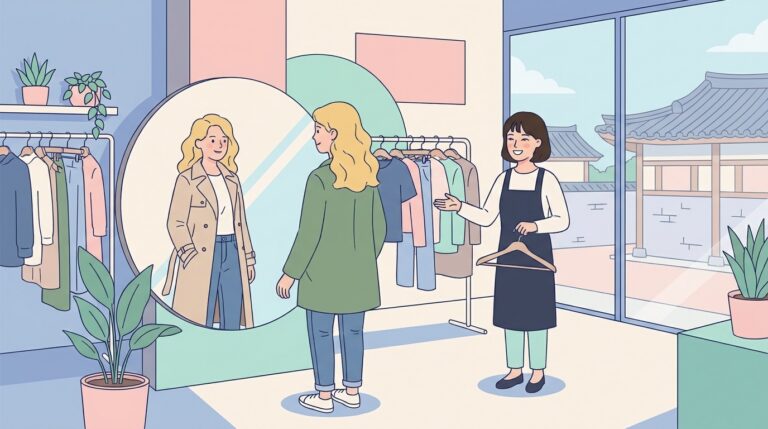
Picture this: You are strolling through the stylish streets of Hongdae or Seongsu-dong. Through a glass storefront, a chic knit sweater catches your eye. You step inside, feeling inspired by your favorite K-drama leads who pull off effortless oversized silhouettes. You pick up the hanger, but hesitation hits. In your home country, you comfortably wear a Medium. Here in Seoul, the Medium looks a bit snug across the shoulders, while the Large looks dramatically relaxed.
A friendly store clerk approaches with a warm smile and asks, “도와드릴까요?” (Dowadeurilkkayo? / Can I help you?). Suddenly, you freeze. How do you explain your usual size at home and ask whether stepping up to a Large is the smarter choice? Many of our Daily Hangul learners, like Sarah from Vancouver, have shared this exact moment of anxiety. They worried about sounding awkward or misunderstanding unique Korean fit aesthetics.
Learning how to ask for fit advice turns an intimidating checkout gamble into an authentic shopping adventure. This guide is crafted directly from real-life retail encounters and learner questions, giving you practical phrases to shop Korean fashion with absolute confidence.
Phase 2: 핵심 표현 3선 심층 분석 (Top 3 Key Expressions)
1. 평소에 미디움 입는데 라지 입는 게 나을까요?
- Pronunciation: [Pyeongsoe midieum imneunde raji imneun ge naeulkkayo?] (Think of pyeong-so-eh like saying ‘young soul’ without the y, and nae-ul-kka-yo with a soft questioning lilt at the end).
- Meaning: “I usually wear medium, would it be better to wear large?” (Direct: In ordinary times I wear medium, but is wearing large better?)
- K-Culture Moment: You will hear this exact cadence in Korean fashion vlogs on YouTube when creators consult personal shoppers in department stores.
- Editor’s Insight: The ending ~는 게 나을까요? (~neun ge naeulkkayo?) is the gold standard for asking for a soft recommendation. It sounds polite, collaborative, and never demanding.
- Situation Spectrum: Casual (⚠️ only with close friends) | Semi-formal (✅ perfect for boutique staff) | Formal (✅ respectful in department stores)
- 🤔 Think About It: In English, we often ask “Should I get a Large?” which focuses on our action. In Korean, asking whether something “is better” (~나을까요) shifts the focus to the outcome and invites the other person’s aesthetic expertise.
2. 이게 핏이 좀 작게 나왔나요?
- Pronunciation: [Ige pisi jom jakge nawannayo?] (Pronounce pisi just like the English word ‘fit’ with an added soft ‘ee’ sound).
- Meaning: “Did this come out a bit small in fit?” (Actual nuance: Does this item run small?)
- K-Culture Moment: Seen often in variety shows like I Live Alone when celebrities try on newly arrived season samples.
- Editor’s Insight: Korean uses the verb 나오다 (naoda – to come out) to describe how a manufactured product was sized or cut. Adding 좀 (jom – a little) softens the inquiry politely.
- Situation Spectrum: Casual (✅) | Semi-formal (✅) | Formal (✅)
- 🤔 Think About It: Why say “came out small” instead of “is small”? It places the characteristic on the manufacturing cut rather than criticizing the garment itself.
3. 넉넉하게 입으려면 어떤 사이즈가 좋아요?
- Pronunciation: [Neongneokhage ibeuryeomyeon eotteon saijeuga joayo?] (Start neong-neok with open resonance, rhyming loosely with ‘young truck’).
- Meaning: “If I want to wear it comfortably/oversized, which size is good?”
- K-Culture Moment: Frequently used by K-Pop idols during behind-the-scenes fitting videos when styling streetwear.
- Editor’s Insight: 넉넉하다 (neongneokhada) implies roominess, comfort, and breathing room. It is much more natural than simply saying “big” (크게).
- Situation Spectrum: Casual (✅) | Semi-formal (✅) | Formal (✅)
- 🤔 Think About It: Comfort in Korean fashion often translates to intentional styling rather than just loose clothing.
Phase 3: 교과서 한국어 vs 진짜 한국어 (Textbook vs. Real-Life Korean)
Situation 1: Asking if the garment runs small
- 📖 교과서 한국어: 이 옷의 치수는 작습니까? (I osui chisuneun jakseumnikka? / Is the measurement of this garment small?)
- 🗣️ 진짜 한국어: 이거 보통 사이즈보다 좀 작게 나왔어요? (Igeo botong saijeuboda jom jakge nawasseoyo? / Does this run a bit smaller than regular sizes?)
- 💡 왜 다를까? Native speakers rarely say 치수 (chisu) in casual clothing shops. They prefer the loanword 사이즈 (saijeu) and discuss whether it came out (나왔어요) smaller or bigger.
Situation 2: Asking if an oversized look works
- 📖 교과서 한국어: 큰 치수를 입는 것이 더 좋습니까? (Keun chisureul imneun geosi deo joseumnikka? / Is wearing a big measurement better?)
- 🗣️ 진짜 한국어: 루즈핏으로 입으려면 라지가 나을까요? (Rujeupiseuro ibeuryeomyeon rajiga naeulkkayo? / Would Large be better if I want a loose fit?)
- 💡 왜 다를까? Korean fashion lovers embrace style loanwords like 루즈핏 (rujeupit – loose fit) or 오버핏 (obeopit – over-fit) to describe exact street aesthetics.
Phase 4: K-Culture 딥다이브 & 비언어적 매너 (Culture Deep Dive & Mannerisms)
4-1. 눈치 (Nunchi) & Body Language
When discussing sizes in Korea, do not immediately toss clothes onto a counter. Hold the hanger gently with both hands at chest level, holding it slightly against your frame. Tilt your head slightly as you ask, demonstrating that you value the clerk’s professional opinion. When handing back a piece you tried, always hold the hanger hook facing forward with both hands. This subtle show of care (배려, baeryeo) will instantly earn you friendlier, more attentive service.
4-2. The Korean Sizing Landscape: “Free Size” and Oversized Silhouettes
Korean sizing often differs from North American or European sizing. An Asian Medium (M) is frequently closer to a Western Small (S). Furthermore, you will encounter the ubiquitous 프리사이즈 (Free Size). Free Size does not mean one-size-fits-all; it usually denotes an item designed to drape comfortably on individuals wearing sizes S to M. If you enjoy contemporary Korean streetwear, staff frequently advise sizing up because cuts are intentionally proportioned to look boxy and relaxed rather than form-fitting.
Phase 5: 실전 롤플레이 시나리오 (Interactive Roleplay Scenario)
Setting: A minimalist concept clothing store in Hannam-dong, Seoul. Soft indie music plays while racks of neutral-toned jackets line the walls.
Characters: Alex (Traveler, A2 Korean learner) & Staff Min-ho (Chic, knowledgeable store assistant).
- Staff Min-ho: 🎭 Approaches with a warm bow. 어서 오세요! 편하게 입어보세요. (Eoseo oseyo! Pyeonhage ibeoboseyo. / Welcome! Feel free to try anything on.)
- Alex: 🎭 Holding a wool jacket in Medium, looking slightly puzzled. 저기요, 제가 평소에 미디움 입는데 라지 입는 게 나을까요? (Jeogiyo, jega pyeongsoe midieum imneunde raji imneun ge naeulkkayo? / Excuse me, I usually wear a medium, would it be better to wear a large?)
- Staff Min-ho: 🎭 Examines the shoulders of the jacket. 이 코트는 어깨가 조금 슬림하게 나왔어요. (I koteuneun eokkaega jogeum seullimhage nawasseoyo. / The shoulders on this coat came out a bit slim.)
- Alex: 🎭 Nods understandingly. 아, 그래요? 넉넉하게 입으려면 라지가 좋겠네요? (A, geuraeyo? Neongneokhage ibeuryeomyeon rajiga jokgenneyo? / Ah, really? Then large would be good if I want a roomy fit?)
- Staff Min-ho: 🎭 Retrieves a Large from the rack and gestures to the fitting room. 네, 안에 니트 입으실 거면 라지를 추천해요. (Ne, ane niteu ibeusil geomyeon rajireul chucheonhaeyo. / Yes, if you plan to wear a knit sweater inside, I recommend Large.)
- Alex: 🎭 Takes the hanger with both hands. 피팅룸에서 입어봐도 돼요? (Pitingrumeseo ibeobwado dwaeyo? / May I try this on in the fitting room?)
- Staff Min-ho: 🎭 Directs toward the curtain. 네, 저쪽 피팅룸 이용해 주세요. 페이스커버 착용 부탁드려요! (Ne, jeojjok pitingrum iyonghae juseyo. Peiseukeobeo chakyong butakdeuryeoyo! / Yes, please use that fitting room over there. Please make sure to use a face cover!)
- Alex: 🎭 Smiles brightly. 네, 감사합니다! 입어볼게요. (Ne, gamsahamnida! Ibeobolgeyo. / Yes, thank you! I will try it on.)
🔀 인터랙티브 분기점 (Interactive Branching Point)
After trying on the Large, it feels a little too wide on the sleeves. What do you say to Min-ho?
- Option A: “라지는 너무 커서 싫어요. 그냥 갈게요.” (Raji-neun neomu keoseo sireoyo. Geunyang galgeyo. / Large is too big and I hate it. I’ll just leave.)
- Option B: “핏은 예쁜데, 소매가 살짝 길어서 미디움도 한 번 입어볼 수 있을까요?” (Piseun yeppeunde, somaega saljjak gireoseo midieumdo han beon ibeobol su isseulkkayo? / The fit is pretty, but the sleeves are slightly long. Could I try the medium once too?)
- Option C: “미디움 주세요!” (Midieum juseyo! / Give me medium!)
Feedback:
* Option A [Bad]: Too blunt and dismissive. In Korean customer interactions, flatly saying you dislike something sounds abrasive.
* Option B [Best]: Polite, compliments the piece first (핏은 예쁜데), gently states the issue (소매가 살짝 길어서), and makes a respectful request.
* Option C [Risk]: Grammatically correct, but sounds demanding without context or the soft polite buffers customary in Korean shopping.
Phase 6: 10초 감정 섀도잉 드릴 (Emotional Shadowing Drill)
Practice matching these sentences with natural rhythm and realistic feelings. The / represents a natural micro-pause.
[🤔 진지하게 고민하며 - Thoughtful & Contemplative]
평소에 미디움 입는데 / 라지 입는 게 나을까요?
(Pyeongsoe midieum imneunde / raji imneun ge naeulkkayo?)-
[💡 깨달음을 얻고 기분 좋게 - Pleased realization]
아! / 안에 니트 입으면 / 라지가 딱 맞겠네요!
(A! / ane niteu ibeumyeon / rajiga ttak makgenneyo!) -
[😊 조심스럽고 다정하게 - Polite & Gentle request]
혹시 / 다른 색상으로도 / 입어볼 수 있을까요?
(Hoksi / dareun saeksangeurodo / ibeobol su isseulkkayo?)
Phase 7: K-Culture 미니 사전 (Mini Fashion Dictionary)
- 핏 (Pit) | Fit / Silhouette | Borrowed from English ‘fit’, used everywhere in Korean retail to talk about how flattering the silhouette falls on your body (e.g., “핏이 예뻐요” = The silhouette is gorgeous).
- 정사이즈 (Jeongsaijeu) | True to size | Essential term when reading Korean online clothing reviews or asking staff if an item conforms strictly to standard sizing.
- 오버핏 (Obeopit) | Oversized silhouette | A hallmark of Korean street fashion. Not simply “too large”, but intentionally tailored with drop shoulders and a relaxed chest.
- 페이스커버 (Peiseukeobeo) | Face Cover | A disposable mesh/non-woven hood provided in fitting rooms to protect garments from makeup and sunblock stains.
Phase 8: 여행자를 위한 생존 키트 (Traveler’s Survival Kit)
서바이벌 표현 TOP 3 (Top 3 Survival Phrases)
- 이거 입어봐도 돼요? (Igeo ibeobwado dwaeyo?)
- Pro Tip: Always ask before stepping into a fitting room. Many boutiques have strict rules about white clothing or knitwear.
- 세탁은 어떻게 해요? (Setageun eotteoke haeyo?)
- Pro Tip: Ask this for delicate linens, cashmeres, or padded jackets before paying.
- 드라이클리닝 해야 돼요? (Deuraikeullining haeya dwaeyo?)
- Pro Tip: Quick way to know if you can toss it into a standard washing machine or if it needs professional care.
Editor’s Travel Note
- Navigation: Skip foreign map apps that struggle in Seoul. Download the Naver Map app navigation guide to locate trendy indie shops tucked away inside winding alleys of Ikseon-dong or Yeonnam-dong.
- Tax Refund: Keep your passport handy! Many boutiques offer instant on-site tax refunds (즉시 환급, jeuksi hwangeup) directly at the payment counter.
Phase 9: “한 발 더 깊이” (Cultural Reflection Essay)
In many Western shopping experiences, independence is prized: shoppers browse quietly with headphones on and only interact during payment. In Korea, however, a clothing transaction is often seen as a brief collaborative styling session. When you ask, “라지 입는 게 나을까요?”, you aren’t showing ignorance; you are engaging in an understated cultural harmony where the clerk’s discernment is respected. This subtle balance of deference and hospitality turns a mundane purchase into a memorable interpersonal moment.
💬 Your Turn: Have you ever bought clothes while traveling that turned out to be completely different from your normal size back home? What style surprises have you encountered in Korean fashion? Share your stories below!
Phase 10: FAQ & 오해 방지 (FAQ & Common Mistakes)
Q: Can I try on white T-shirts or knitwear in Korean clothing shops?
A: In many street boutiques and department stores, trying on white garments, silk tops, or tight knits is restricted to prevent cosmetic smudges. Always look for a sign or politely ask, “이거 입어볼 수 있나요?” (Igeo ibeobol su innayo?). If permitted, use the provided face cover.
Q: What does ‘Free Size’ actually mean in centimeter terms?
A: Free Size generally aligns with women’s Korean sizes 55 to 66 (US 4–8) and men’s 95 to 100. If you are taller or have broader shoulders, Free Size tops may feel cropped or tight around the arms.
Q: How do I ask if an item will shrink after washing?
A: You can ask: “세탁하면 줄어들어요?” (Setakhamyeon jureodeureoyo? / Does it shrink if washed?). The staff will let you know whether hand washing or dry cleaning is required.
🚨 흔한 실수 (Common Mistakes TOP 3)
- Mistake: Entering the fitting room with your shoes on.
- Correct Action: Look at the floor of the stall. If there is a raised wooden step or mat, remove your shoes before stepping onto it.
- Mistake: Asking “Are you large?” instead of “Do you have large?”
- Correct Action: Don’t say “라지예요?” to the clerk. Say “라지 사이즈 있어요?” (Raji saijeu isseoyo? / Do you have a large size?).
- Mistake: Throwing clothes over the curtain rod when exiting.
- Correct Action: Hand the clothes back directly to the assistant with both hands, accompanied by a polite “감사합니다” (Gamsahamnida).
Phase 11: 액션 미션 & 참여 유도 (Action Missions)
- 🥉 Bronze Level: Stand in front of your bedroom mirror, hold up a coat, and practice saying “평소에 미디움 입는데 라지 입는 게 나을까요?” three times out loud.
- 🥈 Silver Level: Check your favorite K-pop idol or actor’s Instagram feed. Find an oversized outfit and write a Korean comment: “오버핏이 정말 잘 어울려요!” (Obeopisi jeongmal jal eoullyeoyo! / The oversized fit really suits you!).
- 🥇 Gold Level: Visit a local Korean boutique, cosmetics store, or your next shopping trip to Seoul, and ask the clerk for size advice in natural Korean.
- 🎮 K-Culture Mission: Watch an episode of a fashion-forward drama (like Crash Landing on You or Record of Youth) and listen closely for the words ‘사이즈’ (saijeu) or ‘핏’ (pit).
Phase 12: 인터랙티브 퀴즈 챌린지 (Quiz Challenge)
Test your knowledge from today’s lesson!
- Situation Judgment: You are looking at a jacket that fits close to the body, and you want to ask if the cut itself was produced on the smaller side. Which phrase is best?
- A) 이 옷은 왜 이렇게 작아요? (Why is this clothes so small?)
- B) 이게 핏이 좀 작게 나왔나요? (Did this come out a bit small in fit?)
- C) 큰 거 가져오세요. (Bring a big one.)
- Fill in the Blank:
“제가 평소에 미디움 입는데 라지 입는 게 ________?” (I usually wear medium, would it be better to wear large?)- A) 나을까요 (naeulkkayo)
- B) 먹을까요 (meogeulkkayo)
- C) 갈까요 (galkkayo)
- True / False: In Korean fashion stores, “Free Size” means the garment is guaranteed to adjust and fit every body size comfortably.
- True / False
👉 Click to reveal answers & explanations!
- Answer: B. “이게 핏이 좀 작게 나왔나요?” is courteous and focuses on the garment cut rather than sounding accusatory.
- Answer: A. 나을까요 (naeulkkayo) comes from 낫다 (to be better). The whole sentence means “Would it be better to wear large?”
- Answer: False. Free Size usually fits standard small-to-medium body types and is not a universal size for everyone.
🎬 Watch Our Daily Videos! (Daily Hangul Official Instagram)
Review the expressions you learned in this article with our fun daily short videos! Check out native pronunciation and real-life nuances in action.
- Instagram @dailyhangul_en







