

Conquering Korea’s Stunning Mega Bakery Cafes: The Ultimate Insider Guide
Phase 1: Empathy (Story-Immersive Opening)
안녕하세요! 매일한글 에디터입니다. (Hello! I’m your Daily Hangul editor.)
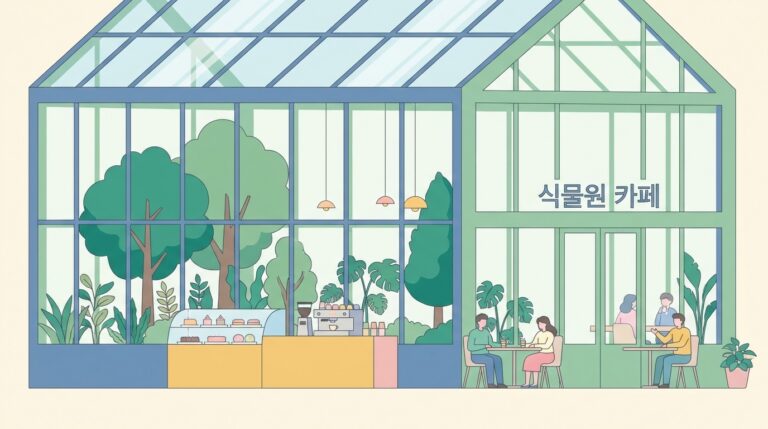
Picture this: You hop into a car on a Saturday afternoon and drive just an hour outside Seoul to Paju or Yangpyeong. You pull up to what looks like a futuristic botanical garden or a five-story modern art museum. You open the massive double doors, and your jaw instantly drops. Lush tropical palms tower over multi-tiered amphitheater seating, a natural indoor waterfall cascades into a stone pond, and right before your eyes lies an endless runway of over fifty freshly baked artisanal breads, cream-stuffed croissants, and glistening salted butter rolls.
Then, reality hits. The place is bustling. Scores of people are carrying multi-story trays, baristas are calling numbers, and you find yourself wondering: Where do I even sit? Do I grab the bread first or hunt down a table on the third floor? Can I really leave my backpack unattended while I order? What do I say when my tray is overflowing?
If you have ever felt completely frozen in a Korean mega bakery cafe (대형 베이커리 카페), you are definitely not alone! Many intermediate learners know how to order an Iced Americano at a tiny franchise in Hongdae, but stepping into Korea’s architectural wonderland cafes requires a whole new set of navigational skills and nuanced vocabulary. Drawing from real experiences shared by our community of global learners, this guide will transform you from an overwhelmed tourist into a savvy cafe connoisseur who claims seats, picks out signature pastries, and navigates self-service stations like a true Seoulite.
Phase 2: Core Expressions in Depth (핵심 표현 3선)
1. 자리 먼저 잡아야 할 것 같아요 (Hangul)
- Pronunciation: [Jari meonjeo jab-aya hal geot gat-ayo] (Sounds like: Jah-ree mun-juh jahb-ah-yah hal gut gah-tah-yo. Tip: Think of ‘jari’ as ‘spot’ and ‘meonjeo’ as ‘first’.)
- Meaning: Literal: “I think we have to catch seats first.” | Real Nuance: “Finding a table is our top priority before we touch the pastry trays.”
- K-Culture Moment: Seen in weekend road trip vlogs and romance K-Dramas whenever couples step into buzzing suburban hotspots with scenic ocean or mountain views.
- Editor’s Insight: The pattern
-아/어야 할 것 같아요(-a/eoya hal geot gat-ayo) softens a strong necessity into a polite, considerate suggestion. Rather than barking an order like “Sit down now,” it invites agreement from your companion. - Situation Spectrum: Casual ✅ | Semi-formal ✅ | Formal ⚠️
- 🤔 Think About It: In many Western countries, hostesses seat you or ordering comes first. In Korean mega cafes, why is “claiming territory” (자리 잡기) the universally accepted first move?
2. 빵 종류가 너무 많아서 못 고르겠어요 (Hangul)
- Pronunciation: [Ppang jongnyuga neomu manhaseo mot goreugesseoyo] (Sounds like: Ppahng jong-nyu-gah nuh-moo mahn-ah-suh moht go-roo-geh-ssuh-yo. Double ‘pp’ sounds tense, like popping a bubble!)
- Meaning: Literal: “There are too many bread types so I cannot choose.” | Real Nuance: “I am completely spoiled for choice; everything looks unreal!”
- K-Culture Moment: That classic moment when a food influencer panics in front of a 30-meter-long pastry bar loaded with garlic baguettes, strawberry brioches, and black sesame buns.
- Editor’s Insight: Notice the use of
못(mot) instead of안(an).못 고르겠어요expresses that your inability to choose is caused by sheer abundance, not a lack of desire to eat! - Situation Spectrum: Casual ✅ | Semi-formal ✅ | Formal 🚫
- 🤔 Think About It: How does your native language express being pleasantly overwhelmed by culinary choices? Does it emphasize frustration or delight?
3. 남으면 자율 포장대에서 싸 가면 돼요 (Hangul)
- Pronunciation: [Nameumyeon jayul pojangdae-eseo ssa gamyeon dwaeyo] (Sounds like: Nahm-eu-myun jah-yool poh-jahng-dae-eh-suh ssah gah-myun dway-yo.)
- Meaning: Literal: “If it remains, we can wrap and go at the autonomous packing table.” | Real Nuance: “Don’t worry if we over-order; we can box up the leftovers ourselves.”
- K-Culture Moment: When friends justify buying five massive pastries for two people by pointing out the self-service packaging counter stocked with wax paper, plastic bags, and string.
- Editor’s Insight: Korean mega cafes avoid customer service bottlenecks by providing a
자율 포장대(self-packaging station). Knowing this word removes the guilt of ordering that giant strawberry loaf! - Situation Spectrum: Casual ✅ | Semi-formal ✅ | Formal ⚠️
- 🤔 Think About It: Self-packaging stations rely entirely on customer autonomy and honesty. What does this reveal about communal trust in public Korean dining spaces?
Phase 3: Textbook Korean vs. Real Korean (교과서 vs. 진짜 한국어)
Situation 1: Asking if a table is occupied
- 📖 교과서 한국어: “이 자리에 앉아도 되겠습니까?” (I jarie anjado doegesseumnikka? / May I sit at this seat?)
- 🗣️ 진짜 한국어: “혹시 여기 자리 있나요?” (Hoksi yeogi jari innayo? / Excuse me, is someone sitting here?)
- 💡 왜 다를까? Textbook Korean sounds like a military officer asking permission. Real Koreans use
혹시(by any chance) with a gentle rising intonation to politely check if an unattended tumbler or jacket means the seat is taken.
Situation 2: Asking the staff what pastry is best
- 📖 교과서 한국어: “어떤 빵이 가장 맛있습니까?” (Eotteon ppangi gajang masisseumnikka? / Which bread is the most delicious?)
- 🗣️ 진짜 한국어: “여기 시그니처 빵이 뭐예요?” (Yeogi sigeunicheo ppangi mwoyeyo? / What is your signature bread here?)
- 💡 왜 다를까? Large bakery cafes always market 2 to 3
시그니처(signature) items that match their architectural concept. Asking for “signature” gets you the cafe’s prized, freshly baked creation rather than a generic recommendation.
Phase 4: K-Culture Deep Dive & Non-Verbal Manners
4-1. 눈치 (Nunchi) & Gestures in Mega Cafes
Navigating a multi-level mega cafe requires high-level 눈치 (social awareness). When scoping out prime window seats overlooking the ocean or indoor arboretum:
* The Personal Belonging Claim: Koreans regularly place water bottles, diaries, tote bags, or even laptops on tables to claim them before walking downstairs to pick bread. If you see an object on a table—even if nobody is there—that seat is taken! Avoid moving anyone’s belongings.
* Two-Hand Tray Grip: Bakery cafe trays are notoriously heavy when loaded with porcelain plates and iced mugs. Always lift trays with both hands, elbows held slightly inward, and nod slightly (목례) as you navigate crowded glass stairwells.
* Tongs Discipline: Never touch pastries with bare hands or return an item to the shelf once your tongs touch it. Use the parchment paper sheets provided next to the tray stack.
4-2. Cultural Code: Suburban Escapism & “Space Branding”
Why did Korea invent massive 4,000-square-meter cafes with indoor forests, art galleries, and reflecting pools? In high-density cities like Seoul, living spaces are compact and apartments dominate the skyline. Mega bakery cafes, usually located in Gyeonggi-do or coastal cities, function as “suburban living rooms” and day-cation destinations (드라이브 코스). For younger generations, these spaces are architectural playgrounds built for 인스타 감성 (Instagram aesthetic), where the physical environment itself is the primary consumer product.
Phase 5: Real-Life Roleplay Scenario
Setting: “Cafe Verde Botanica,” a massive 3-story glasshouse bakery cafe in Paju filled with palm trees and bubbling brooks.
Characters:
* Sora: Your trend-savvy Korean bestie with an eagle eye for great pastries.
* You: An intermediate Korean learner ready to conquer the pastry aisle.
[Scene: Walking past the grand glass entrance into an echoing, sunlit jungle cafe.]

소라: 와, 주말이라 사람 진짜 많다! 너 빵 먼저 담을래, 아니면 자리부터 잡을래?
(Wa, jumal-ira saram jinjja manta! Neo ppang meonjeo dameullae, animyeon jaributeo jabeullae?)
"Wow, it's the weekend so there are so many people! Do you want to grab pastries first, or find seats first?"
🎭 [Points toward the packed 2nd-floor terrace]

나: 사람 많은 거 보니까 자리 먼저 잡아야 할 것 같아.
(Saram maneun geo bonikka jari meonjeo jab-aya hal geot gata.)
"Seeing all these people, I think we should secure seats first."
🎭 [Glances upstairs looking for open spots]

소라: 역시 센스 있네! 저기 2층 창가 자리에 내 가방 두고 올 테니까, 넌 1층에서 트레이 챙겨줘!
(Yeoksi senseu inne! Jeogi icheung changga jarie nae gabang dugo ol tenikka, neon ilcheung-eseo teurei chaenggyeojwo!)
"You've got great instincts! I'll go leave my bag at that 2nd-floor window table, so grab a tray on the 1st floor!"
🎭 [Rushes up the glass staircase]

나: 알겠어! 집게랑 유산지도 깔아서 기다릴게.
(Algesseo! Jipgerang yusanjido kkaraseo gidarilge.)
"Got it! I'll lay down the parchment paper with the tongs and wait."
🎭 [Neatly places paper on two wooden trays]

[Sora returns after securing the window seats]

소라: 자리 맡았어! 자, 이제 본격적으로 골라보자. 여기 소금빵이랑 대파 크림치즈 베이글이 시그니처래.
(Jari matasseo! Ja, ije bongyeokjeogeuro gollaboja. Yeogi sogeumppang-irang daepa keurimchijeu beigeur-i sigeunicheorae.)
"Got the seats! Alright, let's start picking. They say the salt bread and scallion cream cheese bagel are their signatures here."
🎭 [Eyes glittering as she surveys the pastry display]

나: 빵 종류가 너무 많아서 다 먹고 싶어. 우리 너무 많이 담는 거 아니야?
(Ppang jongnyuga neomu manhaseo da meokgo sipeo. Uri neomu mani damneun geo aniya?)
"There are so many kinds of bread, I want to eat everything. Aren't we putting too much on our tray?"
🎭 [Holding tongs hesitantly over a gigantic mont blanc pastry]

소라: 괜찮아, 남으면 자율 포장대에서 싸 가면 돼! 먹고 싶은 거 다 골라!
(Gwaenchana, nameumyeon jayul pojangdae-eseo ssa gamyeon dwae! Meokgo sipeun geo da golla!)
"It's fine! If anything is left, we can just pack it up at the self-packaging bar! Pick whatever you want!"
🎭 [Giggles and picks up another seasonal fruit pastry]

나: 좋아! 그럼 먹고 남은 건 내가 챙겨갈게.
(Joa! Geureom meokgo nameun geon naega chaenggyeogalke.)
"Awesome! In that case, I'll take home whatever we can't finish."
🎭 [Confidently places the pastry onto the tray with a smile]
🔀 Interactive Decision Point
After filling your tray, you realize the drink order line has 15 people waiting. What do you do?
- Option A: Put your bread on the pickup counter immediately and shout your drink order.
Feedback: Bad! Bakery cafes process pastries and drinks together at the main register (POS). Cutting the line will earn frowns from staff and customers. - Option B: Tell Sora: “음료 줄 서 있는 동안 빵 계산 먼저 되나 물어볼까?” (Should we ask if bread can be paid first while waiting?)
Feedback: Risk! Some mega cafes have separated checkout stations for bakery vs. drinks, but most ring them up together. Checking signs on the floor is safer before asking. - Option C: Stay in line together with the tray, wait for your turn at the POS, and say: “빵이랑 아이스 아메리카노 두 잔 결제해 주세요.” (Please ring up the bread and two iced Americanos.)
Feedback: Best! Perfect, standard etiquette. You register both bakery items and drinks at the cashier, pay once, take your bakery tray with you, and receive a vibrating pager (진동벨) for your drinks!
Phase 6: 10-Second Emotion Shadowing Drill
Speak these lines aloud! Follow the slash marks (/) for natural breath breaks and channel the emotion tags.
[😲 감탄하며 - Awestruck & Mesmerized]
“와… / 빵 종류가 너무 많아서 / 진짜 못 고르겠어요!”
(Wa… / ppang jongnyuga neomu manhaseo / jinjja mot goreugesseoyo!)-
[🏃♀️ 다급하고 다정하게 - Urgent Yet Considerate]
“사람 몰리기 전에 / 우리 자리 먼저 잡아야 / 할 것 같아요!”
(Saram molligi jeone / uri jari meonjeo jab-aya / hal geot gat-ayo!) -
[😌 안도하며 여유롭게 - Relieved & Carefree]
“걱정하지 마세요 / 남으면 자율 포장대에서 / 싸 가면 돼요!”
(Geokjeonghaji maseyo / nameumyeon jayul pojangdae-eseo / ssa gamyeon dwaeyo!)
Phase 7: K-Culture Mini Dictionary
- 대형 카페 (Daehyeong Kape): Mega / Large-scale Cafe. Refers to multi-level architectural complexes located mostly in the suburbs, featuring gardens, lakes, or galleries.
- 뷰 맛집 (Byu Matjib): View Gourmet / Spot with a View. A playful compound of “View” and “Famous Eatery (맛집).” Used when the panoramic landscape or interior garden is just as delicious as the food.
- 빵지순례 (Ppangji-sunrye): Pastry Pilgrimage. A blend of
빵(bread) and성지순례(pilgrimage). Describes traveling across cities specifically to visit legendary bakeries. - 자율 포장대 (Jayul Pojangdae): Self-packaging Station. The dedicated corner equipped with disposable boxes, plastic gloves, bakery paper bags, and tape where guests package their own uneaten pastries.
Phase 8: Traveler’s Survival Kit
Survival TOP 3 Expressions
- 1. 자리 맡아 두셨나요? (Jari mata dusyeonnayo? / Have you claimed this seat?)
- Pro Tip: Use this when you find a prime table with just an umbrella or notebook on it to double-check with nearby diners.
- 2. 따뜻하게 데워 먹을 수 있나요? (Ttatteuthage deowo meogeul su innayo? / Can I heat this up?)
- Pro Tip: Many mega cafes have commercial toasters or microwaves at the self-bar so you can warm up hard breads and croissants.
- 3. 진동벨 울리면 가지러 갈게요. (Jindongbel ullimyeon gajireo galgeyo. / I will pick it up when the buzzer rings.)
- Pro Tip: Mega cafe drinks take 10–20 minutes on weekends. Find your seat first and descend only after the pager vibrates!
Editor’s Travel Note
- Transportation: Most mega bakery cafes are outside central subway grids. Search for your cafe on the Naver Map navigation app and check parking lot capacity (
주차장 여부) or weekend bus routes before heading out. - Timing: Visit on weekday afternoons (2 PM – 4 PM) or before 11:30 AM on weekends. By 1:30 PM on a sunny Sunday, lines for signature pastries can wrap around the building!
Phase 9: Step Deeper (한 발 더 깊이)
In Korean society, mega cafes represent far more than a caffeine fix. They are modern monuments to the “Third Place” (제3의 공간)—a social surrounding separate from the two primary environments of home and workplace. Because rapid urban modernization prioritized dense apartment complexes over expansive private backyards, suburban mega cafes stepped in to fulfill the collective desire for green open spaces, art, and nature. When you visit a mega cafe, you aren’t just buying coffee and bread; you are temporarily renting a serene botanical sanctuary and escaping high-pressure city rhythms.
💬 Your Turn: Have you ever visited a cafe that felt like an entire amusement park or museum? Which pastry would you grab first—savory garlic cheese bread or sweet strawberry cream croissant? Tell us in the comments below!
Phase 10: FAQ & Common Mistakes
Q: Can I really leave my laptop or purse on a cafe table to save my seat in Korea?
A: Yes, it is standard practice across South Korea due to the exceptionally low rate of opportunistic street theft. However, for peace of mind, leaving a less critical item like a jacket, water bottle, or notebook while keeping your passport and wallet on you is the smartest approach.
Q: Do mega bakery cafes require one drink per person (1인 1음료)?
A: Almost all Korean cafes enforce the 1인 1음료 (one drink per person) policy. Even if you purchase 40,000 KRW worth of pastries, the cashier will still gently expect each adult to order at least one beverage.
Q: What should I do with my empty plates and mugs when leaving?
A: Look for the counter labeled 반납대 (Bannapdae) or Return. Do not leave your dirty tray on the table. Separate leftover liquids, return glass mugs to their designated racks, and place your wooden trays on the shelf.
🚨 Common Mistakes Alert
- Mistake: Handing pastries back to the baker after picking them up with tongs.
Correct Action: Once food hits your tray, it is considered sold for sanitary reasons. Choose with your eyes first before reaching out with tongs. - Mistake: Asking the cashier to pack your three leftover croissants.
Correct Action: Head over to the자율 포장대(self-service packing corner). Take a paper bag, pack it neatly yourself, and save time for everyone! - Mistake: Waiting near the busy pickup counter for your drinks.
Correct Action: Take your buzzing pager (진동벨) directly to your table. Signals reach across all floors and outdoor garden patios!
Phase 11: Action Mission & Engagement
- 🥉 Bronze Mission: Practice saying the shadowing drill sentence “빵 종류가 너무 많아서 못 고르겠어요!” out loud three times until you can say it in under 4 seconds.
- 🥈 Silver Mission: Open your Instagram or YouTube search bar and look up the tag
#대형베이커리카페. Pick one cafe that catches your eye and write down its name in Hangul in your study notebook. - 🥇 Gold Mission: On your next trip to Korea (or at a local Korean bakery), ask the clerk: “여기 시그니처 빵이 뭐예요?” (What is the signature bread here?) and order their recommendation!
🎮 K-Culture Challenge: Watch an episode of a Korean weekend travel show (like Omniscient Interfering View or Amazing Saturday) and spot how celebrities react when entering a bakery. Listen for words like 대박 (daebak), 시그니처 (signature), and 포장 (takeout).
Phase 12: Interactive Quiz Challenge
Test your mega cafe mastery! Can you get all three correct?
1. Situational Judgment:
You walk into a 4-story botanical bakery cafe on Saturday at 2:00 PM. The ground floor is packed with 100 people. What is the most strategic first step?
(A) Grab tongs and pile five pastries onto your tray.
(B) Say “자리 먼저 잡아야 할 것 같아요” and send someone upstairs to find a table.
(C) Stand in the drink pickup line and wait for a barista to seat you.
2. Fill in the Blank:
빵이 많이 남았어요. 저기 ______에서 봉투에 담아 가요.
(We have a lot of bread left over. Let’s pack it in a bag over at the ______.)
(A) 반납대 (Bannapdae)
(B) 주문대 (Jumundae)
(C) 자율 포장대 (Jayul pojangdae)
3. True or False (Culture Check):
In Korean mega bakery cafes, if you order three expensive loaves of bread for two people, you can skip ordering drinks altogether.
(True / False)
👉 Click to reveal answers and explanations!
- Answer: (B)
Explanation: Mega cafes operate on a self-seating model. On busy weekends, you could end up holding a heavy tray of pastries for 30 minutes with nowhere to sit if you don’t secure your table first! -
Answer: (C) 자율 포장대 (Jayul pojangdae)
Explanation:자율 포장대is the self-packaging station where guests can box or bag their uneaten treats.반납대is the return counter, and주문대is the order counter. -
Answer: False
Explanation: Most cafes maintain a strict1인 1음료(one drink per person) rule to maintain the huge facility, regardless of how much bakery food you purchase.
🎬 Watch Our Daily Videos! (Daily Hangul Official Instagram)
Review the expressions you learned in this article with our fun daily short videos! Check out native pronunciation and real-life nuances in action.
- Instagram @dailyhangul_en







