

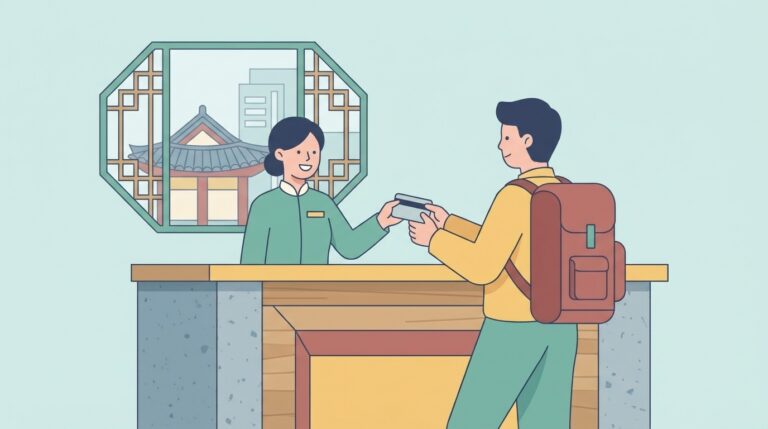
Check Out Like a Local: How to Say Your Stay Was Comfortable in Korean
Phase 1: Empathy & Narrative Opening
안녕하세요! 매일한글 에디터입니다. (Hello! I’m your Daily Hangul editor.) Have you ever watched a heartwarming K-drama where the lead character checks out of a charming traditional hanok stay or a sleek Seoul hotel, exchanging a warm, genuine smile with the host? In real life, however, hotel checkout can feel unexpectedly tense. Picture this: you are standing before the sleek front desk in Myeongdong, holding your room keycard. You truly had the sweetest sleep, and the concierge went out of their way to call you a taxi when it was pouring rain. You want so badly to express your heartfelt gratitude, but anxiety strikes. You end up sliding the key across the marble counter with a hushed “Thank you” and scurrying out the door.
You are not alone! In fact, over 80% of our beginner students share that leaving a hotel feels awkwardly transactional because they freeze up. But learning just one natural, warm sentence will instantly bridge that gap. Based on real feedback from dozens of our A1 travelers, this guide is designed to transform that awkward checkout into an unforgettable, genuine cultural connection.
Phase 2: Top 3 Core Expressions Breakdown
1. 숙박하는 동안 정말 편안했어요. (Sukbakhaneun dongan jeongmal pyeon-anhaesseoyo.)
- Pronunciation: sook-bahk-ha-neun dong-ahn jung-mahl pyun-ahn-hae-ssuh-yo (Think of “jung-mahl” like the English word “jungle” without the “le”, and “pyeon-an” like a smooth, gentle sigh: pyun-ahn).
- Meaning: Literal: “During my stay, it was really comfortable.” / Real Nuance: “I had a wonderful, truly relaxing stay here.”
- K-Culture Moment: The polite female lead in King the Land checking out of a luxury resort suite with a polite, gracious smile.
- Editor’s Insight: This sentence sounds elegant yet completely natural for a hotel guest. “숙박” (sukbak) is the formal term for lodging, making you sound surprisingly polished even as a beginner.
- Situation Spectrum: Casual 🚫 / Semi-formal ✅ / Formal ✅
- 🤔 Think About It: In English, we often say “I had a great stay!” centered around I. In Korean, notice how the subject “I” disappears, focusing instead on the state of comfort (편안했어요) experienced during the time spent.
2. 편하게 잘 쉬다 가요. (Pyeonhage jal swida gayo.)
- Pronunciation: pyun-ha-geh jahl swee-dah gah-yo (“Swida” sounds like a quick “swy-da” with the “sw” from “switch”).
- Meaning: Literal: “I rest well comfortably and leave.” / Real Nuance: “Thank you for having me; I got plenty of rest!”
- K-Culture Moment: A guest leaving a cozy countryside guesthouse in Hometown Cha-Cha-Cha, thanking the warm host.
- Editor’s Insight: This is warmer, friendlier, and slightly more conversational than expression #1. It’s the gold standard for Airbnbs, boutique hotels, and guesthouses.
- Situation Spectrum: Casual ⚠️ / Semi-formal ✅ / Formal ⚠️
- 🤔 Think About It: Why does Korean explicitly say “rest and leave” (쉬다 가요)? Korean culture values restful peace (쉼) as one of the ultimate gifts a host can provide a weary traveler.
3. 체크아웃 부탁드립니다. (Chekeuaut butakdeurimnida.)
- Pronunciation: check-eu-out boo-tahk-deu-rim-nee-dah (Direct loanword “checkout” followed by the polite magic phrase boo-tahk-deu-rim-nee-dah).
- Meaning: Literal: “I request check-out.” / Real Nuance: “I’d like to check out, please.”
- K-Culture Moment: Business travelers in corporate K-dramas quickly handing over their access cards at a 5-star hotel.
- Editor’s Insight: “부탁드립니다” (butakdeurimnida) is your golden phrase across all of South Korea. It softens every request into a polite, respectful appeal.
- Situation Spectrum: Casual 🚫 / Semi-formal ✅ / Formal ✅
- 🤔 Think About It: Instead of commanding “Check me out,” this phrase literally entrusts the favor to the listener, establishing immediate harmony.
Phase 3: Textbook Korean vs. Real Korean
Situation A: Initiating your checkout
- 📖 교과서 한국어 (Textbook): 저는 지금 체크아웃을 하고 싶습니다. (Jeoneun jigeum chekeuauteul hago sipseumnida. / “I want to do check-out now.”)
- 🗣️ 진짜 한국어 (Real-life): 체크아웃 부탁드려요! (Chekeuaut butakdeuryeoyo! / “Check-out, please!”)
- 💡 왜 다를까? (Why is it different?): Native speakers drop unnecessary self-references like “저는” (I) and prefer light request endings (부탁드려요) over stiff declarations of personal desire (~하고 싶습니다).
Situation B: Saying the room was comfortable
- 📖 교과서 한국어 (Textbook): 호텔 시설이 매우 만족스러웠습니다. (Hotel siseori maeu manjokseureowosseumnida. / “The hotel facilities were very satisfactory.”)
- 🗣️ 진짜 한국어 (Real-life): 정말 편하게 잘 쉬었어요! (Jeongmal pyeonhage jal swieosseoyo! / “I really rested so well!”)
- 💡 왜 다를까? (Why is it different?): Textbook phrases sound like corporate customer satisfaction surveys. Everyday Korean focuses on warmth, personal rest, and gratitude.
Phase 4: K-Culture Deep Dive & Non-Verbal Manners
4-1. 눈치 (Nunchi) & Two-Hand Etiquette
In Korea, hands speak as loudly as words! When you return the room key card, never flip or slide it across the counter with one hand.
* Hold the card with both hands (or place your left hand gently under your right wrist/forearm).
* Make soft eye contact, bow your head slightly (around 15 degrees), and deliver your phrase.
This effortless gesture instantly conveys high emotional intelligence (눈치, Nunchi) and earns immediate respect from hospitality staff.
4-2. The “Hocance” (호캉스) & Jeong (정) Culture
Korea has a vibrant culture of Hocance (호텔 + 바캉스 / Hotel + Vacance), where people book hotels purely to unwind, order room service, and heal (힐링). Because hotel workers take pride in curating a rejuvenating sanctuary, telling them you felt comfortable (편안했어요) acknowledges their hard work. It taps into Jeong (정)—the unique Korean bond of warm empathy between human beings.
Phase 5: Real-World Roleplay Scenario
Setting: 11:00 AM. Front Desk of the stylish ‘Hotel Namsan Forest’.
Characters:
* Minji (Front Desk Manager): Polished, attentive, wearing a friendly smile.
* Alex (You): An A1 traveler ready to conclude a wonderful stay.
- Minji: 안녕하세요! 체크아웃 도와드릴까요? (Annyeonghaseyo! Chekeuaut dowadeurilkkayo? / “Hello! May I help you check out?”)
🎭 Smiling warmly and extending both hands. - Alex: 네, 체크아웃 부탁드려요. (Ne, chekeuaut butakdeuryeoyo. / “Yes, check-out, please.”)
🎭 Hands the card key with both hands. - Minji: 네, 확인되었습니다. 룸 넘버 702호 맞으시죠? (Ne, hwagindoeeotseumnida. Rum neombeo chilbaegiho majeosijyo? / “Yes, confirmed. Room 702, correct?”)
🎭 Tapping the keyboard smoothly. - Alex: 네, 맞아요. (Ne, majayo. / “Yes, that’s right.”)
🎭 Nodding lightly. - Minji: 숙박하시는 동안 불편한 점은 없으셨나요? (Sukbakhasineun dongan bulpyeonhan jeomeun eopseosyeonnayo? / “Was there anything uncomfortable during your stay?”)
🎭 Looking up attentively. - Alex: 아니요! 숙박하는 동안 정말 편안했어요. (Aniyo! Sukbakhaneun dongan jeongmal pyeon-anhaesseoyo. / “No! It was very comfortable during my stay.”)
🎭 Beaming with a polite 15-degree head bow. - Minji: 정말 다행이네요! 좋게 말씀해 주셔서 감사합니다. (Jeongmal dahaengineyo! Joke malsseumhae jusyeoseo gamsahamnida. / “What a relief! Thank you so much for your kind words.”)
🎭 Bowing in return with genuine delight. - Alex: 덕분에 잘 쉬다 가요. 감사합니다! (Deokbune jal swida gayo. Gamsahamnida! / “Thanks to you, I rested well. Thank you!”)
🎭 Picking up luggage, waving softly.
🔀 Interactive Branching Choice
When Minji asks: “숙박하시는 동안 불편한 점은 없으셨나요?” (Was there anything uncomfortable?),
how will you respond?
- Option A: “숙박하는 동안 정말 편안했어요!” (Sukbakhaneun dongan jeongmal pyeon-anhaesseoyo!)
- Outcome: 🌟 Best Choice! Clear, natural, and exceedingly polite. Minji will be touched by your compliment.
- Option B: “응, 좋아.” (Eung, joa.)
- Outcome: ⚠️ Risk! This is informal panmal (반말). Using this with staff sounds dismissive and rude, even if your intention was positive.
- Option C: “방이 너무 작았어요.” (Bangi neomu jagasseoyo. / “The room was way too small.”)
- Outcome: 🚫 Bad Choice! Unless you are lodging an official complaint, blunt criticism at checkout breaks harmony. If you had a good stay, stick to warm words!
Phase 6: 10-Second Emotion Shadowing Drill
Train your muscle memory with these rhythmic voice cues. Pause briefly at every slash (/).
[😊 Warm & Grateful]
숙박하는 동안 / 정말 / 편안했어요!
(Sukbakhaneun dongan / jeongmal / pyeon-anhaesseoyo!)-
[🌿 Relaxed & Heartfelt]
편하게 / 잘 쉬다 / 가요.
(Pyeonhage / jal swida / gayo.) -
[✨ Polite & Crisp]
체크아웃 / 부탁드립니다!
(Chekeuaut / butakdeurimnida!)
Phase 7: K-Culture Mini Dictionary
- 체크아웃 (Chekeu-aut) | Check-out
An easy Konglish term universally understood in all hotels, motels, and resorts across Korea. - 호캉스 (Hocance) | Hotel staycation
A trendy portmanteau of “hotel” and “vacance.” It refers to spending an entire weekend relaxing inside a nice hotel. - 룸 키 (Rum ki) | Room keycard
Often used interchangeably with “카드 키” (kadeu ki). Hand this over when checking out. - 보증금 (Bojeunggeum) | Deposit / Pre-authorization
The incidental hold placed on your credit card upon check-in, automatically released upon check-out.
Phase 8: Survival Kit for Travelers
Top 3 Survival Phrases
- 짐 좀 맡겨도 될까요? (Jim jom matgyeodo doelkkayo?)
Pro Tip: “Can I leave my luggage here?” Use this if your flight leaves late in the evening! - 택시 한 대 불러주실 수 있나요? (Taeksi han dae bulleojusil su innayo?)
Pro Tip: “Could you call a taxi for me?” Great when Kakao T is busy during rush hour. - 영수증 주세요. (Yeongsujeung juseyo.)
Pro Tip: “Please give me the receipt.” Essential for tax refunds and travel budgets.
Editor’s Travel Note
- Before exploring the city after checkout, ensure you have set up your trip with our recommended Naver Map navigation setup guide since Google Maps has limited pedestrian routing in South Korea.
- If you need transit funds right after checkout, check out our T-money transportation card top-up tutorial to breeze onto the subway effortlessly.
Phase 9: “One Step Deeper” (Cultural Reflection)
In Western cultures, checkouts are frequently brief, functional transactions: you drop the key in a drop box and slip out the revolving door. In Korea, however, human relations (인간관계) place deep emphasis on closure (마무리). How you leave a place defines the memory you leave behind. Expressing that you were comfortable (편안했어요) is not merely small talk; it is an acknowledgment of the unseen labor of cleaners, front desk clerks, and hospitality workers who ensured your safety in a foreign country.
💬 Your Turn: What is the most memorable hotel experience you have ever had? How would you describe that comfort in your native language compared to Korean? Tell us in the comments below!
Phase 10: FAQ & Common Mistakes
Q: Can I just say “감사합니다” (Gamsahamnida) and leave?
A: Absolutely! “감사합니다” is always polite. However, adding “정말 편안했어요” (It was really comfortable) changes your interaction from a generic greeting into a personal, memorable compliment that will genuinely make the staff’s day.
Q: What if I stay at a guesthouse or Airbnb with an older host?
A: In that case, phrase #2: “편하게 잘 쉬다 가요!” (Pyeonhage jal swida gayo!) sounds even more touching and warm than the formal phrase #1.
Q: How do I reply if the staff asks “어디로 가세요?” (Where are you heading)?
A: Simply state your next destination + “~에 가요” (e gayo). For example: “공항에 가요” (Gonghange gayo / I’m heading to the airport).
🚨 Common Mistakes Alert
- Mistake: Sliding the keycard with one hand while looking at your phone.
Correct Action: Keep your phone in your pocket, hold the card with both hands, and offer a gentle nod. - Mistake: Saying “숙박 좋아” (Sukbak joa) to staff.
Correct Action: Never drop the polite ending “-요” (-yo). Always say “정말 좋았어요!” (Jeongmal joasseoyo!). - Mistake: Using “잘 잤어요” (I slept well) directly to hotel staff.
Correct Action: While grammatically correct, “잘 잤어요” is overly intimate and used mostly between family and couples. Use “잘 쉬었어요” (I rested well) instead.
Phase 11: Action Missions
- 🥉 Bronze Mission (Solo Shadowing): Stand in front of your mirror, hold a plastic card with two hands, and say “숙박하는 동안 정말 편안했어요” 3 times out loud with a smile.
- 🥈 Silver Mission (Social Share): Post a travel photo of a hotel or cozy room on Instagram or Threads and caption it: “편하게 잘 쉬다 가요! 🌿 #DailyHangul #LearnKorean”.
- 🥇 Gold Mission (Real-Life Challenge): On your next stay at a hotel or Airbnb in Korea, deliver this exact compliment to the front desk agent upon checking out.
- 🎮 K-Culture Mission: Watch an episode of a slice-of-life K-drama (like Hospital Playlist or Summer Strike) and listen for instances where characters say 잘 쉬어 or 쉬다 가요.
Phase 12: Interactive Quiz Challenge
1. Situational Judgment
You are checking out of a boutique hotel in Busan. The concierge asks if you had any trouble during the night. You slept peacefully. Which phrase is the most natural and polite?
* A) 체크아웃 해줘. (Chekeuaut haejwo.)
* B) 숙박하는 동안 정말 편안했어요. (Sukbakhaneun dongan jeongmal pyeon-anhaesseoyo.)
* C) 방이 매우 잤습니다. (Bangi maeu jasseumnida.)
👉 View Answer & Explanation
Correct Answer: B
Explanation: B is the ideal polite phrase. Option A is in informal, rude speech (반말). Option C is nonsensical because rooms cannot ‘sleep’!
2. Fill-in-the-Blank
Fill in the missing word for checking out smoothly:
“체크아웃 ________.” (Please check me out.)
* A) 부탁드립니다 (butakdeurimnida)
* B) 하지마세요 (hajimaseyo)
* C) 없어요 (eopseoyo)
👉 View Answer & Explanation
Correct Answer: A
Explanation: “부탁드립니다” means “please / I kindly request.” “하지마세요” means “don’t do it,” and “없어요” means “there isn’t.”
3. Cultural True or False
True or False: When handing your room key card back to the receptionist at checkout, it is considered polite and respectful in Korean culture to hand it over using both hands while making slight eye contact.
👉 View Answer & Explanation
Correct Answer: True
Explanation: Using two hands shows respect, gratitude, and good manners (예의) across all daily interactions in Korea.
🎬 Watch Our Daily Videos! (Daily Hangul Official Instagram)
Review the expressions you learned in this article with our fun daily short videos! Check out native pronunciation and real-life nuances in action.
- Instagram @dailyhangul_en







