

Master Shopping at Korean Pop-Up Stores: How to Snag Limited-Edition Merch
Phase 1: 공감 (Story-Driven Opening)
안녕하세요! 매일한글 에디터입니다.
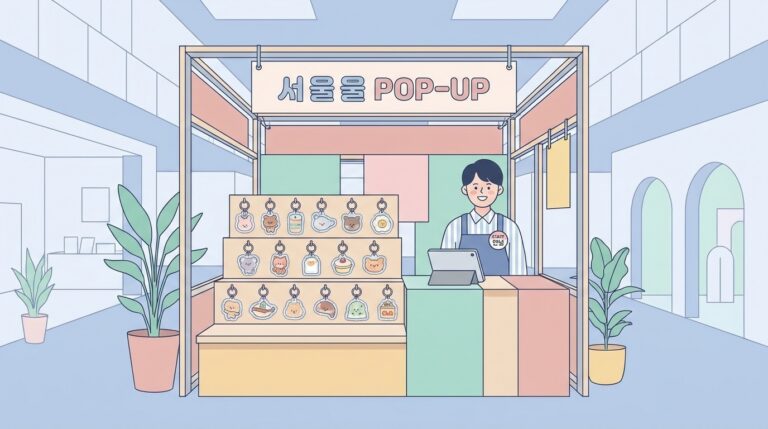
Picture this: You are standing in the basement level of The Hyundai Seoul, surrounded by eye-popping pastel neon signs, life-sized character standees, and a line winding around the corner. You waited forty minutes through a reservation queue just to enter this exclusive K-pop idol collaboration pop-up store. Your heart races as you spot the holy grail on the display shelf: a plush, limited-edition acrylic keyring with glitter details.
You pick up three of them—one for yourself and two for your best friends back home who pleaded with you over text. But when you step up to the counter, the friendly staff member crosses their arms gently in an ‘X’ and speaks quickly in polite Korean. You freeze. Did you do something wrong? Are they out of stock?
Don’t panic! You didn’t break any laws—you just encountered Korea’s strict pop-up purchase limit policy! Pop-up stores in trend hotspots like Seongsu-dong, Hongdae, and Yeouido release hyper-exclusive merchandise, and to prevent scalpers from clearing out the shelves, they enforce strict limits per customer.
Learning how to ask about purchase limits and exclusive items turns an anxious register moment into a smooth, victorious shopping conquest. Based on real feedback from hundreds of our A2 learners navigating Seoul’s bustling shopping districts, this guide is designed to give you the exact sentences, cultural nunchi, and confidence you need to secure your favorite goodies without breaking a sweat.
Phase 2: 핵심 표현 3선 심층 분석 (Top 3 Key Expressions)
1. 이번 팝업에서만 파는 한정판 키링이에요
- Pronunciation: Ibeon pab-eob-eseoman paneun hanjeongpan kiring-ieyo. (Sound analogy: Think ee-beon like ‘e-bike’, pab-eob like ‘pop-up’, han-jeong-pan like ‘Han Solo’ + ‘jung-le’ + ‘pan’.)
- Meaning: Literal: “It is a limited-edition keyring sold only at this pop-up.” / Nuance: “This keyring is an exclusive item you can only get right here, right now.”
- K-Culture Moment: Seen frequently in K-lifestyle vlogs and idol behind-the-scenes content when members tour their own merch booths and brag about exclusive goodies.
- Editor’s Insight: Notice the small particle -만 (-man) attached to 팝업에서 (pab-eob-eseo). In Korean, adding -만 means “only.” It turns a regular location into an exclusive, VIP-only spot.
- Situation Spectrum:
- Casual (to friends): ⚠️ (Use 반말: 이번 팝업에서만 파는 한정판 키링이야)
- Semi-formal (Staff/Shopping): ✅ (Standard polite form -이에요/-예요)
- Formal (Broadcast/Announcements): 🚫 (Use 입니다 form)
- 🤔 Think About It: In English, we often rely on flashy buzzwords like “VIP drop” or “collab-only.” In Korean, compound nouns like 한정판 (hanjeongpan – limited edition) convey immense prestige with just three syllables. What kind of items make you wait in line for hours?
2. 1인당 2개까지 살 수 있어요
- Pronunciation: Iring-dang du-gae-kkaji sal su isseoyo. (Sound analogy: I-ring sounds like ‘ear-ring’, dang rhymes with ‘gong’, kkaji sounds like a snappy ‘cah-jee’.)
- Meaning: Literal: “Per 1 person, up to 2 items can be bought.” / Nuance: “There is a purchase limit of two per person.”
- K-Culture Moment: The polite response every store clerk gives when K-drama characters or shoppers try to hoard limited-edition designer or idol items.
- Editor’s Insight: The pattern [Number]인당 ([number]-in-dang) means “per person,” and -까지 (-kkaji) means “up to / until.” Coupled with the essential A2 beginner grammar -(을)수 있어요 (can do), this is the golden formula for understanding buying rules.
- Situation Spectrum:
- Casual: ⚠️ (1인당 2개까지 살 수 있어)
- Semi-formal: ✅ (Perfect for clerks and customers alike)
- Formal: ✅ (1인당 2개까지 구매 가능하십니다)
- 🤔 Think About It: Why do Korean pop-ups enforce such strict personal limits rather than letting whoever arrives first buy everything? It reflects a cultural emphasis on fairness (gongjeong) among fans.
3. 이거 품절인가요?
- Pronunciation: Igeo pumjeol-ingayo? (Sound analogy: pum rhymes with ‘room’, jeol rhymes with ‘yule’.)
- Meaning: Literal: “Is this sold out?” / Nuance: “Excuse me, is this item out of stock?”
- K-Culture Moment: Heard constantly outside Seongsu bakeries selling viral Dubai chocolates or pop-up stands during midday rush.
- Editor’s Insight: The word 품절 (pumjeol) specifically applies to merchandise or food that has run out of stock. Asking with -인가요? (-ingayo?) softens your question, making you sound gentle, respectful, and native-level natural.
- Situation Spectrum:
- Casual: ⚠️ (이거 품절이야?)
- Semi-formal: ✅ (Extremely natural and polite in stores)
- Formal: ✅ (이 제품 품절입니까?)
- 🤔 Think About It: Notice how soft -인가요? sounds compared to a direct -입니까?. Korean politeness often leans into gentle questioning rather than blunt inquiries.
Phase 3: 교과서 한국어 vs 진짜 한국어 (Textbook vs. Real-Life Korean)
Situation 1: Asking if there is a limit on how many you can buy
- 📖 교과서 한국어 (Textbook): 이 상품의 1인당 구매 제한 수량이 얼마입니까? (I sangpum-ui iring-dang gumae jehan suryang-i eolma-imnikka? – “What is the purchase limit quantity per person for this commodity?”)
- 🗣️ 진짜 한국어 (Real-Life): 이거 1인당 몇 개까지 돼요? (Igeo iring-dang myeot gae-kkaji dwaeyo? – “How many of these can I get per person?”)
- 💡 왜 다를까? (Why is it different?): Textbook Korean overuses heavy Sino-Korean vocabulary (구매 제한 수량). Native speakers replace complex administrative phrasing with the everyday helper verb 돼요? (Is it allowed / Does it work?).
Situation 2: Checking if an item is completely gone
- 📖 교과서 한국어 (Textbook): 모든 물건이 매진되었습니다. (Modeun mulgeon-i maejin-doe-eotseumnida. – “All goods have been sold out.”)
- 🗣️ 진짜 한국어 (Real-Life): 오늘 수량은 다 나갔어요. (Oneul suryang-eun da nagasseoyo. – “Today’s stock is all gone.”)
- 💡 왜 다를까? (Why is it different?): Pop-up stores restock daily! Clerks will rarely say a permanent “all sold out forever” (매진); they will warmly say it “all went out for today” (다 나갔어요).
Phase 4: K-Culture 딥다이브 & 비언어적 매너 (Deep Dive & Manners)
4-1. 눈치 (Nunchi) & Gestures at the Counter
When shopping at Korean department store pop-ups, non-verbal cues speak louder than words:
* The Two-Finger Check: If you aren’t sure of the limit, hold up two fingers with a polite head tilt and ask: “두 개 돼요?” (Du gae dwaeyo? / Can I get two?). It’s universally understood and polite.
* Two-Handed Hand-off: When handing your payment card or receiving fragile goods, always use both hands (or touch your left hand to your right forearm). Handing a card over with one casual flick comes across as dismissive.
* Basket Etiquette: Many pop-ups hand you a shopping tote upon entry. Keep your items neatly inside until the cashier scans them one by one. Do not dump them on the counter all at once.
4-2. Cultural Code: The “Open Run” (오픈런) Phenomenon
Why are purchase limits so fiercely guarded in Korea? Enter the world of 오픈런 (Open Run)—sprinting into department stores the second the doors unlock at 10:30 AM. From limited K-pop character keyrings to viral pastry brand collabs, limited-edition items carry immense social currency on Instagram and TikTok. To give every eager fan a fair shot and combat black-market scalpers (되팔이, doepal-i), Korean pop-ups place strict caps on items, especially small, viral accessories like keyrings, stickers, and photo-card binders.
Phase 5: 실전 롤플레이 시나리오 (Real-Life Roleplay)
Setting: Basement 2 Pop-Up Zone at a trendy Yeouido department store. Neon banners glow, music plays, and the friendly store clerk Minji stands behind the checkout counter with a barcode scanner.
- Turn 1 (Shopper): 저기요, 이 키링 진짜 귀여워요! 이번 팝업 한정판 맞아요? (Jeogiyo, i kiring jinjja gwiyeowoyo! Ibeon pab-eob hanjeongpan maj-ayo? – 🎭 Pointing with sparkly eyes at the acrylic keyring display. “Excuse me, this keyring is so cute! Is it really this pop-up’s limited edition?”)
- Turn 2 (Clerk Minji): 네, 맞아요! 이번 팝업에서만 파는 한정판 키링이에요. (Ne, maj-ayo! Ibeon pab-eob-eseoman paneun hanjeongpan kiring-ieyo. – 🎭 Nodding with a bright smile. “Yes, that’s right! It’s a limited-edition keyring sold only at this pop-up.”)
- Turn 3 (Shopper): 와, 대박! 그럼 이거 세 개 살게요. (Wa, daebak! Geureom igeo se gae salgeyo. – 🎭 Enthusiastically picking up three keyrings and setting them on the counter. “Wow, awesome! Then I will buy three of these.”)
- Turn 4 (Clerk Minji): 아, 고객님 죄송하지만 이 키링은 1인당 2개까지 살 수 있어요. (A, gogaengnim joesonghajiman i kiring-eun iring-dang du-gae-kkaji sal su isseoyo. – 🎭 Gently tilting head with an apologetic expression and holding up two fingers. “Ah, customer, I’m very sorry, but these keyrings can only be bought up to 2 per person.”)
- Turn 5 (Shopper): 아, 정말요? 몰랐어요! 그럼 두 개만 주세요. (A, jeongmalyo? Mollasseoyo! Geureom du gaeman juseyo. – 🎭 Taking one back with an understanding smile. “Ah, really? I didn’t know! Then just two, please.”)
- Turn 6 (Clerk Minji): 감사합니다! 혹시 다른 굿즈는 더 필요 없으세요? (Gamsahamnida! Hoksi dareun gutjeu-neun deo piryo eopseuseyo? – 🎭 Scanning the barcodes. “Thank you! By any chance, do you need any other merch?”)
- Turn 7 (Shopper): 저 스티커도 사고 싶은데, 혹시 품절인가요? (Jeo seutikeodo sago sipeunde, hoksi pumjeol-ingayo? – 🎭 Pointing behind the register. “I want to buy those stickers too; are they sold out?”)
- Turn 8 (Clerk Minji): 스티커는 아직 재고 있어요! 같이 계산해 드릴게요. (Seutikeo-neun ajik jaego isseoyo! Gachi gyesanhae deurilgeyo. – 🎭 Grabbing a sticker pack. “Stickers are still in stock! I’ll ring them up together.”)
🔀 Interactive Decision Point (What would you do?)
When Minji says you can only buy 2 keyrings, you really want a 3rd for your sister. What do you say?
- Option A: “제 친구가 밖에서 기다려요. 친구 몫까지 3개 주시면 안 돼요?” (Can’t you give me 3 including my friend outside?)
- Option B: “아, 이해했어요! 그럼 2개 결제하고, 나중에 친구랑 다시 올게요.” (Ah, I understand! Then I’ll pay for 2, and come back later with my friend.)
- Option C: “그냥 3개 다 찍어주세요. 모른 척 해주세요!” (Just scan all 3. Pretend you didn’t notice!)
Feedback:
* Option A (Risk): Pop-up staff are monitored strictly by supervisors and queue cameras; asking for an absent friend puts the staff member in a very uncomfortable position.
* Option B (Best! ⭐): Respectful, cheerful, and follows the rules! You maintain great store rapport, and bringing your friend in person later allows you to legally buy another two.
* Option C (Bad): Never push Korean retail workers to bend rules (모른 척 해주세요). It violates department store policy and creates acute social awkwardness.
Phase 6: 10초 감정 섀도잉 드릴 (10-Second Emotional Shadowing)
Practice these lines out loud with feeling! The slashes (/) indicate where native speakers take tiny rhythmic pauses.
[✨ 호기심 가득하고 신나게 - Excited & Curious]- 이번 팝업에서만 / 파는 키링 맞아요? / 너무 예뻐요!
- Ibeon pab-eob-eseoman / paneun kiring maj-ayo? / Neomu yeppeoyo!
- (“Is this keyring / really sold only at this pop-up? / It’s so pretty!”)
[🥺 아쉽지만 공손하고 싹싹하게 - Slightly Sad but Sweet & Polite]- 아, / 1인당 2개까지예요? / 그럼 / 2개만 할게요!
- A, / iring-dang du-gae-kkaji-yeyo? / Geureom / du-gaeman halgeyo!
- (“Oh, / it’s limited to two per person? / In that case, / I’ll take just two!”)
[👀 조심스럽고 친절하게 - Soft & Inquiring]- 저기요, / 이 스티커는 / 혹시 품절인가요?
- Jeogiyo, / i seutikeo-neun / hoksi pumjeol-ingayo?
- (“Excuse me, / as for these stickers, / are they sold out by any chance?”)
Phase 7: K-Culture 미니 사전 (Core Pop-Up Vocabulary)
- 한정판 (Hanjeongpan)
- Translation: Limited Edition.
- Usage: Appears on shelf tags, posters, and signs (한정판 키링, 한정판 포토카드). If you see this word, it will not be re-manufactured!
- 굿즈 (Gutjeu)
- Translation: Official Merchandise / Goods.
- Usage: Derived from the English word ‘goods’, it refers specifically to character, idol, anime, or branded products sold at pop-ups (굿즈 존, 공식 굿즈).
- 품절 (Pumjeol)
- Translation: Sold Out / Out of Stock.
- Usage: In stores, you will often see a red circular sticker slapped onto the display tag reading 품절 (Sold Out) or 일시 품절 (Temporarily Out of Stock).
- 오픈런 (Opeun-reon)
- Translation: Open Run (rushing when doors open).
- Usage: Widely used in conversation: “오늘 더현대 팝업 오픈런 했어요!” (I did an open run for the Hyundai pop-up today!).
Phase 8: 여행자를 위한 생존 키트 (Traveler’s Survival Kit)
TOP 3 Survival Phrases
- Phrase 1: 이거 재고 남아 있어요? (Igeo jaego nama isseoyo? – Is there stock left for this?)
- Pro Tip: If the display is empty, ask this! Often they have backup boxes tucked right under the counter.
- Phrase 2: 1인당 몇 개 살 수 있어요? (Iring-dang myeot gae sal su isseoyo? – How many can I buy per person?)
- Pro Tip: Ask this before loading up your shopping basket to save yourself time at checkout.
- Phrase 3: 쇼핑백 하나 주세요. (Syopingbaek hana juseyo. – Please give me one shopping bag.)
- Pro Tip: In Korea, plastic and paper bags legally require a small fee (usually 100~300 KRW). They won’t give you one automatically unless you ask!
Editor’s Travel Note
- App Essentials: Pop-up lines in Korea are largely managed through digital queue kiosks. Make sure to download the Catch Table app for restaurant and pop-up waitlists before heading out, or search the pop-up location on the Naver Map application to see operating hours and reservation warnings.
- Payment Tips: Korea is virtually cashless. International Visa or Mastercard chip cards and Apple Pay (at select modern terminals) are standard. However, small overseas cards occasionally get blocked on temporary pop-up terminals, so always keep a backup card or some cash on hand just in case!
Phase 9: “한 발 더 깊이” (Thinking Deeper)
In Western retail, the philosophy often boils down to “first come, first served—buy out the store if your wallet allows.” In modern Korean fandom culture (Deokjil, 덕질), however, the collective sharing of joy holds immense weight. While extreme scalpers exist, community social pressure expects fans to leave merch for the next person in line. The phrase 1인당 제한 (limit per person) is not seen as a restriction on individual freedom, but as a collective social contract ensuring fairness for the whole community.
💬 Your Turn: In your home country, do stores limit how many limited-edition items one customer can buy? How do people react when they are told “two per person”?
Phase 10: FAQ & 오해 방지 (FAQ Schema)
Q: Can I pay separately with two different cards to bypass the 1-person limit?
A: No. The phrase 1인당 (per person) literally applies to your physical presence, not your credit card or receipt count. Trying to split payments at the counter will lead to an awkward refusal by the staff.
Q: What is the difference between ‘품절 (Pumjeol)’ and ‘매진 (Maejin)’?
A: Both mean sold out, but 품절 is used for physical retail goods and merchandise (e.g., keyrings, clothes, lipsticks), while 매진 is typically used for tickets, seats, and shows (e.g., concert tickets, train seats).
Q: Can my friend standing outside the store come in just to pay for my extra items?
A: Only if they have also entered through the official queue system! If entry requires a digital reservation or wristband, a friend cannot simply step up to the register without waiting in line.
🚨 Common Mistakes Warning Board
- ❌ Mistake 1: Grabbing the display model (디스플레이 제품) off the stand.
- 👉 Correct Action: Limited items are usually kept behind the counter. Point to the sample and ask the staff for a new, boxed one (새 상품으로 주세요).
- ❌ Mistake 2: Confusing -개 (gae) and -명 (myeong).
- 👉 Correct Action: Count items with 개 (gae) (e.g., 두 개 / 2 items) and people with 명 (myeong) (e.g., 두 명 / 2 people). Don’t say 키링 두 명 주세요 (That means “Please give me two people of keyrings”)!
- ❌ Mistake 3: Assuming all items in the store have the same purchase limit.
- 👉 Correct Action: Keyrings might be 2 per person, while postcards might be 5 per person. Always check the small text beside the price tag!
Phase 11: 액션 미션 & 참여 유도 (Action Missions)
- 🥉 Bronze Mission (Solo Practice): Stand in front of your mirror with two pens or keys. Say aloud: “1인당 2개까지 살 수 있어요!” with a smooth, friendly rhythm three times.
- 🥈 Silver Mission (Social Media): Take a photo of your favorite keyring or collectible. Post it to your Instagram story with the Korean caption: “내 최애 한정판 키링! (My favorite limited-edition keyring!)”.
- 🥇 Gold Mission (Real Life): Next time you visit a Korean convenience store or cafe with a seasonal item, ask the clerk: “이거 혹시 품절인가요? (Is this sold out by any chance?)”.
- 🎮 K-Culture Mission: Watch a vlog of someone visiting a pop-up in Seongsu on YouTube. Listen closely and comment below when you hear the words 한정판 or 품절!
Phase 12: 인터랙티브 퀴즈 챌린지 (Interactive Quiz)
Test your pop-up survival skills!
- Situational Judgment: You want to buy 4 limited-edition keyrings for your family, but the sign says:
[1인당 2개 한정]. What is the most polite and natural Korean response at the checkout?- (A) 네 개 다 그냥 찍어주세요! (Scan all four anyway!)
- (B) 그럼 두 개만 먼저 살게요! (Then I’ll just buy two first!)
- (C) 왜 안 돼요? 너무해요. (Why not? You’re too mean.)
- Fill in the Blank: Fill in the particles for “sold only at this pop-up“:
- 이번 팝업(____)(____) 파는 한정판이에요. (Sold only at this pop-up.)
- True or False: In Korean stores, the word 매진 (Maejin) is commonly used when a stuffed animal keyring is out of stock.
- [True / False]
🔍 Click here to reveal the answers and explanations!
- Answer: (B)
- Explanation: Acknowledging the limit respectfully with “그럼 두 개만 먼저 살게요” shows perfect cultural manners (nunchi).
- Answer: 에서, 만 (에서만 / -eseoman)
- Explanation: -에서 marks the location (“at this pop-up”), and -만 adds exclusivity (“only”). Together, they create 에서만 (“only at”)!
- Answer: False
- Explanation: Physical goods like keyrings use 품절 (Pumjeol)! 매진 (Maejin) is reserved for tickets and concert admissions.
- Explanation: Physical goods like keyrings use 품절 (Pumjeol)! 매진 (Maejin) is reserved for tickets and concert admissions.
🎬 Watch Our Daily Videos! (Daily Hangul Official Instagram)
Review the expressions you learned in this article with our fun daily short videos! Check out native pronunciation and real-life nuances in action.
- Instagram @dailyhangul_en







