

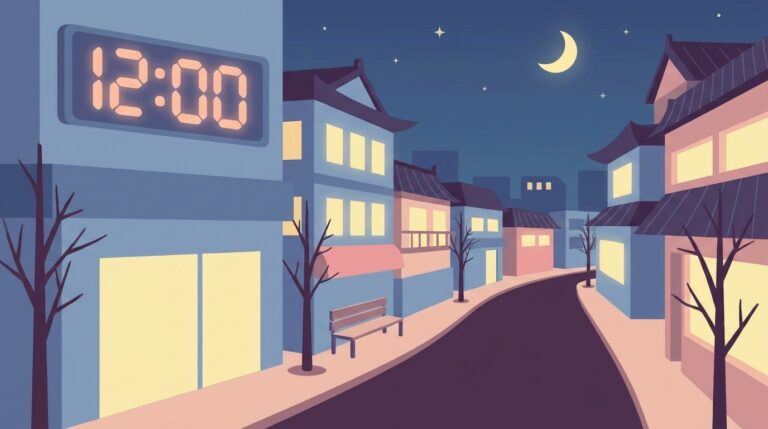
자정 열두 시예요 (It is 12:00 midnight): Your Ultimate Guide to Late-Night Korean Time
Phase 1: Empathy & Story Opening
안녕하세요! 매일한글 에디터입니다. (Hello! It’s your Daily Hangul editor.)
Imagine this: You are sitting at a bustling chicken and beer joint in Hongdae with Korean friends. Laughter fills the air, K-pop beats thrum in the background, and delicious crispy chicken is disappearing fast. Suddenly, your friend glances at their glowing phone screen, gasps, and shows you the screen displaying 00:00. Your mind freezes. Is this yeong si (zero o’clock)? Jajeong? Or yeoldu si? You want to know if you can still catch the last subway train, but the words get tangled on your tongue.
Over the past ten years coaching beginner learners, midnight is consistently the exact moment where students get stuck. Korean uses two distinct number systems, plus special words for noon and midnight. Master this phrase today, and you won’t just tell time—you will confidently navigate Seoul’s legendary nightlife, protect your curfew, and sound like a true local who knows exactly when the day ends and begins!
Phase 2: Top 3 Core Expressions Deep-Dive
1. 자정 열두 시예요 (Jajeong yeoldu si-yeyo)
- Pronunciation: [Jajeong yeol-du si-ye-yo] (Sounds like: Jah-jeong yull-doo she-yay-yo)
- Meaning: Literal: “It is midnight twelve o’clock” | Real Nuance: “It is 12:00 midnight sharp.”
- K-Culture Moment: The iconic dramatic cutoff in romance dramas where Cinderella curfews kick in, or when K-Pop idol agencies drop surprise teaser trailers right at 00:00.
- Editor’s Insight: 자정 (jajeong) is Sino-Korean for midnight, while 열두 시 (yeoldu si) uses Native Korean numbers for hour-counting. Saying them together adds crystal-clear emphasis that you mean night, not midday lunch!
- Situation Spectrum: Casual ✅ | Semi-formal ✅ | Formal ✅
- 🤔 Think About It: In English, we simply say “midnight” or “twelve AM.” Why do you think Korean frequently combines both the concept word (자정) and the number (열두 시) in daily speech?
2. 벌써 열두 시예요? (Beolsseo yeoldu si-yeyo?)
- Pronunciation: [Beol-sseo yeol-du si-ye-yo] (Sounds like: Bowl-ssuh yull-doo she-yay-yo)
- Meaning: Literal: “Already twelve o’clock is it?” | Real Nuance: “Is it midnight already?! Time flies!”
- K-Culture Moment: Singing your heart out in a noraebang (karaoke room) and realizing two hours have vanished in the blink of an eye.
- Editor’s Insight: 벌써 (beolsseo) implies sudden surprise at an unexpected reality. Use it with wide eyes to show how much fun you’re having with your companions.
- Situation Spectrum: Casual ✅ | Semi-formal ✅ | Formal ⚠️
- 🤔 Think About It: How does your culture react when an evening outing stretches into the middle of the night?
3. 막차 끊겼어요 (Makcha kkeun-gyeosseoyo)
- Pronunciation: [Mak-cha kkeun-gyeot-seo-yo] (Sounds like: Mahk-cha kkoon-gyut-suh-yo)
- Meaning: Literal: “The last transport got cut off” | Real Nuance: “The last train/bus is gone!”
- K-Culture Moment: Walking to the subway station entrance only to see the security gate half-closed and fellow commuters sighing together.
- Editor’s Insight: At 12:00 midnight in Seoul, 막차 (last train) is everyone’s countdown clock. Knowing this phrase will instantly connect you with every local on the street.
- Situation Spectrum: Casual ✅ | Semi-formal ✅ | Formal ✅
- 🤔 Think About It: In cities with 24-hour subways, missing transport isn’t a shared cultural ritual. In Korea, the 막차 deadline shapes the entire rhythm of an evening.
Phase 3: Textbook Korean vs. Real Korean
Situation 1: Stating the time on your phone screen (00:00)
- 📖 Textbook Korean: 오전 영 시입니다. (Ojeon yeong si-imnida. – “It is 00:00 AM.”)
- 🗣️ Real Korean: 밤 열두 시예요. (Bam yeoldu si-yeyo. – “It’s 12 at night.”) or 그냥 자정이에요. (Geunyang jajeong-ieyo. – “It’s just midnight.”)
- 💡 Why is it different? Nobody speaks like a 24-hour digital clock. Saying yeong si (zero o’clock) sounds like a military radio broadcast or computer terminal.
Situation 2: Alerting a friend that it’s getting very late
- 📖 Textbook Korean: 귀가할 시간입니다. (Gwiga-hal sigan-imnida. – “It is the hour to return home.”)
- 🗣️ Real Korean: 벌써 열두 시 넘었어요! (Beolsseo yeoldu si neomeosseoyo! – “It’s already past 12!”)
- 💡 Why is it different? Natural spoken Korean highlights the passing of the hour (열두 시 넘었어요) rather than stiff, formal book vocabulary like 귀가 (returning home).
Phase 4: K-Culture Deep Dive & Non-Verbal Manners
4-1. 눈치 (Nunchi) & Polite Gestures Around Midnight
When you’re out with Korean friends or colleagues and midnight approaches, never look abruptly at your wrist watch while someone is speaking—it signals boredom. Instead, practice subtle 눈치 (nunchi): gently check your lock screen under the table, or glance up toward the wall clock with a slight tilt of your head while gently saying, “시간이 벌써 이렇게 됐네요…” (Look how late the time got…). This polite body language shows you value the company while acknowledging the hour.
4-2. Culture Code: The Midnight Decision
In Seoul, midnight is not the end of the night—it is the ultimate fork in the road! Around 12:00 AM, Korean groups face the classic 막차 dilemma: do you sprint to catch the last line 2 green subway train, or do you commit to “밤샘” (bamsaem – staying out all night) with round two (2차) at a 24-hour stew restaurant or comic cafe? Understanding 자정 열두 시 is your golden ticket to participating in this beloved Korean nightlife ritual.
Phase 5: Real-World Roleplay Scenario
Setting: You are enjoying midnight street food at an outdoor pocha tent in Mapo-gu with your Korean college buddy, Minho (민호).
- 민호 (Minho): [젓가락을 내려놓으며 / Putting down chopsticks] 오늘 진짜 재미있다! 근데 지금 몇 시야? (Oneul jinjja jaemiitta! Geunde jigeum myeot siya?)
Today is so fun! But what time is it now? - You: [스마트폰 화면을 보며 / Checking smartphone screen] 잠시만요… 자정 열두 시예요. (Jamsimanyo… Jajeong yeoldu si-yeyo.)
Hold on… It is 12:00 midnight. - 민호 (Minho): [눈이 커지며 / Eyes widening] 헐, 벌써 열두 시예요? 시간 진짜 빠르다! (Heol, beolsseo yeoldu si-yeyo? Sigan jinjja ppareuda!)
Whoa, is it already 12:00? Time flies so fast! - You: [걱정스러운 표정으로 / Looking concerned] 지하철 막차 아직 있어요? (Jihacheol makcha ajik isseoyo?)
Is there still a last subway train? - 민호 (Minho): [앱을 확인하며 / Checking the transit app] 음, 열두 시 십 오 분에 막차 있어요. (Eum, yeoldu si sip-o bune makcha isseoyo.)
Um, there is a last train at 12:15. - You: [일어설 준비를 하며 / Getting ready to stand up] 그럼 지금 가야 해요! (Geureom jigeum gaya haeyo!)
Then we have to go right now! - 민호 (Minho): [미소 지으며 / Smiling warmly] 아니면 라면 한 그릇 더 먹고 택시 탈래요? (Animyeon ramyeon han geureut deo meokgo taeksi tallaeyo?)
Or do you want to eat one more bowl of ramyeon and grab a taxi? - You: [고민하다 웃으며 / Laughing after a pause] 좋아요, 라면 먹어요! (Joayo, ramyeon meogeoyo!)
Sounds good, let’s have ramyeon!
🔀 Interactive Choice Branch
What will you say to wrap up the midnight meal when the bill arrives?
- Option A: 제가 계산할게요! (Jega gyesanhalgeyo! – I will pay!)
- Option B: 이제 영 시니까 가요. (Ije yeong-sinikka gayo. – Since it is zero o’clock, let’s go.)
- Option C: 막차 타러 뛰어요! (Makcha tareo ttwieoyo! – Let’s run to catch the last train!)
Feedback:
* Choice A (Best): 🌟 Excellent! Offering to treat a friend who guided you through Seoul builds deep jeong (affection).
* Choice B (Bad): ❌ Unnatural. Native speakers never use “영 시” (zero o’clock) in social settings.
* Choice C (Risk): ⚠️ Authentic and fun, but make sure you have your running shoes on if you only have 10 minutes left!
Phase 6: 10-Second Emotional Shadowing Drill
Practice matching the emotional melody of natural Korean:
[😮 깜짝 놀라며 / Surprised & wide-eyed]
벌써 / 밤 열두 시예요?
(Beolsseo / bam yeoldu si-yeyo?)-
[🏃♂️ 다급하고 빠르게 / Urgent & rushed]
빨리 가요, / 막차 타야 해요!
(Ppalli gayo, / makcha taya haeyo!) -
[😌 안도하며 / Relieved & relaxed]
다행이다, / 아직 자정 안 됐어요.
(Dahaeng-ida, / ajik jajeong an dwaesseoyo.)
Phase 7: K-Culture Mini Dictionary
- 자정 (Jajeong): Midnight (00:00). Used in formal announcements, broadcasts, and everyday time checks.
- 정각 (Jeong-gak): Sharp / On the dot. Example: 열두 시 정각 (yeoldu si jeong-gak = 12 o’clock sharp).
- 막차 (Makcha): The last train or bus of the day. A vital survival word for anyone staying out past 11:30 PM in Korea.
- 올빼미족 (Olppaemi-jok): Night owl (literally “owl clan”). Describes people who thrive in Korea’s 24-hour cafe and convenience store culture.
Phase 8: Traveler’s Survival Kit
Top 3 Survival Phrases
- 지금 몇 시예요? (Jigeum myeot si-yeyo?)
Pro Tip: Use this anytime you need a quick time check from a store clerk or pedestrian. - 자정 넘어서도 해요? (Jajeong neomeoseodo haeyo?)
Pro Tip: Ask this to store clerks to check if the restaurant or cafe remains open past midnight. - 택시 어디서 타요? (Taeksi eodiseo tayo?)
Pro Tip: Essential when 막차 has ended and you need the designated late-night taxi stand.
Editor’s Travel Note
Seoul’s subways generally stop running between 12:00 AM and 1:00 AM on weekdays, and earlier on weekends. Before midnight strikes, open your smartphone and set up the 카카오 T 앱 다운로드 for hassle-free late-night taxi hailing, and check real-time transit status using 네이버 지도 길찾기. Always keep your T-Money card topped up by at least 10,000 KRW just in case!
Phase 9: One Step Deeper
In Western cultures, midnight often signals quiet hours and retreating into personal spaces. In Korea, midnight is vibrant and collective. Streets are illuminated, brightly lit 24-hour convenience stores welcome night strollers, and friends debate ordering late-night snacks (야식 – yasik). This shared nighttime energy shows the deep Korean sense of communal safety and bonding (정 – jeong). Telling time at midnight isn’t just about reading digits—it’s an invitation to take part in a city that truly never sleeps.
💬 Your Turn: What is the latest you have ever stayed out with friends in your home country? Would you run for the 막차 or stay out until morning? Tell us in the comments below!
Phase 10: FAQ & Common Mistakes
Q: Can I just say ‘열두 시’ without specifying day or night?
A: In context, yes! If it’s dark outside, everyone knows you mean night. However, adding 자정 (midnight) or 밤 (night) ensures 100% clarity, especially when setting late-night alarms or meetup times.
Q: Why do we use ‘열두’ instead of ‘십이’ for the hour?
A: Korean always counts hours in Native Korean numbers (하나, 둘, 셋 … 열두) and minutes in Sino-Korean numbers (일, 이, 삼 … 십). Therefore, 12 o’clock is 열두 시, never 십이 시!
Q: What is the opposite word for 자정 (midnight)?
A: The opposite is 정오 (Jeong-o), which means midday or 12:00 noon. You can also simply say 낮 열두 시 (12 in the afternoon).
🚨 Common Mistakes Warning Board
- Saying “영 시” (Zero o’clock) in conversation: Native speakers will find this robotic. Always say 자정 or 밤 열두 시.
- Mixing up number systems: Saying 십이 시 instead of 열두 시. Remember: Hours = Native Korean (열두).
- Forgetting politeness endings: Saying just 자정 to strangers or shopkeepers. Always attach the polite ending: 자정이에요 or 자정 열두 시예요.
Phase 11: Action Mission & Engagement
- 🥉 Bronze Mission (Solo): Look at your clock at 12:00 AM (or imagine it) and say out loud three times: “지금 자정 열두 시예요!”
- 🥈 Silver Mission (Social): Share your favorite Korean late-night snack (야식) photo on Instagram and caption it: “자정 열두 시에 먹는 야식!” tagging @DailyHangul.
- 🥇 Gold Mission (Real-world): Next time you watch a K-Drama or talk with a Korean exchange partner, listen for the words 자정, 열두 시, or 막차 and note the context!
- 🎮 K-Culture Mission: Search for your favorite K-pop artist’s midnight teaser drop and see how fans tweet the hour using 자정!
Phase 12: Interactive Quiz Challenge
Test your midnight Korean skills below!
1. Situation Quiz: Your friend asks you what time it is right now at 00:00 midnight. What is the most natural, polite response?
* A) 오전 영 시입니다.
* B) 자정 열두 시예요.
* C) 십이 시예요.
👉 Click here for the Answer & Explanation
Correct Answer: B) 자정 열두 시예요.
Explanation: Native speakers use Native Korean numbers for hours (열두) and pair it with 자정 (midnight) for total clarity. Option A is too robotic, and Option C uses the wrong Sino-Korean number system.
2. Fill-in-the-Blank: Complete the urgent sentence to catch transport:
“빨리 가요, 지하철 ______ 끊겨요!” (Hurry, the last subway is getting cut off!)
👉 Click here for the Answer & Explanation
Correct Answer: 막차 (Makcha)
Explanation: 막차 literally means “last vehicle/transport” and is the essential word for midnight travelers.
3. True or False: In casual speech, Korean speakers regularly say ‘영 시’ (zero o’clock) when hanging out with friends.
👉 Click here for the Answer & Explanation
Correct Answer: False
Explanation: ‘영 시’ is used on digital timetables or technical contexts, but humans naturally say ‘자정’ or ‘밤 열두 시’.
🎬 Watch Our Daily Videos! (Daily Hangul Official Instagram)
Review the expressions you learned in this article with our fun daily short videos! Check out native pronunciation and real-life nuances in action.
- Instagram @dailyhangul_en







