

Phase 1: Empathy & Opening
안녕하세요! 매일한글 에디터입니다. (Hello! This is your Daily Hangul editor.)
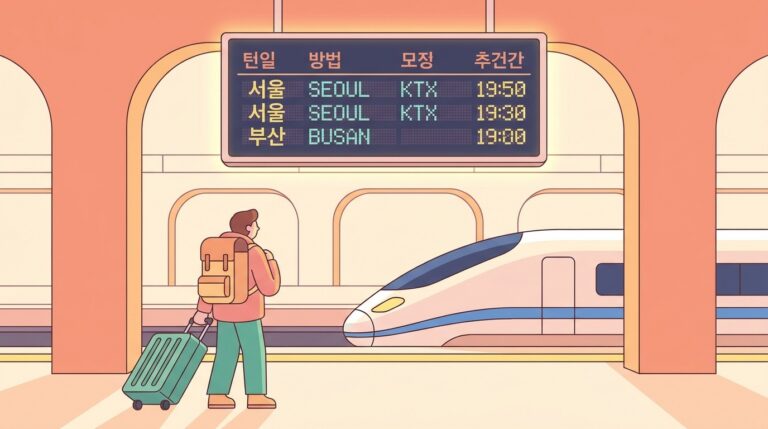
Imagine this: You are sprinting through the grand glass halls of Seoul Station, rolling suitcase clattering behind you, panting like Gong Yoo dodging zombies in Train to Busan. You glance up at the giant digital departure board, and your stomach drops. Your KTX to Busan departed exactly two minutes ago. Your booked seat is officially gone, your itinerary is in shambles, and you stand there wondering: Can I still get on another train? Did I just lose all my money? What on earth do I say to the station master?
Take a deep breath! You are not trapped in Seoul forever. Train systems in Korea are incredibly efficient and surprisingly forgiving if you know the exact words to say. In this practical guide based on real situations experienced by hundreds of our Daily Hangul learners, I will show you how to walk up to the ticket counter with total confidence and swap your missed train ticket for the next available seat.
Phase 2: Core Expressions Deep Dive
Here are the top three survival expressions you need when your train leaves without you.
1. 기차를 놓쳤어요. (Gichareul notchyeosseoyo.)
- Pronunciation: [Gi-cha-reul not-chyeo-sseo-yo] (Sounds like: “Gee-cha-rule no-cho-so-yo” with a soft ‘ch’ sound)
- Meaning: Literal: “I missed the train.” | Actual Nuance: “Excuse me, my train has already left without me.”
- K-Culture Moment: You hear this line in almost every romantic K-Drama right before the male lead races to the station to catch the female lead.
- Editor’s Insight: The base verb is
놓치다(notchida, to miss/let slip). Using the polite past tense~았/었어요signals respect while explaining your mishap right away.- Situation Spectrum: Casual 🚫 | Semi-formal ✅ | Formal ✅
- 🤔 Think About It: In English, we say “I missed the train” (active). In Korean,
놓치다suggests the object slipped away through circumstances. How does this subtle phrasing feel gentler to your listener?2. 다음 열차로 바꿀 수 있나요? (Daeum yeolcharo bakkul su innayo?)
- Pronunciation: [Dae-um yeol-cha-ro bak-kul su in-na-yo] (Sounds like: “Die-oom yohl-cha-ro bahk-kool soo in-nah-yo”)
- Meaning: Literal: “Can I change to the next train?” | Actual Nuance: “Is it possible to transfer my ticket to the upcoming departure?”
- K-Culture Moment: Seen often in variety shows like 2 Days & 1 Night when cast members lose travel missions and desperately negotiate ticket changes at rural train stations.
- Editor’s Insight:
다음(daeum) means “next”,열차(yeolcha) is the formal word for train, and~로 바꿀 수 있나요?is your magic Swiss-army-knife pattern for exchanging anything in Korea.- Situation Spectrum: Casual ⚠️ | Semi-formal ✅ | Formal ✅
- 🤔 Think About It: Notice the polite interrogative ending
~나요?. Why do you think Korean service interactions prefer gentle question endings over direct commands like “Change my ticket”?3. 수수료가 얼마예요? (Susuryoga eolmayeyo?)
- Pronunciation: [Su-su-ryo-ga eol-ma-ye-yo] (Sounds like: “Soo-soo-ryo-gah ull-mah-yeh-yo”)
- Meaning: Literal: “How much is the fee?” | Actual Nuance: “How much penalty or surcharge do I need to pay for this change?”
- K-Culture Moment: The relatable moment in travel vlogs where creators sheepishly tap their travel card after realizing missing a train costs a small fee.
- Editor’s Insight: When you miss a KTX, Korail charges a modest delay penalty (often between 15% and 70% depending on how many minutes past departure you report it). Asking this upfront shows you understand station policy!
- Situation Spectrum: Casual 🚫 | Semi-formal ✅ | Formal ✅
- 🤔 Think About It: Discussing money in Korea is polite and practical when framed with clear question markers like
얼마예요?(eolmayeyo).
Phase 3: Textbook Korean vs. Real-World Korean
Situation 1: Asking if there are empty seats on the next train
- 📖 교과서 한국어 (Textbook): 다음 기차에 잔여 좌석이 존재합니까? (Daeum gichae janyeo jwaseogi jonjaehamnikka? – “Do residual seats exist on the subsequent train?”)
- 🗣️ 진짜 한국어 (Real-World): 다음 기차 자리 있어요? (Daeum gicha jari isseoyo? – “Are there seats on the next train?”)
- 💡 왜 다를까? (Why is it different?): Native speakers use everyday words like
자리(jari, seat) rather than the rigid Sino-Korean term잔여 좌석(residual seat) during live conversations.
Situation 2: Asking for the fastest available departure
- 📖 교과서 한국어 (Textbook): 승차권을 가장 빠른 시간대로 교환 요청합니다. (Seungchagwoneul gajang ppareun sigandaero gyohwan yocheonghamnida. – “I request the exchange of this boarding pass for the quickest time.”)
- 🗣️ 진짜 한국어 (Real-World): 제일 빠른 다음 걸로 바꿔주세요. (Jeil ppareun daeum geollo bakkwojuseyo. – “Please change it to the fastest next one.”)
- 💡 왜 다를까? (Why is it different?): In urgent situations at a busy counter, concise grammar (
제일 빠른 다음 거) saves time and sounds far more natural.
Phase 4: K-Culture Deep Dive & Non-Verbal Manners
4-1. 눈치 (Nunchi) & Gestures at the Station Counter
When you miss your train, do not stand in the general information queue. Walk straight toward the ticket sales window labeled 매표소 (Maepyoso – Ticket Office).
* Two-Handed Courtesy: Hand your phone (with the KorailTalk reservation screen) or paper ticket to the clerk using both hands or with your right hand supported at the wrist by your left hand.
* The Apologetic Head Tilt: Lower your head slightly with a gentle, apologetic smile. Showing modest regret (“I know this is my mistake, but please help me!”) instantly sparks Korean hospitality and goodwill.
4-2. The “Ppalli-Ppalli” Rail Culture
Korea’s KTX bullet train network runs with precision timing. If a train is scheduled for 14:02, the doors close at 14:01. However, Korail’s station system is built for real-time problem solving. If you report to the counter within minutes of departure, clerks can reassign you or issue an 입석 (Ipseok – Standing Ticket) so you can still reach your destination on time. Koreans value swift, practical solutions above all else.
Phase 5: Real-Life Roleplay Scenario
Setting: The busy KTX Customer Service Counter at Seoul Station on a Friday afternoon.
NPC: Station Agent Park Min-ho (friendly, efficient, wearing a neat Korail navy uniform).
- Agent Park: 안녕하세요, 무엇을 도와드릴까요? (Annyeonghaseyo, mueoseul dowadeurilkkayo?)
- “Hello, how may I help you?”
- You:
🎭 두 손으로 스마트폰 티켓 화면을 보여주며저… 기차를 놓쳤어요. (Jeo… gichareul notchyeosseoyo.)- “Um… I missed my train.”
- Agent Park: 아, 3시 부산행 KTX 타셨어야 했군요. 방금 출발했습니다. (A, se-si Busan-haeng KTX tasyeosseoya haetgunyo. Banggeum chulbalhaessumnida.)
- “Ah, you were supposed to take the 3:00 PM KTX to Busan. It just departed.”
- You: 죄송해요. 다음 열차로 바꿀 수 있나요? (Joesonghaeyo. Daeum yeolcharo bakkul su innayo?)
- “I’m sorry. Can I change it to the next train?”
- Agent Park: 네, 3시 30분 기차가 있는데 일반석은 매진이고 입석만 남았어요. (Ne, se-si samsip-bun gichaga inneunde ilbanseogeun maejin-igo ipseongman namasseoyo.)
- “Yes, there is a 3:30 PM train, but regular seats are sold out; only standing tickets remain.”
- You: 입석도 괜찮아요! 제일 빠른 다음 걸로 바꿔주세요. (Ipseokdo gwaenchanayo! Jeil ppareun daeum geollo bakkwojuseyo.)
- “Standing is fine too! Please change it to the fastest next one.”
- Agent Park:
🎭 키보드를 두드리며네, 시간 경과 수수료 제외하고 변경해 드렸습니다. (Ne, sigan gyeonggwa susuryo jewehago byeongyeonghae deuryeossumnida.)- “Okay, I changed it for you after deducting the late departure fee.”
- You:
🎭 살짝 목례하며정말 감사합니다! (Jeongmal gamsahamnida!)- “Thank you so very much!”
🔀 Interactive Choice Point: How will you respond to Agent Park?
- Choice A: “다음 기차 특실은 있어요?” (Daeum gicha teukshireun isseoyo? – “Are there first-class seats on the next train?”)
- 🌟 Best Outcome: Smart move! If standing sounds exhausting, First Class (
특실, Teukshil) often has single seats left open.
- 🌟 Best Outcome: Smart move! If standing sounds exhausting, First Class (
- Choice B: “그냥 환불해 주세요.” (Geunyang hwanbulhae juseyo. – “Just give me a refund.”)
- ⚠️ Risk Outcome: You will receive money back, but with a post-departure fee deducted. You will still need to find another way to travel.
- Choice C: “안 늦었는데 그냥 태워주세요!” (An neujeonneunde geunyang taewojuseyo! – “I wasn’t that late, just let me board!”)
- 🚫 Bad Outcome: The train has physically departed the platform! Never argue safety policies with station staff.
Phase 6: 10-Second Emotion Shadowing Drill
Repeat these lines aloud with the indicated pause (/) and feeling tag:
[🥺 난감하고 미안한 감정으로 / Frustrated and apologetic]
저기요… / 제가 기차를 / 놓쳤어요.
(Jeogiyo… / jega gichareul / notchyeosseoyo.)-
[🙏 간절하고 공손한 목소리로 / Earnest and polite]
다음 기차로 / 바꿀 수 있나요? / 부탁드립니다.
(Daeum gicharo / bakkul su innayo? / Butakdeurimnida.) -
[😌 안도하며 밝고 산뜻하게 / Relieved and cheerful]
입석도 괜찮아요! / 정말 감사합니다.
(Ipseokdo gwaenchanayo! / Jeongmal gamsahamnida.)
Phase 7: K-Culture Mini Dictionary
- 매표소 (Maepyoso) | Ticket Box / Counter
Usage: The physical counter staffed by humans. When your train departs, ticket vending kiosks won’t handle expired tickets, so you must visit the매표소. - 입석 (Ipseok) | Standing Room Ticket
Usage: A discounted train ticket without an assigned seat. You can stand in the vestibule between train cars or sit in folding jump-seats. - 수수료 (Susuryo) | Transaction Fee / Cancellation Penalty
Usage: The nominal deduction charged when refunding or re-issuing a ticket after departure. - 반환 (Banhwan) | Ticket Return / Cancellation
Usage: Official signage seen above station desks (승차권 반환창구– Ticket Refund Desk).
Phase 8: Traveler’s Survival Kit
Top 3 Survival Expressions
- 다음 기차 몇 시에 있어요? (Daeum gicha myeot sie isseoyo?)
Pro Tip: Use this to check all departure times quickly without checking your screen. - 입석 자리라도 있나요? (Ipseok jarirado innayo?)
Pro Tip: Perfect during weekend peak hours when trains look 100% booked. - 취소표 나왔나요? (Chwisopyo nawannayo?)
Pro Tip: Asking if any last-minute canceled tickets popped up can score you an actual seat!
Editor’s Travel Note
- App Tip: Always download the official 코레일톡 (KorailTalk) 공식 앱 다운로드 before traveling. If your train hasn’t departed yet, you can modify it right inside the app with zero hassle.
- Grace Window: Once the train departs, in-app modifications are locked! You must immediately find a human counter within 10 to 20 minutes to keep your ticket’s value.
Phase 9: A Step Deeper into Korean Society
In many Western transport hubs, missing a booked time slot means purchasing a 100% new ticket from scratch. In Korea, however, public transportation balances technological strictness with interpersonal empathy known as 정 (Jeong). Station staff recognize that urban transfers and traffic happen. As long as you approach the counter respectfully within a short time after departure, the system protects travelers by converting the ticket with small, transparent penalties. Courtesy and mutual respect open doors in Korea faster than any automated machine.
💬 Your Turn: Have you ever missed a train or bus in another country? Share your story in the comments below!
Phase 10: FAQ & Common Mistakes
Q: Can I change my ticket at the automated vending machine after the train leaves?
A: No. Automated machines only handle future upcoming departures. For any train that has already left its station, you must visit the staffed counter (매표소).
Q: What happens if all next trains are completely sold out?
A: Ask for an 입석 (standing ticket) or 자유석 (non-reserved seat on select weekday trains). Trains rarely turn away travelers completely unless extreme safety limits are reached.
Q: How much fee will I pay if I miss my KTX?
A: If you report to the counter within 20 minutes after departure, the penalty is typically only 15% of the fare. It increases to 40% (within 60 minutes) and 70% (up to arrival time at destination).
🚨 Common Mistakes Alert
- Mistake 1: Waiting in the ticket vending line. Automated kiosks cannot process expired tickets. Go straight to a counter clerk.
- Mistake 2: Throwing away your mobile or paper ticket. Keep your booking code visible on your screen. The clerk needs the ticket number to execute the change.
- Mistake 3: Panicking and buying a brand new ticket online. If you purchase a new one on your app, you will lose the chance to trade in your missed ticket for a discounted transfer!
Phase 11: Action Missions
- 🥉 Bronze Mission (Solo Practice): Stand in front of your mirror and say: “기차를 놓쳤어요. 다음 열차로 바꿀 수 있나요?” smoothly in under 5 seconds.
- 🥈 Silver Mission (Social Connection): Leave a comment below using the phrase
제일 빠른 걸로 바꿔주세요. - 🥇 Gold Mission (Real Life): Next time you take a bus or train in Korea, ask the station counter staff a friendly question in Korean using
자리 있어요?. - 🎮 K-Culture Mission: Watch an episode of a travel variety show like Seoul Busters or Europe Outside Your Tent and spot when someone asks for a ticket exchange!
Phase 12: Interactive Quiz Challenge
1. Situational Judgment: You arrive at Busan Station 5 minutes after your train departs. What should you do first?
* (A) Leave the station and take a taxi.
* (B) Go to the automated kiosk and tap the screen repeatedly.
* (C) Run to the 매표소 (Ticket Counter) and say “기차를 놓쳤어요. 다음 열차로 바꿀 수 있나요?”.
2. Fill in the Blank: 다음 열차로 ________ 수 있나요? (Can I change to the next train?)
* (A) 먹을 (meogeul)
* (B) 바꿀 (bakkul)
* (C) 잘 (jal)
3. True or False: If the next train is fully booked with regular seats, you can never get on the train.
* (True / False)
👉 Click here to reveal answers & explanations!
- Question 1 Answer: (C) Always go to the staffed counter right away to minimize late penalties!
- Question 2 Answer: (B) 바꿀 (
바꾸다means to change or exchange;바꿀 수 있나요?means “Can I change it?”). - Question 3 Answer: False! You can request an
입석(standing ticket) and still reach your destination on time.
🎬 Watch Our Daily Videos! (Daily Hangul Official Instagram)
Review the expressions you learned in this article with our fun daily short videos! Check out native pronunciation and real-life nuances in action.
- Instagram @dailyhangul_en







