

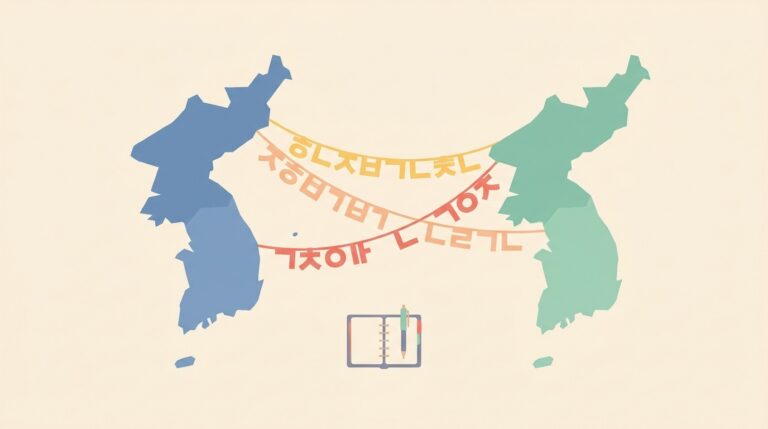
Phase 1: Empathy (Linguistic Immersion Opening)
안녕하세요! 매일한글 에디터입니다. (Annyeonghaseyo! It’s your Daily Hangul editor here.)
Picture this: You are glued to the screen watching Crash Landing on You (사랑의 불시착). Yoon Se-ri, a fashionable Seoul heiress stranded in the northern countryside, attempts to express her casual gratitude and requests everyday necessities using words like “샴푸 (syampu – shampoo)” and “패션 (paesyeon – fashion).” Captain Ri’s comrades stare back in utter bewilderment, wondering what foreign dialect she is speaking. Later, when an officer curtly replies to her polite apology with “일없습니다 (Ileopseumnida),” she flinches, interpreting it through her Seoul lens as a sharp dismissal: “None of your business!” Little does she know that in the North, it is actually a reassuring and courteous phrase meaning “Don’t mention it; it’s completely fine.”
If you have ever felt your heart skip a beat trying to untangle these geopolitical nuances, you are encountering one of the most fascinating sociolinguistic phenomena on Earth. Over seven decades of geopolitical division following the 1953 armistice have carved a profound linguistic rift across the Korean Peninsula. South Korea’s Seoul-anchored Pyo-juneo (표준어 – Standard Language) and North Korea’s Pyongyang-centered Munhwa-eo (문화어 – Cultured Language) have diverged across phonology, morphology, lexicology, and pragmatic speech levels.
Mastering this divergence is the crowning jewel of C2-level Korean proficiency. It elevates you from someone who merely speaks the language to a discerning cultural philologist who understands how history, ideology, and national trauma sculpt syntax and semantics. Based on extensive field interviews with North Korean defectors, sociolinguists from the Grand National Language Dictionary project, and advanced learners, this masterclass provides your navigational map across the 38th parallel of Korean linguistics.
Phase 2: Core Expressions Deep Dive
1. 일없습니다 (Ileopseumnida)
- Pronunciation: Il-eop-seum-ni-da (sounds like eel-up-seum-nee-da, delivered with a crisp, downward cadenced rhythm)
- Meaning: Literal: “There is no business/matter.” | South Korea Nuance: A blunt, dismissive brush-off meaning “It’s none of your business” or “Leave me alone.” | North Korea Nuance: A warm, reassuring pragmatic marker equivalent to “You are welcome,” “Don’t worry about it,” or “No problem at all.”
- K-Culture Moment: In modern dramas and films portraying inter-Korean diplomacy (such as Crash Landing on You or the political thriller Steel Rain), this exact phrase serves as the classic catalyst for humorous or tense cross-border misunderstandings before trust is established.
- Editor’s Insight: In historical northern dialects, “일없다” retained the benign vernacular sense of absence of trouble. While South Korea underwent rapid industrialization and solidified the Sino-Korean “괜찮습니다 (Gwaenchansseumnida)” for polite absolution, the North institutionalized “일없습니다” into everyday egalitarian etiquette.
- Situation Spectrum: Casual (⚠️), Semi-formal (✅ North / 🚫 South), Formal (✅ North / 🚫 South)
- 🤔 Think About It: How can two societies sharing the same ancestral root invert the politeness polarity of identical words due to isolated sociopolitical evolution?
2. 동무 (Dongmu)
- Pronunciation: Dong-mu (sounds like dong-moo, soft initial ‘d’ merging into an open, grounded vowel)
- Meaning: Etymological/Traditional: “Childhood playmate, bosom companion.” | South Korea Nuance: Heavily tabooed and ideologically frozen; universally associated with communist rhetoric (“comrade”) and strictly avoided in contemporary conversation except in fossilized compound phrases like “어깨동무 (eokkaedongmu – arm-in-arm friendship).” | North Korea Nuance: The ubiquitous, official civic address for fellow citizens, peers, and social equals.
- K-Culture Moment: In classic Korean cinematic masterpieces like Taegukgi: The Brotherhood of War (태극기 휘날리며), you hear soldiers transition from calling each other “동무” with pure, innocent nostalgia in childhood flashbacks to experiencing visceral terror when the word is co-opted on the battlefield.
- Editor’s Insight: South Koreans systematically replaced the native indigenous term “동무” with the Sino-Korean term “친구 (chingu – 友達/親舊)” to distance themselves from northern state ideology. This represents a poignant linguistic amputation where an indigenous Korean morpheme was discarded for geopolitical survival.
- Situation Spectrum: Casual (🚫 South / ✅ North), Semi-formal (🚫 South / ✅ North), Formal (🚫 South / ✅ North)
- 🤔 Think About It: Has your native language ever completely abandoned a poetic indigenous word simply because an adversary’s political movement adopted it?
3. 살결물 (Salgyeolmul)
- Pronunciation: Sal-gyeol-mul (sounds like sahl-gyul-mool, blending the native Korean roots for flesh/skin sal, texture gyeol, and water mul)
- Meaning: Literal: “Skin-texture water.” | South Korea Equivalent: “스킨 (seukin – skin toner)” or “화장수 (hwajangsu – cosmetic water).” | North Korea Nuance: A pure, descriptive Korean neologism officially standardized during North Korea’s linguistic purification campaigns (Mal-dadeumgi Undong).
- K-Culture Moment: Beauty documentaries examining North Korean cosmetic lines from Sinuiju (such as the famed Bomhyanggi brand) feature bottles prominently labeled “살결물,” presenting a stark contrast to South Korea’s English-drenched beauty emporiums like Olive Young where products are labeled “하이드레이팅 에센스 토너 (ha-ideure-iting esenseu toneo).”
- Editor’s Insight: North Korea’s language policy enforced rigorous linguistic purism (말다듬기) to replace Sino-Korean and foreign loanwords with descriptive native morphemes. South Korea, conversely, embraced hyper-globalization, adopting English loanwords as status symbols of cosmopolitan modernism.
- Situation Spectrum: Casual (✅ North / 🚫 South), Semi-formal (✅ North / 🚫 South), Formal (✅ North / 🚫 South)
- 🤔 Think About It: Does aggressive linguistic purism preserve cultural authenticity, or does it isolate a nation’s speakers from the international scientific and economic discourse?
Phase 3: Textbook Korean vs. Real Korean
Situation 1: Declining an offer / Reassuring someone
- 📖 Textbook Korean: 별말씀을요, 신경 쓰실 필요 전혀 없습니다. (Byeolmalsseumeullyo, sin-gyeong sseusil piryo jeonhyeo eopseumnida. – “Don’t mention it, there is no need whatsoever to concern yourself.”)
- 🗣️ Real South Korean: 아유, 괜찮아요! 전혀 신경 쓰지 마세요~ (A-yu, gwaenchannayo! Jeonhyeo sin-gyeong sseuji maseyo~ – “Oh gosh, it’s totally fine! Don’t worry about it at all~”)
- 🗣️ Real North Korean: 일없습네다! 그런 건 걱정 말라우. (Il-eop-seum-neda! Geureon geon geokjeong mallau. – “No problem at all! Don’t fret over such things.”)
- 💡 Why the difference? South Korean conversational speech relies heavily on soft interjections (“아유”) and honorific hedges to cushion interpersonal boundaries, whereas North Korean Munhwa-eo maintains a resolute, straightforward acoustic delivery rooted in northwestern phonology (“-라우”).
Situation 2: Inquiring about public transit directions
- 📖 Textbook Korean: 실례지만, 지하철역이 어디에 위치해 있습니까? (Sillyejiman, jihacheol-yeogi eodie wichihae itsseumnikka? – “Excuse me, where is the subway station located?”)
- 🗣️ Real South Korean: 저기요, 혹시 이 근처에 지하철 타는 데가 어디예요? (Jeogiyo, hoksi i geuncheoe jihacheol taneun dega eodiyeyo? – “Excuse me, by any chance where can I catch the subway around here?”)
- 🗣️ Real North Korean: 동무, 지하철도 정유소가 어디요? (Dongmu, jihacheoldo jeong-yusoga eodiyo? – “Comrade, where is the subway station stop?”)
- 💡 Why the difference? South Koreans commonly abbreviate the system to “지하철” and use spatial locators like “타는 데,” whereas North Koreans retain “지하철도 (underground railway)” and apply “정유소 (transit stop)” across multiple vehicle networks.
Phase 4: K-Culture Deep Dive & Non-Verbal Manners
4-1. Nunchi & Gestures: Tone, Intonation, and Eye Contact
- The Melodic Seoul Glide vs. The Resolute Pyongyang Cadence: South Korean standard speech is characterized by subtle pitch fluctuations and prolonged phrase endings (말끝 흐리기) designed to project humility, friendliness, and deference. Direct, unblinking eye contact during disagreement is viewed as confrontational in Seoul.
- In Pyongyang’s Munhwa-eo, intonation is marked by crisp, decisive staccato descents, historically shaped by the “revolutionary oratorical style” (혁명적 어조). Maintaining upright posture, assertive volume, and steady eye contact demonstrates revolutionary sincerity, not insolence.
- Nunchi Protocol with Inter-Korean Speakers: When conversing with North Korean defectors or scholars, never treat their dialect as archaic or humorous. Avoid bombarding them with casual Anglo-Korean buzzwords (e.g., “피드백 부탁해요”, “미팅 어레인지 해볼게요”). Linguistic consideration means using transparent Sino-Korean or pure Korean words without sounding condescending.
4-2. Cultural Code Analysis: The Ice Hockey Crisis & Gyeoremal Keunsajeon
At the 2018 PyeongChang Winter Olympics, history was made when North and South Korea fielded a unified women’s ice hockey team. However, within hours of their first joint practice, a communication crisis erupted on the rink. South Korean athletes, accustomed to international sports terminology, shouted commands like “Pass! (패스)”, “Shoot! (슛)”, and “Defend! (디펜스)”. The North Korean players, trained exclusively under purified sports vocabulary, were paralyzed; they knew those actions only as “연락 (yeonnak – communication/pass)”, “때리기 (ttaerigi – striking/shoot)”, and “방어 (bang-eo – defense)”. The coaching staff had to paste a dual-language glossary onto locker room whiteboards to survive the tournament.
This dramatic sports vignette mirrors the monumental academic mission of the Gyeoremal Keunsajeon (겨레말큰사전 – The Grand National Language Dictionary). Launched in 2005 by joint committees from Seoul and Pyongyang, this historic endeavor has cataloged over 330,000 unified entries, attempting to harmonize phonetic divergence (such as the South’s Initial Sound Law) and bridge semantic chasms before linguistic reunification becomes impossible.
Phase 5: Real-World Roleplay Scenario
Setting: The Lexicography Conference Room of the Inter-Korean Joint Compilation Committee, Mapo-gu, Seoul.
Characters:
* Dr. Park Min-ho (박민호 박사): Senior South Korean sociolinguist, analytical, conciliatory.
* Dr. Rim Song-chol (림송철 박사): Renowned North Korean philologist and visiting researcher, highly articulate, proud of morphological heritage.
[Scene Start]

박민호 박사: 림 박사님, 이번 어휘 대조 작업에서 '노동'과 '근로'의 의미 기술 차이가 가장 첨예한 쟁점으로 떠올랐습니다.
(Rim bak-sanim, ibeon eohwi daejo jageob-eseo 'nodong'-gwa 'geullo'-ui uimi gisul cha-iga gajang cheom-yehan jaengjeom-euro tteo-ollatseumnida.)
"Dr. Rim, in this comparative lexical compilation, the semantic definition between 'nodong' and 'geullo' has emerged as our sharpest point of contention."
🎭 [안경을 고쳐 쓰며 두툼한 대조 보고서를 조심스럽게 건넨다.]

림송철 박사: 맞습니다, 박 선생. 공화국에서는 '로동'을 인간의 신성한 창조적 활동으로 보지만, 남측 사전에선 단순한 임금 피고용 개념으로 격하시킨 느낌을 지울 수 없습니다.
(Matseumnida, Park seonsaeng. Gonghwagug-eseoneun 'rodong'-eul in-gan-ui sinseonghan changjojeok hwaldong-euro bojiman, namcheuk sajeon-eseon dansunhan imgeum pigoyong gaenyeom-euro gyeokhasikin neukkimeul ji-ul su eopseumnida.)
"Indeed, Mr. Park. In our Republic, we view 'rodong' as humanity's sacred creative agency, whereas your southern dictionaries appear to reduce it to mere salaried subjugation."
🎭 [단호한 표정으로 보고서 여백에 만년필을 올려놓는다.]

박민호 박사: 남한에서도 과거 군사정권 시절 주입된 '근로'라는 국가주의적 프레임을 벗어나, 노동자의 주체성을 살리는 '노동'으로 용어를 정상화하자는 학계의 목소리가 매우 큽니다.
(Namhan-eseodo gwageo gunsa-jeong-gwon sijeol ju-ipdoen 'geullo'-raneun gukgaju-uijeok peureim-eul beoseona, nodongja-ui jucheseong-eul sallineun 'nodong'-euro yong-eoreul jeongsanghwahajaneun hakgye-ui moksoriga maeu keumnida.)
"Even in South Korea, modern academia strongly advocates reclaiming the agency of 'nodong' to dismantle the state-paternalistic frame of 'geullo' imposed during past military regimes."
🎭 [온화하게 미소 지으며 고개를 끄덕인다.]

림송철 박사: 그래요? 분단 70년 동안 말뿌리는 하나인데, 서로 다른 체제의 색깔이 덧칠되니 참으로 가슴 아픈 일입니다.
(Geuraeyo? Bundan chilssip-nyeon dong-an malppurineun hana-inde, seoro dareun cheje-ui saekkkari deotchildoeni chameuro gaseum apeun irimnida.)
"Is that so? Our linguistic roots remain one after seventy years of division, yet the paints of differing regimes have coated them—it is deeply heartbreaking."
🎭 [무거운 탄식을 내쉬며 따뜻한 둥굴레차를 한 모금 마신다.]

박민호 박사: 표기법도 큰 숙제죠. 남한은 발음의 경제성을 고려해 두음법칙으로 '노동'과 '여자'를 쓰지만, 북한은 어원을 존중해 '로동'과 '녀자'를 고수하니까요.
(Pyogibeopdo keun sukjejyo. Namhan-eun bareum-ui gyeongjeseong-eul goryeohae dueumbeopchik-euro 'nodong'-gwa 'yeoja'-reul sseujiman, bukhan-eun eowoneul jonjunghae 'rodong'-gwa 'nyeoja'-reul gosuhanikkayo.)
"Orthography is another immense hurdle. South Korea applies the Initial Sound Rule for phonological economy resulting in 'nodong' and 'yeoja', while North Korea retains etymology with 'rodong' and 'nyeoja'."
🎭 [화이트보드에 두 표기법을 나란히 적는다.]

림송철 박사: 형태론의 원형을 보존하려는 우리의 노력이 남측 동포들에게는 생경하게 느껴질 수 있다는 점은 인정합니다. '일없다'는 말도 남측에선 랭랭한 거절로 오해받지 않습니까?
(Hyeongtaeron-ui wonhyeong-eul bojonharyeoneun uri-ui noryeogi namcheuk dongpodeuregeneun saeng-gyeonghage neukkyeojil su itsdaneun jeomeun injeonghamnida. 'Ileopda'-neun maldo namcheuk-eseon raengraenghan geojeol-ro ohaebatji anseumnikka?)
"I acknowledge that our effort to conserve morphological origins can feel alien to southern compatriots. Even our simple 'ileopda' is misunderstood in the South as a frosty rejection, is it not?"
🎭 [쓴웃음을 지으며 손바닥을 펼쳐 보인다.]

박민호 박사: 맞습니다. 초기 탈북민 정착 현장에서 '일없습니다'라는 호의가 불친절로 오인되어 갈등을 빚은 사례가 수없이 많았습니다.
(Matseumnida. Chogi talbungmin jeongchak hyeonjang-eseo 'ileopseumnida'-raneun ho-uiga bulchinjeol-ro o-indoeeo galdeung-eul bijeun saryega su-eopsi manatseumnida.)
"Precisely. In defector resettlement centers, that benevolent reassurance was repeatedly misconstrued as hostile curtness, creating avoidable friction."
🎭 [공감 어린 눈빛으로 메모지에 필기를 덧붙인다.]

림송철 박사: 그렇기에 우리 두 사람이 집필하는 이 통일 사전이 이념의 장벽을 헐고, 흩어진 겨레의 마음을 잇는 진정한 언어적 마중물이 되어야 합니다.
(Geureohgie uri du sarami jippilhaneun i tong-il sajeoni inyeom-ui jangbyeog-eul heolgo, heuteojin gyeore-ui ma-eumeul itneun jinjeonghan eoneojeok majungmuri doe-eoya hamnida.)
"Which is why this unified dictionary we are forging must transcend ideological barricades and serve as genuine linguistic priming water to reconnect our divided people."
🎭 [박 박사의 손을 두 손으로 굳게 맞잡는다.]

[Scene End]
🔀 Interactive Decision Point
Dr. Rim turns to you, the visiting international sociolinguist, and asks:
“외국인 학자의 시각에서 보실 때, 향후 남북 언어 통합은 무분별한 외래어를 척결하는 순화에 무게를 두어야 합니까, 아니면 세계화된 외래어를 수용하는 개방성에 무게를 두어야 합니까?” (From an international scholar’s perspective, should future Korean linguistic reunification prioritize purifying reckless foreign loanwords, or embracing globalized loanword openness?)
- Option A: “북한의 말다듬기 원칙을 남한 전역에 적용하여, 불필요한 서구 외래어를 순수 고유어로 전면 대체해야 합니다.” (We should apply the North’s purification policy across the South to eliminate unnecessary Western loanwords entirely.)
- Outcome: [Risk] Dr. Rim smiles at your anti-imperialist zeal, but Dr. Park cautions that forcibly uprooting established scientific and technological loanwords would paralyze South Korea’s globalized economy and research infrastructure.
- Option B: “남북한 언어의 공존을 전제로 한 ‘상호 기술주의(Descriptivism)’를 채택하여, 강제적 표준화 대신 복수 표준어를 인정하고 점진적인 화해를 도모해야 합니다.” (We should adopt mutual linguistic descriptivism that recognizes dual standard variants, fostering gradual convergence rather than forced uniformity.)
- Outcome: [Best] Both scholars nod enthusiastically. This balanced, nuanced C2 perspective respects the organic socio-historical realities of both populations and reflects modern sociolinguistic consensus.
- Option C: “세계화 시대이므로 북한이 남한의 언어 체계를 표준으로 전면 흡수통일해야 합니다.” (Since this is a globalized era, North Korea should simply adopt South Korea’s linguistic standard completely.)
- Outcome: [Bad] Dr. Rim stiffens and looks profoundly alienated. Linguistic imperialism alienates speakers and ignores the structural beauty of North Korea’s indigenous morphological preservation.
Phase 6: 10-Second Emotion Shadowing Drill
Practice reading these sentences aloud, pausing precisely at the slashes (/) and channeling the emotional milestones indicated.
Drill 1: [🧐 학구적이고 진지하게 – Academic & Contemplative]
남북의 언어 이질화는 / 단순한 사투리의 격차가 아니라 / 70년간 축적된 / 체제와 세계관의 차이가 빚어낸 / 언어학적 비극입니다.
(Nambuk-ui eoneo ijilhwaneun / dansunhan saturi-ui gyeokchaga anira / chilssip-nyeon-gan chukjeokdoen / cheje-wa segyegwan-ui cha-iga bijeonaen / eoneohakjeok bigeug-imnida.)
“The inter-Korean linguistic divergence / is not merely a gap in regional dialects / but a linguistic tragedy / forged by seven decades of accumulated systemic and ideological division.”
Drill 2: [🤝 단호하면서도 포용력 있게 – Resolute yet Compassionate]
‘일없습니다’라는 말 한마디에 담긴 / 다정한 배려의 본뜻을 헤아릴 때 / 우리는 비로소 / 분단의 차가운 철조망을 넘어 / 서로에게 다가설 수 있습니다.
(‘Ileopseumnida’-raneun mal hanmadi-e damgin / dajeonghan baeryeo-ui bontteuseul he-aril ttae / urineun biroso / bundan-ui chaga-un cheoljomang-eul neomeo / seoroege dagaseol su itsseumnida.)
“When we truly comprehend the innate, gentle consideration / nestled inside the phrase ‘ileopseumnida’ / we can at last transcend / the frigid barbed wire of division / and step closer toward one another.”
Drill 3: [✨ 통찰력 있고 희망차게 – Insightful & Visionary]
서로 다른 어휘를 억지로 깎아내기보다 / 두 개의 풍요로운 말뿌리를 포용하는 것이 / 진정한 미래 한국어의 / 위대한 통합입니다.
(Seoro dareun eohwireul eokjiro kkakkanegi-boda / du gae-ui pung-yoroun malppurireul poyonghaneun geosi / jinjeonghan mirae Hangugeo-ui / widaehan tonghab-imnida.)
“Rather than artificially shearing down differing vocabularies / embracing both fertile linguistic branches / constitutes the true and majestic integration / of future Korean.”
Phase 7: K-Culture Mini Dictionary
- 문화어 (Munhwa-eo / Cultured Language)
- Translation: The official standard language of North Korea, promulgated in 1966. Centered on the Pyongyang dialect, it rejects the bourgeois influences of the Seoul dialect, emphasizing ideological utility, revolutionary zeal, and morphological fidelity.
- 표준어 (Pyo-juneo / Standard Korean)
- Translation: The official standard language of South Korea, codified as “the modern speech widely used by cultured speakers in Seoul.” It is defined by rapid adaptation to global loanwords, democratic vernacular shifts, and colloquial phonological contractions.
- 겨레말큰사전 (Gyeoremal Keunsajeon / Grand National Language Dictionary)
- Translation: The historic joint inter-Korean lexicographical initiative established to unify over 330,000 disparate lexical items from both Koreas into an all-encompassing, non-ideological national dictionary.
- 두음법칙 (Dueumbeopchik / Initial Sound Rule)
- Translation: The phonological rule practiced strictly in South Korea that prevents the liquids ‘ㄹ’ (r/l) and ‘ㄴ’ (n) from occurring at word beginnings before high front vowels or glides (e.g., historical ryeoksa becoming yeoksa [역사 – history]). North Korea abolished this rule to maintain morphological transparent continuity (writing 력사).
Phase 8: Cultural Observer & Traveler’s Survival Kit
Top 3 Survival Phrases for Navigating Border Semantics
- “문화어로는 이 표현을 어떻게 말하나요?”
(Munhwa-eoroneun i pyohyeoneul eotteohge malhanayo?)
Meaning: “How is this expression articulated in Cultured Language?”
Pro Tip: Use this when speaking with North Korean defectors or academic researchers to invite collaborative dialogue without implying their speech is non-standard. - “제가 쓴 외래어 중에 이해하기 어려운 단어가 있으셨나요?”
(Jega sseun oeraeeo jung-e ihaehabi eoryeo-un daneoga itsseusyeonnayo?)
Meaning: “Were there any loanwords I used that were difficult to understand?”
Pro Tip: Demonstrates sophisticated C2 interpersonal nunchi, mitigating linguistic barriers caused by South Korea’s rampant English borrowing. - “‘일없습니다’의 따뜻한 본뜻을 잘 알고 있습니다.”
(Ileopseumnida-ui ttatteuthan bontteuseul jal algo itsseumnida.)
Meaning: “I am well aware of the warm, original intent behind ‘ileopseumnida’.”
Pro Tip: Instantly disarms North Korean conversational partners, validating their native pragmatics.
Editor’s Travel Note: Immersive Field Research in Seoul
- Intellectual Immersion: Visit the Ministry of Unification Information Center for North Korean Studies located within the National Library of Korea in Seocho-gu, Seoul. You can inspect original North Korean textbooks, newspapers (Rodong Sinmun), and dictionaries firsthand.
- Gastronomic Sociolinguistics: Head to historic Pyeongyang cold noodle sanctuaries in Seoul, such as Eulji Myeonok or Neungrado. When ordering, observe how the signage features “랭면 (raengmyeon)” versus the South’s standard “냉면 (naengmyeon)”—a living testament to the Initial Sound Rule right on your menu!
Phase 9: “Stepping Deeper” (한 발 더 깊이)
Language is not merely a benign communications conduit; it is the living nervous system of geopolitical reality. When an artificial ideological border severed the Korean Peninsula in 1945, language divergence was transformed into statecraft. The South harnessed language as an engine of rapid capitalist globalization, absorbing thousands of Anglo-American loanwords to signal international prestige. The North marshaled language as an ideological fortification, deploying state-mandated purism (Mal-dadeumgi) to forge a collectivist identity insulated from foreign encroachment.
Yet beneath the thick sediment of ideological divergence, the syntactic spine of the Korean language remains astonishingly intact. The agglutinative particle matrix (-eun/neun, -i/ga), the intricate honorific morphology (-si-), and the fundamental subject-object-verb architecture have endured seven decades of isolation. True linguistic reunification will not require engineering an artificial hybrid tongue; rather, it demands that speakers in both Seoul and Pyongyang cultivate the sociolinguistic elasticity to celebrate these divergent trajectories as complementary treasures of a shared cultural heritage.
💬 Your Turn: Does your native language possess split regional dialects shaped by political division, colonization, or ideological boundaries (e.g., East vs. West Germany prior to 1989, or British vs. American English)? How do speakers overcome the resulting semantic hurdles? Share your linguistic insights in the comments below!
Phase 10: FAQ & Misconceptions (FAQ Schema)
Q: Can a South Korean and a North Korean communicate without a translator?
A: Yes, absolutely. Despite over 70 years of complete geopolitical separation, mutual intelligibility in daily conversation remains remarkably high—estimated between 70% and 80%. The core grammar, syntax, high-frequency verbs, and everyday indigenous roots remain virtually identical. Severe communication breakdowns occur primarily in specialized fields like computer science, medical technology, administrative bureaucracy, and contemporary youth slang where South Korea relies on English loanwords and North Korea relies on Sino-Russian terms or purified neologisms.
Q: Why did North Korea abolish the Initial Sound Rule (두음법칙) while South Korea kept it?
A: North Korean linguists, under state direction in the late 1940s and 1960s, embraced a morphological-phonemic spelling system (형태음소론적 표기법). They argued that dropping initial liquids like ‘ㄹ’ (r/l) or turning ‘ㄴ’ (n) into ‘ㅇ’ (silent) obscured the historical and etymological roots of Sino-Korean characters (e.g., writing 勞動 as ‘로동’ instead of ‘노동’). South Korea preserved the Initial Sound Rule because it prioritized phonetic naturalness and the historical sound shifts naturally favored by Seoul dialect speakers.
Q: Did North Korea completely purge all foreign loanwords from their language?
A: No, this is a widespread misconception. While North Korea successfully purified many everyday items (e.g., substituting “얼음보숭이” for “아이스크림”, though “아이스크림” has returned to common usage in recent years), they historically absorbed numerous Russian loanwords that are unfamiliar to South Koreans. Examples include “뜨락또르 (tteuraktto-reul – tractor)” and “깜빠니아 (kkamppania – campaign/drive)”. Furthermore, in border regions and urban centers, black-market South Korean media has popularized contemporary South Korean colloquialisms among the younger generation.
🚨 Common Mistakes Warning Board
- Mistake: Assuming “일없습니다” is a hostile rejection when uttered by a North Korean speaker.
Correct Action: Recognize it as a polite, reassuring “Don’t worry about it / You’re welcome” and respond with a warm smile. - Mistake: Using “동무 (Dongmu)” playfully to address friends in South Korea.
Correct Action: Never use “동무” in South Korea unless referencing literature or joking among intimate peers who understand the linguistic irony; use “친구 (chingu)” or “동료 (dongnyo)”. - Mistake: Presuming that South Korea’s Pyo-juneo is linguistically “superior” or “more correct” than North Korea’s Munhwa-eo.
Correct Action: Adopt an objective descriptive linguistic mindset. Both systems represent valid historical evolutions driven by differing sociopolitical ecologies.
Phase 11: Action Missions
- 🥉 Bronze Mission (Solo Shadowing):
Record a 30-second voice memo reading Dr. Rim’s lines from Phase 5. Focus on dropping the Seoul melodic rise and adopting a steady, resolute, staccato articulation. - 🥈 Silver Mission (Comparative Lexicon Journal):
Select three modern objects in your room (e.g., light bulb, skin lotion, lunchbox) and look up their South Korean standard terms alongside their North Korean purified equivalents (전등/불알, 스킨/살결물, 도시락/곽밥). Share your favorite pair on social media tagging#DailyHangulLinguistics! - 🥇 Gold Mission (Real-World Analysis):
Watch an interview with a North Korean defector on YouTube (such as channels like Now On My Way to Meet You – 이제 만나러 갑니다). Identify at least two instances of phonological divergence (such as non-application of the Initial Sound Law) and write a brief analytical paragraph identifying the speaker’s pragmatic adaptation. - 🎮 K-Culture Mission:
Rewatch Episode 2 or 3 of Crash Landing on You. Keep a tally of every time Yoon Se-ri uses an English loanword and notice how the village women or soldiers negotiate the meaning. Post your findings in our community forum!
Phase 12: Interactive Quiz Challenge
Test your mastery of inter-Korean sociolinguistics! Try to solve the three challenges below before opening the answers.
Question 1: Situational Judgement
You are interning at an inter-Korean economic cooperation forum in Seoul. A visiting scholar from Pyongyang accidentally spills a folder of papers. You quickly help them gather the documents. The scholar smiles warmly and says, “일없습네다, 고맙습네다!” How should you interpret and react to this statement?
* A) The scholar is deeply embarrassed and ordering you to step back and mind your own business.
* B) The scholar is expressing gratitude while reassuring you that the accident is entirely fine and no trouble.
* C) The scholar is stating that you have no work assigned for the remainder of the day.
Question 2: Fill-in-the-Blank
Fill in the missing morphemes to demonstrate your understanding of the Initial Sound Rule (두음법칙):
* South Korea: ________ (Yeoksa – History) | North Korea: ________ (Ryeoksa – History)
* South Korea: ________ (Yeoja – Woman) | North Korea: ________ (Nyeoja – Woman)
Question 3: True or False (Cultural Code)
True or False: North Korea’s Munhwa-eo completely eliminated the traditional Korean honorific system (존댓말) in order to create a classless, egalitarian society where all citizens speak casually to one another.
👉 Click to Reveal Answers & In-Depth Explanations!
Answer 1:
* Correct Answer: B
* Explanation: In North Korean Munhwa-eo, “일없습니다” is a warm, polite formulaic marker meaning “It is no trouble at all / Don’t worry about it.” Selecting A reflects the typical South Korean misinterpretation.
Answer 2:
* Answers:
* South Korea: 역사 | North Korea: 력사
* South Korea: 여자 | North Korea: 녀자
* Explanation: South Korea strictly enforces the Initial Sound Law, converting word-initial ‘ㄹ’ and ‘ㄴ’ before ‘i/y’ into silent ‘ㅇ’, whereas North Korea retains original etymological morphology.
Answer 3:
* Correct Answer: FALSE
* Explanation: While North Korea eliminated certain feudal terms of servitude, it retains an exceptionally complex, highly codified honorific system. Deference markers (-si-, -sumnida) are rigorously applied when addressing elders, state superiors, and public officials. Collectivism did not abolish Korean honorific hierarchy; it repurposed it.
🎬 Watch Our Daily Videos! (Daily Hangul Official Instagram)
Review the expressions you learned in this article with our fun daily short videos! Check out native pronunciation and real-life nuances in action.
- Instagram @dailyhangul_en







