

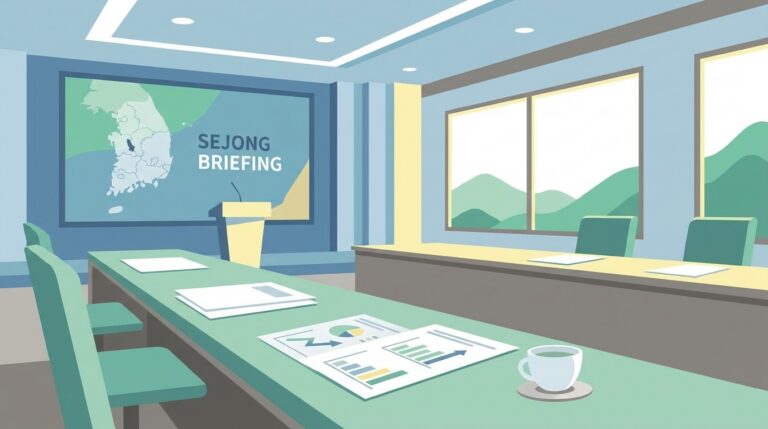
Phase 1: Empathy & Immersion Opening
안녕하세요! 매일한글 에디터입니다. (Hello! I’m your Daily Hangul editor.)
If you have ever watched the political thriller K-drama Chief of Staff (보좌관) or the investigative classic Stranger (비밀의 숲), you know the electric tension of a closed-door briefing room in Yeouido or the Sejong Government Complex. Imagine this: You have poured weeks of rigorous research into a public policy recommendation for a Korean government think tank. You step up to the podium, brimming with moral conviction, and proclaim that a welfare program or environmental mandate must be implemented because it is undeniably ethical and necessary.
Then comes the sudden, icy silence. A senior director adjusts his glasses, clears his throat, and delivers the reality check: “정책의 당위성은 충분히 알겠습니다만, 소요 추계와 행정 집행 가능성은 얼마나 따져보셨습니까?” (We understand the normative justification of the policy, but how rigorously have you evaluated the cost estimations and administrative feasibility?)
At the C1 level, fluency is no longer about simply stringing grammatically correct sentences together; it is about grasping the institutional mindsets, administrative pragmatism, and subtle power dynamics of Korean governance. Based on actual feedback from international policy analysts, legal researchers, and advanced graduate students working in Korea, this masterclass equips you with the exact lexicon, communicative etiquette, and strategic nuance required to dissect policy white papers (정책 백서) and defend legislative proposals with elite-level precision.
Phase 2: Core Expressions Deep Dive
1. 정책의 당위성 (Jeongchaek-ui dangwiseong)
- Pronunciation: [Jeong-chaek-ui dang-wi-seong] (Think of dang-wi as “tang-wee”, rhyming with “bang-we”)
- Meaning: Literal: “The ought-ness / normative necessity of a policy.” Nuanced: The ethical, moral, or theoretical justification for why a policy should exist, regardless of practical constraints.
- K-Culture Moment: In Chief of Staff, when junior aides passionately argue why an industrial safety bill must pass to protect workers, they appeal to 정책의 당위성.
- Editor’s Insight: 당위성 (Dangwiseong) stems from the philosophical concept of “what ought to be” (Sollen). In Korean bureaucratic debates, validating the 당위성 is a prerequisite, but relying on it alone is seen as naive or academic.
- Situation Spectrum: Casual 🚫 | Semi-formal ⚠️ | Formal ✅
- 🤔 Think About It: Does your native language separate the “moral imperative” of a law from its practical execution as distinctly as Korean bureaucratic discourse does?
2. 예산 소요 추계 (Yesan soyo chugye)
- Pronunciation: [Ye-san so-yo chu-gye] (Sound analogy: chu-gye sounds like “chew-gye”)
- Meaning: Literal: “Calculation of required budget.” Nuanced: A fiscal impact analysis or multi-year cost estimation model submitted alongside legislative bills.
- K-Culture Moment: During National Assembly audits (국정감사) broadcast on live news, lawmakers aggressively challenge ministers not on whether an idea is good, but on whether the 예산 소요 추계 is grounded in sound fiscal data.
- Editor’s Insight: 소요 means “required/demanded resources,” and 추계 means “estimation based on statistical trends.” Using this phrase marks you instantly as an administrative insider rather than a casual observer.
- Situation Spectrum: Casual 🚫 | Semi-formal ⚠️ | Formal ✅
- 🤔 Think About It: Why is fiscal accountability often viewed as the primary stumbling block for innovative policies in post-developmental state administrations?
3. 행정 집행 가능성을 따지다 (Haengjeong jiphaeng ganeungseong-eul ttajida)
- Pronunciation: [Haeng-jeong jip-haeng ga-neung-seong-eul tta-ji-da] (Ttajida uses a tense, double consonant: “tah-jee-da”)
- Meaning: Literal: “To calculate/weigh administrative feasibility.” Nuanced: To scrutinize whether local civil servants, departmental infrastructure, and delivery mechanisms can actually operationalize the policy without bureaucratic collapse.
- K-Culture Moment: In local government boardroom dramas, senior directors dismiss unrealistic central government directives by muttering, “현장의 집행 가능성은 따져보고 만든 정책인가요?” (Did they even consider on-the-ground feasibility when making this policy?)
- Editor’s Insight: While 따지다 can sound confrontational in casual speech (like “picking a fight”), in policy review contexts it means to rigorously assess, audit, and cross-examine variables.
- Situation Spectrum: Casual ⚠️ | Semi-formal ✅ | Formal ✅
- 🤔 Think About It: How does shifting from “가능성을 확인하다” (check feasibility) to “가능성을 따지다” (scrutinize feasibility) raise the intellectual weight of your assertion?
Phase 3: Textbook Korean vs. Real-World Korean
Situation 1: Critiquing an over-idealistic white paper proposal
- 📖 교과서 한국어 (Textbook):
이 정책은 좋은 생각이지만 돈이 많이 들고 공무원들이 일하기 힘듭니다.
(I jeongchaek-eun joeun saenggag-ijiman don-i mani deulgo gongmuwon-deur-i ilhagi himdeumnida.)
“This policy is a good idea, but it costs a lot of money and is hard for civil servants to work on.” - 🗣️ 진짜 한국어 (Real-World C1):
정책의 당위성에는 십분 공감하나, 중장기적 재정 소요 추계와 일선 지자체의 행정 집행 가능성을 보다 엄밀히 따져볼 필요가 있습니다.
(Jeongchaek-ui dangwiseong-eneun sipbun gonggamhana, jungjanggijeok jaejeong soyo chugyewa ilseon jijache-ui haengjeong jiphaeng ganeungseong-eul boda eommili ttajyeobol piryoga itseumnida.)
“While I fully acknowledge the normative justification of the policy, we need to more rigorously evaluate mid-to-long-term fiscal requirements and front-line local government administrative feasibility.” - 💡 왜 다를까? (Why the difference?):
Korean administrative communication relies on diplomatic cushion words like 십분 공감하나 (fully empathizing, yet…) to honor the author’s intent before dismantling the practical feasibility with precise institutional jargon (일선 지자체, 소요 추계).
Situation 2: Emphasizing fiscal restraint during a legislative review
- 📖 교과서 한국어 (Textbook):
정부 예산이 부족하니까 법을 다시 고쳐야 합니다.
(Jeongbu yesan-i bujokhani-kka beob-eul dasi gochyeoya hamnida.)
“Because government budget is lacking, we must fix the law again.” - 🗣️ 진짜 한국어 (Real-World C1):
한정된 국가 재정 여건을 감안할 때, 소요 예산의 현실적인 조달 방안 및 법률안의 실효성을 재검토해야 마땅합니다.
(Hanjeongdoen gukga jaejeong yeogeon-eul gamanhal ttae, soyo yesan-ui hyeonsiljeogin jodal bangan mit beomnyuran-ui silhyoseong-eul jaegeomtohaeya mattanghamnida.)
“Considering the constrained national fiscal conditions, it is only proper to re-examine realistic funding procurement measures and the actual efficacy of the legislative bill.” - 💡 왜 다를까? (Why the difference?):
High-level policy analysts avoid colloquial terms like 돈 or 부족하다. Instead, they employ conceptual constructs like 재정 여건을 감안하다 (take fiscal conditions into account) and 조달 방안 (procurement measures).
Phase 4: K-Culture Deep Dive & Non-Verbal Manners
4-1. 눈치 (Nunchi) & Administrative Posture
Presenting legislative critique in Korea is an exercise in high-stakes Nunchi (social radar). When questioning the budget estimates of a ministry’s white paper:
* The Two-Handed Document Presentation: Always hold executive summaries (요약본) with both hands when distributing them across the conference table.
* Deconstructive Eye Contact: Staring directly into a senior director’s eyes while pointing out a budget deficit can be read as an aggressive challenge. Instead, keep your eyes pinned thoughtfully to the specific data table or budgetary chart on the printed briefing paper, using a pen tip to guide attention.
* Cushioning Tone (완충어법): Begin challenging observations with slightly lower vocal pitch and deliberate pacing: “외람된 말씀이오나…” (If I may be so bold…) or “제 검토 소견으로는…” (According to my review findings…).
4-2. Cultural Code: 명분 (Honor/Justification) vs. 실리 (Pragmatism)
Korean policy debate historically hinges on the dialectic between 명분 (ideological justification / moral righteousness) and 실리 (material interest / fiscal realism). From Joseon Dynasty scholar-officials arguing over state grain reserves to modern-day technocrats at the Ministry of Economy and Finance (기획재정부), proposing an idea based solely on 당위성 exposes you to charges of “desk-bound administrative theory” (탁상행정 – Taksang haengjeong). To gain authority, you must demonstrate mastery over cold, empirical implementation costs.
Phase 5: Real-World Roleplay Scenario
Setting: A policy evaluation conference room at a national research institute in Sejong City.
Characters:
* You: Senior Foreign Policy Fellow.
* Director Kim Jin-woo (김진우 국장): A seasoned, sharp-witted budget director known for gutting idealistic proposals.
김진우 국장: 이번 친환경 모빌리티 전환 정책 백서, 방향성은 아주 훌륭합니다. 국가 탄소중립 로드맵에 부합하니까요.
(Ibeon chinhwangyeong mobilliti jeonhwan jeongchaek baekseo, banghyangseong-eun aju hullyunghamnida. Gukga tanso-jungnip rodeumaep-e buhaphanikkayo.)
“The strategic direction of this eco-friendly mobility transition white paper is excellent. It aligns with our national carbon-neutral roadmap.”
🎭 [Nods approvingly while tapping his fountain pen on the executive summary]
You: 감사합니다, 국장님. 다만 백서 검토 과정에서 정책의 당위성 못지않게 국가 예산 범위 내 소요 추계와 행정 집행 가능성을 집중적으로 따져보았습니다.
(Gamsahamnida, gukjangnim. Daman baekseo geomto gwajeong-eseo jeongchaek-ui dangwiseong motji-anke gukga yesan beomwi nae soyo chugyewa haengjeong jiphaeng ganeungseong-eul jipjungjeog-euro ttajyeoboatseumnida.)
“Thank you, Director. However, during the white paper review, alongside normative goals, I critically evaluated budget estimates within national spending limits and administrative feasibility.”
🎭 [Smoothly slides the budgetary breakdown annex across the table using both hands]
김진우 국장: 소요 추계요? 3개년 시범 사업 예산 외에 추가로 발생할 지자체 보조금 문제도 짚으셨습니까?
(Soyo chugyeyo? Samgaenyeon sibeom saeop yesan oe-e chugaro balsaenghal jijache bojogum munjedo jipeosyeotseumnikka?)
“Cost estimation? Aside from the three-year pilot project budget, did you address the municipal subsidies that will inevitably arise?”
🎭 [Leans forward with a piercing gaze, testing your analytical depth]
You: 네, 기존 백서는 지방비 매칭 비율을 과도하게 낙관했습니다. 현실적인 국비 보조율을 산정하지 않으면 일선 지자체의 집행 거부에 직면할 수 있습니다.
(Ne, gijon baekseoneun jibangbi maeching biur-eul gwadohage nakgwanhaetseumnida. Hyeonsiljeogin gukbi bojoyur-eul sanjeonghaji aneumyeon ilseon jijache-ui jiphaeng geobu-e jingmyeonhal su itseumnida.)
“Yes, the original white paper was overly optimistic regarding the local cost-matching ratio. Without calculating a realistic national subsidy rate, we may face execution refusal from front-line municipalities.”
🎭 [Speaks calmly, maintaining steady posture and pointing directly to Section 3.2]
김진우 국장: 정확한 지적입니다. 정책이 아무리 옳아도 재정이 뒷받침되지 않으면 사장되니까요. 대안은 있습니까?
(Jeonghwakhan jijeog-imnida. Jeongchaek-i amuri olhado jaejeong-i dwitbatchimdoeji aneumyeon sajangdoenikkayo. Daean-eun itseumnikka?)
“An accurate point. No matter how righteous a policy is, if fiscal backing fails, it dies on the vine. Do you have an alternative?”
🎭 [Lowers his glasses, nodding with genuine interest]
🔀 Interactive Decision Point
How do you formulate your recommendation to balance normative goals and fiscal reality?
- Option A (The Practical Phased Model): “연차별 로드맵을 수정하여 규제 정비부터 착수하고, 재정 소요는 2단계로 이연하는 방식을 제언합니다.” (Best)
- Option B (The Moral Plea): “기후 위기 대응은 돈을 따질 문제가 아니므로, 기획재정부를 적극 설득해 예산을 무조건 확보해야 합니다.” (Bad)
- Option C (The Bureaucratic Evasion): “그 문제는 국회 소관 상임위에서 알아서 논의할 사항이니 백서 본문에서는 생략하겠습니다.” (Risk)
Feedback:
- If you chose Option A (Best): Perfect! In Korean technocratic circles, proposing phased sequencing (연차별 이연) protects both policy legitimacy and fiscal credibility. Director Kim nods respectfully.
- If you chose Option B (Bad): Major pitfall. Dismissing fiscal constraints with pure moral imperatives marks you as disconnected from administrative realities. The Director will likely freeze the project.
- If you chose Option C (Risk): Dangerous abdication of duty. National think tanks are expected to provide actionable guardrails for the National Assembly, not deflect responsibility.
Phase 6: 10-Second Emotion Shadowing Drill
Practice these high-level rhetorical phrases using the cadence markers (/) and emotional tone cues.
- [🧐 진중하고 차분하게 – Deep, composed analytical tone]
정책의 당위성 못지않게 / 국가 예산 범위 내 소요 추계를 / 면밀히 따져야 합니다.
(Jeongchaek-ui dangwiseong motji-anke / gukga yesan beomwi nae soyo chugye-reul / myeonmilli ttajyeoya hamnida.)
“Alongside normative policy goals, we must meticulously weigh cost estimates within national budget constraints.” -
[💼 단호하면서도 예의 바르게 – Firm, diplomatic, authoritative tone]
입법 취지에는 공감하나 / 일선 행정 현장에서의 / 집행 실효성이 담보되지 않았습니다.
(Ippyeop chwiji-eneun gonggamhana / ilseon haengjeong hyeonjang-eseoui / jiphaeng silhyoseong-i dambodoeji anatseumnida.)
“While I empathize with the legislative intent, administrative enforcement effectiveness has not been secured on the ground.” -
[📊 전략적이고 확신에 찬 어조 – Strategic, persuasive data-driven tone]
재정 소요 모델을 재조정함으로써 / 제도 도입에 따른 / 행정적 부작용을 최소화할 수 있습니다.
(Jaejeong soyo moder-eul jaejojoenghameurosseo / jedo doip-e ttareun / haengjeongjeok bujagyong-eul choesohwahal su itseumnida.)
“By recalibrating the fiscal requirement model, we can minimize administrative side effects stemming from policy adoption.”
Phase 7: K-Culture Mini Dictionary
- 당위성 (Dangwiseong – Normative Imperative / Moral Justification)
- Usage: Refers to why something ought to happen based on constitutional, human rights, or ethical values. In white papers, it introduces the background justification before confronting budget limits.
- 소요 추계 (Soyo chugye – Cost / Resource Estimation)
- Usage: Used almost exclusively in legislative drafting, national planning, and fiscal audits. You will see 비용추계서 (Cost Estimate Statement) attached to every bill introduced in the National Assembly.
- 입법 예고 (Ippeop yego – Pre-Announcement of Legislation)
- Usage: The mandatory public consultation window (typically 40+ days) where the administration publishes draft legislation to collect civic, academic, and business stakeholder feedback.
- 국책연구기관 (Gukchaek yeongu gigwan – National/Government-Funded Think Tank)
- Usage: Institutions like KDI (Korea Development Institute), KREI, or STEPI that generate research informing ministries. Their publications set the high-water mark for Korean academic and administrative writing.
Phase 8: Professional Field Kit
Survival Expressions for Policy Forums
- 한글: 이견 조율을 위해 관계 부처 협의체를 조속히 구성해야 합니다.
- Romanization: Igyeon joyur-eul wihae gwangye bucheo hyeob-uiche-reul josokhi guseonghaeya hamnida.
- Pro Tip: Use 이견 조율 (mediating differing opinions) instead of the casual 싸움 해결 or 의견 맞추기 to describe inter-ministerial conflict resolution.
- 한글: 예산 수반 법률안인 만큼, 재원 조달 방식에 대한 구체적 명시가 선행되어야 합니다.
- Romanization: Yesan suban beomnyuran-in mankeum, jaewon jodal bangsik-e daehan guchejeok myeongsiga seonhaengdoe-eoya hamnida.
- Pro Tip: A classic C1 transition. 예산 수반 법률안 refers to legislation that mandates state funding, which legally requires explicit financing plans.
- 한글: 탁상공론에 그치지 않으려면 현장 실태 조사가 필수적입니다.
- Romanization: Taksanggongnon-e geuchiji aneuryeomyeon hyeonjang siltae josaga pilssujeog-imnida.
- Pro Tip: 탁상공론 (armchair debate / desk-bound theory) is the sharpest critique you can issue against impractical theoretical research.
Editor’s Travel & Research Note
If you are attending policy forums or conducting fieldwork in South Korea’s administrative capitals:
* Navigation: Google Maps often lags in Korea. For seamless navigation through the sprawling complex of government buildings in Sejong or Yeouido, make sure to read the 네이버 지도 앱 다운로드 guide to pinpoint specific ministry gates and underground passages.
* Research Access: Need primary source white papers? Follow the official 국회도서관 열람증 발급 가이드 to gain on-site research access to the National Assembly Library in Yeouido, home to every legislative cost estimation dossier published since 1948.
Phase 9: One Step Deeper (Reflections on Administrative Culture)
In many Western administrative frameworks, policy debates center on ideological contestation between opposing market theories or social rights. However, modern South Korean governance was forged through rapid, compressed economic modernization (압축성장), where technocrats operated under acute capital scarcity. Consequently, the Korean administrative psyche retains an intense wariness of “policies that look noble on paper but bleed national coffers.”
To critique a proposal by merely saying “이것은 정의롭지 않습니다” (This is unjust) often carries less persuasive leverage than demonstrating “이 정책은 행정 집행 단계에서 누수율이 과도하게 높습니다” (This policy suffers from excessive leakage at the administrative execution stage). In Korean public administration, true morality is demonstrated through fiscal competence and flawless operational execution.
💬 Your Turn: Have you noticed whether public policy arguments in your home country prioritize theoretical justice or fiscal feasibility? How would you articulate that balance using the phrase 당위성 and 집행 가능성?
Phase 10: FAQ & Common Pitfalls
Q: Can I use “따지다” when speaking directly to a superior in a Korean ministry?
A: Yes, but only when directed toward an abstract analytical object (e.g., “타당성을 따지다”, “가능성을 따지다”). Never use it toward an individual’s personal motives (e.g., “국장님의 생각을 따지겠습니다” is unacceptable and offensive). When analyzing data or policy systems, 따져보다 shows rigor and academic tenacity.
Q: What is the difference between “소요 추계” (Soyo chugye) and “예산 편성” (Yesan pyeonseong)?
A: 소요 추계 is the prospective calculation of how much money a policy will require over time. 예산 편성 is the formal administrative act of allocating and distributing actual government budget into departmental line items.
Q: When is it appropriate to mention “정책의 당위성”?
A: Use it in the opening remarks (서두) or executive overview of a presentation. Acknowledging the 당위성 proves you understand the human, legal, or social necessity of the bill before you dive into the pragmatic financial audit.
🚨 흔한 실수 (Common Mistakes) Warning Board
- Mistake: Using 돈 계산 (calculating money) in formal policy presentations.
- Correct Action: Replace with 소요 추계 (cost estimation) or 재정 소요 산출 (fiscal requirement calculation).
- Mistake: Overusing 명분 when you actually mean legal/normative validity.
- Correct Action: Use 정책의 당위성 (normative justification of policy) or 입법 취지 (legislative intent).
- Mistake: Saying 실현 가능성 when referring specifically to civil service operations.
- Correct Action: Use 행정 집행 가능성 (administrative enforcement feasibility) to target institutional capacity specifically.
Phase 11: Action Mission & Cultural Discovery
- 🥉 Bronze Mission (Solo Shadowing): Read aloud the Phase 6 shadowing sentences three times, focusing on maintaining a calm, authoritative chest voice without vocal upward inflection at phrase endings.
- 🥈 Silver Mission (Social/Writing Drill): Write a 2-sentence policy critique in Korean on your study journal or LinkedIn: State the 당위성 of a green energy project, followed by a critique of its 소요 추계.
- 🥇 Gold Mission (Live Application): In your next professional meeting or advanced Korean discussion seminar, use the framing phrase: “~의 당위성 못지않게 행정 집행 가능성을 면밀히 따져봐야 합니다.”
- 🎮 K-Culture Mission: Watch Episode 1 or 2 of the political drama Chief of Staff (보좌관) on Netflix. Listen carefully for moments when legislative aides mention 예산안, 상임위, or 집행. Take note of the non-verbal deference they exhibit while presenting sharp, contradictory data.
Phase 12: Interactive Quiz Challenge
1. Context Judgment
Which of the following responses is the most strategically sophisticated and polite rebuttal to an unrealistic policy proposal during a government advisory committee meeting?
* (A) 이 정책은 예산 낭비이고 공무원들이 집행하기 싫어할 것입니다.
* (B) 정책의 당위성에는 전적으로 동의하나, 중장기적 소요 추계와 일선 행정 인프라의 집행 가능성을 종합적으로 고려해야 합니다.
* (C) 현실성이 없으므로 백서 작성자를 문책하고 처음부터 다시 작성해야 합니다.
2. Fill-in-the-Blank
국가 재정법상 신규 법률안을 제안할 때는 제도적 명분뿐만 아니라 향후 5개년간의 [ ]을(를) 첨부하여 재정 건전성을 입증해야 한다.
3. Cultural True/False
In Korean bureaucratic communication, highlighting fiscal constraints and questioning administrative feasibility is seen as disrespectful toward the policy’s moral purpose.
* True / False
정답 및 해설 확인하기 (Click to reveal answers)
- Answer: (B)
- Explanation: Option B perfectly balances diplomatic affirmation (당위성에는 전적으로 동의하나) with rigorous technocratic critique (소요 추계와 집행 가능성을 종합적으로 고려). Options A and C are inappropriately blunt and colloquial.
- Answer: 소요 추계 (또는 비용추계서)
- Explanation: By law, legislative initiatives requiring national funding must submit a multi-year cost estimation model (소요 추계 / 비용추계서).
- Answer: False
- Explanation: Quite the contrary! Questioning feasibility and budget estimates is viewed as the hallmark of a mature, competent analyst who protects state solvency rather than chasing empty slogans (탁상공론).
- Explanation: Quite the contrary! Questioning feasibility and budget estimates is viewed as the hallmark of a mature, competent analyst who protects state solvency rather than chasing empty slogans (탁상공론).
🎬 Watch Our Daily Videos! (Daily Hangul Official Instagram)
Review the expressions you learned in this article with our fun daily short videos! Check out native pronunciation and real-life nuances in action.
- Instagram @dailyhangul_en







