

Bridging the Gap: How to Navigate Korean Generational Talks Like a Cultural Insider
Phase 1: Empathy (Story-Driven Opening)
안녕하세요! This is your Daily Hangul editor, your long-time cultural navigator in Seoul.
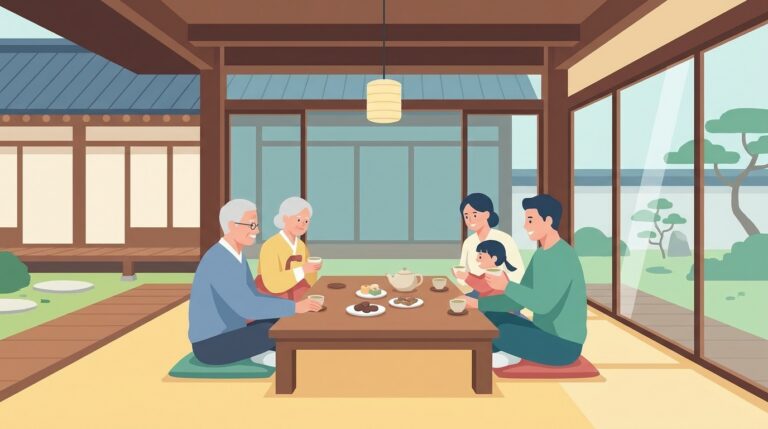
Picture this: You are sitting at a bustling hoeshik (after-work dinner) in Gwanghwamun. On your left sits Director Kim—a veteran of Korea’s rapid industrial push who believes loyalty and staying late build character. On your right sits Jiwon, an ambitious 26-year-old UX designer who champions remote work, psychological safety, and radical transparency. Suddenly, the conversation turns to work ethic. Director Kim sighs, talking about the sacrifice of working six-day weeks in the 1980s, while Jiwon discreetly checks her phone, wondering if this conversation will ever end. You are caught in the middle. Do you smile and stay quiet? Or do you have the linguistic tools to honor both lived experiences without sounding patronizing or out-of-touch?
South Korea is one of the most intellectually thrilling yet socially complex spaces on earth precisely because three distinct eras live under one roof: the industrialization generation who rebuilt a war-torn nation, the 86-democratization movement leaders, and the digital-native MZ/Alpha generations who grew up in hyper-connected affluence. When learners reach the C1 level, textbook politeness alone will no longer save you. You need nuanced, empathetic, and culturally resonant discourse. Drawing directly from executive coaching sessions with international leaders in Seoul, this guide gives you the exact phrases and socio-cultural radar to turn generational tension into profound mutual empathy.
Phase 2: Core 3 Expressions In-Depth
1. 격세지감 (Gyeok-se-ji-gam)
- Pronunciation: [Gyeok-se-ji-gam] (Think of the first syllable ‘gyeok’ like a sharp, crisp ‘cluck’ stopped short at the throat, followed by a breezy ‘se’ like a sudden exhale of steam, finishing with ‘ji-gam’ like rhythmically tapping your fingers.)
- Meaning: Literal: Feeling of a generational gap spanning worlds. / Nuance: Experiencing awe, slight melancholy, or sheer amazement at how rapidly society, technology, or lifestyles have transformed.
- K-Culture Moment: Seen frequently in reflective slice-of-life dramas like Reply 1988 or documentary interviews when elderly market vendors look up at towering Gangnam skyscrapers.
- Editor’s Insight: It is not merely “things have changed.” It captures the emotional vertigo of someone who remembers riding dirt roads seeing autonomous delivery robots today.
- Situation Spectrum: Casual (⚠️ slightly literary) | Semi-formal (✅) | Formal (✅)
- 🤔 Think About It: Does your native tongue have a phrase that captures the exact physical sensation of being an alien in your own hometown due to hyper-accelerated progress?
2. 시대착오적 (Si-dae-chak-o-jeok)
- Pronunciation: [Si-dae-chag-o-jeok] (Glide smoothly through ‘si-dae’, land sharply on ‘chak’ as if snapping dry spaghetti, and resolve cleanly on ‘o-jeok’.)
- Meaning: Literal: Mistaking the time period. / Nuance: Anachronistic; holding outdated values or policies that are out of sync with current contemporary consciousness.
- K-Culture Moment: Used by young protagonists in corporate or legal dramas (like Extraordinary Attorney Woo or Agency) when challenging rigid, patriarchal corporate hierarchies.
- Editor’s Insight: Be careful! Leveling this directly at a senior’s personal story sounds like an insult. Frame it around concepts or outdated protocols, never a person’s dignity.
- Situation Spectrum: Casual (⚠️ harsh) | Semi-formal (✅ when debating concepts) | Formal (✅ debate/media)
- 🤔 Think About It: How does calling an idea “outdated” differ from calling it “anachronistic” in your language’s diplomatic discourse?
3. 상생과 화합 (Sang-saeng-gwa hwa-hap)
- Pronunciation: [Sang-saeng-gwa hwa-hap] (Sustain a warm nasal resonance on ‘sang-saeng’, transition naturally with ‘gwa’, and breathe open on ‘hwa-hap’ like letting out a relaxed sigh.)
- Meaning: Literal: Mutual living and harmonious integration. / Nuance: Win-win coexistence; moving past binary culture wars into mutual synergy and collective understanding.
- K-Culture Moment: The closing rhetoric used in inspiring civic broadcasts, town halls, or cultural reconciliations at the end of deep conflict arcs in Korean cinema.
- Editor’s Insight: This phrase carries deep philosophical weight from East Asian organicism. It implies that generations are not adversaries in a zero-sum game, but branches of the same tree.
- Situation Spectrum: Casual (🚫 overly lofty) | Semi-formal (✅) | Formal (✅)
- 🤔 Think About It: Notice how Korean discourse prefers organic metaphors of harmony (화합) over western legalistic “compromise” (타협).
Phase 3: Textbook Korean vs. Real Korean
Situation 1: Describing deep ideological friction between age groups
- 📖 교과서 한국어: 세대 간의 갈등이 매우 심각합니다. (Se-dae gan-ui gal-deung-i mae-u sim-gak-ham-ni-da.)
- “Generational conflict is very serious.”
- 🗣️ 진짜 한국어: 세대 간에 살아온 궤적이 달라서 체감하는 온도 차가 정말 커요. (Se-dae gan-e sal-a-on gwe-jeog-i dal-la-seo che-gam-ha-neun on-do cha-ga jeong-mal keo-yo.)
- “Because the trajectories each generation lived through are so distinct, the perceived temperature difference is truly vast.”
- 💡 왜 다를까? Advanced native speakers rarely describe societal friction with blunt labels like “conflict is serious.” Instead, they use poetic and visceral spatial metaphors like 궤적 (trajectory) and 온도 차 (difference in temperature) to maintain diplomatic empathy while acknowledging reality.
Situation 2: Proposing a collaborative meeting ground
- 📖 교과서 한국어: 어르신들의 말을 듣고 청년들과 토론해야 합니다. (Eo-reu-sin-deul-ui mal-eul deut-go cheong-nyeon-deul-gwa to-ron-hae-ya ham-ni-da.)
- “We must listen to the elderly and debate with the youth.”
- 🗣️ 진짜 한국어: 양 세대의 시대정신을 존중하면서 접점을 찾아가는 게 급선무예요. (Yang se-dae-ui si-dae-jeong-sin-eul jon-jung-ha-myeon-seo jeop-jeom-eul cha-ja-ga-neun ge geup-seon-mu-ye-yo.)
- “Respecting the zeitgeist of both eras while finding common ground is the immediate priority.”
- 💡 왜 다를까? Using terms like 시대정신 (zeitgeist) elevates the debate from individual bickering to historical understanding, preventing defensive reactions from any party.
Phase 4: K-Culture Deep Dive & Non-Verbal Manners
4-1. 눈치 (Nunchi) & Gestures
When older and younger Koreans debate, subtle bodily rhetoric speaks louder than vocabulary:
* The Tilt of Acknowledgment: When an elder shares memories of hardships, do not nod vigorously like a bobblehead (which can look superficial). Give a slow, deliberate down-tilt of your chin, holding your gaze softly downwards for a second to show 공감 (somber resonance).
* The Two-Handed Softener: If you must offer a counterpoint to an older colleague, keep your hands rested together on the table, palms soft. Avoid pointing or sharp palm gestures. Start with an open breath: “말씀하신 배경은 충분히 공감합니다만…” (I deeply empathize with the context you shared, however…).
4-2. Cultural Code Analysis: The Echo of Compressed Growth (압축성장)
To bridge Korean generations, you must understand that the modern Korean elder lived through an economic transformation that took Western societies 200 years, compressed into just 40.
* Watch films like Ode to My Father (국제시장) and contrasting modern office dramas like Misaeng (미생).
* When seniors emphasize 근면 (diligence) and 헌신 (devotion), they are not bragging; they are recounting survival reflexes in an era without social safety nets. Conversely, when MZ workers insist on 워라밸 (work-life balance) and personal boundaries, they are confronting intense hyper-competition in an era of slowing growth. Recognizing these differing survival survival kits transforms judgment into empathy.
Phase 5: Real-World Roleplay Scenario
Setting: A quiet private dining room in Jongno.
Characters:
* Director Park (59): Demanding, warm-hearted veteran of the democratization generation.
* Minji (28): Sharp, digital-native strategy associate.
* Alex (You – C1 Learner): Global Project Lead.
Turn 1
* 박 부장 (Director Park): 🎭 고기를 뒤집으며 한숨을 쉰다 요즘 젊은 직원들은 주말 특근이라도 하자고 하면 표정부터 굳어버려요. 우리 때는 회사가 곧 가족이었는데 말이지.
(Yo-jeum jeol-meun jik-won-deul-eun ju-mal teuk-geun-i-ra-do ha-ja-go ha-myeon pyo-jeong-bu-teo gut-eo-beo-ryeo-yo. U-ri ttae-neun hoe-sa-ga got ga-jok-i-eot-neun-de mal-i-ji.)
“Young staff these days freeze up the moment weekend shifts are mentioned. Back in our day, the company was family.”
Turn 2
* 민지 (Minji): 🎭 젓가락을 내려놓고 침착하지만 단호하게 부장님 시절의 헌신은 존경하지만, 지속 가능한 성과를 내려면 개인의 회복 시간도 필수적인 시대잖아요.
(Bu-jang-nim si-jeol-ui heon-sin-eun jon-gyeong-ha-ji-man, ji-sok ga-neung-han seong-gwa-reul nae-ryeo-myeon gae-in-ui hoe-bok si-gan-do pil-su-jeok-in si-dae-jan-a-yo.)
“I respect your generation’s devotion, Director, but in this era, personal recovery time is indispensable for sustainable performance.”
Turn 3
* Alex (You): 🎭 두 손으로 잔을 살짝 만지며 온화하게 중재한다 두 분 말씀 모두 깊이 공감되는 지점이 있습니다.
(Du bun mal-sseum mo-du gip-i gong-gam-doe-neun ji-jeom-i it-seum-ni-da.)
“I see profound points of empathy in what both of you have shared.”
Turn 4
* 박 부장 (Director Park): 🎭 알렉스를 쳐다보며 그래? 알렉스 팀장 눈에는 우리 세대가 너무 구시대적이고 융통성 없어 보이나?
(Geu-rae? Al-rek-seu tim-jang nun-e-neun u-ri se-dae-ga neo-mu gu-si-dae-jeok-i-go yung-tong-seong eop-seo bo-i-na?)
“Is that so? In your eyes, Team Leader Alex, does our generation seem terribly outdated and inflexible?”
Turn 5
* Alex (You): 전혀 그렇지 않습니다. 부장님 세대의 헌신이 있었기에 오늘날의 인프라와 기회가 존재한다는 건 격세지감을 느끼며 늘 감사하는 부분입니다.
(Jeon-hyeo geu-reoh-ji an-seum-ni-da. Bu-jang-nim se-dae-ui heon-sin-i it-eot-gi-e o-neul-nal-ui in-peu-ra-wa gi-hoe-ga jon-jae-han-da-neun geon gyeok-se-ji-gam-eul neu-kki-myeo neul gam-sa-ha-neun bu-bun-im-ni-da.)
“Not at all. Recognizing that today’s infrastructure and opportunities exist thanks to your generation’s dedication fills me with a deep sense of wonder and gratitude.”
Turn 6
* 민지 (Minji): 🎭 놀란 듯 고개를 끄덕인다 맞아요. 저도 그 기본 바탕을 부정하는 건 절대 아니에요.
(Maj-a-yo. Jeo-do geu gi-bon ba-tang-eul bu-jeong-ha-neun geon jeol-dae a-ni-e-yo.)
“That’s true. I am certainly not denying that foundational groundwork.”
Turn 7
* Alex (You): 🎭 두 사람을 번갈아 바라보며 다만 지금은 효율성과 몰입도를 극대화하는 상생의 방식을 함께 설계해 나갈 전환기라고 생각합니다.
(Da-man ji-geum-eun hyo-yul-seong-gwa mol-ip-do-reul geuk-dae-hwa-ha-neun sang-saeng-ui bang-sig-eul ham-kke seol-gye-hae na-gal jeon-hwan-gi-ra-go saeng-gak-ham-ni-da.)
“However, I believe we are currently in a transitional period where we must design a mutually beneficial way forward that maximizes both efficiency and deep focus.”
Turn 8
* 박 부장 (Director Park): 🎭 미소를 지으며 잔을 들어 올린다 하하, 알렉스 팀장이 다리를 참 잘 놓네. 자, 서로의 시대를 위해 건배합시다!
(Ha-ha, Al-rek-seu tim-jang-i da-ri-reul cham jal noh-ne. Ja, seo-ro-ui si-dae-reul wi-hae geon-bae-hap-si-da!)
“Haha, you build bridges remarkably well, Alex. Come, let’s toast to each other’s eras!”
🔀 Interactive Choice Point
When Director Park asks if his generation looks outdated (Turn 4), how would you respond?
- Option A: “부장님, 솔직히 요즘 세상에 주말 출근을 강요하는 건 다소 시대착오적입니다.”
- Outcome (Bad): You used 시대착오적 as a direct personal attack. Director Park shuts down, feels invalidated, and the team atmosphere becomes icy.
- Option B: “부장님 세대의 피땀 어린 노력을 깊이 존중하며, 그 바탕 위에서 새로운 시대적 해법을 모색하고 싶습니다.”
- Outcome (Best): Pure cultural mastery. You validate the sacrifice first (saving face and giving honor), then redirect toward modern solutions. Both feel heard.
- Option C: “저는 외국인이라 한국의 세대 차이에 대해 잘 모르겠습니다.”
- Outcome (Risk): Deflection avoids conflict but forfeits leadership status. You miss an opportunity to prove your high-level cultural diplomacy.
Phase 6: 10-Second Emotion Shadowing Drill
Read these out loud, observing the slash marks (/) for breath pauses, matching the emotional tone in brackets:
[🤔 사려 깊고 공감하듯이 / Thoughtful & Empathetic]
양 세대가 살아온 / 시대적 배경을 헤아려 보면, / 서로의 시선이 / 다를 수밖에 없습니다.
(Yang se-dae-ga sal-a-on / si-dae-jeok bae-gyeong-eul he-a-ryeo bo-myeon, / seo-ro-ui si-seon-i / da-reul su-bak-e eop-seum-ni-da.)
“When taking into account the historical contexts each generation lived through, it is only natural that their perspectives differ.”-
[🤝 차분하면서도 단호하게 / Calm yet Resolute]
단순한 과거의 답습이 아니라, / 현재에 맞는 / 상생의 지혜를 모아야 할 때입니다.
(Dan-sun-han gwa-geo-ui dap-seub-i a-ni-ra, / hyeon-jae-e mat-neun / sang-saeng-ui ji-hye-reul mo-a-ya hal ttae-im-ni-da.)
“Rather than merely repeating past formulas, it is time to gather the wisdom of coexistence fitted for the present day.” -
[✨ 긍정적이고 포용적으로 / Warm & Inclusive]
서로의 다름을 / 소모적인 갈등이 아닌 / 건강한 자극으로 받아들이면 좋겠습니다.
(Seo-ro-ui da-reum-eul / so-mo-jeok-in gal-deung-i a-nin / geon-gang-han ja-geug-eu-ro bat-a-deul-i-myeon joh-get-seum-ni-da.)
“I hope we can embrace our differences not as exhausting conflict, but as healthy invigoration.”
Phase 7: K-Culture Mini Dictionary
-
꼰대 (Kkon-dae) [Noun]
Translation: Dogmatic elder / Rigid bossy individual.
Context: Originally slang for old men or teachers, it now describes anyone—regardless of age—who imposes their past success formulas onto others while dismissing current realities. -
각자도생 (Gak-ja-do-saeng) [Idiom]
Translation: Everyone fending for themselves.
Context: A widespread socio-cultural term describing hyper-individual survival strategies in modern competitive Korea when social safety nets feel fragile. -
온고지신 (On-go-ji-sin) [Idiom]
Translation: Reviewing the old to understand the new.
Context: A classic Confucian idiom frequently utilized in high-level corporate culture to honor traditional grit while innovating modern agile methodologies. -
디지털 네이티브 (Di-ji-teol Ne-i-ti-beu) [Noun]
Translation: Digital Native.
Context: Used in media to refer to MZ and Gen Alpha cohorts who process information visually, iteratively, and non-hierarchically.
Phase 8: Survival Kit for Travelers & Expats
Survival Expressions TOP 3
- 말씀 나누면서 정말 많은 것을 배웁니다.
(Mal-sseum na-nu-myeon-seo jeong-mal manh-eun geos-eul bae-um-ni-da.)
Pro Tip: The golden bridge phrase when speaking with seniors. It flatters their wisdom and defuses any perceived generational defiance. - 각자의 위치에서 최선을 다하고 계시네요.
(Gak-ja-ui wi-chi-e-seo choe-seon-eul da-ha-go gye-si-ne-yo.)
Pro Tip: A neutral, empathetic validator that honors both a stressed junior coworker and a burdened senior executive. - 저희 세대와는 또 다른 통찰이 느껴집니다.
(Jeo-hui se-dae-wa-neun tto da-reun tong-chal-i neu-k擊-yeo-jim-ni-da.)
Pro Tip: A high-register comment to praise unique perspectives without judging them as right or wrong.
Editor’s Travel Note
To truly grasp Korea’s hyper-compressed timeline, take a morning walk through tapgol park near Jongno 3-ga, where elderly veterans gather, then hop on the subway to Seongsu-dong, Seoul’s hipster hub packed with popup stores. For deeper historic immersion, check out the National Museum of Korean Contemporary History guide, situated right across from Gwanghwamun. Don’t forget to navigate using the Naver Map app download for transit to seamlessly explore these contrasting historical zones.
Phase 9: “One Step Deeper” (Philosophical Essay)
South Korea’s generational landscape is not merely a clash of ages; it is an overlap of distinct historic epochs occurring simultaneously on the same street corner. When an elderly citizen scolds someone for not offering a seat on the subway, or when a young professional turns off Slack right at 6:00 PM, both are defending valid survival frameworks shaped by their respective socio-political landscapes. To speak Korean at the C1 level is to look beyond surface irritation and recognize that language in Korea is an organic living museum of survival, democracy, and hyper-modern ambition.
💬 Your Turn: Have you ever experienced a generational gap during an interaction in Korea? How did you respond, and what Korean expression would you use now?
Phase 10: FAQ & Mistake Prevention
Q: Can I use the word “꼰대 (Kkon-dae)” jokingly in front of older Koreans?
A: Absolutely not unless you are extremely close and the older person uses it self-deprecatingly first. Even in humor, labeling someone a kkondae implies they are deaf to new perspectives and emotionally arrogant.
Q: How do I disagree with an elder colleague politely at C1 level?
A: Always cushion your rebuttal using the “동의-전환 (Agree-Pivot)” technique. Start with: “선배님 말씀의 취지는 깊이 공감합니다만 (While I deeply resonate with the intent of your words), 이런 측면도 고려해 볼 수 있을 것 같습니다 (it seems we could also consider this angle).”
Q: Is MZ generation (MZ세대) considered an offensive term?
A: No, it is widely utilized across Korean news, business reports, and marketing. However, some young professionals find it slightly reductive because it lumps people born in 1982 and 2005 into one generic category.
🚨 Common Mistakes Warning Board
- Mistake 1: Calling someone’s thoughts “틀렸다 (wrong)” instead of “다르다 (different)”.
- Correct Action: Use “관점의 차이인 것 같습니다” (It seems to be a difference in perspective).
- Mistake 2: Using informal Banmal gestures (like casually tapping someone’s shoulder) while using formal 존댓말.
- Correct Action: Keep hands composed and avoid touching senior conversation partners unless invited.
- Mistake 3: Treating generational discourse as a debate to be won.
- Correct Action: Aim for 화합 (harmony) and 상생 (coexistence) rather than victory.
Phase 11: Action Missions
- 🥉 Bronze Mission: Practice the 3 shadowing sentences from Phase 6 aloud in front of a mirror until you can deliver them without hesitating.
- 🥈 Silver Mission: Write an Instagram caption or personal journal entry using 격세지감 to describe a change in your own life or hometown.
- 🥇 Gold Mission: Use the phrase “각자의 위치에서 최선의 방안을 고민하고 계시네요” during your next Korean group discussion or conversation practice.
- 🎮 K-Culture Mission: Watch an episode of a Korean variety or workplace show (e.g., You Quiz on the Block) and note down three expressions older guests use to describe the younger generation.
Phase 12: Interactive Quiz Challenge
- Situational Judgment: You are discussing workplace efficiency with an executive who insists on doing everything manually on paper. Which phrase offers the most respectful, diplomatic counterpoint?
- (A) “부장님, 그 방식은 너무 구시대적이고 게으른 방식입니다.”
- (B) “전통적인 방식의 신중함도 중요하지만, 디지털 툴과의 상생을 꾀하면 훨씬 효율적일 것 같습니다.”
- (C) “꼰대처럼 굴지 마시고 요즘 툴을 배우세요.”
- Fill in the Blank:
새로운 빌딩들 사이에 옛 한옥들이 보존된 풍경을 보니 참으로 ( )을/를 느끼게 됩니다. -
True or False: Calling a historical policy “시대착오적” in an academic debate is considered an intolerable personal insult in Korea.
👉 Click here to reveal answers & explanations
- Answer: (B)
Explanation: Option B honors the traditional merit (신중함) while diplomatically suggesting synergy (상생) with digital tools. Options A and C are disrespectful. -
Answer: 격세지감
Explanation: 격세지감 captures the profound feeling of temporal transition between ancient Hanoks and modern skyscrapers. -
Answer: False
Explanation: In objective socio-political or academic debates, describing policies or ideas as 시대착오적 (anachronistic) is acceptable and common; it only becomes rude when directed as an ad hominem insult against an individual.
🎬 Watch Our Daily Videos! (Daily Hangul Official Instagram)
Review the expressions you learned in this article with our fun daily short videos! Check out native pronunciation and real-life nuances in action.
- Instagram @dailyhangul_en







