

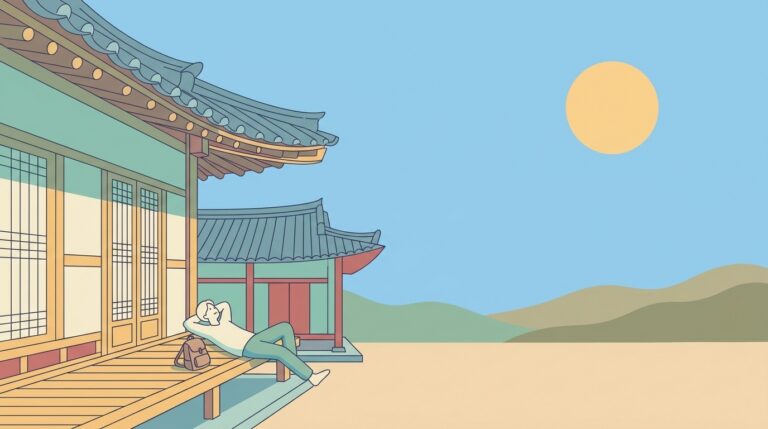
Beyond the Ppalli-Ppalli Rush: How Lying on a Hanok Porch Taught Me to Breathe
Phase 1: 공감 (Story-Driven Opening)
안녕하세요! 매일한글 에디터입니다. (Hello! I’m your Daily Hangul editor.)
If you have ever visited Seoul, you know the exhilarating rhythm of Ppalli-Ppalli (빨리빨리, “hurry, hurry”). The subway doors chime and close in a flash, your iced Americano appears before your receipt even finishes printing, and overnight deliveries (saebyeok-baesong) arrive on your doorstep while you are still dreaming. It is remarkably convenient—until you realize your shoulders are permanently tensed up by your ears.
A few years ago, during an exhausting sprint of editing and city deadlines, I booked a bus to a quiet village in Damyang. There, I kicked off my shoes, climbed onto the wide wooden porch (daecheongmaru, 대청마루) of a century-old Hanok, and collapsed onto my back. I did not check notifications. I did not make a to-do list. I simply stared at the swallows swooping beneath the curved tiled eaves and watched the summer clouds drift past. In that quiet hour, my host grandmother handed me a bowl of cold barley tea and whispered, “이제야 숨통이 좀 트이지?” (Now you can finally catch your breath, right?)
Many of our Daily Hangul students tell us: “I know how to order food fast, but how do I talk about slowing down and resting in Korean?” Today, we are putting away the flashcards of hustle culture. You will learn the authentic, poetic, and everyday Korean expressions needed to take a well-deserved mental pause (swimpyo, 쉼표)—grounded in real rural culture (Chonkangse) and backed by feedback from hundreds of intermediate learners.
Phase 2: 핵심 표현 3선 심층 분석 (Top 3 Core Expressions)
1. 아무것도 안 하고 멍때리고 싶어요 (Amugeotdo an hago meongttaerigo sipeoyo)
- Pronunciation: [Ah-moo-geot-do an ha-go meong-ttae-ri-go shi-peo-yo] (Think of “meong” like the deep, hollow resonance of a brass gong: “mung”, followed by a sharp pop “ttae-ri”)
- Meaning:
- Literal: I want to hit a blank space and do nothing.
- Real Nuance: “I just want to space out and completely turn off my brain for a while.”
- K-Culture Moment: Seen frequently in healing reality shows like Three Meals a Day (삼시세끼) or In the SOOP, when idols collapse into camping chairs after hectic world tours and just gaze blankly into the campfire or the horizon.
- Editor’s Insight: Meongttaerida (멍때리다) used to be colloquial slang, but it is now culturally celebrated. Korea even hosts national “Spacing Out Competitions” (Meongttae-gi Daehoe) by the Han River! Use it when life feels overstimulating.
- Situation Spectrum: Casual: ✅ | Semi-formal: ✅ (with polite -yo) | Formal: 🚫 (In a job interview, say 휴식을 취하고 싶습니다 instead)
- 🤔 Think About It: Does your native language view “spacing out” as being lazy, or does it recognize it as a legitimate form of emotional recovery like Korean does?
2. 잠시 쉼표를 찍는 중이에요 (Jamsi swimpyoreul jjingneun jung-ieyo)
- Pronunciation: [Jam-shi swim-pyo-reul jjing-neun joong-ee-eh-yo] (Pronounce “swim” softly like blowing cool air over hot soup: “shweem”)
- Meaning:
- Literal: I am in the middle of stamping a comma.
- Real Nuance: “I am taking a mindful pause in my life to regroup.”
- K-Culture Moment: The signature theme phrase in dramas like Summer Strike (아무것도 하고 싶지 않아) and Little Forest, where burned-out city dwellers pause their careers to figure out who they truly are.
- Editor’s Insight: A swimpyo (쉼표) is literally a punctuation comma. In Korean philosophical thought, life is a continuous sentence; taking a rest isn’t a full stop (period, 마침표), but simply a brief comma (swimpyo) before the next clause begins.
- Situation Spectrum: Casual: ✅ | Semi-formal: ✅ | Formal: ⚠️ (Grammatically acceptable, but slightly poetic)
- 🤔 Think About It: Why do you think modern Koreans prefer describing life choices as a “comma” rather than “quitting” or “giving up”?
3. 마루에 누워 있으니 살 것 같아요 (Marue nuwo isseuni sal geot gat-ayo)
- Pronunciation: [Mah-roo-eh noo-wo ee-sseu-nee sal geot gah-tah-yo] (The phrase “sal geot” sounds like saying “sal-gut” with a bright lift at the end)
- Meaning:
- Literal: Because I am lying on the wooden floor, it feels like I will live.
- Real Nuance: “Lying here on this wooden porch makes me feel alive again / What a lifesaver!”
- K-Culture Moment: Characters collapsing onto the cool floorboards of a rural countryside house in K-Dramas after walking up a scorching mountain path under the July sun.
- Editor’s Insight: Koreans constantly use 살 것 같다 (sal geot gat-da, “I feel like I’ll survive”) after drinking ice water on a hot day, taking off tight boots, or resting in a breezy spot. It dramatically conveys profound physical relief.
- Situation Spectrum: Casual: ✅ | Semi-formal: ✅ | Formal: ⚠️
- 🤔 Think About It: Notice how English speakers say “This is heaven,” while Koreans say “I feel like I will live.” What does this reveal about the value placed on vitality and survival?
Phase 3: 교과서 한국어 vs 진짜 한국어 (Textbook vs. Real-Life Korean)
Situation 1: Explaining that you are enjoying peaceful downtime
- 📖 교과서 한국어 (Textbook):
- 저는 지금 조용히 휴식을 취하고 있습니다. (Jeoneun jigeum joyonghi hyusigeul chwihago itseumnida.)
- “I am currently taking a quiet rest.”
- 🗣️ 진짜 한국어 (Real-Life):
- 지금 바람 쐬면서 완전 멍때리고 있어. (Jigeum baram ssoemyeonseo wanjeon meongttaerigo isseo.)
- “I’m out getting some fresh air and totally spacing out right now.”
- 💡 왜 다를까? Textbook Korean treats resting as a formal event or clinical activity (hyusik-eul chwihada). Native speakers prefer sensory-rich verbs like baram ssoeda (catching the breeze) and the trendy, relatable meongttaerida.
Situation 2: Expressing relief after escaping overwhelming pressure
- 📖 교과서 한국어 (Textbook):
- 이제 제 마음이 매우 편안해졌습니다. (Ije je ma-eumi maeu pyeon-anhaejeotseumnida.)
- “Now my mind has become very comfortable.”
- 🗣️ 진짜 한국어 (Real-Life):
- 도시에만 있다가 여기 오니까 이제야 좀 숨통이 트여요. (Dosieman itdaga yeogi onikka ijeya jom sumtong-i teuyeoyo.)
- “After being cooped up in the city, coming here lets me finally breathe again.”
- 💡 왜 다를까? Korean expressions for emotional decompression are deeply rooted in physical respiration. Saying sumtong-i teu-ida (literally, “my airway has opened up”) vividly depicts release from suffocating hustle culture.
Phase 4: K-Culture 딥다이브 & 비언어적 매너 (Deep Dive & Non-Verbal Manners)
4-1. 눈치 (Nunchi) & Hanok Etiquette
When you step onto the daecheongmaru (대청마루, the open wooden floor of a Hanok):
1. The Stepping Stone Ritual (Diddimdol, 디딤돌): Never step onto the wooden floor with shoes on! Turn your shoes outward (facing the yard) on the stone step before stepping up in clean socks or bare feet. This is both polite and ensures you can slide them back on seamlessly when stepping down.
2. The Exhale of Surrender: When leaning back or lying down on the maru, a slow, audible sigh—“하아~ 좋다” (Haaa~ jota)—is completely acceptable. It shows your host that you feel safe and unburdened in their home.
3. Postural Modesty: While lying down is welcome in casual countryside stays, avoid sprawling out with your feet pointed directly toward village elders or an open altar room (Anbang).
4-2. Cultural Code: ‘Chonkangse’ (촌캉스) & Slow Cinema
While Seoul has popularized ultra-fast cafe culture, younger generations are rebelling against constant productivity through Chonkangse (촌캉스)—a portmanteau of Chon (countryside, 촌) and Vacance (vacation). Instead of checking off 15 tourist attractions a day, visitors rent out old farmhouses, wear floral granny pants (ilbaji, 일바지), brew tea, and practice slow living, mirroring the beloved film Little Forest (리틀 포레스트). It is the quintessential cultural antidote to Ppalli-Ppalli.
Phase 5: 실전 롤플레이 시나리오 (Real-World Roleplay Scenario)
Setting: You have escaped Seoul to stay at a traditional tile-roofed Hanok homestay in rural Damyang. The afternoon air smells of cedar and sweet rain. An elderly host, Grandma Sun-ja (순자 할머니), comes out holding a woven tray.
- 할머니 (Grandma Sun-ja): 아이구, 서울에서 여기까지 오느라 고생 많았지? (Aigu, Seoureseo yeogikkaji oneura gosaeng manatji?)
- 🎭 (Smiling warmly, setting down a bowl of chilled watermelon slices on the wooden floor)
- “Oh goodness, you went through so much trouble traveling all the way from Seoul, didn’t you?”
- 나 (You): 아니에요, 할머니. 마루에 올라오자마자 바람이 불어서 시원해요. (Anieyo, halmeoni. Marue olla-ojamaja barami bureoseo siwonhaeyo.)
- 🎭 (Gently wiping your hands and looking up at the high wooden beams)
- “Not at all, Grandma. As soon as I stepped onto the maru, a cool breeze blew in.”
- 할머니 (Grandma Sun-ja): 그래, 시골집 마루가 여름엔 최고야. 도시에서는 맨날 바쁘게 뛰어다녔지? (Geurae, sigoljip maruga yeoreumen choegoya. Dosieseoneun maennal bappeuge ttwieodanyeotji?)
- 🎭 (Handing you a slice of watermelon with both hands)
- “Indeed, a country porch is the best in summer. You must have been running around busy every single day in the city, right?”
- 나 (You): 네, 맞아요. 항상 시간에 쫓기듯 살아서 너무 지쳤었어요. (Ne, majayo. Hangsang sigane jjokgideut saraseo neomu jichyeosseosseoyo.)
- 🎭 (Taking a bite of watermelon and letting your shoulders sink down)
- “Yes, exactly. I was always living like I was chased by time, so I was exhausted.”
- 할머니 (Grandma Sun-ja): 여긴 아무도 재촉하는 사람 없으니, 그냥 마루에 편하게 누워 봐. (Yeogin amudo jaechokhaneun saram eopseuni, geunyang marue pyeonhage nuwo bwa.)
- 🎭 (Patting the smooth, polished floorboards next to you)
- “Nobody rushes you here, so just lie back comfortably on the floor.”
- 나 (You): 이렇게 누워서 하늘만 보고 있으니 살 것 같아요. (Ireoke nuwoseo haneulman bogo isseuni sal geot gat-ayo.)
- 🎭 (Stretching your arms over your head with a relieved smile)
- “Lying down like this and just watching the sky makes me feel alive again.”
- 할머니 (Grandma Sun-ja): 그래, 그래. 인생엔 가끔 그렇게 쉼표도 찍고 멍도 때려야 하는 법이야. (Geurae, geurae. Insaengen gakkeum geureoke swimpyodo jjikgo meongdo ttaeryeoya haneun beobiya.)
- 🎭 (Fanning you softly with a woven bamboo fan)
- “That’s it, that’s it. In life, everyone needs to put down a comma and just zone out once in a while.”
- 나 (You): 네, 오늘은 아무 생각도 안 하고 푹 쉴게요. (Ne, oneureun amu saenggakdo an hago puk swilgeyo.)
- 🎭 (Closing your eyes as a sparrow chirps outside)
- “Yes, today I won’t think about anything and will just rest deeply.”
🔀 인터랙티브 분기점 (Interactive Choice)
Grandma asks: “저녁 먹기 전까지 뭐 할 거니?” (What will you do until dinnertime?)
- 선택지 A: “숙제랑 밀린 이메일을 마루에서 빨리 끝내려고요!” (Sukjerang millin imeireul marueseo ppalli kkeunnaeryeogoyo!)
- 👉 Feedback [Bad]: Oh no! Grandma will click her tongue (Tsk-tsk). Bringing city rush and laptop deadlines to a Hanok maru defeats the entire purpose of village healing.
- 선택지 B: “마루에 누워서 한 시간만 아무것도 안 하고 멍때릴래요.” (Marue nuwoseo han siganman amugeotdo an hago meongttaerillaeyo.)
- 👉 Feedback [Best]: Perfect 100 points! Grandma will laugh, give you an extra slice of sweet melon (chamoe), and tell you to take a nap.
- 선택지 C: “심심한데 시내에 가서 쇼핑몰 구경하고 올게요.” (Simsimhande sinaee gaseo syopingmol gugyeonghago olgeyo.)
- 👉 Feedback [Risk]: You miss out on the serene magic of the countryside, and getting a local rural taxi before dinner might leave you stranded in the dark!
Phase 6: 10초 감정 섀도잉 드릴 (10-Second Emotion Shadowing Drill)
Practice matching your pitch and breath to these emotional cadences. Pauses are indicated by /.
[😌 깊은 한숨과 온전한 안도감 (Deep sigh with total relief)]- “마루에 누워 있으니 / 이제야 좀 / 살 것 같아요.”
- (Marue nuwo isseuni / ijeya jom / sal geot gat-ayo.)
[🥱 나른하고 평화로운 말투 (Languid, dreamy tone)]- “아무 생각 없이 / 그냥 반나절만 / 멍때리고 싶다…”
- (Amu saenggak eopsi / geunyang bannajeolman / meongttaerigo sipda…)
[🧘 담담하고 성숙한 다짐 (Calm, grounded affirmation)]- “서두르지 않고 / 잠시 내 삶에 / 쉼표를 찍는 중이에요.”
- (Seodureuji anko / jamsi nae salme / swimpyoreul jjingneun jung-ieyo.)
Phase 7: K-Culture 미니 사전 (Mini Dictionary)
- 멍때리기 (Meongttaerigi)
- Meaning: The art of zoning out / spacing out.
- Usage: Used everywhere from university libraries to office breaks: “우리 머리도 식힐 겸 10분만 멍때리자” (Let’s zone out for 10 minutes to cool off our heads).
- 대청마루 (Daecheongmaru)
- Meaning: The main central wooden-floored hall of a traditional Hanok house.
- Usage: Acts as an open-air living room that connects all rooms while catching mountain cross-breezes.
- 촌캉스 (Chonkangse)
- Meaning: Countryside vacation (Village + Vacance).
- Usage: A popular travel trend for 20-and-30-somethings trading luxury city hotels for rustic farm stays, wellington boots, and firewood barbecues.
- 힐링 (Healing)
- Meaning: Restorative wellness / emotional rejuvenation (Konglish with distinct nuance).
- Usage: Unlike the clinical English term, Koreans say “이거 완전 힐링이다” (This is pure emotional healing) when enjoying tea, quiet rain, or listening to calm music.
Phase 8: 여행자를 위한 생존 키트 (Traveler’s Survival Kit)
서바이벌 표현 TOP 3
- “마루에 잠깐 앉아도 될까요?” (Marue jamkkan anjado doelkkayo?)
- Meaning: “May I sit on the wooden porch for a moment?”
- Pro Tip: Useful when visiting open cultural heritage villages or Hanok tea houses.
- “조용히 쉴 수 있는 방으로 부탁드려요.” (Joyonghi swil su inneun bang-euro butakdeuryeoyo.)
- Meaning: “Could I please have a quiet room where I can rest peacefully?”
- Pro Tip: Hanok walls are historically made of clay and paper (hanji), so asking for a secluded room ensures uninterrupted quiet.
- “따뜻한 차 한잔 마실 수 있을까요?” (Ttatteutan cha hanjan masil su isseulkkayo?)
- Meaning: “Could I have a cup of warm tea?”
- Pro Tip: Drinking warm grain or herbal tea (ssanghwatacha, boricha) while sitting on the maru accelerates body relaxation.
Editor’s Travel Note
- Navigation in the Countryside: Google Maps often fails in rural regions. We strongly suggest you refer to our guide on [Naver Map app download and navigation tips] to check local village bus timetables and pinpoint secluded Hanok stays.
- Booking Train Tickets: Avoid rush hours when traveling to provinces like Jeolla-do or Gangwon-do. Use the official [Korail Talk train reservation system] to book quiet early morning KTX seats.
Phase 9: “한 발 더 깊이” (One Step Deeper)
Korea’s Ppalli-Ppalli speed built high-speed trains, rapid internet, and world-class manufacturing from post-war ashes. Yet, human bodies are not machines built solely for output. This is why the counter-concept of 여유 (Yeoyu, slowness / breathing room) is so intensely romanticized and cherished here. Pausing on a Hanok maru is not an escape from reality; it is a sacred cultural reset button that grants you the stamina to keep running tomorrow.
💬 Your Turn: Have you ever experienced a moment during your travels where simply doing nothing felt like the most productive thing you did all week? Share your story in the comments below!
Phase 10: FAQ & 오해 방지 (FAQ Schema)
Q: Can I use the word “멍때리다 (meongttaerida)” with my boss or language teacher?
A: It is an informal word. While it is widely accepted in comfortable daily conversation, say “머리를 식히다” (meorireul sikhida, to clear one’s head) or “휴식을 취하다” (hyusigeul chwihada, to rest) when addressing corporate supervisors or during formal presentations.
Q: What is the difference between “쉬다 (swida)” and “쉼표를 찍다 (swimpyoreul jjikda)”?
A: 쉬다 is the everyday verb meaning to take a break or sleep. 쉼표를 찍다 is a metaphorical, expressive phrase used when deliberately pausing your career, busy routine, or fast-paced life to gain perspective.
Q: Do all Hanok accommodations allow guests to lie on the main wooden floor?
A: Yes, if you are a staying guest! The daecheongmaru is designed as a shared resting area. However, if it is a preserved museum house (like certain heritage structures in Bukchon or Andong Hahoe Village), look for signs saying “올라가지 마시오” (Do not step up).
🚨 흔한 실수 (Common Mistakes) 경고판
- Mistake 1: Stepping onto the Hanok wooden floor while wearing outdoor sneakers.
- Correct Action: Always slip off shoes at the stone step (diddimdol) below.
- Mistake 2: Translating “I’m spacing out” as “제 뇌가 비었어요” (My brain is empty).
- Correct Action: Say “저 지금 멍때리는 중이에요” (Jeo jigeum meongttaerineun jung-ieyo).
- Mistake 3: Using “살 것 같다” only in near-death medical emergencies.
- Correct Action: Use it casually whenever you experience satisfying relief, like drinking cold water on a humid day!
Phase 11: 액션 미션 & 참여 유도 (Action Missions)
- 🥉 Bronze Mission (Solo): Look out your window right now, set a timer for 60 seconds, and practice 멍때리기 (spacing out). When finished, whisper: “이제야 좀 살 것 같다!”
- 🥈 Silver Mission (Social): Post a peaceful photo of nature, the sky, or a tea cup on Instagram or Threads with the caption: “잠시 쉼표를 찍는 중 🍃 #DailyHangul #Chonkangse”.
- 🥇 Gold Mission (Real Life): The next time your Korean friend asks what you are doing this weekend, reply: “주말에 아무것도 안 하고 집에서 멍때릴 거야!”
- 🎮 K-Culture Mission: Watch episode 1 of the drama Summer Strike (아무것도 하고 싶지 않아) or the movie Little Forest, and spot the exact moment the main character steps onto a countryside porch.
Phase 12: 인터랙티브 퀴즈 챌린지 (Interactive Quiz Challenge)
1. 상황 판단 (Context Assessment):
You have been working overtime in Seoul for two weeks. You finally sit down on a quiet Hanok porch with a cool cup of tea. What is the most natural, emotional phrase to utter with a deep sigh?
* (A) 저는 지금 매우 바쁩니다.
* (B) 마루에 누우니 이제야 살 것 같아요.
* (C) 여기서 축구를 하고 싶습니다.
2. 빈칸 채우기 (Fill in the Blank):
“I am taking a mindful pause in my life.”
-> “내 삶에 잠시 (_____)를 찍는 중이에요.”
* (A) 마침표 (Period)
* (B) 물음표 (Question mark)
* (C) 쉼표 (Comma)
3. True or False 문화 퀴즈:
Traditional countryside vacations where young city people stay in peaceful Hanok villages and wear rustic flower pants are called ‘Chonkangse’ (촌캉스). [ T / F ]
👉 Click here to reveal the answers and explanations!
- 정답: (B)
- 해설: “마루에 누우니 이제야 살 것 같아요” captures the classic Korean expression of immense emotional and physical relief. (A) means “I am very busy,” and (C) means “I want to play soccer here”!
- 정답: (C) 쉼표
- 해설: 쉼표 (comma) signifies a temporary, refreshing pause in life’s ongoing sentence.
- 정답: True (T)
- 해설: Chonkangse combines Chon (countryside) and Vacance (vacation), perfectly embodying Korea’s slow-living cultural movement.
- 해설: Chonkangse combines Chon (countryside) and Vacance (vacation), perfectly embodying Korea’s slow-living cultural movement.
🎬 Watch Our Daily Videos! (Daily Hangul Official Instagram)
Review the expressions you learned in this article with our fun daily short videos! Check out native pronunciation and real-life nuances in action.
- Instagram @dailyhangul_en







