

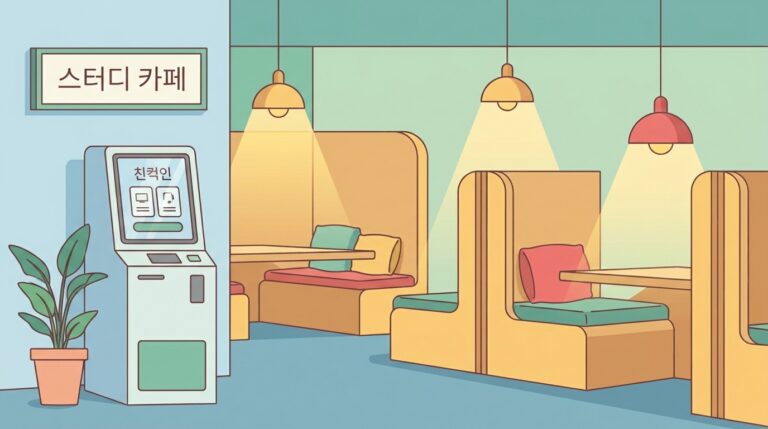
Master Korean Study Cafes: How to Buy a 50-Hour Pass Like a Local
Phase 1: Empathy (Story Immersion Opening)
안녕하세요! 매일한글 에디터입니다. (Hello! This is your Daily Hangul Editor.)
Picture this: You just landed in Seoul, inspired by late-night K-drama study montages in shows like Crash Course in Romance. You spot a stylish, 24-hour study cafe in Sinchon. You step through the sliding glass doors, ready to focus on your Korean studies, but you run straight into your first boss battle: a giant touchscreen kiosk glowing entirely in Korean. Buttons like 당일권 (day pass), 시간권 (time pass), and 기간권 (term pass) flash before your eyes. You want to study here every evening after dinner, so buying a 50-hour time package makes the most sense—yet your fingers freeze over the screen. What if you press the wrong button and book a non-refundable 4-week locker instead?
Don’t worry at all! Over 800 Daily Hangul students have shared this exact panic with me. Korean study cafes—affectionately called Seu-ka (스카)—are incredible modern sanctuaries once you know the secret code. In this guide, you will master the exact A2-level Korean phrases to load hours, pick your favorite desk, and navigate study cafe rules with complete confidence. Let’s make this your easiest Seoul mission yet!
Phase 2: Core 3 Expressions In-Depth
1. 시간권 50시간 충전할게요 (Sigan-gwon osip-sigan chungjeonhalgeyo)
- Pronunciation: [Si-gan-gwon o-sip-si-gan chung-jeon-hal-ge-yo] (Think of ‘chungjeon’ like ‘choong-jun’, sounding like charging a phone battery!)
- Meaning: Literal: “I will recharge a time pass of 50 hours.” / Nuance: “I’d like to load a 50-hour time pass, please.”
- K-Culture Moment: In university neighborhood study cafes, students frequently use the verb 충전하다 (to charge) for both smartphone batteries and prepaid time credits.
- Editor’s Insight: In Korean, prepaid balance accounts—whether public transit T-money cards or study hours—use the word 충전 (charge). Remembering that time equals battery power makes this stick instantly.
- Situation Spectrum:
- Casual (to friends): 50시간 충전했어! (✅)
- Semi-formal (at kiosk / staff): 50시간 충전할게요. (✅)
- Formal (business setting): 50시간권을 충전하고자 합니다. (⚠️ – overly stiff for a cafe)
- 🤔 Think About It: Why does Korean treat “time” like an electric charge you refill into an account? How does your native language describe buying blocks of time?
2. 자리 이동하고 싶어요 (Jari idonghago sipeoyo)
- Pronunciation: [Ja-ri i-dong-ha-go si-peo-yo] (Sounds like ‘Jah-ree ee-dong ha-go she-paw-yo’)
- Meaning: Literal: “I want to move seats.” / Nuance: “Can I change my seat? / I’d like to switch seats.”
- K-Culture Moment: You sat under an air conditioning vent that is freezing cold, or someone next to you has a loud mechanical keyboard. You head to the kiosk screen to pick a warmer spot.
- Editor’s Insight: Many modern kiosks allow you to tap 자리 이동 (Seat Transfer) directly without paying extra fees. At the front desk or via phone support, this polite -고 싶어요 form is friendly and natural.
- Situation Spectrum:
- Casual: 자리 바꿀래! (✅)
- Semi-formal: 자리 이동하고 싶어요. (✅)
- Formal: 좌석 변경을 요청드립니다. (🚫 – too bureaucratic)
- 🤔 Think About It: In English, we often say “switch seats,” while Korean prefers 이동 (movement/relocation). What does this tell us about spatial awareness in Korean culture?
3. 퇴실 처리 꼭 해야 돼요 (Toesil cheori kkok haeya dwaeyo)
- Pronunciation: [Toe-sil cheo-ri kkok hae-ya dwae-yo] (Rhymes with ‘Toe-sheel chaw-ree cock hay-yah dway-yo’)
- Meaning: Literal: “Must definitely process departure.” / Nuance: “You really have to check out when you leave.”
- K-Culture Moment: A veteran student reminds a rookie who is packing up their bag: “If you forget to scan your exit barcode, your 50 hours will keep counting down all night!”
- Editor’s Insight: 퇴실 (Toesil) combines 退 (step back/exit) and 室 (room). Adding 처리 (processing) refers to swiping your barcode or phone QR code at the turnstile kiosk.
- Situation Spectrum:
- Casual: 나갈 때 퇴실 꼭 찍어! (✅)
- Semi-formal: 퇴실 처리 꼭 해야 돼요. (✅)
- Formal: 반드시 퇴실 처리를 완료해 주시기 바랍니다. (✅ – official kiosk notice)
- 🤔 Think About It: Why is automated accountability so prevalent in shared Korean study facilities?
Phase 3: Textbook Korean vs Real Korean
Situation 1: Telling a friend you are going to study
- 📖 교과서 한국어 (Textbook Korean): 저는 오늘 저녁에 공부를 하러 스터디카페에 갈 것입니다. (Jeoneun oneul jeonyeoge gongbureul hareo seuteodikapee gal geosimnida. – “I shall go to the study cafe to study this evening.”)
- 🗣️ 진짜 한국어 (Real Korean): 저 저녁마다 스카 가요! (Jeo jeonyeongmada seuka gayo! – “I hit the study cafe every evening!”)
- 💡 왜 다를까?: Korean locals almost never say the full four-syllable word 스터디카페 in daily banter. They shorten it into the trendy portmanteau 스카 (Seu-ka), paired with the handy frequency marker -마다 (every).
Situation 2: Noting that your time is running out
- 📖 교과서 한국어 (Textbook Korean): 이용 가능한 잔여 시간이 모두 소진되었습니다. (Iyong ganeunghan janyeo sigani modu sojindoeeosseumnida. – “All remaining usable time has been exhausted.”)
- 🗣️ 진짜 한국어 (Real Korean): 시간 거의 다 됐어요! (Sigan geoui da dwaesseoyo! – “My time is almost up!”)
- 💡 왜 다를까?: Native speakers favor simple verbs like 되다 (to become/reach) rather than technical administrative vocabulary like 소진 (exhaustion/depletion).
Phase 4: K-Culture Deep Dive & Non-verbal Manners
4-1. 눈치 (Nunchi) & Gestures in the Quiet Zone
When stepping into the study zone (열람실), social awareness (nunchi) is at maximum volume because physical sound must be near zero:
* The Silent Footstep: Walk on the balls of your feet. Dragging slipper soles or wearing squeaky sneakers will earn immediate sideways glances.
* Silent Gadgets: You will rarely hear typing clicks. Koreans use a 무소음 마우스 (silent click mouse) and silicone keyboard covers. If you don’t own one, most cafes provide loaner silent mice in the lounge cabinet!
* Phone Etiquette: Never place a vibrating phone on a bare wooden desk. The buzz resonates like an earthquake. Keep it on total silent mode or rest it on a soft notebook.
4-2. Cultural Code: The Gong-stagram Phenomenon
If you browse Instagram in Korea, search the hashtag #공스타그램 (Gong-stagram = 공부 + 인스타그램). High schoolers and university students broadcast their intense study regimens. Study cafes compete fiercely to attract this crowd by offering barista-quality complimentary espresso machines, high-end herbal teas, phone charging stations, and ergonomic chairs. Loading a 50-hour or 100-hour pass shows dedication to personal self-improvement, turning study time into an empowering lifestyle routine.
Phase 5: Real-World Roleplay Scenario
Setting: The sleek entrance lobby of ‘Haru Study Cafe’ near Hongdae. You are standing in front of the kiosk, and Min-ho, a friendly college student regular wearing wire-rim glasses, notices you looking puzzled.
- Turn 1 (Min-ho): 혹시 키오스크 사용 도와드릴까요? (Hoksi kioseukeu sayong dowadeurilkkayo?)
- 🎭 Smiling gently, pointing toward the screen prompt.
- (“Would you perhaps like some help with the kiosk?”)
- Turn 2 (You): 네, 감사해요! 시간권 50시간 충전하고 싶어요. (Ne, gamsahaeyo! Sigan-gwon osip-sigan chungjeonhago sipeoyo.)
- 🎭 Expressing relief, bowing your head slightly.
- (“Yes, thank you! I’d like to load a 50-hour time pass.”)
- Turn 3 (Min-ho): 화면에서 ‘시간 패키지’ 누르시고 전화번호 입력하세요. (Hwamyeon-eseo ‘sigan paekiji’ nureusigo jeonhwabeonho ipryeokhaseyo.)
- 🎭 Tapping the blue button on the display for you.
- (“Press ‘Time Package’ on the screen and enter your phone number.”)
- Turn 4 (You): 외국인 번호도 등록돼요? (Oegugin beonhodo deungrokdwaeyo?)
- 🎭 Checking your mobile phone screen nervously.
- (“Can foreign or prepay phone numbers be registered too?”)
- Turn 5 (Min-ho): 네, 인증번호 없이 바코드 받을 번호면 돼요. (Ne, injeungbeonho eopsi bakodeu badeul beonhomyeon dwaeyo.)
- 🎭 Reassuring with two thumbs up.
- (“Yes, any number that can receive a text or Kakao barcode works without identity verification.”)
- Turn 6 (You): 결제했어요! 좌석은 어디서 골라요? (Gyeoljehaesseoyo! Jwaseogeun eodiseo golrayo?)
- 🎭 Holding up your receipt after tapping your credit card.
- (“Payment complete! Where do I choose my seat?”)
- Turn 7 (Min-ho): 여기 좌석배치도에서 초록색 자리 터치하시면 돼요. (Yeogi jwaseokbaechido-eseo choroksaek jari teochihasimyeon dwaeyo.)
- 🎭 Pointing at the seating floor plan map on the monitor.
- (“Just touch any green seat on the floor map right here.”)
- Turn 8 (You): 친절하게 알려주셔서 정말 감사해요! (Chinjeolhage allyeojusyeoseo jeongmal gamsahaeyo!)
- 🎭 Smiling warmly with hands together in gratitude.
- (“Thank you so much for explaining so kindly!”)
🔀 Interactive Decision Point
You select seat number 24 and walk inside. After two hours of study, your stomach grumbles and you want to step out for a quick convenience store snack. What do you press at the kiosk scanner?
* Choice A: Tap [퇴실 (Check-Out)] and walk outside.
* Choice B: Tap [외출 (Temporary Outing)] and scan your mobile barcode.
* Choice C: Just squeeze through the security turnstile without tapping anything.
- Feedback A (Risk): If you select 퇴실 (Check-Out), the system terminates your session and surrenders your desk! Someone else can book your seat, and you’ll have to re-enter from scratch.
- Feedback B (Best): Perfect! Selecting 외출 holds your desk and preserves your personal items for up to 60~90 minutes while paused or deducted accurately.
- Feedback C (Bad): The turnstile alarm will beep loudly, disturbing the silent cafe, and the automated barrier won’t open for you.
Phase 6: 10-Second Emotion Shadowing Drill
Practice matching rhythm and pitch using the pauses (/) and emotional cues below:
[😊 Confident & Determined]
저 오늘부터 / 스카 50시간 충전해서 / 매일 저녁에 올 거예요!
(Jeo oneulbuteo / seuka osip-sigan chungjeonhaeseo / maeil jeonyeoge ol geoyeyo!)
“Starting today / I loaded 50 hours at the study cafe / and I’ll come every evening!”-
[🤫 Whispering & Polite]
저기요, / 혹시 자리 이동 / 키오스크에서 하면 되나요?
(Jeogiyo, / hoksi jari idong / kioseukeu-eseo hamyeon doenayo?)
“Excuse me, / can I move my seat / by doing it at the kiosk?” -
[😮 In a hurry & Realizing]
잠깐 편의점 갈 때는 / 꼭 ‘외출’ 버튼을 / 눌러야 돼요!
(Jamkkan pyeon-uijeom gal ttaeneun / kkok ‘oechul’ beoteuneul / nulleoya dwaeyo!)
“When going to the convenience store for a bit / you must press / the ‘Temporary Outing’ button!”
Phase 7: K-Culture Mini Dictionary
- 스카 (Seu-ka) | Noun | Short for ‘스터디카페’ (Study Cafe). Used daily by all generations in casual speech, replacing old-school dark study halls.
- 시간권 (Sigan-gwon) | Noun | Hourly block pass (e.g., 30, 50, 100 hours). Unlike a daily pass (당일권), unused time rolls over until your validity date expires.
- 외출 vs 퇴실 (Oechul vs Toesil) | Nouns | ‘외출’ means stepping out briefly while keeping your seat reserved; ‘퇴실’ means permanently checking out for the day.
- 카공족 (Ka-gong-jok) | Noun | People who study in normal commercial coffee shops (카페에서 공부하는 사람들). Study cafes were popularized precisely because commercial cafes began limiting kagongjok seating!
Phase 8: Survival Kit for Travelers
Top 3 Kiosk Survival Lines
- 와이파이 비밀번호 어디 있어요? (Wa-i-pa-i bimilbeonho eodi isseoyo?)
- Pronunciation: [Wah-ee-pah-ee bee-meel-bun-ho uh-dee eess-uh-yo?]
- Pro Tip: Usually printed on the top corner of your entry receipt or taped to the lounge refrigerator!
- 외출 시간 얼마나 남았어요? (Oechul sigan eolmana nam-asseoyo?)
- Pronunciation: [Way-chool she-gan uhl-mah-nah nahm-ahss-uh-yo?]
- Pro Tip: Most cafes grant 60 minutes for meals during an outing. Exceeding it returns your seat to public inventory.
- 영수증 재출력해 주세요. (Yeongsujeung jaechulryeok-hae juseyo.)
- Pronunciation: [Young-soo-jeung jae-chool-ryuk-hae joo-seh-yo.]
- Pro Tip: Use this if your paper barcode tears or your phone battery suddenly dies.
Editor’s Travel Note
Before wandering looking for a quiet workspace, use the Naver Map app download guide to search “스터디카페” around your metro station. Look for 24-hour places featuring photos of automated kiosks. International credit cards (Visa/Mastercard) work seamlessly on 90% of contemporary kiosks, but carrying a local backup transit/prepay card like Wowpass or Namane Card ensures you never get declined.
Phase 9: “One Step Deeper” (Reflective Prompt)
Walk into any Korean study cafe and you will witness a cultural miracle: thousands of dollars worth of laptops, iPad Pros, AirPods, and designer wallets resting completely unattended on desks while owners take a 45-minute lunch break. Korea’s extraordinary public safety relies on a deeply ingrained community trust code combined with comprehensive CCTV networks. People respect shared learning spaces as sanctuaries of hard work. When you study here, you are participating in a mutual contract of respect, quiet focus, and collective ambition.
💬 Your Turn: Does your home country have automated quiet work spaces like this? How would you feel leaving your laptop unattended while grabbing a coffee? Share your thoughts below!
Phase 10: FAQ & Avoiding Misunderstandings
Q: Can I talk on the phone inside the study cafe?
A: Absolutely not inside the study zones (스터디존/열람실). You must step out into the hallway or elevator landing outside the cafe entrance to take phone calls, keeping your voice lowered.
Q: What is the difference between a ‘Focus Zone’ and a ‘Laptop Zone’?
A: A Focus Zone (포커스존) strictly prohibits laptop keyboard typing and mouse clicks—it is reserved exclusively for reading and handwriting. The Laptop Zone (노트북존/카페존) welcomes mouse clicks and light typing with keyboard covers.
Q: What happens if I forget to press ‘퇴실’ (Check-out) when I go home?
A: If you have a 50-hour time pass, the timer will keep running all night until your purchased hours reach zero! Always tap your barcode at the exit kiosk before leaving.
🚨 Common Mistakes Alert
- Mistake: Eating smelly takeout food inside the snack lounge.
- Correct Action: Only consume light snacks, cookies, or provided coffee. Heavy food should be eaten at nearby diners.
- Mistake: Choosing 당일권 (Day Pass) when you plan to visit multiple days.
- Correct Action: Day passes expire at dawn even if hours remain. Pick 시간권 (Hourly Pass) for flexible multi-day visits.
- Mistake: Forgetting your barcode screenshot.
- Correct Action: Always take a quick screenshot of your entry QR code so you don’t need to reopen text messages repeatedly at the door.
Phase 11: Action Mission & Engagement
- 🥉 Bronze Mission (Solo): Say out loud three times: “시간권 50시간 충전할게요!” with a strong, confident voice.
- 🥈 Silver Mission (Social): Take a photo of your study desk or favorite study drink and post it with the Korean hashtag
#공부인증(Study Verification). - 🥇 Gold Mission (Real World): Locate a study cafe on your map in Korea, step up to the kiosk, switch the language or read the Korean menu, and load your first pass!
- 🎮 K-Culture Mission: Watch an episode of a Korean youth drama (such as Twenty-Five Twenty-One or Sky Castle) and spot where students gather to study. Can you identify the difference between traditional 독서실 and modern 스카?
Phase 12: Interactive Quiz Challenge
Test your real-world skills before heading to the kiosk!
- Situation Judgment: You want to leave your seat for 30 minutes to eat a triangle kimbap at the convenience store downstairs. Which button should you press at the entrance screen?
- A) 퇴실 (Toesil)
- B) 외출 (Oechul)
- C) 환불 (Hwanbul)
- Fill-in-the-Blank:
저는 매일 저녁에 공부하러 ________에 가요. (I go to the study cafe every evening to study.)- Hint: The trendy two-syllable abbreviation!
- True or False Cultural Fact:
In a Korean study cafe’s Focus Zone, it is totally acceptable to type notes rapidly on a gaming mechanical keyboard without a silicone cover.
👉 Click to reveal quiz answers & explanations!
- Answer: B) 외출 (Oechul)
- Explanation: 외출 holds your assigned seat while you step out temporarily. Pressing 퇴실 cancels your seat reservation entirely!
- Answer: 스카 (Seuka)
- Explanation: While ‘스터디카페’ is grammatically correct, ‘스카’ is the authentic daily slang term used by students.
- Answer: False
- Explanation: Focus zones mandate absolute silence. Mechanical keyboards produce loud clicks that disrupt others; you must use a silent silicone cover or move to the designated Laptop Zone (노트북존).
- Explanation: Focus zones mandate absolute silence. Mechanical keyboards produce loud clicks that disrupt others; you must use a silent silicone cover or move to the designated Laptop Zone (노트북존).
🎬 Watch Our Daily Videos! (Daily Hangul Official Instagram)
Review the expressions you learned in this article with our fun daily short videos! Check out native pronunciation and real-life nuances in action.
- Instagram @dailyhangul_en







