

Phase 1: 공감 (Story Immersion Opening)
안녕하세요! 매일한글 에디터입니다.
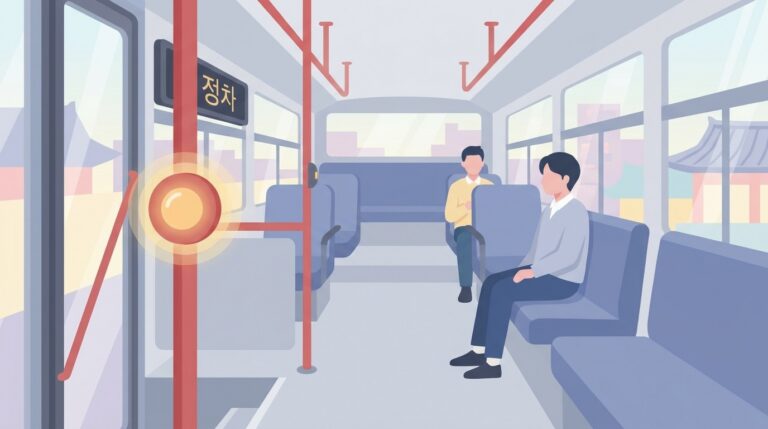
Picture this: You are standing in the aisle of bright blue Seoul Bus 273. The vehicle is swooping through the bustling university streets of Sinchon. You are gripping the yellow handrail with all your might. The automated announcement chimes: “이번 정류장은 신촌역입니다” (Ibeon jeongnyujangeun Sinchonyeok-imnida – This stop is Sinchon Station). That is your stop! You look around nervously. Nobody is moving. The red bell on the pole is right beside you, but should you press it right now? Do you run toward the rear exit door while the bus is still cruising at full speed?
If you have watched K-Dramas like Extraordinary Attorney Woo or My Liberation Notes, taking the bus in Korea looks breezy, rhythmic, and effortlessly aesthetic. Yet for real travelers and beginners, navigating a moving Korean bus feels like an Olympic agility test! At Daily Hangul, the single most common panic story our beginner students share is missing their bus stop because they were too shy to ring the bell or speak up. Today, we will turn you into a confident Seoul bus rider who rings the bell and exits like a seasoned native.
Phase 2: 핵심 표현 3선 심층 분석 (Top 3 Core Expressions)
1. 저 이번에 내려요! (Jeo ibeone naeryeoyo!)
- Pronunciation: [Jeo i-beo-ne nae-ryeo-yo] (Sounds like: Juh ee-bun-eh neh-ryuh-yo)
- Meaning: Literal: “I am getting off this time!” | Real Nuance: “Pardon me, this is my stop / I’m getting off here!”
- K-Culture Moment: You are hemmed in near the back door during the 6:30 PM Gangnam commute, and you need nearby passengers to make way immediately.
- Editor’s Insight: While textbook Korean teaches “내릴게요” (Naerilgeyo – I will get off), saying “저 이번에 내려요!” explicitly alerts the crowd surrounding you to shift aside so you do not miss your doorway window.
- Situation Spectrum: Casual ⚠️ | Semi-formal ✅ | Formal ✅
- 🤔 Think About It: In many English-speaking transit systems, passengers quietly say “Excuse me.” Koreans state their immediate physical action (“I am getting off!”) to coordinate communal movement smoothly.
2. 벨 눌렀어요? (Bel nulleosseoyo?)
- Pronunciation: [Bel nul-leot-seo-yo?] (Sounds like: Bell nool-lut-suh-yo?)
- Meaning: Literal: “Did you press the bell?” | Real Nuance: “Has anyone rung the stop bell yet?”
- K-Culture Moment: An elderly halmeoni (grandmother) carrying fresh market produce turns to you near the pole to confirm before reaching for the buzzer.
- Editor’s Insight: In Korea, once the bell is pressed, every stop bell on the bus glows bright red with a ding. If the light is already glowing, asking or pressing again is unnecessary.
- Situation Spectrum: Casual ⚠️ | Semi-formal ✅ | Formal ✅
- 🤔 Think About It: Checking if someone pressed the bell rather than mindlessly spamming buttons is a subtle display of Nunchi (social awareness).
3. 잠시만요, 지나갈게요! (Jamsimanyo, jinagalgeyo!)
- Pronunciation: [Jam-si-man-yo, ji-na-gal-ge-yo] (Sounds like: Jahm-she-mahn-yo, jee-nah-gahl-geh-yo)
- Meaning: Literal: “Just a moment, I will pass!” | Real Nuance: “Excuse me, squeezing through!”
- K-Culture Moment: Stepping past university students with oversized backpacks blocking the back stairwell as the bus slows down.
- Editor’s Insight: Instead of a simple “Sorry” (죄송합니다), adding 지나갈게요 creates momentum. Passengers will instantly twist their shoulders sideways to let you slip through.
- Situation Spectrum: Casual ⚠️ | Semi-formal ✅ | Formal ✅
- 🤔 Think About It: Korean public politeness focuses on functional consideration: notifying others where your body will move prevents sudden bumps.
Phase 3: 교과서 한국어 vs 진짜 한국어 (Textbook vs. Real-world)
Situation 1: Telling the driver you want to get off
- 📖 교과서 한국어: “기사님, 다음 정류장에서 내려 주십시오.” (Gisanim, daeum jeongnyujangeseo naeryeo jusipsio. – Driver, please let me disembark at the subsequent stop.)
- 🗣️ 진짜 한국어: Simply press the 하차 벨 (Hacha bel) or say “저 내릴게요!” (Jeo naerilgeyo!)
- 💡 왜 다를까?: Korean city bus drivers rely strictly on the buzzer system. Shouting lengthy formal grammar while the engine hums is impractical and distracts the driver.
Situation 2: Asking people to let you reach the exit door
- 📖 교과서 한국어: “실례합니다만, 길을 비켜 주시겠습니까?” (Sillyehamnidaman, gireul bikyeo jusigessseumnikka? – Excuse me, would you be so kind as to vacate the walkway?)
- 🗣️ 진짜 한국어: “잠시만요!” (Jamsimanyo!)
- 💡 왜 다를까?: In fast-paced Seoul commute hours, short and brisk phrases maintain both safety and speed.
Phase 4: K-Culture 딥다이브 & 비언어적 매너 (Deep Dive & Manners)
4-1. 눈치 (Nunchi) & Gestures
- Timing the Bell: Press the button right after the audio says “이번 정류장은 [Name]입니다” (This stop is [Name]), but before it announces the next upcoming stop (다음은…).
- Safety First: You do not need to sprint down the aisle while the bus is speeding! Hold the handrail firmly. Modern transport guidelines ask passengers to stand up only when the bus decelerates.
- Body Angle: Keep your transit card or phone ready in your hand before you reach the door sensor to prevent holding up the line behind you.
4-2. Cultural Code: The ‘Ppalli-Ppalli’ Commute
Seoul’s public transportation is famous for its clockwork efficiency and lightning-quick transfers. If nobody presses the red bell and nobody is waiting at the curbside stop, the driver will safely skip the stop to keep the schedule. Furthermore, the 환승 할인 (Hwanseung hal-in – Transfer Discount) gives you free or deeply discounted transfers within 30 minutes, provided you tap your card on the exit reader as you step off!
Phase 5: 실전 롤플레이 시나리오 (Real-World Roleplay)
Setting: Blue Bus 143 approaching Express Bus Terminal during the afternoon rush. Alex (an A1 learner) is standing next to Minji, a helpful Seoulite.
- Alex: 🎭 [Peeking at bus route map, looking uncertain] 저기요, 이번 정류장이 고속터미널 맞아요? (Jeogiyo, ibeon jeongnyujangi Gosok-teomineol majayo? – Excuse me, is this stop Express Bus Terminal?)
- Minji: 🎭 [Nods warmly with a smile] 네, 맞아요! 방송 나오네요. (Ne, majayo! Bangsong naoneyo. – Yes, that’s right! The announcement is playing now.)
- Alex: 🎭 [Glancing at the pole] 그럼 지금 벨 눌러야 해요? (Geureom jigeum bel nulleoya haeyo? – Then do I need to press the bell now?)
- Minji: 🎭 [Pointing up to the buzzer] 아, 저기 빨간 불 켜졌어요! 이미 누가 눌렀어요. (A, jeogi ppalgan bul kyeojyeosseoyo! Imi nuga nulleosseoyo. – Ah, the red light is on! Someone already pressed it.)
- Alex: 🎭 [Holding the handrail tight] 아, 다행이다! 지금 문 앞으로 가요? (A, dahaeng-ida! Jigeum mun apeuro gayo? – Ah, what a relief! Should I go to the door now?)
- Minji: 🎭 [Gently signaling with hand] 버스 멈추면 천천히 가세요. 위험해요! (Beoseu meomchumyeon cheoncheonhi gaseyo. Wiheomhaeyo! – Go slowly once the bus stops. It’s dangerous!)
- Alex: 🎭 [Taking out transportation card] 카드도 미리 찍어요? (Kadeudo miri jjigeoyo? – Do I tap my card in advance too?)
- Minji: 🎭 [Tapping her own card against the machine] 네, 내리면서 여기에 삑 찍으시면 돼요! (Ne, naerimyeonseo yeogie ppik jjigeusimyeon dwaeyo! – Yes, just beep it right here as you exit!)
🔀 인터랙티브 분기점 (Interactive Scenario Decision)
The bus has come to a full stop. Three people are standing directly between you and the open door, looking at their smartphones. What do you do?
* Option A: Say clearly, “저 내릴게요! 잠시만요!” (Jeo naerilgeyo! Jamsimanyo!) and take a deliberate step forward.
Feedback: [Best] Perfect! Passengers will instantly tuck in and clear a pathway without annoyance.
* Option B: Push quietly past them with your elbows without making any sound.
Feedback: [Bad] This is perceived as rude and can cause people to stumble in a tight exit area.
* Option C: Stand quietly waiting for them to move on their own, risking the door closing.
Feedback: [Risk] Seoul bus doors close in 3 to 5 seconds if clear movement stops! You might end up at the next neighborhood.
Phase 6: 10초 감정 섀도잉 드릴 (Emotion Shadowing Drill)
Practice reading these out loud by pausing at each slash (/) and matching the emotional cues:
[😰 초조하지만 또박또박하게 / Anxious but clear]
저… / 이번 정류장에서 / 내릴게요! / (Jeo… / ibeon jeongnyujang-eseo / naerilgeyo!)-
[😊 안도하고 차분하게 / Relieved and calm]
벨 눌렀으니까 / 천천히 / 내려요. / (Bel nulleosseunikka / cheoncheonhi / naeryeoyo.) -
[🏃 다급하고 예의 바르게 / Urgent yet polite]
기사님! / 문 좀 / 열어주세요! / (Gisanim! / mun jom / yeoreojuseyo!)
Phase 7: K-Culture 미니 사전 (Mini Dictionary)
- 하차 벨 (Hacha bel) | Stop Bell | The circular red or yellow buzzer located along handrails and windows on Korean buses.
- 환승 (Hwanseung) | Transit Transfer | Transferring between buses or subways within 30 minutes to receive free/discounted fare.
- 하차 태그 (Hacha tae-geu) | Tapping Off | Beeping your T-money card or mobile transit pass onto the exit sensor before stepping out.
- 정류장 (Jeongnyujang) | Bus Stop | The designated curb post or sheltered station for passenger boarding and drop-off.
Phase 8: 여행자를 위한 생존 키트 (Traveler Survival Kit)
서바이벌 표현 TOP 3 (Survival Phrases)
- 문 열어주세요! (Mun yeoreojuseyo!)
Meaning: Please open the door!
Pro Tip: If the rear doors snap shut before you can exit, shout this respectfully toward the front cabin. - 카드가 안 찍혀요. (Kadeuga an jjikhyeoyo.)
Meaning: The card won’t scan.
Pro Tip: Useful if the sensor blinks red with an error chime. - 기사님, 잠깐만요! (Gisanim, jamkkanmanyo!)
Meaning: Driver, just one second!
Pro Tip: Use this to halt the driver from pulling away while you help an elderly traveler or manage luggage.
Editor’s Travel Note
Always install the [네이버 지도 앱 다운로드 (Naver Map App Download)] or [카카오버스 앱 이용 가이드 (KakaoBus App Guide)] before leaving your accommodation. Standard global map tools often fail to provide live, minute-by-minute Korean bus arrival schedules and real-time stop-countdown notifications!
Phase 9: “한 발 더 깊이” (Cultural Reflection)
Korean bus etiquette is a fascinating mirror of Korea’s dynamic synthesis between Ppalli-ppalli (fast efficiency) and mutual civic duty. Decades ago, bus conductors would slap the side of the bus shouting “오라이!” (All right!) to speed departures. Today, sophisticated automated sensors, luminous stop bells, and cashless terminals have replaced them, but the civic code remains: respect everyone’s time by preparing early, but respect everyone’s safety by keeping the aisles navigable.
💬 Your Turn: Have you ever ridden public transit in another country and panicked about when to request a stop? Drop your story in the comments below!
Phase 10: FAQ & 오해 방지 (FAQ Schema)
Q: Do I need to press the stop bell if someone else has already pressed it?
A: No. Once any passenger presses a stop bell, all bells light up red and an internal chime rings for the driver. Pressing it again will not change anything.
Q: What happens if I forget to tap my card when getting off?
A: You will lose your transfer discount (환승 할인), and the system may charge you the maximum route penalty fare on your next transit ride.
Q: Can I carry a cup of take-out iced coffee onto the bus in Seoul?
A: No. Under Seoul city bylaws, bus drivers have the legal right to refuse passengers holding open, take-out beverages or disposable cups with food to prevent spills.
🚨 흔한 실수 (Common Mistakes) 경고판
- Standing up too early while the bus is turning sharply: Keep your seat or grip the pole until the bus slows down at the curb.
- Waiting for the bus to stop before pressing the bell: Press it immediately when the stop announcement sounds, not after the bus passes the stop!
- Forgetting to say ‘잠시만요’: Don’t silently push through; speaking up makes passengers part like the Red Sea.
Phase 11: 액션 미션 & 참여 유도 (Action Missions)
- 🥉 Bronze Mission: Stand in front of your mirror and practice saying “저 이번에 내려요!” (Jeo ibeone naeryeoyo!) with clear eye contact 5 times.
- 🥈 Silver Mission: Share your favorite K-Drama bus scene on Instagram or Threads and tag @DailyHangul with the phrase #하차벨.
- 🥇 Gold Mission: On your next trip to Korea, board a city bus, ring the red stop bell on time, and tap off without hesitation!
- 🎮 K-Culture Mission: Watch an episode of a modern slice-of-life drama (like Hospital Playlist) and listen for the distinct “띵동” bell sound on transit scenes.
Phase 12: 인터랙티브 퀴즈 챌린지 (Quiz Challenge)
1. [상황 판단] The automated voice announces your stop. You look up and see the stop bell is glowing red. What should you do?
* (A) Press every bell within arm’s reach.
* (B) Wait safely, holding the rail, and prepare your transit card to exit.
* (C) Shout at the driver to make sure he heard.
2. [빈칸 채우기] Fill in the blank:
“내리기 전에 하차 _____을 누르세요.” (Press the stop _____ before getting off.)
3. [True or False] You can bring an open cup of iced bubble tea onto a Seoul city bus as long as you hold it tightly.
* (True / False)
👉 Click here to reveal the answers and explanations!
Answers & Explanations:
1. Answer: (B) – The glowing red bell confirms the driver has received the stop request. Hold the handrail and get your card ready!
2. Answer: 벨 (Bel) – “하차 벨을 누르세요” means Press the stop bell.
3. Answer: False – Seoul regulations strictly ban boarding with open take-out drinks and uncovered food items for passenger safety.
🎬 Watch Our Daily Videos! (Daily Hangul Official Instagram)
Review the expressions you learned in this article with our fun daily short videos! Check out native pronunciation and real-life nuances in action.
- Instagram @dailyhangul_en







