

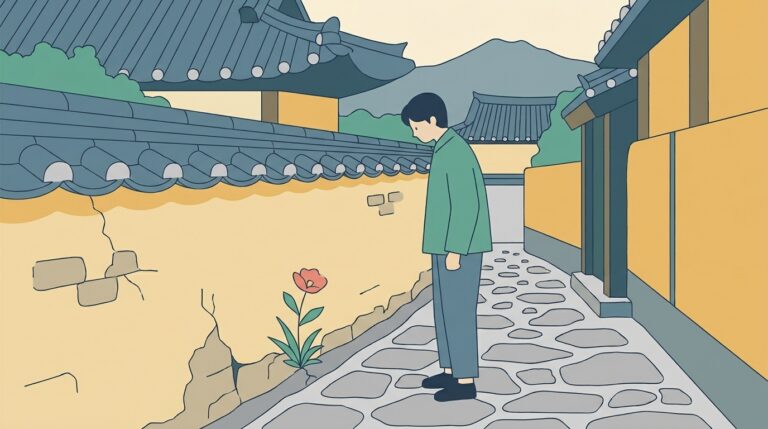
Essence of the Literary Essay: Drawing Philosophical Universality from Daily Observations
Phase 1: Empathy (Story Immersion)
안녕하세요! 매일한글 에디터입니다. (Hello! It’s your Daily Hangul editor.)
Picture this: You are sitting at a quiet wooden table inside an old tea house tucked away in the back alleys of Seochon, Seoul. Raindrops trickle down the eaves, tracing erratic paths on the windowpane. Nearby, an elder slowly rearranges mismatched terracotta flowerpots along a cracked stone threshold. In Korean dramas like My Liberation Notes (나의 해방일지) or the introspective writings of modern Korean essayists, these tiny, unremarkable sights are never merely background noise. Instead, the narrator pauses, breathes in the damp air, and extracts a universe of philosophical longing from a single damp leaf.
Yet, as an advanced learner pushing toward C2 mastery, you might find yourself hitting an invisible wall. You have conquered complex grammar, political terminology, and business honorifics—yet when you attempt to pen an intimate essay or express contemplative awe in Korean, your words feel stiff, dry, or overwhelmingly academic. You want to ask, “Why does this mundane detail tug at my heart?”, but end up sounding like a news anchor delivering a cold documentary script.
True fluency culminates in the literary essay (수필 / 에세이)—the sublime art of turning an ordinary walk through a Seoul alley into a luminous meditation on human existence. Drawing from years of mentoring C-level writers, this guide reveals the precise syntax, metaphoric verb pairings, and sensory vocabulary that will transform your Korean from merely functional to poignantly poetic.
Phase 2: Deep Dive into 3 Core Literary Expressions
1. 사소한 풍경에서 길어 올리다 (Sasohan punggyeong-eseo gireo ollida)
- Pronunciation: [사소한 풍경에서 길어 올리다] (sah-so-han poong-gyeong-eh-seo geel-eo ohl-lee-da — think of ‘gireo’ as drawing water up from a deep, ancient stone well).
- Meaning: Literally “to haul/draw up [thoughts or truth] from an unassuming landscape”; figuratively, to unearth deep philosophical insight from ordinary scenes.
- K-Culture Moment: Echoes the poetic interior monologues in Lost (인간실격), where everyday Seoul landscapes prompt soul-searching meditations.
- Editor’s Insight: The verb 길어 올리다 originally depicts hoisting buckets of cool water from a subterranean spring. In literary Korean, you use it when contemplation requires physical, meditative labor—retrieving hidden truth from superficial reality.
- Situation Spectrum: Casual 🚫 | Semi-formal ⚠️ | Formal/Literary ✅
- 🤔 Think About It: In English, we often say we “find inspiration.” Why does Korean imagine philosophical insight as water hauled up from the depths of the earth?
2. 낯설게 바라보다 (Natseolge baraboda)
- Pronunciation: [낟썰게 바라보다] (nat-sseol-geh bah-rah-boh-da — the ‘t’ catches crisply before exploding into the reinforced ‘ss’ sound).
- Meaning: Literally “to gaze with unfamiliarity”; figuratively, to defamiliarize one’s gaze and see the habitual world with fresh, questioning wonder.
- K-Culture Moment: Often cited in Korean literary talk shows and art retrospectives, such as RM of BTS discussing how visiting quiet galleries helps him observe everyday city life anew.
- Editor’s Insight: This phrase stems from the literary concept of defamiliarization (오스트라네니에 / 낯설게하기). It implies deliberately shedding habitual assumptions so that a street corner you have passed a thousand times suddenly feels like an uncharted island.
- Situation Spectrum: Casual ⚠️ | Semi-formal ✅ | Formal/Literary ✅
- 🤔 Think About It: How does deliberately making your familiar surroundings “unfamiliar” change the way you interact with urban solitude?
3. 발걸음을 붙잡다 (Balgeoreum-eul bupjapda)
- Pronunciation: [발꺼름을 붇잡따] (bahl-ggeo-reum-eul boot-jahp-dda — rhythmically anchored by the resonant ‘l’ and tense ‘tt’).
- Meaning: Literally “to grasp one’s steps”; idiomatically, an unexpected visual detail or scene that arrests your motion and forces you to pause.
- K-Culture Moment: Frequently featured in travel essays of Jeju or Gangneung when an author is halted by a weathered sign or a stray kitten curled asleep beneath an old vending machine.
- Editor’s Insight: Note the agency! You didn’t merely decide to stop; the scene itself had hands—it reached out and held your feet in place. It honors the evocative power of the outside world.
- Situation Spectrum: Casual ✅ | Semi-formal ✅ | Formal/Literary ✅
- 🤔 Think About It: What does personifying an environment as “holding your feet” say about the relational dynamic between observer and world in Korean thought?
Phase 3: Textbook Korean vs Real Native Korean
Situation 1: Noticing a Crack in an Old Concrete Wall
- 📖 교과서 한국어 (Textbook):
길을 걷다가 담벼락에 금이 간 것을 보고 여러 가지 생각이 들었습니다.
(Gireul geotdaga dambyeorage geumi gan geoseul bogo yeoreo gaji saenggagi deureosseumnida. / While walking, I saw a crack in the wall and had various thoughts.) - 🗣️ 진짜 한국어 (Literary Essay Style):
매일 지나치던 골목인데, 유독 담벼락의 깊은 균열이 발걸음을 붙잡더라고요. 그 틈새로 비집고 나온 풀 한 포기에서 불현듯 삶의 지독한 생명력을 길어 올리게 되었죠.
(Maeil jinachideon golmoginde, yudok dambyeoragui gipeun gyunyeori balgeoreumeul bupjapdeoragoyo. Geu teumsaero bijipgo naon pul han pogieseo bulhyeondeut salmui jidokhan saengmyeongnyeogeul gireo ollige doeeotjyo. / It was an alley I passed every day, yet that deep fissure in the wall caught my steps. From a single clump of grass wedged into that gap, I suddenly drew up the fierce vitality of existence.) - 💡 왜 다를까? Textbook Korean strings together dry, mechanical subject-object linkages. Native essayists employ evocative verbs like 비집고 나오다 (to squeeze through) and sensory anchors like 눈에 밟히다 or 발걸음을 붙잡다 to make the reader feel the physical texture of the moment.
Situation 2: Pausing to Reflect on Passing Strangers
- 📖 교과서 한국어 (Textbook):
지하철의 사람들을 보면서 그들의 인생이 궁금해졌습니다.
(Jihacheorui saramdeureul bomyeonseo geudeurui insaengi gunggeumhaejyeosseumnida. / Looking at people on the subway, I became curious about their lives.) - 🗣️ 진짜 한국어 (Literary Essay Style):
무표정한 활자 같은 얼굴들 너머로, 저마다 짊어진 침묵의 무게를 낯설게 응시해 봅니다. 사소한 한숨 끝에 매달린 삶의 무늬들이 스쳐 지나가네요.
(Mupyojeonghan hwalja gateun eolguldeul neomeoro, jeomada jilmeojin chimmugui muge-reul natseolge eungsihae bomnida. Sasohan hansum kkeute maedallin salmui munyideuri seuchyeo jinaganeyo. / Beyond those faces blank as printed type, I gaze with estrangement at the weight of silence each carries. The subtle patterns of life suspended at the edge of a quiet sigh drift past.) - 💡 왜 다를까? Instead of flatly declaring curiosity (궁금하다), C2 essayists project metaphorical dimensions onto common human posture—transforming a morning commute into an existential tapestry.
Phase 4: K-Culture Deep Dive & Non-verbal Etiquette
4-1. Nunchi & Gaze: The Art of “Eungsi” (응시)
In Korean essayist traditions, how you physically observe is as vital as how you write. Staring brazenly at someone in public breaks social decorum (실례). However, writers cultivate 물끄러미 바라보기 (gazing quietly with serene detachment) or 응시(凝視) (still, contemplative gazing). When pausing by a storefront or bench in Korea to take notes:
* Keep your body posture relaxed; never tilt your phone or notebook toward people intrusively.
* If your eyes meet a local’s, a delicate, almost imperceptible nod combined with a gentle, reflective downward glance communicates that you are savoring the ambiance, not scrutinizing them.
4-2. Cultural Code: The Korean “Sanmun” (산문) Renaissance
Korea is undergoing a massive literary revival centered around independent bookstores (독립서점) in neighborhoods like Mangwon, Yeonhui, and Okin-dong. Unlike grand biographical epics, modern readers adore 소소한 일상 속의 철학 (philosophy hidden within humble daily routines). From bestsellers exploring the inner life of convenience store clerks to reflections written while drying laundry on rooftop flats (옥탑방), Korean readers treasure writers who find transcendence in microscopic domesticity.
Phase 5: Real-Life Roleplay Scenario
Setting: Chaek-gwa-Maeum (책과 마음), a dimly lit independent bookstore and cafe in Seochon on a drizzle-swept Tuesday afternoon.
Characters:
* You: An advanced learner polishing a collection of reflective Seoul essays.
* Min-seo (민서): An independent essay author and editor reviewing manuscripts behind the wooden bar.
- 민서: 밖에는 보슬비가 제법 내리네요. 아까부터 창밖 은행나무 밑동만 물끄러미 보시던데, 어떤 문장을 고르고 계셨어요?
(Bakkeneun boseulbiga jeobeop naerineyo. Akkabuteo changbak eunhaengnamu mitdongman mulkkeoromi bosideonde, eotteon munjangeul goreugo gyesyeosseoyo?)
“The drizzle is picking up outside. You’ve been quietly gazing at the base of that ginkgo tree for a while—what sentence were you searching for?” -
You:
🎭 살포시 미소 지으며 노트를 어루만진다 (Smiling gently while touching the notebook)
늘 밟고 지나가던 보도블록 틈새에 고인 빗물이 문득 낯설게 다가오더라고요.
(Neul balpgo jinagadeon bodobeullok teumsae-e goin binmuri mundeuk natseolge dagaodeoragoyo.)
“The puddle gathered in the crack of the paving stones I always stepped over suddenly felt so unfamiliar to me.” -
민서: 아, 그 고인 물이요? 누구나 무심히 튀기며 지나가는 웅덩이일 텐데요.
(A, geu goin muriyo? Nuguna musimhi twigimyeo jinaganeun ungdeong-iil tendeyo.)
“Ah, that puddle? Most people just splash right past it without a second thought.” -
You:
🎭 나직하고 차분한 어조로 (In a low, composed tone)
네, 하지만 그 작은 수면에 비친 회색 하늘이 너무 선명해서 발걸음이 절로 멈춰졌어요.
(Ne, hajiman geu jageun sumyeone bichin hoesaek haneuri neomu seonmyeonghaeseo balgeoreumi jeollo meomchwojyeosseoyo.)
“Yes, but the gray sky reflected on that tiny water surface was so vivid that my steps stopped on their own.” -
민서:
🎭 흥미롭다는 듯 안경을 고쳐 쓰며 (Adjusting glasses with genuine curiosity)
사소한 얼룩에서 하늘의 깊이를 길어 올리셨군요. 그 시선이 참 따뜻해요.
(Sasohan eollugeseo haneurui gipireul gireo ollisyeotgunyo. Geu siseoni cham ttatteuthaeyo.)
“You drew up the depth of the sky from a mere smudge on the ground. That gaze of yours is remarkably warm.” -
You: 흔하고 초라한 풍경일수록 ‘왜 지금 내 눈을 붙잡을까’ 되묻다 보면, 비로소 삶의 보편적인 외로움이 읽히는 것 같아요.
(Heunhago chorahan punggyeong-ilsurok ‘wae jigeum nae nuneul bupjabeulkka’ doemutda bomyeon, biroso salmui bopyeonjeogin oeroumi ilkineun geot gatayo.)
“The more humble and worn a landscape is, the more asking ‘why did this catch my eye now?’ allows universal human solitude to emerge.” -
민서:
🎭 고개를 깊이 끄덕이며 따뜻한 둥굴레차를 건넨다 (Nodding deeply, handing over a warm cup of Solomon's seal tea)
그게 바로 수필의 정수죠. 일상을 해체해서 자기만의 문법으로 다시 엮어내는 힘이 대단하세요.
(Geuge baro supilui jeongsujyo. Ilsang-eul haechehaeseo jagimanui mumbeobeuro dasi yeok-eonaeneun himi daedanhaseyo.)
“That is the absolute essence of the essay. Your ability to deconstruct the mundane and weave it anew into your own grammar is marvelous.” -
You: 좋게 봐주셔서 감사합니다. 이 여운이 달아나기 전에 한 줄 더 적어 내려가야겠어요.
(Joke bwajusyeoseo gamsahamnida. I yeouni daranagi jeone han jul deo jeogeo naeryeogayagesseoyo.)
“Thank you for understanding so warmly. Before this lingering resonance slips away, I must jot down one more line.”
🔀 Interactive Choice Junction
At Min-seo’s query, how would you respond if you wanted to deepen the philosophical exchange?
- Option A (Best): “사소한 틈새일수록 계절의 무게가 더 진하게 고이는 법이니까요. 제 글도 그런 작은 결을 담아내고 싶어요.” (Poetic, resonant, effortlessly philosophical.)
- Option B (Academic/Dry): “빗물의 굴절률과 도심의 건축적 균열 현상에 대해 수필 형식으로 분석하는 중입니다.” (Too clinical and technical; destroys the literary mood.)
- Option C (Overly Casual): “그냥 멍때리고 있었는데 비 오니까 감성 터지네요! SNS에 감성 글귀 올리려고요.” (Cheapens profound observation into superficial trendiness.)
Phase 6: 10-Second Emotional Shadowing Drill
Practice these lines with realistic rhythm, breathing pauses (/), and emotional inflection:
[🍂 잔잔하게 사색하며 - Calmly contemplative]
매일 걷던 골목길인데 / 유독 그 갈라진 틈새가 / 제 발걸음을 붙잡더라고요.
(Maeil geotdeon golmokgirinde / yudok geu gallajin teumsaega / je balgeoreumeul bupjapdeoragoyo.)-
[✨ 깨달음을 얻은 듯 나직이 - Softly, as if hitting upon an epiphany]
사소한 풍경 너머에서 / 삶의 보편적인 온기를 / 길어 올리는 중입니다.
(Sasohan punggyeong neomeo-eseo / salmui bopyeonjeogin ongireul / gireo ollineun jung-imnida.) -
[☕ 여운을 음미하며 - Savoring the quiet resonance]
익숙한 일상을 / 낯설게 바라보는 순간 / 평범했던 하루가 문학이 돼요.
(Iksukhan ilsang-eul / natseolge baraboneun sungan / pyeongbeomhaetdeon haruga munhagi dwaeyo.)
Phase 7: K-Culture Mini Dictionary
- 낯설게하기 (Natseolge-hagi): Estrangement / Defamiliarization. The conscious technique of describing standard social habits or city scenes from an alien angle to evoke poetic contemplation.
- 눈에 밟히다 (Nune balpida): Literally “to be stepped on by one’s eye.” Refers to a small, vulnerable, or poignant detail (like an elderly vendor’s weathered gloves) that clings persistently to your thoughts.
- 길어 올리다 (Gireo ollida): To scoop up or haul up wisdom from depth. Essential literary verb used with abstract nouns like 진실 (truth), 의미 (meaning), and 사유 (thought).
- 여운 (Yeoun): The afterglow or reverberation of a poignant experience, poem, or conversation that hums quietly in your chest long after the event has ceased.
Phase 8: Traveler’s Survival Kit for Mindful Wandering
Top 3 Survival Expressions
- 잠시 생각에 잠겨 있어서 미처 못 봤네요.
(Jamsi saenggage jamgyeo isseoseo micheo mot bwanneyo.)
“I was lost in thought for a moment and failed to notice.”
Pro Tip: Elegant phrasing if you bump into someone or linger too long at a sidewalk counter. - 조용히 머물다 가기 참 좋은 공간이네요.
(Joyonghi meomulda gagi cham joeun gongganineyio.)
“This space is truly wonderful for resting in quiet contemplation.”
Pro Tip: The ultimate compliment for owners of indie bookstores and vintage tea shops. - 이 골목 특유의 고즈넉한 정취가 마음에 남아요.
(I golmok teuyu-ui gojeuneokhan jeongchwiga maeume namayo.)
“The serene, tranquil charm unique to this alley stays in my heart.”
Pro Tip: Use 고즈넉하다 (serenely quiet/historical) instead of simple 조용하다 to sound exceptionally cultured.
Editor’s Travel Note
Skip the crowded neon photo-spots for an afternoon. Wander through the quiet stone pathways of Seochon or the uphill paths of Seongbuk-dong. Use the Naver Map App Download to bookmark quiet independent essay bookshops like Ira Seojeok (이라서적) or Boan Yeogwan (보안여관). Always bring a pocket notebook; in Seoul, moments of literary gold appear without warning.
Phase 9: “One Step Deeper” (Philosophical Reflection)
Traditional Korean aesthetics often cherish 여백의 미 (Yeobaek-ui mi)—the beauty of negative space found in Chosun ink paintings. A masterpiece is defined not by what fills the canvas, but by what is purposefully left unsaid. In essay writing, this manifests as withholding excessive explanation, allowing an isolated observation—a chipped porcelain teacup or a faded bus schedule—to speak directly to the shared human condition. When you stop striving to explain everything and instead let an image breathe, your Korean transcends grammar and touches genuine literary grace.
💬 Your Turn: Look around the room right now. What is one tiny, overlooked object near you? How would you describe it with a “defamiliarized” gaze (낯선 시선) in Korean? Share your sentence in the comments below!
Phase 10: FAQ & Common Mistakes
Q: Can I use “길어 올리다” in everyday casual chatting with friends?
A: Use it sparingly. Saying “너한테서 인생의 교훈을 길어 올렸어” (I hauled life lessons up from you) during casual drinks will sound excessively theatrical or mock-serious unless you are being deliberately dramatic for comedic effect.
Q: What is the difference between “생각하다” and “사유하다”?
A: 생각하다 is generic thinking (deciding what to eat, pondering tomorrow’s schedule). 사유하다 (思惟하다) implies deep, sustained philosophical contemplation on being, time, and morality.
Q: How do I avoid sounding overly archaic or pretentious when using these terms?
A: Balance elevated verbal nouns with natural, humble conversational sentence endings like ~더라고요 (sharing personal discovery) or ~는 것 같아요 (gentle, unassertive deduction) rather than stiff classical declarative endings (~도다, ~노라).
🚨 Common Mistakes Warning Board
- Mistake: Overusing dictionary-translated academic words like 철학적 사색 in every sentence.
- Correct Action: Anchor your thought in concrete sensory objects first (e.g., 낡은 의자, 식어버린 커피).
- Mistake: Confusing 눈에 밟히다 (heart tugged by lingering pity/concern) with simply 눈에 띄다 (eye-catching/standout).
- Correct Action: Reserve 눈에 밟히다 when an image leaves a bittersweet, concerned impression.
- Mistake: Forgetting connective flow. Jumping straight from “I saw a pebble” to “Humans are mortal.”
- Correct Action: Build a transitional bridge using phrases like 비단 ~뿐만 아니라 or 문득 삶의 한 궤적이 겹쳐 보였습니다.
Phase 11: Action Missions
- 🥉 Bronze Mission (Solo): Find one weathered, inanimate object in your home. Write three sentences using the structure:
[Object]을/를 낯설게 바라보니, 문득 ~라는 생각이 발걸음을 붙잡았다. - 🥈 Silver Mission (Social): Take a photo of an ordinary street angle today. Post it on your social feed with the caption:
사소한 풍경에서 길어 올린 오늘의 여운. - 🥇 Gold Mission (Real Life): Visit a quiet local cafe or park in Korea. Spend 15 minutes observing without touching your phone. Write a 5-line micro-essay in Korean utilizing all three core Phase 2 expressions!
🎮 K-Culture Mission: Watch an episode of My Liberation Notes (나의 해방일지). Note the moments when Yeom Mi-jeong gazes out the subway window. Write down how her voiceover bridges outer scenery with inner isolation.
Phase 12: Interactive Quiz Challenge
1. Situational Judgment
You are writing an essay about an old tree with twisted roots surviving between asphalt roads. Which sentence best embodies high-level essayistic depth?
* A) 아스팔트 사이에 나무가 자라는 것은 생물학적으로 놀라운 일입니다.
* B) 삭막한 아스팔트를 비집고 선 굽은 뿌리에서, 침묵으로 버텨낸 삶의 숭고함을 길어 올리게 됩니다.
* C) 아스팔트에 나무가 있어서 걷기 불편했지만 신기해서 사진을 찍었어요.
2. Fill-in-the-Blank
매일 지나치는 익숙한 골목길도 시선을 바꾸어 (___________) 바라보면 새로운 사유의 공간으로 탈바꿈한다.
* Hint: An adverbial form meaning “unfamiliarly / with defamiliarizing wonder.”
3. Cultural True/False
In Korean literary essays, expressing 여백의 미 requires using complex Chinese four-character idioms (사자성어) in every paragraph.
* [True / False]
👉 Click to reveal Quiz Answers & Explanations
- Answer: B
- Explanation: Option B weaves sensory imagery (삭막한 아스팔트, 비집고 선 굽은 뿌리) with the core philosophical verb phrase (길어 올리게 됩니다). A is a scientific report; C is mundane vlog commentary.
- Answer: 낯설게 (Natseolge)
- Explanation: Paired with 바라보다, 낯설게 바라보다 forms the quintessential defamiliarization formula in Korean essay prose.
- Answer: False
- Explanation: 여백의 미 (beauty of empty space) relies on restraint and leaving breathing room for the reader’s imagination, not overcrowding the prose with dense Sino-Korean idioms.
- Explanation: 여백의 미 (beauty of empty space) relies on restraint and leaving breathing room for the reader’s imagination, not overcrowding the prose with dense Sino-Korean idioms.
🎬 Watch Our Daily Videos! (Daily Hangul Official Instagram)
Review the expressions you learned in this article with our fun daily short videos! Check out native pronunciation and real-life nuances in action.
- Instagram @dailyhangul_en







