

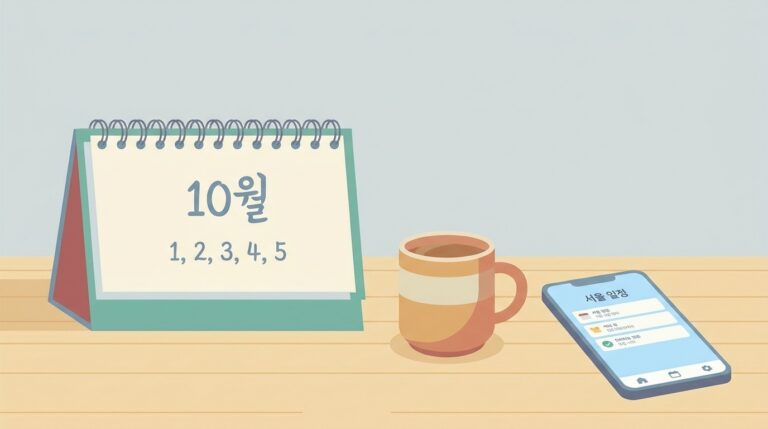
Phase 1: Empathy (Storytelling Opening)
안녕하세요! 매일한글 에디터입니다.
Picture this: You are walking down the buzzing streets of Hongdae with your Korean friend, Jinho. You both want to visit an exclusive K-drama pop-up store before it closes for good. Jinho whips out his phone, scrolls through an Instagram announcement, turns to you with a slight frown, and says, “달력을 확인해 보세요! (Dalryeogeul hwaginhae boseyo!)” You freeze. You know the word phone, you know the word look, but looking at numbers in Korean suddenly feels like trying to decipher ancient code. Is it month first? Day first? What does Yu-wol mean if six is Yuk? While you hesitate, the reservation window opens and closes in three seconds flat.
Missing an event or showing up on the wrong day is a rite of passage every Korean learner dreads. In fact, over 80% of our beginner students tell us that scheduling appointments and reading dates on booking apps is their biggest daily panic in Korea. Don’t worry—you are not alone, and it is far simpler than it looks! Today, we will unlock the secret rhythm of Korean dates and calendars so you can book concerts, meet friends, and navigate daily life in Seoul with total confidence.
Phase 2: Core Expressions Deep Dive
1. 달력을 확인해 보세요 (Dalryeogeul hwaginhae boseyo)
- Pronunciation: [Dal-ryeog-eul hwa-gin-hae bo-se-yo] (Sounds like: Dahl-lyuh-gool hwa-geen-hae bo-seh-yo)
- Meaning: Literal: “Please check the calendar.” | Real Nuance: “Could you check your schedule / calendar?”
- K-Culture Moment: Seen in nearly every workplace or romance K-drama when two characters try to schedule their next weekend date or project meeting.
- Editor’s Insight: The verb ending -해 보세요 (-hae boseyo) literally means “try doing.” It softens the instruction into a polite, considerate request rather than a direct order.
- Situation Spectrum: Casual ⚠️ | Semi-formal ✅ | Formal ✅
- 🤔 Think About It: In English, we often say “Check your schedule.” Why do Koreans specifically say “Check the calendar (달력)”? How does visualizing a shared calendar reflect Korean planning culture?
2. 오늘 며칠이에요? (Oneul myeochirieyo?)
- Pronunciation: [O-neul myeo-chi-ri-e-yo] (Sounds like: Oh-neul myuh-chee-ree-eh-yo)
- Meaning: Literal: “Today, what date is it?” | Real Nuance: “What is today’s date?”
- K-Culture Moment: That classic scene where a student or idol suddenly forgets the date on a live broadcast and blinks blankly at the camera.
- Editor’s Insight: Notice that Koreans do not say “몇 일 (myeot il)”. The spelling and pronunciation merge permanently into 며칠 (myeochil). Remembering this will save you from a mistake even native speakers sometimes make!
- Situation Spectrum: Casual ⚠️ (use 오늘 며칠이야?) | Semi-formal ✅ | Formal ⚠️
- 🤔 Think About It: Notice how “오늘 (today)” comes first. In Korean grammar, the broad context (today) always frames the specific question (what date).
3. 이번 주 금요일 어때요? (Ibeon ju geumyoil eottaeyo?)
- Pronunciation: [I-beon ju geum-yo-il eo-ttae-yo] (Sounds like: Ee-beon joo geum-yoh-eel uh-tteh-yoh)
- Meaning: Literal: “This week Friday, how is it?” | Real Nuance: “How about this Friday?”
- K-Culture Moment: Asking someone out for Chimaek (chicken and beer) right before the weekend kicks off.
- Editor’s Insight: “어때요? (eottaeyo?)” is the ultimate conversational swiss-army knife. Pair it with any day of the week to suggest plans without sounding pushy.
- Situation Spectrum: Casual ✅ | Semi-formal ✅ | Formal ⚠️
- 🤔 Think About It: Why is proposing Friday plans so culturally iconic in Korea? Think about the cultural weight of Bulgeum (Burning Friday)!
Phase 3: Textbook Korean vs. Real Korean
Situation 1: Asking someone to double-check their calendar
- 📖 교과서 한국어 (Textbook): 달력을 확인해 주십시오. (Dalryeogeul hwaginhae jusipsio.)
- 🗣️ 진짜 한국어 (Real-life): 달력 한번 봐봐요! (Dalryeok hanbeon bwabwayo!)
- 💡 왜 다를까? (Why is it different?): While -주십시오 is grammatically pristine, it sounds like an automated public subway announcement. In everyday conversation, Koreans naturally add “한번 (hanbeon – once/a look)” and “봐봐요 (bwabwayo – take a look)” to sound warm and friendly.
Situation 2: Asking what day it is today
- 📖 교과서 한국어 (Textbook): 오늘의 일자는 무엇입니까? (Oneurui iljaneun mueosimnikka?)
- 🗣️ 진짜 한국어 (Real-life): 오늘 며칠이에요? (Oneul myeochirieyo?)
- 💡 왜 다를까? (Why is it different?): “일자 (ilja)” is a Sino-Korean legal/business term reserved for official paper contracts. Saying it out loud at a café will earn you puzzled looks!
Phase 4: K-Culture Deep Dive & Non-Verbal Manners
4-1. 눈치 (Nunchi) & Gestures
When showing someone your calendar on a smartphone in Korea, do not shove the screen right into their face. Koreans gently turn the screen slightly towards the other person with both hands lightly cupping the phone, tilting the head down slightly. When you say “달력을 확인해 보세요,” a soft nod while pointing with an open palm (rather than an index finger) demonstrates respect and warmth.
4-2. Cultural Code: The Macro-to-Micro Mindset
Have you ever noticed how Korean dates are written?
* English: Day / Month / Year (15 October 2024) or Month / Day / Year (October 15, 2024)
* Korean: Year / Month / Day (2024년 10월 15일)
This is not just arbitrary formatting—it mirrors the Korean collectivist worldview. In Korean culture, you always identify the biggest universe first: Country $\rightarrow$ City $\rightarrow$ Street address; Family name $\rightarrow$ Given name; and Year $\rightarrow$ Month $\rightarrow$ Day $\rightarrow$ Day of week. If you look at K-Pop comeback teaser posters, the big numbers at the top are always the year and month!
Phase 5: Real-Life Roleplay Scenario
- Setting: A bustling café in Seongsu-dong. Minji is browsing a viral K-Pop merch pop-up reservation page on her phone.
- Characters:
- Minji: Your trendy, organized Korean friend.
- You (Alex): A1 beginner eager to confirm tickets.
- Minji: 알렉스 씨, 팝업스토어 예약 열렸어요! (Alex-ssi, pab-eop-seu-to-eo ye-yak yeol-lyeo-sseo-yo!)
🎭 Shows her phone with an excited gasp.
(“Alex, reservations for the pop-up store just opened!”) -
Alex: 진짜요? 오늘 며칠이에요? (Jinjja-yo? Oneul myeochirieyo?)
🎭 Looks closely at the phone screen.
(“Really? What’s the date today?”) -
Minji: 오늘은 10월 12일이에요. (Oneureun si-wol sip-i-il-i-e-yo.)
🎭 Points at the header on the screen.
(“Today is October 12th.”) -
Alex: 다음 주에 갈 수 있어요? (Daeum jue gal su isseoyo?)
🎭 Tilts head thoughtfully.
(“Can we go next week?”) -
Minji: 달력을 확인해 보세요. (Dalryeogeul hwaginhae boseyo.)
🎭 Passes the phone gently with two hands.
(“Please check the calendar.”) -
Alex: 이번 주 금요일 어때요? (Ibeon ju geumyoil eottaeyo?)
🎭 Smiles while checking the available dates.
(“How about this Friday?”) -
Minji: 금요일 좋아요! 바로 예약할게요. (Geumyoil joayo! Baro yeyak-hal-ge-yo.)
🎭 Taps the screen quickly to finish booking.
(“Friday sounds great! I will reserve it right away.”) -
Alex: 고마워요, 민지 씨! (Gomawoyo, Minji-ssi!)
🎭 Gives a friendly celebratory high-five.
(“Thank you, Minji!”)
🔀 Interactive Decision Point
Minji asks: “우리 몇 시에 만날까요? (What time should we meet?)” How do you respond?
* Option A: “오후 2시 어때요? (Ohu du-si eottaeyo?)”
Feedback: 🌟 Best! Perfect natural phrasing using “어때요?” and proper Sino/Native time rules.
* Option B: “달력 확인해! (Dalryeok hwaginhae!)”
Feedback: ⚠️ Risk! This is informal panmal (반말). Unless Minji is your younger sibling or childhood friend, this can sound blunt and rude.
* Option C: “몰라요. (Mollayo.)”
Feedback: 🚫 Bad. Means “I don’t know” coldly and abruptly kills the friendly conversation vibe.
Phase 6: 10-Second Emotion Shadowing Drill
Read these aloud, pausing at the slashes (/), feeling the emotional intent:
[🤔 Curious & Checking]
오늘 / 며칠이에요?
(Oneul / myeochirieyo?)
Rise slightly at the end of “며칠이에요?”-
[💡 Gentle & Polite Suggestion]
달력을 / 확인해 보세요.
(Dalryeogeul / hwaginhae boseyo.)
Keep a soft, descending tone at “보세요” to sound considerate. -
[😊 Bright & Hopeful]
이번 주 금요일 / 어때요?
(Ibeon ju geumyoil / eottaeyo?)
Add an uplifting lilt on “어때요?” like offering a surprise gift.
Phase 7: K-Culture Mini Dictionary
- 달력 (Dalryeok) – Calendar
Everyday noun for wall calendars, desk planners, and digital calendar apps.
Example: 탁상 달력 (Tak-sang dalryeok – Desk calendar). - 며칠 (Myeochil) – What date / A few days
Used both for asking the date (오늘 며칠이에요?) and describing a duration of a few days (며칠 동안 – for a few days). - 약속 (Yaksok) – Appointment / Plans / Promise
Koreans don’t just say “I have plans”; they say “약속이 있어요 (I have a yaksok).” It covers dinner dates, business meetings, and casual hangouts. - 불금 (Bulgeum) – Burning Friday (TGIF)
A blend of 불 (fire) and 금요일 (Friday). The ultimate cultural keyword for celebrating the arrival of the weekend.
Phase 8: Traveler’s Survival Kit
Top 3 Survival Phrases
- 오늘 몇 일이에요? $\rightarrow$ 오늘 며칠이에요? (Oneul myeochirieyo?)
Pro Tip: Use this at museum ticket counters, train stations, or pop-up booths when writing entry forms. - 예약 날짜 바꿀 수 있어요? (Yeyak naljja bakkul su isseoyo?)
Pro Tip: “Can I change the reservation date?” Lifesaver if your travel itinerary shifts. - 오늘 영업해요? (Oneul yeong-eop-haeyo?)
Pro Tip: “Are you open today?” Crucial when visiting trendy spots in Yeonnam-dong or Ikseon-dong that close irregularly.
Editor’s Travel Note
When navigating Korea, standard Google Calendar often lacks official Korean holidays (공휴일 – Gonghyuil). We highly recommend checking your schedule using the Naver Map and Calendar service or the built-in KakaoTalk calendar feature “Talk Calendar (톡캘린더)”. In Korea, public holidays are called 빨간 날 (Ppalgan nal – Red Days) because they are printed in bright red on wall calendars!
Phase 9: “One Step Deeper” (Cultural Reflection)
In Western languages, time often flows forward from the individual’s immediate moment—we zoom out from the minute to the hour, to the day, to the year. In Korean culture, time is framed within the collective universe first. You specify the grand container (the year: 2025년) before narrowing down to the tiny slice of time where you and your friend meet (오후 3시).
This reflects an ancient philosophical preference: harmony within the greater whole before asserting the personal detail. When you read a Korean calendar, you are literally training your mind to look at the big picture first.
💬 Your Turn: Does your native language read dates big-to-small or small-to-big? Share your native language format in the comments below!
Phase 10: FAQ & Avoiding Common Mistakes
Q: Why do June (6월) and October (10월) sound irregular?
A: Normally, 6 is 육 (yuk) and 10 is 십 (sip). But when attached to 월 (month), they soften into 유월 (Yu-wol) and 시월 (Si-wol). This vowel harmony rule exists simply to prevent awkward, harsh tongue-clicks in everyday speech!
Q: How do I say the days of the week easily?
A: Remember the elements of nature! 월 (Moon/Mon), 화 (Fire/Tue), 수 (Water/Wed), 목 (Wood/Thu), 금 (Gold/Fri), 토 (Earth/Sat), 일 (Sun/Sun). Just append “요일 (yo-il)” to each element.
Q: What is the difference between 날짜 (naljja) and 며칠 (myeochil)?
A: 날짜 is the general noun for “date” (e.g., 날짜를 정해요 – Let’s pick a date), whereas 며칠 is the specific question word for “which day / what date” (e.g., 오늘 며칠이에요?).
🚨 Common Mistakes Alert!
- Saying “육월” or “십월”:
Wrong: 육월에 만나요. (Yuk-wol-e mannayo.)
Correct: 유월에 만나요. (Yu-wol-e mannayo.) - Writing “몇일”:
Wrong: 오늘 몇일이에요?
Correct: 오늘 며칠이에요? - Putting the Day before the Month:
Wrong: 25일 12월 (25th December)
Correct: 12월 25일 (December 25th)
Phase 11: Action Missions
- 🥉 Bronze Mission (Solo): Open your smartphone calendar app right now. Switch the display language to Korean for just 5 minutes and locate today’s date.
- 🥈 Silver Mission (Social): Send a message to a Korean friend or study partner on KakaoTalk: “이번 주 금요일 어때요? (How about this Friday?)”
- 🥇 Gold Mission (Real Life): Walk into a café or shop in Korea (or an online Korean forum) and ask someone: “오늘 며칠이에요?”
🎮 K-Culture Mission: Go to Twitter or Weverse, search for your favorite K-pop group’s official account, find their latest “Schedule (스케줄)” poster, and write down the comeback date in the comments in pure Korean (Year + Month + Day)!
Phase 12: Interactive Quiz Challenge
Question 1 (Situation Check):
You want to politely tell your study partner to check their schedule planner. Which phrase is best?
a) 달력 봐! (Dalryeok bwa!)
b) 달력을 확인해 보세요. (Dalryeogeul hwaginhae boseyo.)
c) 오늘 며칠이야? (Oneul myeochiriya?)
Question 2 (Fill in the Blank):
Fill in the missing irregular months:
5월 (오월) $\rightarrow$ [ ? ] (June) $\rightarrow$ 7월 (칠월) … 9월 (구월) $\rightarrow$ [ ? ] (October)
Question 3 (True or False):
In Korea, writing a date as “Day / Month / Year” is the standard official format. (True / False)
👉 Click here for answers and explanations!
- Answer: b) 달력을 확인해 보세요.
Explanation: Option a is informal (반말), and option c is asking what date today is. Option b is the most polite, natural choice! -
Answer: 유월 (Yu-wol) and 시월 (Si-wol).
Explanation: The final consonants of 육 (6) and 십 (10) drop off when followed by 월 (month) for smooth pronunciation. -
Answer: False.
Explanation: Korea strictly follows the Macro-to-Micro rule: Year (년) $\rightarrow$ Month (월) $\rightarrow$ Day (일)!
🎬 Watch Our Daily Videos! (Daily Hangul Official Instagram)
Review the expressions you learned in this article with our fun daily short videos! Check out native pronunciation and real-life nuances in action.
- Instagram @dailyhangul_en






