

Skip Hotel Room Cleaning in Korea: The Friendly Beginner’s Guide
Phase 1: Empathy (Story-Driven Opening)
안녕하세요! 매일한글 에디터입니다. (Hello! This is your Daily Hangul editor.)
Picture this: You just spent an exhilarating night exploring the neon-soaked streets of Hongdae, eating crispy hotteok and singing your lungs out at a karaoke room (노래방). You crash into your cozy boutique hotel bed around 3 AM. The next morning at 10 AM, while you are sprawled out in mismatched pajama pants, your luggage exploded across the floor with skincare hauls and K-Pop albums, you hear a sharp knock on the door: “청소 들어갑니다! (Housekeeping!)”
Panic sets in. You freeze under your duvet. You desperately want to tell them, “No thanks, I’m good! Please don’t clean today, but could I maybe just get two clean towels?” Instead, your brain draws a total blank. You either hide silently holding your breath like a spy in an action thriller, or open the door a crack and awkwardly wave your hands while whispering “No, no, it’s okay, bye!”
Don’t worry, you are not alone! Over the past ten years coaching traveling beginners at Daily Hangul, this exact hotel door panic ranks as one of the top five most common anxiety-inducing moments. Mastering just a couple of simple phrases will transform your stay from awkward panic into smooth, confident local interactions. Let’s make sure you get your well-deserved beauty sleep and fresh towels without any stress.
Phase 2: Core 3 Expressions In-Depth
Here are three essential lifesaver phrases every traveler needs when staying at a hotel, guesthouse, or Hanok stay in Korea.
1. 객실 청소는 안 해 주셔도 돼요 (Gaek-sil cheong-so-neun an hae ju-syeo-do dwae-yo)
- Pronunciation: Gaek-sil cheong-so-neun an hae joo-shyeo-doh dway-yo (Sound trick: Say cheong-so like “clean-soap”, and dwae-yo rhymes with “way-yo”)
- Meaning: Literal: “As for room cleaning, even if you do not do it, it is okay.” / Real Nuance: “You don’t need to clean my room today, thank you.”
- K-Culture Moment: You will often hear this polite declining pattern (-안 해도 돼요 / you don’t have to) in K-dramas when a warm character politely refuses extra favors from their thoughtful landlord or mother-in-law without sounding dismissive.
- Editor’s Insight: The magic suffix here is -도 돼요 (do dwae-yo), which means “it is permitted / it is fine.” Adding 안 (an – not) turns it into the gentlest way in the Korean language to say “No need!” without sounding blunt.
- Situation Spectrum:
- Casual (Close friends): 🚫
- Semi-formal (Staff, front desk, elders): ✅ (Perfect!)
- Formal (Official business presentations): ⚠️
- 🤔 Think About It: In English, we often say a direct “Don’t clean my room.” In Korean, directly commanding someone not to do their job can sound cold. Why do you think Korean expresses this as “It is okay even if you don’t”?
2. 수건만 더 주세요 (Su-geon-man deo ju-se-yo)
- Pronunciation: Soo-gun-mahn duh joo-say-yo (Sound trick: Su-geon sounds like “Sue-gun”; deo sounds like the English word “duh” said softly)
- Meaning: Literal: “Only towels, more, please give me.” / Real Nuance: “Could I just have some extra towels, please?”
- K-Culture Moment: In Korean bathhouses (찜질방 – jjimjilbang) or trendy Airbnbs, people use this quick, natural phrase whenever they run out of small face towels.
- Editor’s Insight: Notice the particle -만 (-man). It means “only” or “just.” Using this tells the housekeeping staff immediately: You don’t have to change sheets or vacuum; just hand me the towels and your job is done! It saves everyone time and awkwardness.
- Situation Spectrum:
- Casual: 🚫
- Semi-formal (Hotel staff, restaurants): ✅
- Formal: ⚠️
- 🤔 Think About It: Notice how the request ends with 주세요 (ju-se-yo). Notice how many daily Korean interactions revolve around this warm phrase of asking for care.
3. 와이파이 비밀번호가 뭐예요? (Wa-i-pa-i bi-mil-beon-ho-ga mwo-ye-yo?)
- Pronunciation: Wah-ee-pah-ee bee-meel-bun-hoh-gah mwoh-yay-yo? (Sound trick: bi-mil sounds like “bee-meal”; mwo-ye-yo rhymes with “boy-yay-yo”)
- Meaning: Literal: “Wi-Fi secret number, what is it?” / Real Nuance: “What is the Wi-Fi password?”
- K-Culture Moment: The very first phrase any character utters when moving into an officetel in K-webtoons or traveling to Jeju Island with friends!
- Editor’s Insight: While textbook Korean teaches the long word 비밀번호 (bi-mil-beon-ho), native speakers in real life shorten it to 비번 (bi-beon). You can simply ask: 와이파이 비번이 뭐예요? (Wa-i-pa-i bi-beon-i mwo-ye-yo?).
- Situation Spectrum:
- Casual: ⚠️ (Use 뭐야? with close friends)
- Semi-formal: ✅ (Every hotel, cafe, and lounge)
- Formal: ⚠️
- 🤔 Think About It: Korea has some of the fastest internet in the world, and nearly every corner has free Wi-Fi. What does asking for a “secret number” reveal about how tech vocabulary blends English loanwords with Sino-Korean roots?
Phase 3: Textbook Korean vs. Real Korean
Many language apps teach robotic, stiff phrases that sound like an eviction notice. Let’s look at how Koreans actually talk.
Situation 1: Declining Housekeeping
- 📖 Textbook Korean: 청소를 거부합니다 (Cheong-so-reul geo-bu-ham-ni-da) — “I refuse cleaning service.”
- 🗣️ Real Korean: 청소는 괜찮아요, 수건만 주세요! (Cheong-so-neun gwaen-chan-a-yo, su-geon-man ju-se-yo!) — “Cleaning is fine (no need), just towels please!”
- 💡 Why is it different? Nobody “refuses” service in daily life! Koreans love using 괜찮아요 (gwaen-chan-a-yo / It’s fine) to gently turn down an offer with zero confrontation.
Situation 2: Asking for the Wi-Fi Info
- 📖 Textbook Korean: 무선 인터넷 접속 정보를 제공해 주십시오 (Mu-seon in-teo-net jeop-sok jeong-bo-reul je-gong-hae ju-sip-si-o) — “Please provide the wireless internet connection parameters.”
- 🗣️ Real Korean: 와이파이 비번 어디 적혀 있어요? (Wa-i-pa-i bi-beon eo-di jeok-hyeo it-seo-yo?) — “Where is the Wi-Fi password written down?”
- 💡 Why is it different? In Korea, the password is almost always printed on the router, the room key envelope, or the TV screen. Asking where it is written gets you a direct point of the finger instead of someone reciting a 12-digit code!
Phase 4: K-Culture Deep Dive & Non-Verbal Manners
4-1. 눈치 (Nunchi) & Gestures at the Hotel Door
In Korea, Nunchi (tactful situational awareness) is everything. If housekeeping knocks while you are inside:
1. Do not shout through a closed door with your voice booming. That can come across as abrupt or irritated.
2. Open the door slightly (keep the chain on if you aren’t fully dressed!), give a gentle 15-degree head bow, and place one hand lightly over your chest or clasp both hands together in front of you.
3. When receiving fresh towels, always use two hands (두 손). Taking items with one hand can look dismissive to middle-aged staff (이모님 – Imonim).
4-2. The Korean Eco-Friendly Trend & “Do Not Disturb”
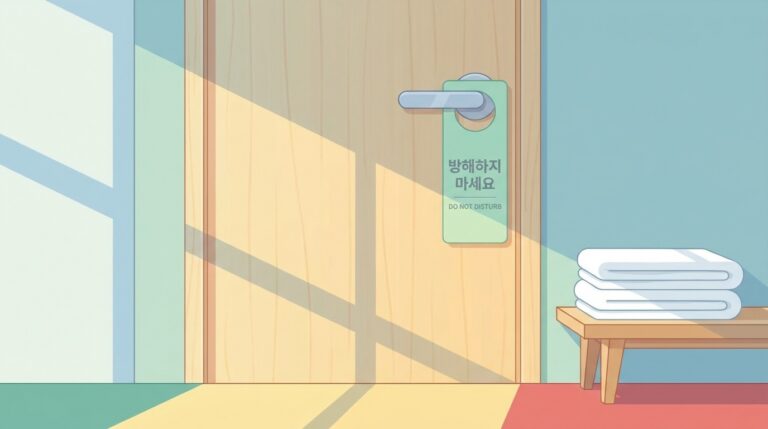
Most modern Korean hotels (from Lotte City Hotel to boutique stays in Gangnam) now follow eco-friendly hotel policies called 그린 캠페인 (Green Campaign). Bed linens are typically not replaced daily unless you leave a specific card on your pillow. Many hotel doors have illuminated touch buttons near your master light switch inside: 청소 요청 (Make Up Room) and 방해 금지 (Do Not Disturb). If you tap the red “Do Not Disturb” light before you go to sleep, nobody will knock in the morning!
Phase 5: Real-World Roleplay Scenario
Setting: A sunlit hallway of an aesthetic boutique hotel in Bukchon Hanok Village. You opened the door after hearing a knock.
Character: Auntie Min-jung (김민정 이모님), a super friendly, quick-working housekeeper carrying a stack of fluffy white towels.
- Turn 1 (Min-jung): 안녕하세요! 지금 방 청소해 드릴까요?
(An-nyeong-ha-se-yo! Ji-geum bang cheong-so-hae deu-ril-kka-yo?)
“Hello! Shall I clean the room for you now?”
🎭 Smiling warmly with a bundle of towels ready in her arms -
Turn 2 (You): 아, 안녕하세요! 객실 청소는 안 해 주셔도 돼요.
(A, an-nyeong-ha-se-yo! Gaek-sil cheong-so-neun an hae ju-syeo-do dwae-yo.)
“Ah, hello! You don’t need to clean the room, thank you.”
🎭 Bowing your head politely with hands together -
Turn 3 (Min-jung): 아, 그러세요? 쓰레기통만 비워 드릴까요?
(A, geu-reo-se-yo? Sseu-re-gi-tong-man bi-wo deu-ril-kka-yo?)
“Ah, is that so? Shall I just empty your trash can?”
🎭 Gesturing slightly toward the doorway -
Turn 4 (You): 네, 쓰레기통만 비워 주세요. 그리고 수건만 더 주세요!
(Ne, sseu-re-gi-tong-man bi-wo ju-se-yo. Geu-ri-go su-geon-man deo ju-se-yo!)
“Yes, please just empty the trash can. And could I have more towels, please?”
🎭 Handing out the small bin with both hands and smiling -
Turn 5 (Min-jung): 네, 여기 새 수건 네 장 있어요. 더 필요한 건 없으세요?
(Ne, yeo-gi sae su-geon ne jang it-seo-yo. Deo pil-yo-han geon eop-seu-se-yo?)
“Sure, here are four fresh towels. Is there anything else you need?”
🎭 Handing over a neat bundle of clean white towels -
Turn 6 (You): 혹시 생수 두 병만 더 받을 수 있을까요?
(Hok-si saeng-su du byeong-man deo ba-deul su it-seul-kka-yo?)
“By any chance, could I get two more bottles of water?”
🎭 Asking politely with a hopeful expression -
Turn 7 (Min-jung): 그럼요! 시원한 물 여기 두 병 드릴게요. 푹 쉬세요!
(Geu-reom-yo! Si-won-han mul yeo-gi du byeong deu-ril-ge-yo. Puk swi-se-yo!)
“Of course! Here are two cold bottles of water. Get plenty of rest!”
🎭 Pulling cold water from her cart and nodding cheerfully -
Turn 8 (You): 정말 감사합니다. 수고하세요!
(Jeong-mal gam-sa-ham-ni-da. Su-go-ha-se-yo!)
“Thank you so much. Have a great day!”
🎭 Receiving the bottles with two hands and giving a final appreciative bow
🔀 Interactive Decision Fork
What if Min-jung asks: “어메니티는 더 안 필요하세요? (Don’t you need more amenities?)” and your shampoo is totally empty. What do you reply?
- Choice A: 필요 없어요! 가세요! (Pil-yo eop-seo-yo! Ga-se-yo!)
- Feedback (Bad): Yikes! This means “I don’t need it! Go away!” It sounds aggressive and will hurt her feelings.
- Choice B: 샴푸 하나만 더 주세요! (Syam-pu ha-na-man deo ju-se-yo!)
- Feedback (Best!): Spot on! Clear, courteous, natural, and accurately uses the -만 (only) particle.
- Choice C: 샴푸 주세요 거절합니다. (Syam-pu ju-se-yo geo-jeol-ham-ni-da.)
- Feedback (Risk): Contradictory robot mode! You said “Give me shampoo” and “I refuse” in the same breath. She will be very confused.
Phase 6: 10-Second Emotion Shadowing Drill
Read these aloud mimicking native rhythm. Slashes (/) indicate natural breath pauses.
[😊 밝고 다정하게 / Bright & friendly]- 객실 청소는 / 괜찮아요! (Gaek-sil cheong-so-neun / gwaen-chan-a-yo!)
[🙏 조심스럽고 정중하게 / Polite & gentle]- 수건 두 장만 / 더 주실 수 있나요? (Su-geon du jang-man / deo ju-sil su it-na-yo?)
[💡 궁금하고 또박또박 / Curious & clear]- 혹시 / 와이파이 비번이 / 뭐예요? (Hok-si / wa-i-pa-i bi-beon-i / mwo-ye-yo?)
[ 따뜻하고 감사한 마음으로 / Warm & grateful]- 감사합니다 / 수고하세요! (Gam-sa-ham-ni-da / su-go-ha-se-yo!)
Phase 7: K-Culture Mini Dictionary
- 수건 (Su-geon) — Towel
- Usage: Korean hotel towels are usually hand-towel sized (페이스 타월). If you want a giant bath sheet, you can specify 큰 수건 (keun su-geon) or 바스타월 (ba-seu-ta-wol).
- 비번 (Bi-beon) — Password / PIN
- Usage: Short for 비밀번호. Widely used for digital door locks on your Airbnb, luggage lockers in Seoul subway stations, and Wi-Fi networks.
- 생수 (Saeng-su) — Bottled drinking water
- Usage: Tap water in Korea is clean, but almost everyone drinks bottled or filtered water (정수기 물). Hotels usually provide two complimentary bottles per day.
- 꿀잠 (Kkul-jam) — Sweet, deep sleep (Honey sleep)
- Usage: A beloved slang term combining 꿀 (honey) and 잠 (sleep). When you skip morning cleaning to sleep in until noon, you are enjoying pure 꿀잠!
Phase 8: Traveler’s Survival Kit
Top 3 Survival Phrases
- 1. 휴지 더 주세요 (Hyu-ji deo ju-se-yo)
- Meaning: Please give me more toilet paper.
- Pro Tip: Useful in older hotels or Hanok accommodations where rolls are kept in smaller quantities.
- 2. 물 온수가 안 나와요 (Mul on-su-ga an na-wa-yo)
- Meaning: Hot water is not coming out.
- Pro Tip: In Korean guesthouses, you often need to press the 온수 (Hot Water) button on the wall boiler panel (보일러) before the shower gets hot!
- 3. 체크아웃 연장 돼요? (Che-keu-a-ut yeon-jang dwae-yo?)
- Meaning: Can I extend late check-out?
- Pro Tip: Usually costs 10,000 to 20,000 KRW per additional hour at standard city hotels.
Editor’s Travel Note
- Essential Navigation: Google Maps does not provide accurate walking directions in Korea due to national security map data laws. Make sure to download the Naver Map app on your phone before arriving at Incheon Airport.
- Connecting Hassle-Free: If the hotel Wi-Fi feels sluggish on rainy days, you can reserve an unlimited data eSIM or pick up a pocket Wi-Fi router (와이파이 도시락) directly at terminal arrival gates.
Phase 9: “One Step Deeper” (Cultural Reflection)
In Western hospitality, a sign saying “Do Not Disturb” is completely neutral and standard. However, in Korean community-centric culture, hotel housekeepers take personal pride in providing care and maintaining cleanliness for guests under their roof. When a guest simply says “No cleaning,” older staff might worry that something was unsatisfactory with their service or that the guest is feeling unwell.
By saying 청소는 안 해 주셔도 돼요, 감사합니다 (You don’t need to clean, thank you) with a warm smile, you shift the message from “Leave me alone” to “I appreciate your willingness to help, but I am comfortable as I am.” This subtle linguistic distinction showcases the beauty of Korean politeness—it always honors the other person’s effort.
💬 Your Turn: Have you ever experienced an awkward encounter with hotel staff abroad because of language barriers? Drop your story in the comments below!
Phase 10: FAQ & Avoiding Misunderstandings
Q: Can I just leave the English “Do Not Disturb” hanger on the door handle?
A: Yes! Every major hotel in Korea recognizes the standard “Do Not Disturb” hanger or electronic switch. However, if you are staying in a residential Airbnb, small motel (모텔), or traditional Hanok guesthouse, they might not have door hangers. In that case, sending a quick message to your host with “청소는 안 해 주셔도 돼요!” is the best approach.
Q: Do I need to tip the housekeeping staff in Korea when they hand me towels?
A: No! Tipping is strictly not part of Korean culture. Leaving money on the pillow or offering cash to room staff will only confuse them; they may run after you thinking you accidentally dropped your money. A sincere bow with “감사합니다 (Gam-sa-ham-ni-da)” is the best reward.
Q: How do I tell them to take out the trash without cleaning the whole room?
A: Simply leave your tied trash bag right outside your room door in the hallway in the morning, or hand it to them saying: “쓰레기만 버려 주세요 (Sseu-re-gi-man beo-ryeo ju-se-yo / Just throw away the trash please).”
🚨 Common Mistakes Alert!
- Mistake: Shouting “청소 싫어요! (Cheong-so sil-eo-yo!)” through the door.
- Why it’s bad: This literally means “I hate cleaning!” It sounds childish and rude.
- Correct Action: Say “청소 괜찮아요! (Cheong-so gwaen-chan-a-yo! / Cleaning is okay/no need!)”.
- Mistake: Taking fresh towels with one hand while holding your smartphone with the other.
- Why it’s bad: In Korean etiquette, receiving things with one hand from someone older appears disrespectful.
- Correct Action: Hold the towels with both hands and slightly nod your head.
- Mistake: Asking “와이파이 공짜예요? (Wa-i-pa-i gong-jja-ye-yo?)” in hotels.
- Why it’s bad: While understandable, 공짜 (gong-jja) sounds slightly cheap.
- Correct Action: Ask “와이파이 무료예요? (Wa-i-pa-i mu-ryo-ye-yo? / Is Wi-Fi free of charge?)” for a polished impression.
Phase 11: Action Mission & Engagement
Put your learning to work with this step-by-step 3-tier challenge:
- 🥉 Bronze Level (Solo Practice): Stand in front of your bedroom door. Practice opening it gently, giving a slight 15-degree head bow, and whispering out loud: “청소는 안 해 주셔도 돼요! 수건만 주세요!” repeat three times until it rolls off your tongue smoothly.
- 🥈 Silver Level (Social Practice): Screenshot your favorite phrase from this guide, post it on your Instagram Story or Threads, tag
@DailyHangul, and share which Korean city you want to visit first! - 🥇 Gold Level (Real-World Mission): On your next trip to Korea, decline room cleaning or ask the front desk for extra water bottles entirely in Korean without switching to English!
🎮 K-Culture Mission: Watch any hotel or travel scene in popular K-Dramas (such as King the Land or Crash Landing on You). Listen closely whenever someone asks for help—can you spot the phrase -해 주세요 (-hae ju-se-yo)?
Phase 12: Interactive Quiz Challenge
Test your skills before checking into your room!
Question 1 (Situational Judgment)
You woke up late in your Seoul hotel. Housekeeping knocks on your door. You want more water bottles and don’t want the room cleaned. Which phrase is best?
a) 청소하지 마! 물 줘! (Cheong-so-ha-ji ma! Mul jwo!)
b) 청소는 안 해 주셔도 돼요. 물만 더 주세요. (Gaek-sil cheong-so-neun an hae ju-syeo-do dwae-yo. Mul-man deo ju-se-yo.)
c) 물 싫어요 청소하세요. (Mul sil-eo-yo cheong-so-ha-se-yo.)
👉 Click to view Answer & Explanation
- Correct Answer: b)
- Explanation: Option (a) uses informal low-talk (반말) which is very rude to staff. Option (c) means “I hate water, please clean,” which is the opposite of what you want! Option (b) is polite, warm, and natural.
Question 2 (Fill in the Blank)
Complete the sentence to ask for the Wi-Fi password:
“와이파이 ______가 뭐예요?”
a) 화장실 (Hwa-jang-sil)
b) 비밀번호 (Bi-mil-beon-ho)
c) 수건 (Su-geon)
👉 Click to view Answer & Explanation
- Correct Answer: b) 비밀번호 (Bi-mil-beon-ho)
- Explanation: 비밀번호 means password/PIN. 화장실 means restroom, and 수건 means towel.
Question 3 (True or False Cultural Quiz)
Statement: When hotel staff in Korea bring fresh towels or water to your room, it is customary to tip them at least 2,000 KRW to 5,000 KRW.
👉 Click to view Answer & Explanation
- Correct Answer: False!
- Explanation: There is zero tipping culture in South Korea. Offering tips can make staff uncomfortable. A polite bow and “감사합니다 (Gam-sa-ham-ni-da)” is the highest courtesy!
🎬 Watch Our Daily Videos! (Daily Hangul Official Instagram)
Review the expressions you learned in this article with our fun daily short videos! Check out native pronunciation and real-life nuances in action.
- Instagram @dailyhangul_en







