

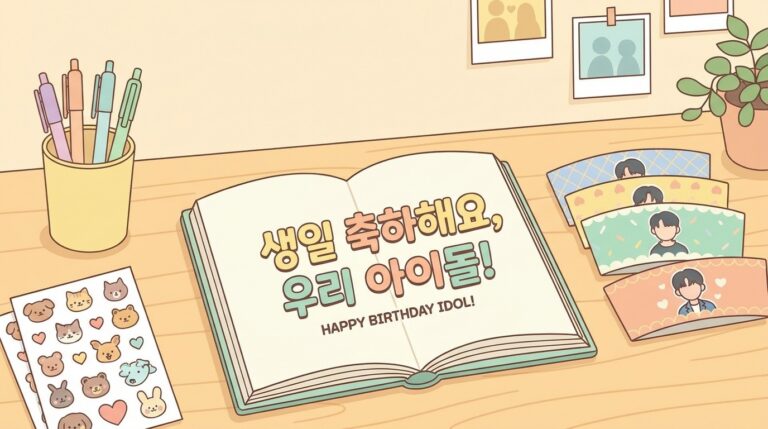
Phase 1: 공감 (Story-Immersive Opening)
안녕하세요! 매일한글 에디터입니다. (Hello! This is your Daily Hangul editor.)
Imagine walking into a sunlit cafe tucked away in an alley of Hongdae or Seongsu on a crisp Saturday afternoon. The windows are decorated with lovely posters of your favorite idol, cup sleeves are stacked high in pastel towers, and your bias’s solo songs play softly in the background. You’ve just ordered the signature drink set, clutched your first lucky draw photo card, and then you see it: a beautifully decorated corner with colorful pens, cute masking tape, and an open binder labeled 메시지 북 (Message Book).
Your heart instantly flutters—and then freezes. Other fans (덕메, fan friends) are joyfully doodling and leaving touching paragraphs in neat Korean. You pull out a chair, open a fresh page, cap off a marker, and suddenly your mind goes completely blank. What if my Korean sounds robotic? Is it rude to use informal speech? What if the cafe organizers really bind this book and hand it to my idol’s entertainment agency next week, and my message looks awkward?
Take a deep breath! You don’t need to write a poetic essay in advanced Korean to melt your idol’s heart. Over the past five years, we have guided hundreds of global K-pop fans through their first 생일 카페 (birthday cafe) visits. What idols cherish most isn’t complex vocabulary; it is sincerity, warmth, and respectful affection. By the end of this guide, you will master the exact three phrases and cultural etiquette needed to write an unforgettable handwritten message that will bring a genuine smile to your bias.
Phase 2: 핵심 표현 3선 심층 분석 (Core Expressions)
Here are the three must-have expressions for your handwritten message book entry, crafted for elementary (A2) learners!
1. 태어나 줘서 고마워요 (Tae-eo-na jwo-seo go-ma-wo-yo)
- Pronunciation: [Tae-eo-na jwo-seo go-ma-wo-yo] (Think: “Teh-uh-nah jwaw-saw go-mah-woh-yoh”—smooth and flowing like a warm wave)
- Meaning: Literal: “Thank you for being born for me/us.” | Real Nuance: “Your very existence is a blessing in my life.”
- K-Culture Moment: This is the undisputed #1 phrase printed on fan banners at concerts and shouted during encore stages when surprise birthday cakes roll out.
- Editor’s Insight: In English, “thank you for being born” can sound dramatic or intense. In Korean culture, however, thanking someone for their birth is the warmest, most respectful way to honor someone you deeply care about. The auxiliary verb
-아/어 주다shows that their existence feels like a generous gift to the world.- Situation Spectrum: Casual (태어나 줘서 고마워): ✅ (for younger idols/friends) | Semi-formal (태어나 줘서 고마워요): ✅ (Sweet spot for birthday cafes!) | Formal (태어나 주셔서 감사합니다): ⚠️ (Slightly stiff for a cute fan note)
- 🤔 Think About It: Does your native language celebrate a person’s existence itself, or does it focus purely on wishing them a fun day?
2. 언제나 응원하고 있어요 (Eon-je-na eung-won-ha-go iss-eo-yo)
- Pronunciation: [Eon-je-na eung-won-ha-go iss-eo-yo] (Pronounce “eung” like the humming sound when you agree: “Ung!”)
- Meaning: Literal: “I am cheering for you always.” | Real Nuance: “No matter what happens, I’m always standing right behind you.”
- K-Culture Moment: You will see this written in every Weverse fan letter or handwritten cafe postcard. When an idol faces intense schedules or comebacks, this phrase gives them emotional armor.
- Editor’s Insight: The
-고 있다grammar pattern indicates a continuous, ongoing state. By telling your idol you are actively cheering for them, you let them know that your support isn’t fleeting—it is constant and reliable.- Situation Spectrum: Casual (언제나 응원해): ✅ | Semi-formal (언제나 응원하고 있어요): ✅ | Formal (언제나 응원하겠습니다): ✅ (Very common in official fan letters)
- 🤔 Think About It: In English, we often say “Good luck!” or “Rooting for you!” How does “cheering constantly” feel different in terms of commitment?
3. 아프지 말고 늘 행복하세요 (A-peu-ji mal-go neul haeng-bok-ha-se-yo)
- Pronunciation: [A-peu-ji mal-go neul haeng-bok-ha-se-yo] (Crisp ‘p’ in a-peu, soft ‘mal-go’)
- Meaning: Literal: “Don’t get sick and always be happy.” | Real Nuance: “Your health and happiness are what matter most to us.”
- K-Culture Moment: Whenever idols complete grueling world tours, fans flood comment sections with this exact phrase. Even the members say this to each other during their year-end emotional speeches.
- Editor’s Insight: Notice that Korean care starts with bodily health: “아프지 말고” (Don’t be sick) comes before happiness! In Korea, taking care of one’s body and wellness is considered the foundation of all joy.
- Situation Spectrum: Casual (아프지 말고 행복해): ✅ | Semi-formal (아프지 말고 행복해요): ✅ | Polite request (아프지 말고 늘 행복하세요): ✅ (Perfect for idol notes)
- 🤔 Think About It: Why do you think Korean affection is so deeply tied to health and eating well compared to Western cultures?
Phase 3: 교과서 한국어 vs 진짜 한국어 (Textbook vs Real Korean)
Let’s see how standard classroom phrasing transforms into natural fan language inside a birthday cafe.
Situation 1: Wishing a Happy Birthday
- 📖 교과서 한국어: 당신의 생일을 진심으로 축하합니다. (Dangsin-ui saeng-il-eul jinsim-euro chukha-hamnida.) – “I sincerely congratulate your birthday, you.”
- 🗣️ 진짜 한국어: 생일 너무너무 축하해요! 맛있는 거 많이 먹어요! (Saeng-il neomu-neomu chukha-hae-yo! Mas-iss-neun geo man-i meog-eo-yo!) – “Happy, happy birthday! Eat lots of delicious food today!”
- 💡 왜 다를까?: In real Korean, the word 당신 (dangsin) can sound cold, confrontational, or oddly literary. Native speakers drop pronouns and add enthusiastic duplications like 너무너무 (very very) and food wishes to show warmth.
Situation 2: Expressing Long-term Support
- 📖 교과서 한국어: 귀하의 성공적인 활동을 기원합니다. (Gwiha-ui seong-gongjeogin hwaldong-eul giwonhamnida.) – “I pray for your honorable successful activities.”
- 🗣️ 진짜 한국어: 항상 우리 곁에 있어 줘서 고마워요. (Hangsang uri gyeot-e iss-eo jwo-seo go-ma-wo-yo.) – “Thank you for always staying by our side.”
- 💡 왜 다를까?: Textbook phrases can sound like a formal corporate contract. Fans express emotional solidarity by saying “우리 곁에” (by our side), highlighting the bond between the idol and the fandom.
Phase 4: K-Culture 딥다이브 & 비언어적 매너 (Deep-Dive & Manners)
4-1. 눈치 (Nunchi) & Etiquette at the Message Book Table
- Don’t monopolize the table: Message books are shared community heirlooms. Usually, there is only one or two binders for hundreds of visitors. Keep your writing time to 3–5 minutes. If others are waiting behind you, step aside while thinking of your message.
- Respect page borders and fellow fans: Don’t paste massive stickers that cover another fan’s letter. Korean fans practice mutual consideration: leave a neat 2-3 inch square if the page is shared, or confine your note to your allocated sheet.
- No invasive personal information: Never write your personal phone number, private social media handles, or overly intimate requests. Keep the focus entirely on celebrating the idol.
4-2. Cultural Code Analysis: The Journey of the Message Book
Why do fans pour their hearts into these notebooks? In Korean fan culture (덕질, deok-jil), the organizers of birthday cafes are often dedicated fan-club masters (홈마 or 총대). At the conclusion of the 3-day event, organizers compile the messages, bind them with professional covers, wrap them in luxury gift boxes, and deliver them directly to the idol’s management agency or mail room. There is a very real chance your handwritten Hangul will be read by your bias on their sofa after practice!
Phase 5: 실전 롤플레이 시나리오 (Roleplay Scenario)
Setting: You are standing at a pastel-pink themed birthday cafe in Mapo-gu. The cafe staff member (and volunteer fan organizer), Min-ji, is restocking sticker sheets next to the Message Book table.
- Turn 1 (Min-ji): 안녕하세요! 음료 특전 받으셨나요? (Annyeonghaseyo! Eumryo teukjeon badeusyeotnayo?) – 🎭 Smiles warmly and points toward the counter pickup tray. – “Hello! Did you receive your drink special perks?”
- Turn 2 (You): 네, 받았어요! 혹시 여기 메시지 북 써도 돼요? (Ne, badeos-eo-yo! Hoksi yeogi meseiji buk sseodo dwaeyo?) – 🎭 Points politely toward the open binder. – “Yes, I got them! By any chance, may I write in this message book?”
- Turn 3 (Min-ji): 네, 물론이죠! 편하게 앉아서 쓰세요. 스티커도 자유롭게 쓰시면 돼요. (Ne, mollon-ijyo! Pyeonhage anj-aseo sseuseyo. Seutikeodo jayurobge sseusimyeon dwaeyo.) – 🎭 Pulls out a chair and slides a basket of pastel pens. – “Yes, of course! Feel free to sit down and write. You can use the stickers freely, too.”
- Turn 4 (You): 와, 감사해요! 다들 편지를 정말 예쁘게 쓰셨네요. (Wa, gamsahaeyo! Dadeul pyeonji-reul jeongmal yeppeuge sseusyeotneyo.) – 🎭 Glances at the colorful pages with an admiring smile. – “Wow, thank you! Everyone wrote their letters so beautifully.”
- Turn 5 (Min-ji): 해외 팬분들도 많이 쓰고 가셨어요. 천천히 적어주세요! (Hae-oe paen-bundeul-do man-i sseugo gasyeoss-eo-yo. Cheoncheonhi jeog-eo-juseyo!) – 🎭 Hands you a heart-shaped sticker sheet encouragingly. – “Many international fans have written notes too. Please take your time writing!”
- Turn 6 (You): 혹시 다 쓴 책은 소속사로 보내나요? (Hoksi da sseun chaek-eun sosoksa-ro bonaenayo?) – 🎭 Tilts head slightly with curious eyes. – “By any chance, will the finished book be sent to their agency?”
- Turn 7 (Min-ji): 네! 카페 끝나고 다음 주 월요일에 소속사로 택배 보낼 예정이에요. (Ne! Kape kkeutnago daeum ju woryoil-e sosoksa-ro taekbae bonael yejeong-ieyo.) – 🎭 Nods proudly with a sparkling smile. – “Yes! As soon as the cafe event finishes, we plan to courier it to the agency next Monday.”
- Turn 8 (You): 대박! 정성껏 예쁘게 쓸게요. 감사합니다! (Daebak! Jeongseongkkeot yeppeuge sseulgeyo. Gamsahamnida!) – 🎭 Claps hands lightly in excitement, then begins writing. – “Awesome! I will write it neatly and with all my heart. Thank you!”
🔀 인터랙티브 분기점 (Interactive Choice)
You sit down to write your first sentence. What do you put at the top of your page?
- Option A: “야! 밥 많이 먹고 나랑 결혼하자!” (Ya! Bap man-i meok-go narang gyeolhonhaja! – Hey! Eat lots of food and let’s get married!)
- Option B: “태어나 줘서 고마워요. 언제나 멀리서도 응원하고 있어요!” (Tae-eo-na jwo-seo go-ma-wo-yo. Eon-je-na meolliseodo eung-won-ha-go iss-eo-yo! – Thank you for being born. I am always cheering for you, even from afar!)
- Option C: “선생님, 귀하의 생신을 진심으로 축하드립니다.” (Seonsaengnim, gwiha-ui saengsin-eul jinsim-euro chukhadeurimnida. – Teacher/Sir, I sincerely congratulate your honorable elderly birthday.)
Feedback:
* Option A (Risk): 🚨 Calling an idol “야” (informal rude ‘hey’) and immediately proposing might be a running meme online, but in a physical keepsake book delivered to an agency, it can appear disrespectful or overbearing.
* Option B (Best!): 🌟 Perfectly strikes the balance of polite warmth, genuine gratitude, and emotional resonance. The organizer and your bias will feel your sincere love!
* Option C (Bad): ⚠️ “생신” and “귀하” are terms used for grandparents or company chairmen. Your idol might chuckle, but it feels like a formal business greeting rather than a fan note!
Phase 6: 10초 감정 섀도잉 드릴 (Shadowing Drill)
Practice reading these rhythmically with emotional inflection before you put pen to paper!
[😊 기쁘고 설레게 - Bright & Joyful]- 생일 너무너무 축하해요! / 태어나 줘서 / 고마워요!
- (Saeng-il neomu-neomu chukha-hae-yo! / Tae-eo-na jwo-seo / go-ma-wo-yo!)
- “Happy, happy birthday! Thank you so much for being born!”
[🥺 진심을 담아 따뜻하게 - Heartfelt & Warm]- 밥 잘 챙겨 먹고, / 아프지 말고 / 늘 행복하세요.
- (Bap jal chaeng-gyeo meok-go, / a-peu-ji mal-go / neul haeng-bok-ha-se-yo.)
- “Make sure to eat well, don’t get sick, and always be happy.”
[💪 든든하고 다정하게 - Supportive & Reassuring]- 어디에 있든 / 언제나 / 응원하고 있어요!
- (Eodie itdeun / eonjena / eung-won-ha-go iss-eo-yo!)
- “Wherever you are, I am always cheering for you!”
Phase 7: K-Culture 미니 사전 (Mini Dictionary)
- 최애 (Choe-ae)
- Meaning: Ultimate bias / Number one favorite member.
- Usage: Short for “최고로 애정하다” (to love the most). You can introduce yourself in the note: “제 최애는 민규예요!” (My ultimate bias is Mingyu!).
- 생카 (Saeng-ka)
- Meaning: Idol birthday cafe.
- Usage: The fan-created abbreviation combining “생일” (birthday) and “카페” (cafe). In conversation: “오늘 생카 세 군데 돌았어요!” (I visited three birthday cafes today!).
- 덕매 (Deok-mae)
- Meaning: Fan friend / Companion in fandom life.
- Usage: A compound of “덕질” (fandom activity) and “메이트” (mate). If you meet someone friendly at the message table, they are your potential 덕매!
- 특전 (Teuk-jeon)
- Meaning: Special event goods / Cafe freebies.
- Usage: The exclusive cup sleeves, stickers, postcards, and photocards handed out when ordering the event menu.
Phase 8: 여행자를 위한 생존 키트 (Traveler’s Survival Kit)
Survival Expressions TOP 3
- 스티커 써도 돼요? (Seutikeo sseodo dwaeyo?)
- Meaning: Can I use these stickers?
- Pro Tip: Always ask before peeling decorative masking tape or glitter stickers off the table tray.
- 펜 빌려도 될까요? (Pen billyeodo doelkkayo?)
- Meaning: Could I borrow a pen?
- Pro Tip: Keep this handy if you left your pencil case at the hotel. Cafe staff are always eager to lend you colored markers.
- 메시지 북 어디에 있어요? (Meseiji buk eodie isseoyo?)
- Meaning: Where is the message book located?
- Pro Tip: Some cafes place the binder in a quiet corner away from the register. Use this phrase when entering a crowded venue.
Editor’s Travel Note
- Finding Events: To map out cafe locations, consult our X Twitter Birthday Cafe Search Guide using keywords like
#아이돌이름_생일카페or#Happy_Idol_Day. - Transit & Payments: Most cafes accept international credit cards for drink orders, but the on-site 럭키드로우 (Lucky Draw) machines or coin games often require 1,000 KRW cash bills. Keep an emergency envelope of 1,000 won banknotes in your bag.
- Navigation: Never rely on Google Maps for alleyway cafes in Seoul. Use the Naver Map Application Guide to pinpoint cafes down to the specific building floor.
Phase 9: “한 발 더 깊이” (Cultural Reflection)
In Western letter-writing traditions, birthday cards often focus on individual milestones: wishing someone a wild party, exciting travels, or achieving career success. In Korea, however, a message book is deeply communal. Fans frequently write, “우리 곁에 와줘서 고마워요” (Thank you for coming to be by our side) and “밥 꼭 챙겨 먹어요” (Make sure you eat your meals).
This reflects the Korean philosophical concept of 정 (Jeong)—an unspoken, reciprocal emotional bond. By prioritizing an idol’s health, their appetite, and thanking them for their existence, fans aren’t treating idols like distant deities on a billboard. They treat them like beloved family members whose physical well-being brings peace to the entire community.
💬 Your Turn: What is one phrase in your mother tongue that shows love through caring about someone’s daily health? Share it in the comments below!
Phase 10: FAQ & 흔한 실수 (FAQ & Common Mistakes)
Q: Can I write my message in English, or should it strictly be in Korean?
A: Mixing both is wonderful! Writing 1–2 heartfelt Korean sentences (like “태어나 줘서 고마워요”) followed by a short note in your native language shows immense sincerity. Korean idols often love reading notes from international fans because it proves their music crosses oceans.
Q: Can I use 반말 (informal Korean) in the message book?
A: If your bias is older than you or you are unsure, stick to 존댓말 (polite speech with -요, such as 축하해요, 행복하세요). Even if you are older than the idol, polite language displays respectful and elegant fan love in a physical book.
Q: What should I bring with me to a birthday cafe message table?
A: The cafe usually provides pens and stickers, but bringing your own quick-drying fine-tip pen (0.5mm gel pen) ensures your message won’t smudge when the organizer closes the binder pages!
🚨 흔한 실수 (Common Mistakes) 경고판
- Mistake 1: Using automated translators for complex idioms.
- Correct Action: Keep sentences short and simple (Subject + Verb). Direct translations like “You slay my existence” become bizarre and alarming in Korean.
- Mistake 2: Writing your phone number or KakaoTalk ID.
- Correct Action: Never leave private contact details. Cafe organizers filter out inappropriate notes before presenting the binder to agencies.
- Mistake 3: Taking up an entire blank page when space is limited.
- Correct Action: Look at the previous entries. If each fan wrote a 4-line postcard-sized note, follow that visual layout so everyone gets a turn.
Phase 11: 액션 미션 & 참여 유도 (Action Missions)
- 🥉 Bronze Mission (Solo Practice): Grab a blank sheet of paper or post-it note at home. Write out “태어나 줘서 고마워요!” and “늘 행복하세요!” three times by hand in neat Hangul.
- 🥈 Silver Mission (Social Share): Snap a photo of your handwritten practice note and post it on your Instagram Story or X (Twitter) with the hashtag
#DailyHangulCafeChallenge. - 🥇 Gold Mission (Real Life Action): Visit an upcoming idol birthday cafe in your city or during your Seoul trip, locate the message book, and leave a genuine handwritten note using today’s phrases!
- 🎮 K-Culture Mission: Watch your favorite idol’s most recent birthday livestream (VLive, Weverse, or YouTube). Count how many times fans comment “밥 먹었어요?” (Did you eat?) or “태어나 줘서 고마워요” in the live chat!
Phase 12: 인터랙티브 퀴즈 챌린지 (Quiz Challenge)
Test your knowledge before grabbing your pastel marker!
1. Situational Judgment:
You are writing in the message book. Which closing sentence is the most natural and affectionate for an A2 learner?
* A) 죽을 때까지 일하세요. (Work until you die.)
* B) 아프지 말고 늘 행복하세요! (Don’t get sick and always be happy!)
* C) 당신의 수명을 진심으로 기원합니다. (I pray for your biological lifespan.)
2. Fill-in-the-Blank:
Complete the iconic birthday greeting thanking the idol for their existence:
* “________ 줘서 고마워요!”
3. True or False:
* True or False: Asking your idol “밥 잘 챙겨 먹었어요?” (Did you eat well?) in a birthday note is considered overly nosy and impolite in Korean fan culture.
👉 Click to reveal answers & explanations!
- Answer: B – 아프지 말고 늘 행복하세요! is the gold-standard phrase wishing both good health and continuous joy. Option A is aggressive, and Option C is excessively formal and robotic.
- Answer: 태어나 (Tae-eo-na) – The complete phrase is 태어나 줘서 고마워요 (Thank you for being born)!
- Answer: False! – Asking about food and health is one of the highest expressions of care and affection in Korean culture. Your idol will feel deeply touched!
🎬 Watch Our Daily Videos! (Daily Hangul Official Instagram)
Review the expressions you learned in this article with our fun daily short videos! Check out native pronunciation and real-life nuances in action.
- Instagram @dailyhangul_en






