

Phase 1: Empathy (Story Opening)
안녕하세요! 매일한글 에디터입니다. If you’ve ever watched the hit K-Drama Start-Up (스타트업) or Search: WWW (검색어를 입력하세요 WWW), you’ve seen those intense, thrilling tech office scenes: developers and product managers furiously typing away in modern glass offices, drinking iced Americanos (아아), and cheering when a workflow finally clicks. But in real life, whether you’re working at a fast-growing startup in Pangyo Techno Valley or collaborating remotely with a Korean team, workplace communication can be terrifying—especially when technical jargon gets involved!
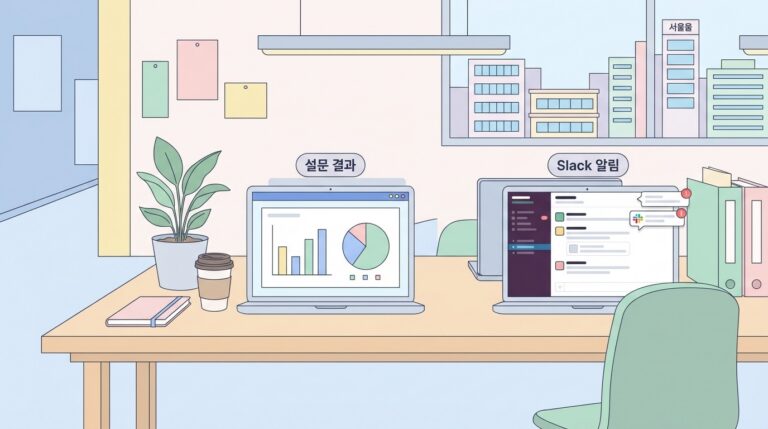
Imagine this: your team just launched a brand-new customer survey. In the past, someone had to manually check responses, copy-paste them into a spreadsheet, and ping everyone on Slack. You spent your afternoon building a smart automation between Notion, Jira, and Slack. Now, you need to announce it in the team meeting. You want to say: “Whenever a new customer survey response arrives, it logs simultaneously into a spreadsheet and Slack.” How do you say this in Korean without sounding like a robotic translated manual or an outdated grammar drill? Based on feedback from hundreds of intermediate learners working in Korean business environments, mastering this specific workflow phrase unlocks instant respect and proves you have true professional fluency. Let’s make you sound like a dependable, tech-savvy team member!
Phase 2: Core 3 Expressions In-Depth
1. 고객 응답이 들어올 때마다 (Gogaek eungdabi deureool ttaemada)
- Pronunciation: [Gogaek eungdabi deureool ttaemada] (Sound analogy: Think of “Go-get” + “oong-dah-bee” + “deu-reo-ol” + “tae-mah-dah”)
- Meaning: “Whenever a customer response comes in”
- K-Culture Moment: In modern Korean offices, customer feedback is king. In Start-Up, whenever user reviews flooded the sandbox servers, the team huddled around tracking customer signals. The grammar point -(으)ㄹ 때마다 means “whenever / every time something happens.”
- Editor’s Insight: Notice the verb 들어오다 (deureooda), which literally means “to enter” or “to come in.” Koreans naturally conceptualize incoming digital data, messages, orders, and survey results as physically “entering” the room or inbox.
- Situation Spectrum: Casual (⚠️) / Semi-formal (✅) / Formal (✅)
- 🤔 Think About It: In English, we often say “Whenever we receive data.” In Korean, the data itself is the subject that “comes in” (응답이 들어오다). How does treating data as an active incoming guest shift the focus to responsiveness?
2. 동시에 기록되도록 연결했어요 (Dongsie girokdoedorok yeongyeolhaesseoyo)
- Pronunciation: [Dongsie girokdoedorok yeongyeolhaesseoyo] (Sound analogy: “Dong-she-eh” + “kee-rok-dway-do-rok” + “young-gyeol-hae-ssuh-yo”)
- Meaning: “I connected it so that it logs/records simultaneously”
- K-Culture Moment: When IT teams demo their integration pipelines during sprint reviews, -도록 연결하다 is the gold-standard phrase to explain cause, purpose, and result in one sleek stroke.
- Editor’s Insight: The grammar ending -도록 하다 denotes setting up conditions so that a specific result naturally follows. By combining it with 동시에 (dongsie – simultaneously), you highlight your efficiency and technical competence.
- Situation Spectrum: Casual (⚠️) / Semi-formal (✅) / Formal (✅)
- 🤔 Think About It: English developers often say “I automated it.” Korean tech workers frequently use “연결했어요 (I linked/connected it)” or “연동했어요 (I integrated it),” emphasizing harmony and flow between systems.
3. 슬랙으로 바로 알림이 떠요 (Seullaegeuro baro allimi tteoyo)
- Pronunciation: [Seullaek-euro baro allimi tteoyo] (Sound analogy: “Slack” + “oo-ro” + “bah-ro” + “ahl-leem-ee” + “ttuh-yo”)
- Meaning: “An alert pops up on Slack right away”
- K-Culture Moment: Hearing the Slack knock sound or seeing a notification popup in an open-plan office in Gangnam triggers immediate team attention. 뜨다 (tteoda – to float/pop up) is the vivid everyday word Koreans use for digital notifications.
- Editor’s Insight: While textbooks teach “통보됩니다 (It is notified)” or “표시됩니다 (It is displayed),” native speakers in tech always say “알림이 떠요 (The notification floats up).” It sounds dynamic and lively.
- Situation Spectrum: Casual (✅) / Semi-formal (✅) / Formal (⚠️)
- 🤔 Think About It: The verb 뜨다 originally describes the sun rising (해가 뜨다) or something floating on water. How does visualizing a notification as “rising up” change how you interact with your digital workspace?
Phase 3: Textbook Korean vs. Real Korean
Situation 1: Explaining your automated setup in a stand-up meeting
- 📖 교과서 한국어 (Textbook): “고객 설문조사 결과가 스프레드시트와 슬랙에 전송되는 기능을 구현하였습니다.” (I implemented a function where customer survey results are transmitted to a spreadsheet and Slack.)
- 🗣️ 진짜 한국어 (Real-World): “응답 들어올 때마다 시트랑 슬랙에 바로 연동되게 걸어뒀어요.” (I hooked it up so whenever a response comes in, it syncs directly to the sheet and Slack.)
- 💡 왜 다를까? (Why is it different?): Textbook Korean overuses heavy Sino-Korean passive verbs like 구현하였습니다 (implemented). Real startup professionals prefer crisp verbal constructions like 연동되게 걸어뒀어요 (hooked it up to integrate), keeping stand-ups fast and punchy.
Situation 2: Highlighting team time savings
- 📖 교과서 한국어 (Textbook): “이를 통하여 업무의 소요 시간을 대폭 절감할 수 있습니다.” (Through this, we can significantly reduce the required time for work.)
- 🗣️ 진짜 한국어 (Real-World): “이제 일일이 수작업으로 복붙 안 하셔도 돼요!” (Now you don’t have to copy-paste everything manually one by one!)
- 💡 왜 다를까? (Why is it different?): In daily Korean collaboration, conversational slang like 복붙 (bok-but – copy & paste) and empathetic expressions like 일일이 (il-il-i – tedious one-by-one effort) show that you understand your team’s everyday pain points.
Phase 4: K-Culture Deep Dive & Non-Verbal Manners
4-1. Nunchi (눈치) & Tech Meeting Gestures
When presenting an automation workflow to a Korean team leader (팀장님) or colleagues, subtle body language establishes your professionalism:
1. Screen Gesture with Two Hands: When pointing toward a shared screen, avoid using an isolated index finger. Open your palm slightly upward with both hands loosely aligned, directing your team’s gaze gently to the Slack channel feed.
2. The Humble Delivery: Even if you saved the company 10 hours a week, maintain modest warmth. Start with a light head nod: “팀장님, 번거로우실까 봐… (Team leader, in case it was tedious for everyone…)” before unveiling the automation.
3. Active Listening Cues: While the team tests the survey link, maintain eye contact, lean forward slightly, and nod with an affirming “네, 맞습니다 (Yes, exactly)” rather than remaining silent behind your laptop.
4-2. Culture Code: The Pangyo Dialect (판교 사투리)
South Korea’s Silicon Valley is Pangyo Techno Valley (판교 테크노밸리). Over the past decade, a unique workplace linguistic culture emerged here known playfully as 판교 사투리 (Pangyo Dialect). It mixes English tech terminology with polite Korean endings: “이거 슬랙으로 싱크(sync) 맞추고, 지라 티켓 트리거(trigger) 걸어둘게요!” Understanding how to blend technical loanwords seamlessly into Korean sentences proves you can swim with the current of modern Korean corporate innovation.
Phase 5: Real-World Roleplay Scenario
Setting: A hybrid product sprint meeting at a trendy tech incubator in Seongsu-dong, Seoul.
Characters:
* 민지 팀장 (Team Lead Minji): Sharp, encouraging, always focused on agile velocity.
* You (Alex / 알렉스): Global operations specialist managing customer workflows.
- 민지: 알렉스 씨, 지난주에 배포한 고객 만족도 설문조사 응답 확인은 어떻게 되고 있나요?
(Alex-ssi, jinanju-e baepohan gogaek manjokdo seolmunjosa eungdap hwagig-eun eotteoke doego innayo?)
“Alex, how are we handling the responses from the customer satisfaction survey deployed last week?”
🎭 (Checking her tablet with a slight frown of concern) -
You: 아, 팀장님! 매번 수동으로 확인하기 번거로우실 것 같아서 자동화해 뒀어요.
(A, timjangnim! Maebeon sudong-euro hwaginhagi beongeorou-sil geot gat-aseo jadonghwahae dwosseoyo.)
“Ah, Team Lead! I figured checking it manually every time would be tedious, so I automated it.”
🎭 (Smiling confidently while opening the Notion dashboard) -
민지: 정말요? 어떻게 세팅하셨어요?
(Jeongmallyo? Eotteoke setinghasyeosseoyo?)
“Really? How did you set it up?”
🎭 (Leaning in with genuine curiosity) -
You: 고객 설문조사 폼에 새로운 응답이 들어올 때마다 스프레드시트와 슬랙에 동시에 기록되도록 연결했어요.
(Gogaek seolmunjosa pom-e saeroun eungdabi deureool ttaemada seupeuredeusiteuwa seullaeg-e dongsie girokdoedorok yeongyeolhaesseoyo.)
“Whenever a new customer survey response arrives, I connected it so it logs simultaneously into a spreadsheet and Slack.”
🎭 (Demonstrating a live test submission on your laptop) -
민지: 와, 대박! 실시간으로 바로 채널에 뜨는 건가요?
(Wa, daebak! Silsigan-euro baro chaeneore tteuneun geongayo?)
“Wow, amazing! Does it pop up in the channel in real-time?”
🎭 (Watching the Slack channel light up with a chime) -
You: 네! 심각한 불만 피드백은 지라 버그 티켓으로 자동 생성되게 걸어뒀습니다.
(Ne! Simgakhan bulman pideubaeg-eun jira beogeu tikeseuro jadong saengseongdoege georoodweossseumnida.)
“Yes! Critical negative feedback is also set up to auto-generate a Jira bug ticket.”
🎭 (Handing over the test log tablet with both hands) -
민지: 진짜 든든하네요. 알렉스 씨 덕분에 우리 팀 리소스 엄청 아끼겠어요!
(Jinjja deundeunhaneyo. Alex-ssi deokbune uri tim risoseu eomcheong akkigesseoyo!)
“That’s so dependable. Thanks to you, Alex, our team will save so many resources!”
🎭 (Giving an appreciative two-handed thumbs-up) -
You: 유용하게 쓰였으면 좋겠습니다. 혹시 수정할 부분 있으면 언제든 말씀해 주세요!
(Yuyonghage sseuyeosseumyeon jokessseumnida. Hoksi sujeonghal bubun isseumyeon eonjedeun malsseumhae juseyo!)
“I hope it serves us well. If there’s anything to tweak, please let me know anytime!”
🎭 (Nodding politely with a warm smile)
🔀 Interactive Decision Point
When Minji asks if the setup can handle multi-channel surveys from KakaoTalk forms as well, how do you respond?
- Option A: “카카오톡 폼 연동도 바로 가능하도록 오늘 안에 API 파이프라인 붙여둘게요!” (I’ll attach the API pipeline within today so KakaoTalk integration is ready immediately!)
- Option B: “그건 제 담당 업무가 아니라서 개발팀에 직접 물어보셔야 해요.” (That’s not my job, so you must ask the development team directly.)
- Option C: “안 될 것 같은데요. 시스템 터질 수도 있어요.” (Probably won’t work. The system might crash.)
Feedback:
* Option A (Best): Proactive, solution-focused, and uses natural Pangyo terminology. This shows top-tier team leadership.
* Option B (Risk): While clear on boundaries, the bluntness sounds overly detached and disrupts collaborative team cohesion (팀워크).
* Option C (Bad): Extremely casual tone, pessimistic, and alarming to your supervisor.
Phase 6: 10-Second Emotion Shadowing Drill
Practice matching your pitch and breath to these emotional cues. Pay attention to the pause markers (/).
[😊 뿌듯하고 명확하게 - Proud and Clear]
고객 설문조사 폼에 / 새로운 응답이 들어올 때마다 / 스프레드시트와 슬랙에 / 동시에 기록되도록 연결했어요!
(Gogaek seolmunjosa pom-e / saeroun eungdabi deureool ttaemada / seupeuredeusiteuwa seullaeg-e / dongsie girokdoedorok yeongyeolhaesseoyo!)-
[⚡ 신속하고 든든하게 - Fast and Reassuring]
알림이 실시간으로 뜨니까 / 누락될 걱정 전혀 없어요.
(Allimi silsigan-euro tteunikka / nurakdoel geokjeong jeonhyeo eopseoyo.)
“Since notifications pop up in real-time / there is zero worry of anything slipping through.” -
[🤝 공손하고 열린 태도로 - Polite and Collaborative]
혹시 추가 연동 필요한 채널 있으시면 / 언제든 편하게 말씀해 주세요!
(Hoksi chuga yeondong piryohan chaeneol isseusimyeon / eonjedeun pyeonhage malsseumhae juseyo!)
“If there are any additional channels that need integration / please feel free to let me know anytime!”
Phase 7: K-Culture Mini Dictionary
- 연동 (Yeondong) | System Integration / Linking
Used universally in Korean tech to describe bridging two databases, tools, or apps (e.g., “노션이랑 슬랙 연동 – Notion and Slack integration”). - 자동화 (Jadonghwa) | Automation
A corporate buzzword across all industries in Korea. Often combined with “구축하다 (to build)” or “돌리다 (to run/spin)”. - 실시간 (Silsigan) | Real-time / Instant
Crucial in Korean customer service culture, where speed (빨리빨리) and live updates are top expectations. - 수작업 (Sujageop) | Manual labor / Manual work
The nemesis of automation! Used when complaining about or eliminating tedious hand-entered tasks (e.g., “수작업 줄이기 – Reducing manual grunt work”).
Phase 8: Survival Kit for Tech Professionals & Travelers
Survival Expressions TOP 3
- “슬랙 채널로 링크 공유해 드릴게요.”
(Seullaek chaeneollo ringkeu gongyuhye deurilgeyo.)
Meaning: I’ll share the link through the Slack channel.
Pro Tip: Use this at the end of meetings instead of sending clunky email attachments. - “노션 페이지에 정리해 두었습니다.”
(Nosyeon peijie jeongnihae dueossseumnida.)
Meaning: I have organized it on the Notion page.
Pro Tip: Perfect status update phrase for your manager or cross-functional peers. - “연동 테스트 한 번만 부탁드립니다.”
(Yeondong teseuteu han beonman butakdeurimnida.)
Meaning: Please give this integration test a quick try.
Pro Tip: A gentle, polite request before rolling out a webhook to the entire department.
Editor’s Travel & Remote Work Note
If you’re visiting Korea as a digital nomad or business traveler working out of co-working spaces in Gangnam, Yeouido, or Seongsu:
* To navigate seamlessly to tech meetup venues and business hubs, check out our recommended guide on the 네이버 지도 앱 다운로드 to find direct transit routes without confusion.
* Korean cafes almost always offer blistering 1 Gbps Wi-Fi, but check the printed receipt for the Wi-Fi password (와이파이 비밀번호) before asking the busy barista!
Phase 9: “Going One Step Deeper” (Critical Thinking)
In Western software development, individual ownership of a feature is highlighted through phrases like “I automated my pipeline.” However, in Korean corporate life, language revolves around 우리 (uri – we/our) and relational convenience. When you say “기록되도록 연결했어요”, the focus is not on your personal brilliance, but on eliminating friction for the entire collective team. By framing automation as an act of service—relieving your teammates from tedious manual typing—you build deep social capital (정 and 신뢰) in the Korean workplace.
💬 Your Turn: What manual task at your work or study would you love to automate, and how would you explain it to your Korean team? Share your sentence in the comments below!
Phase 10: FAQ & Avoiding Misunderstandings
Q: What is the difference between 연동하다 (yeondonghada) and 연결하다 (yeongyeolhada)?
A: 연결하다 is a broad term for connecting anything physically or digitally (like plugging in a cable or opening a link). 연동하다 is specialized for systems, software, and databases operating in harmony where an action in System A triggers a reaction in System B.
Q: Can I use the word “자동화” (jadonghwa) as a verb directly?
A: You cannot just say “자동화했어요” without context. Usually, you attach -하다 to form 자동화하다 (to automate), or use the descriptive form 자동으로 넘어가게 만들었어요 (I made it transfer automatically).
Q: Why do Koreans say “알림이 뜨다” instead of “알림이 오다”?
A: Both are understood, but 알림이 오다 (a notification comes) sounds like receiving a text message, whereas 알림이 뜨다 (a notification pops up) specifically highlights the visual visual push notification banner appearing on your monitor or smartphone screen.
🚨 Common Mistakes (흔한 실수)
- Translating “I automated it” as “내가 자동했다”:
Correction: Always use 자동화했어요 (jadonghwahaesseoyo). “자동” is just a noun meaning “automatic”; it requires “-화” (transformation) to mean automation. - Using informal speech (반말) when reporting progress:
Correction: Even with close coworkers, during a sprint or ticket review, finish reports with -했어요 or -했습니다 to maintain professional respect. - Overusing passive robotic phrasing:
Correction: Avoid saying “데이터가 전송되어 기록되었습니다.” It sounds like reading an instruction booklet. Use the dynamic “동시에 기록되도록 연결했어요”.
Phase 11: Action Missions
- 🥉 Bronze Mission (Solo): Read the Phase 6 Shadowing Drill out loud 3 times. Focus on natural pauses before
/. - 🥈 Silver Mission (Social): Open your Notion or Slack app, change your interface language to Korean for one day, and take a screenshot of your favorite tech vocabulary word.
- 🥇 Gold Mission (Real-world): Next time you send a file or automate a link for a Korean-speaking colleague or tutor, text them: “시트에 자동으로 연동되게 걸어뒀어요! (I set it to sync automatically to the sheet!)”
- 🎮 K-Culture Mission: Watch an episode of a Korean workplace drama (Misaeng, Start-Up, or Agency) and listen for when someone uses the words 연결 (connection) or 실시간 (real-time).
Phase 12: Interactive Quiz Challenge
Test what you’ve mastered today! Choose your answers, then click the toggle to check.
- Situational Choice: You want to inform your team that every new survey response will show up immediately in Slack. Which sentence is most natural?
- A) 고객 응답 들어오면 슬랙에 수동으로 입력하세요.
- B) 응답 들어올 때마다 슬랙으로 실시간 알림이 뜨도록 연동해 뒀어요.
- C) 고객 설문조사 파일이 컴퓨터에서 자동으로 삭제됩니다.
- Fill-in-the-Blank: Fill in the missing particles and endings to say “I connected it so that it logs simultaneously”:
“동시[ ] 기록[ ] 연결했어요.” -
True / False Culture Quiz: In modern Korean startup offices in Pangyo, using industry loanwords like “싱크 (sync)” or “트리거 (trigger)” alongside Korean grammar is considered poor etiquette. (True / False)
👉 Click here to reveal answers and explanations!
- Answer: B | B is the most natural, tech-fluent expression. A tells people to do it manually, and C says files will be deleted!
- Answer: 동시에 기록되도록 연결했어요 | -에 indicates the time point (“simultaneously”), and -되도록 creates the causative purpose (“so that it is recorded”).
- Answer: False | In Pangyo and Seoul’s startup hubs, blending natural tech loanwords into conversational Korean (“Pangyo Dialect”) is standard, widely accepted professional practice!
🎬 Watch Our Daily Videos! (Daily Hangul Official Instagram)
Review the expressions you learned in this article with our fun daily short videos! Check out native pronunciation and real-life nuances in action.
- Instagram @dailyhangul_en







