

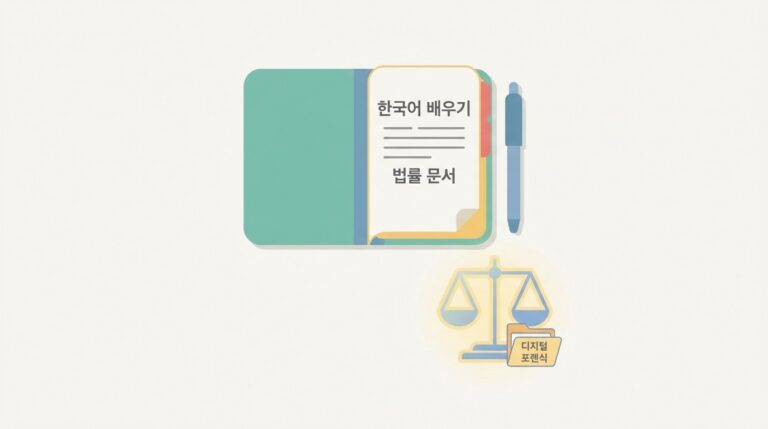
Master Legal Korean: Digital Forensics, Exclusionary Rules, and the Power of ‘The Right to Attend’
Phase 1: 공감 (Story-driven Opening)
안녕하세요! 매일한글 에디터입니다.
Have you ever watched an intense K-Drama courtroom battle—like in Stranger (비밀의 숲) or Law School (로스쿨)—where a prosecutor triumphantly slaps a USB drive onto the table, only for the defense attorney to stand up, adjust their glasses, and completely dismantle the prosecution’s case in five sharp sentences? If you have, you probably noticed that the fight wasn’t about what was inside the hard drive, but how the police copied it.
In South Korea’s hyper-digitalized legal landscape, digital forensics (디지털 포렌식) is the centerpiece of modern criminal justice. However, many advanced learners hit a massive wall here. You might know words like “증거 (evidence)” or “경찰 (police),” but when legal dramas or real-life news in Seocho-dong start dissecting “위법수집증거 배제법칙 (The Exclusionary Rule)” and the crucial “피압수자의 참여권 (the suspect’s right to attend forensic imaging),” even C1-level speakers freeze.
One of our advanced students, an international legal consultant living in Seoul, once told me: “I understand standard Korean corporate jargon, but during an unexpected regulatory audit, I couldn’t articulate why an unverified forensic data extraction breached our due process.”
Mastering this phase of C2 Korean isn’t just about sounding sophisticated; it gives you the linguistic armor to comprehend Korea’s constitutional balance between investigative power and personal liberties. Based on direct insights from legal professionals and real Supreme Court precedents, this guide will transform the way you perceive legal Korean forever. Let’s dive right in!
Phase 2: 핵심 표현 3선 심층 분석 (Core Expressions Deep Dive)
1. 참여권을 실질적으로 보장하다 (Cham-yeo-gwon-eul sil-jil-jeok-eu-ro bo-jang-ha-da)
- Pronunciation: [Cham-yeo-gwon-eul sil-jil-jeok-eu-ro bo-jang-ha-da] (Think of ‘cham’ like ‘charming’, ‘yeo’ like ‘yawn’, and ‘gwon’ like ‘gwan-in-law’.)
- Meaning: To substantially guarantee the right to be present / attend.
- K-Culture Moment: In episode 4 of a courtroom drama, when investigators seize a corporate laptop and immediately attempt to clone the drive in the hallway without the defendant’s counsel present, the attorney barges in and shouts this phrase to halt the operation.
- Editor’s Insight: In Korean constitutional and criminal procedure, “실질적 (substantial/substantive)” is the magic word. It is never enough for investigators to merely send a nominal text message saying “we are imaging your drive now.” They must provide a genuine, realistic opportunity for the party to observe the hash calculation and target selection.
- Situation Spectrum:
- Casual: 🚫
- Semi-formal: ⚠️
- Formal / Legal Proceedings: ✅
- 🤔 Think About It: In Anglo-American jurisprudence, Fourth Amendment protections often center on the “reasonable expectation of privacy.” In contrast, Korean criminal procedure heavily emphasizes the active procedural right to oversee the state’s extraction process directly. Why do you think Korean law puts such intense weight on physical presence?
2. 위법수집증거로 배제되다 (Wi-beop-su-jip-jeung-geo-ro bae-je-doe-da)
- Pronunciation: [Wi-beop-su-jip-jeung-geo-ro bae-je-doe-da] (Sound analogy: ‘We-bup’ like ‘we bump’, ‘su-jip’ like ‘shoe-jeep’, ‘jeung-geo’ like ‘jung-gear’.)
- Meaning: To be excluded as illegally obtained evidence.
- K-Culture Moment: Often shortened in courtroom jargon to “위수증 (Wi-su-jeung).” The defense counsel stands before the judge, declaring that because the forensic imaging omitted the defendant’s participation, the entire data file must be dismissed under Article 308-2 of the Criminal Procedure Code.
- Editor’s Insight: This is the Korean equivalent of the exclusionary rule. Korean law operates under the principle that if the primary procedure is tainted by a fundamental breach of due process, all subsequent derivatives are excluded (the fruit of the poisonous tree doctrine, known locally as 독수과실 이론).
- Situation Spectrum:
- Casual: 🚫
- Semi-formal: ⚠️
- Formal / Legal Proceedings: ✅
- 🤔 Think About It: Notice the passive form
배제되다(to be excluded) rather than the active배제하다(to exclude). In Korean judicial argumentation, framing the evidence as inherently disqualified focuses the spotlight on the tainted nature of the item itself.
3. 증거능력을 다투다 (Jeung-geo-neung-ryeok-eul da-tu-da)
- Pronunciation: [Jeung-geo-neung-ryeok-eul da-tu-da] (Sound analogy: ‘Jeung’ like ‘young’ with a ‘j’, ‘neung-ryeok’ like ‘nung-ryuck’.)
- Meaning: Literal: “To fight over the ability of evidence” | Real Nuance: To challenge the legal admissibility of evidence.
- K-Culture Moment: Seen during pre-trial hearings where top-tier litigators deliberate whether a cloned smartphone image can even be shown to the court, long before debating whether the client is actually innocent or guilty.
- Editor’s Insight: Do not confuse
증거능력(admissibility: whether it is qualified to enter the courtroom) with증명력(probative value: how convincing the evidence actually is). Advanced speakers show their C2 prowess by knowing that증거능력을 다투다occurs first. - Situation Spectrum:
- Casual: 🚫
- Semi-formal: ⚠️
- Formal / Legal Proceedings: ✅
- 🤔 Think About It: Why does Korean use the verb
다투다(to dispute, quarrel, or compete) for legal motions? It highlights the adversarial nature of court proceedings as a verbal and procedural duel between parties.
Phase 3: 교과서 한국어 vs 진짜 한국어 (Textbook vs. Real-World Korean)
Scenario 1: Objecting to an unnotified digital copy
- 📖 교과서 한국어 (Textbook Korean):
“이 복제본은 절차를 지키지 않고 만들었기 때문에 법원에서 사용할 수 없습니다.”
(I bok-je-bon-eun jeol-cha-reul ji-ki-ji an-ko man-deul-eot-gi ttae-mun-e beob-won-e-seo sa-yong-hal su eop-seum-ni-da. / This copy was made without following procedures, so it cannot be used in court.) - 🗣️ 진짜 한국어 (Real Forensic Litigation Korean):
“피압수자의 참여권이 배제된 상태에서 생성된 이미징 파일은 절차적 실질을 결여하여 증거능력이 전면 부정됩니다.”
(Pi-ap-su-ja-ui cham-yeo-gwon-i bae-je-doen sang-tae-e-seo saeng-seong-doen i-mi-jing pa-il-eun jeol-cha-jeok sil-jil-eul gyeol-yeo-ha-yeo jeung-geo-neung-ryeok-i jeon-myeon bu-jeong-doem-ni-da. / Forensic image files created while the suspect’s right of presence was denied lack procedural integrity, rendering their admissibility completely nullified.) - 💡 왜 다를까?: Legal Korean relies on Sino-Korean nominal compounds (
결여,전면 부정,절차적 실질) to convey objective, statutory authority rather than subjective emotional protest.
Scenario 2: Refusing to hand over the phone password without a lawyer
- 📖 교과서 한국어 (Textbook Korean):
“변호사가 올 때까지 핸드폰 비밀번호를 알려주지 않겠습니다.”
(Byeon-ho-sa-ga ol ttae-kka-ji haen-deu-pon bi-mil-beon-ho-reul al-ryeo-ju-ji an-get-seum-ni-da. / I will not give you my phone password until my lawyer arrives.) - 🗣️ 진짜 한국어 (Real Forensic Litigation Korean):
“변호인의 조력권과 참여권 행사를 보장받기 전까지는 포렌식 절차 일체에 응할 수 없습니다.”
(Byeon-ho-in-ui jo-ryeok-gwon-gwa cham-yeo-gwon haeng-sa-reul bo-jang-bat-gi jeon-kka-ji-neun po-ren-sik jeol-cha il-che-e eung-hal su eop-seum-ni-da. / Until my right to counsel and right to participate are formally secured, I cannot comply with any part of this forensic procedure.) - 💡 왜 다를까?: Stating “I won’t tell you” sounds confrontational and can be misinterpreted as uncooperative obstinacy. Framing your refusal as an exercise of recognized constitutional rights (
권리 행사) shifts the procedural burden entirely onto the investigator.
Phase 4: K-Culture 딥다이브 & 비언어적 매너 (Culture Deep Dive & Mannerisms)
4-1. 눈치 (Nunchi) & Tactical Demeanor During Investigative Seizures
In Korea, an unannounced search and seizure (압수수색) at an office or residence is a high-tension psychological game. Investigators will frequently arrive early in the morning with cardboard boxes and high-speed write-blocker forensic laptops.
* Body Language: Never physically step in front of investigators or touch hardware once the warrant is presented—doing so risks immediate arrest under 공무집행방해죄 (Obstruction of the Execution of Official Duties).
* The Verbal Stance: Maintain calm eye contact, stand upright, hold both hands formally in front, and politely request: “영장의 압수 대상 범위를 먼저 확인하겠습니다 (I will first inspect the designated scope of seizure on the warrant).”
* Nunchi Strategy: When investigators suggest, “Let’s just copy everything quickly so we can all go home early,” do not succumb to peer pressure. That is a common tactical prod. You must politely insist on cataloging each target file: “무관정보 선별 절차에 입회하겠습니다 (I will attend the process of filtering non-relevant data).”
4-2. The Seocho-dong Courtroom Archetype in K-Dramas
In high-ranking legal dramas like Stranger, legal professionals do not shout theatrically like their Western TV counterparts. Instead, the real climax occurs when an attorney calmly points out that the digital hash value (해시값) calculated during the morning raid does not match the prosecution’s trial exhibit. In Korean legal culture, technological meticulousness coupled with constitutional rigor is viewed as the ultimate display of legal intellect.
Phase 5: 실전 롤플레이 시나리오 (Real-World Roleplay Scenario)
Setting: Digital Investigation Room 302, Cyber Crime Division, Seoul Metropolitan Police Agency.
Characters:
* Investigator Park (박 수사관): A veteran digital forensics detective aiming to extract files swiftly.
* Attorney Kang Min-woo (강민우 변호사): A sharp, principled defense attorney protecting your rights.
* You (피압수자/Suspect): The head of a tech startup whose corporate laptop is subject to an imaging warrant.
— Dialogue —
박 수사관: 🎭 (외장 하드를 노트북에 연결하며 무심하게 키보드를 두드린다) “자, 시간 없으니까 지금 바로 전체 이미징 뜨겠습니다. 서명 여기 하세요.”
(Ja, si-gan eop-seu-ni-kka ji-geum ba-ro jeon-che i-mi-jing tteu-get-seum-ni-da. Seo-myeong yeo-gi ha-se-yo. / Alright, we are short on time, so we will image the entire drive immediately. Sign here.)
강민우 변호사: 🎭 (노트북 화면 앞을 정중히 손으로 가로막으며 단호하게) “잠깐만요, 수사관님. 피압수자와 변호인의 참여권 고지 및 행사 의사 확인이 먼저 아닙니까?”
(Jam-kkan-man-yo, su-sa-gwan-nim. Pi-ap-su-ja-wa byeon-ho-in-ui cham-yeo-gwon go-ji mit haeng-sa ui-sa hwak-in-i meon-jeo a-nim-ni-kka? / Just a moment, Detective. Shouldn’t notification of the suspect’s and counsel’s right of presence and verification of our intent to attend come first?)
박 수사관: 🎭 (눈살을 찌푸리며 한숨을 쉰다) “아 변호사님, 영장에 디지털 증거 일체 압수 가능하다고 되어 있어요. 복제 다 끝나고 통지서 드릴게요.”
(A byeon-ho-sa-nim, yeong-jang-e di-ji-teol jeung-geo il-che ap-su ga-neung-ha-da-go doe-eo it-seo-yo. Bok-je da kkeun-na-go tong-ji-seo deu-ril-ge-yo. / Oh, counselor, the warrant states we can seize all digital evidence. I will hand you the official notice once the extraction is completed.)
강민우 변호사: 🎭 (침착하고 차분한 목소리로 법령집 메모를 펼치며) “대법원 전원합의체 판례 모르십니까? 영장 혐의 사실과 관련된 ‘무관정보’ 선별 및 이미징 전 과정에 실질적 참여를 보장하지 않으면, 추출된 데이터는 위법수집증거로 배제됩니다.”
(Dae-beob-won jeon-won-hap-ui-che pan-rye mo-reu-sim-ni-kka? Yeong-jang hyeom-ui sa-sil-gwa gwan-ryeon-doen ‘mu-gwan-jeong-bo’ seon-byeol mit i-mi-jing jeon gwa-jeong-e sil-jil-jeok cham-yeo-reul bo-jang-ha-ji an-eu-myeon, chu-chul-doen de-i-teo-neun wi-beop-su-jip-jeung-geo-ro bae-je-doem-ni-da. / Are you unfamiliar with the Supreme Court En Banc ruling? If substantive participation is not guaranteed throughout the extraction and the filtering of non-relevant data, the extracted data is dismissed as illegally obtained evidence.)
박 수사관: 🎭 (잠시 멈칫하며 키보드에서 손을 뗀다) “그럼 피의자분, 직접 일일이 파일 확인하면서 입회하실 겁니까? 밤샘 작업 될 텐데요?”
(Geu-reom pi-ui-ja-bun, jik-jeop il-il-i pa-il hwak-in-ha-myeon-seo ip-hoe-ha-sil geom-ni-kka? Bam-saem ja-geop doel ten-de-yo? / Then will you, the suspect, personally verify every single file and attend throughout? It’s going to take all night.)
You: 🎭 (당황하지 않고 침착하게 강 변호사를 바라보며 고개를 끄덕인다) “네, 수사관님. 제 참여권을 포기하지 않겠습니다. 변호인 입회하에 해시값 대조 작업까지 끝까지 참관하겠습니다.”
(Ne, su-sa-gwan-nim. Je cham-yeo-gwon-eul po-gi-ha-ji an-get-seum-ni-da. Byeon-ho-in ip-hoe-ha-e hae-si-gap dae-jo ja-geop-kka-ji kkeut-kka-ji cham-gwan-ha-get-seum-ni-da. / Yes, Detective. I will not waive my right to attend. I will observe until the end, including the verification of hash values in the presence of my counsel.)
강민우 변호사: 🎭 (미소를 살짝 띠며 수사관에게 확인서를 내민다) “혐의 사실 관련 키워드 추출 목록 먼저 교부해 주십시오.”
(Hyeom-ui sa-sil gwan-ryeon ki-wo-deu chu-chul mok-rok meon-jeo gyo-bu-hae ju-sip-si-o. / Please provide the list of extraction keywords related to the suspected offenses first.)
박 수사관: 🎭 (결국 마우스에서 손을 떼고 의자에 기대앉는다) “…알겠습니다. 10분 뒤에 키워드 목록 검토 후 참여 절차 밟아서 진행하죠.”
(…Al-get-seum-ni-da. Sip-bun dwi-e ki-wo-deu mok-rok geom-to hu cham-yeo jeol-cha bal-ba-seo jin-haeng-ha-jyo. / …Understood. We will review the keyword list in 10 minutes and proceed following formal attendance procedures.)
🔀 인라인 분기점 (Interactive Choice Point)
Investigators abruptly suggest copying the entire hard drive image first to an external server “to save everyone time”:
- Option A: “바쁘시니까 그냥 복사본 먼저 뜨시고, 나중에 변호사랑 확인하면 안 될까요?” (Since you are busy, can’t you just make the copy first and let my lawyer check it later?)
- Option B: “변호인의 입회 없이 진행되는 전체 이미징은 영장 집행 범위를 일탈한 위법이므로 절대 동의할 수 없습니다.” (Full imaging conducted without my lawyer’s presence exceeds the scope of the warrant and is unlawful, so I strictly withhold consent.)
- Option C: “지금 컴퓨터 전원을 강제로 뽑아서 작업을 중단시키겠습니다.” (I will forcefully pull the computer’s power cord right now to halt the operation.)
Feedback:
* Option A (Risk / Ineffective): High legal danger! By allowing extraction first, you may be construed as having tacitly waived your right to attend (참여권 묵시적 포기). Once unallocated sectors and personal data enter the state’s drive, fighting admissibility becomes ten times harder.
* Option B (Best): Perfect C2 response! You calmly invoke the legal boundaries of the warrant (영장 집행 범위 일탈) and formally refuse unlawful procedures without physically obstructing duty.
* Option C (Bad / Catastrophic): Severe danger. Pulling cords or physically touching equipment during warrant execution triggers immediate arrest for 공무집행방해죄 (Obstruction of Official Duties) and potentially 증거인멸죄 (Destruction of Evidence).
Phase 6: 10초 감정 섀도잉 드릴 (10-Second Emotion Shadowing Drill)
Practice these high-stakes sentences using the rhythm markers (/) and emotional tone indicators:
- [⚖️ 단호하고 명확하게 / Firm and Unyielding]
“피압수자의 참여권이 배제된 채 / 생성된 증거는 / 결코 정당성을 가질 수 없습니다.”
(Pi-ap-su-ja-ui cham-yeo-gwon-i bae-je-doen chae / saeng-seong-doen jeung-geo-neun / gyeol-ko jeong-dang-seong-eul ga-jil su eop-seum-ni-da.) -
[⚡ 냉철하게 반박하며 / Coolly Refuting an Unlawful Step]
“혐의 사실과 무관한 사생활 정보는 / 선별 삭제되어야 마땅하며 / 무제한 압수는 위법입니다.”
(Hyeom-ui sa-sil-gwa mu-gwan-han sa-saeng-hwal jeong-bo-neun / seon-byeol sak-je-doe-eo-ya ma-ttang-ha-myeo / mu-je-han ap-su-neun wi-beop-im-ni-da.) -
[🛡️ 침착하게 권리를 고수하며 / Calmly Asserting Inherent Rights]
“변호인의 조력을 받을 권리와 / 참여권 행사를 / 공식적으로 요청합니다.”
(Byeon-ho-in-ui jo-ryeok-eul ba-deul gwon-ri-wa / cham-yeo-gwon haeng-sa-reul / gong-sik-jeok-eu-ro yo-cheong-ham-ni-da.)
Phase 7: K-Culture 미니 사전 (Key Terms Mini-Dictionary)
-
압수수색 검증영장 (Apsu-susaek geomjeung-yeongjang)
- Translation: Search, Seizure, and Inspection Warrant
- Usage: The fundamental judicial instrument issued by a judge. In digital forensics, modern courts require it to specify file types, keywords, and suspect timeframes to prevent indiscriminate broad sweeps.
- 이미징 작업 (Imijing jageop)
- Translation: Forensic Bit-Stream Imaging / Cloning
- Usage: Making an exact, bit-by-bit duplicate of a storage drive rather than copying and pasting files. Crucial because it preserves file system metadata, deleted fragments, and system logs.
- 독수과실 이론 (Doksu-gwasil iron)
- Translation: Fruit of the Poisonous Tree Doctrine
- Usage: Derived from constitutional theory; if the initial extraction violated procedural requirements (such as denying participation), all subsequent analysis, derivative leads, and secondary confessions are contaminated and excluded.
- 무관정보 선별 (Mu-gwan-jeong-bo seon-byeol)
- Translation: Segregation and Filtering of Non-Relevant Information
- Usage: Digital devices hold an entire life. Korean Supreme Court precedents demand that investigators isolate and delete photos, medical notes, and family messages that do not pertain to the specific criminal charge.
Phase 8: 여행자 및 주재원을 위한 생존 키트 (Legal Survival Kit)
Top 3 Survival Phrases
- “영장의 범위를 확인하고 변호인을 호출하겠습니다.”
(Yeong-jang-ui beom-wi-reul hwak-in-ha-go byeon-ho-in-eul ho-chul-ha-get-seum-ni-da.)
Pro Tip: Always state this immediately if regulatory authorities or police request access to your digital devices. - “무관정보 압수에 동의하지 않으며, 선별 절차 참여를 신청합니다.”
(Mu-gwan-jeong-bo ap-su-e dong-ui-ha-ji an-eu-myeo, seon-byeol jeol-cha cham-yeo-reul sin-cheong-ham-ni-da.)
Pro Tip: This puts on record that you oppose generalized data sweeps. - “해시값 대조 과정에 입회하여 서명 날인하겠습니다.”
(Hae-si-gap dae-jo gwa-jeong-e ip-hoe-ha-yeo seo-myeong nal-in-ha-get-seum-ni-da.)
Pro Tip: Attending the hash verification ensures that files cannot be swapped or edited later without detection.
Editor’s Travel & Legal Note
If you reside, work, or run a foreign enterprise in Korea, bookmark the official 대한민국 형사사법포털 KICS 웹사이트 to verify procedural statuses. Keep the direct helpline for the 대한법률구조공단 (Korea Legal Aid Corporation) in your phone contacts. Remember: Korean police cannot arbitrarily compel device passwords without explicit statutory procedures, and foreign nationals enjoy identical procedural protections under the Criminal Procedure Code.
Phase 9: “한 발 더 깊이” (Deep Cultural & Jurisprudential Reflection)
Korea is internationally celebrated for its lightning-fast efficiency, known culturally as the “Palli-Palli (빨리빨리)” spirit. However, criminal justice is the exact arena where the Palli-Palli ethos can clash head-on with fundamental human rights. In early digital cases, investigators would routinely clone an entire 2-terabyte hard drive in minutes, claiming that meticulous in-person file filtering was “too time-consuming.”
The landmark 2021 Korean Supreme Court En Banc decision (대법원 2021도11170 전원합의체 판결) firmly drew the line: speed and investigative convenience can never supersede procedural due process (적법절차의 원칙). When you speak these legal phrases, you are not just reciting vocabulary; you are actively engaging with Korea’s hard-won democratic transition toward constitutional supremacy over bureaucratic expedience.
💬 Your Turn: Does your home country’s legal system permit police to clone an entire phone before filtering files, or does defense counsel have the legal right to oversee the forensic imaging live? Share your thoughts below in Korean or English!
Phase 10: FAQ & 흔한 실수 (FAQ Schema & Common Mistakes)
Q: 수사기관이 참여권을 구두로만 알리고 바로 포렌식을 시작해도 적법한가요?
A: 원칙적으로 위법합니다. 대법원 판례에 따르면, 참여권의 고지는 형식적인 구두 안내에 그쳐서는 안 되며, 피압수자나 변호인이 참여할 수 있는 실질적이고 구체적인 시간적 여유와 기회를 부여해야 합니다. 이를 결여한 채 진행된 이미징은 위법수집증거에 해당합니다.
Q: 영장에 ‘컴퓨터 및 일체의 저장매체’라고 적혀 있으면 무관한 파일도 다 가져갈 수 있나요?
A: 아닙니다. 영장 기재 문언이 포괄적이더라도 압수의 대상은 오직 당해 혐의 사실과 직접 관련된 ‘관련정보’로 엄격히 한정됩니다. 따라서 사적인 가족 사진이나 별개의 업무 파일 등 무관정보는 선별 절차를 거쳐 제외되어야 합니다.
Q: 디지털 포렌식에서 ‘해시값(Hash Value)’이 왜 그렇게 중요한가요?
A: 해시값은 디지털 파일의 고유한 ‘전자 지문’입니다. 압수 현장에서 생성된 원본 파일의 해시값과 법정에 제출된 사본 파일의 해시값이 단 1비트라도 일치하지 않으면 증거의 ‘동일성(Identity)’과 ‘무결성(Integrity)’이 깨져 증거능력이 부인됩니다.
🚨 외국인 학습자의 흔한 실수 (Common Mistakes) TOP 3
- Mistake 1: Confusing
증거능력(Admissibility) with증명력(Weight of Evidence).- Correction:
증거능력is whether an item is legally qualified to enter the court;증명력is how persuasive it is. Always dispute증거능력first!
- Correction:
- Mistake 2: Using emotional words like “불공평해요 (It’s unfair)” instead of procedural terms.
- Correction: Use
적법절차 위배 (Violation of due process)or절차적 하자 (Procedural defect).
- Correction: Use
- Mistake 3: Believing that signed consent to seize the physical device automatically waives participation in forensics.
- Correction: Consenting to surrender a laptop (
임의제출) is legally distinct from waiving your right to attend subsequent file filtering. Always assert participation separately.
- Correction: Consenting to surrender a laptop (
Phase 11: 액션 미션 & 참여 유도 (Action Missions)
- 🥉 Bronze Mission (Solo Shadowing): Record yourself reciting the 3 sentences in Phase 6. Focus on pausing precisely at the
/marks with an assertive, measured tone. - 🥈 Silver Mission (Social Learning): Write a short Korean post or comment explaining the concept of
위수증 (위법수집증거 배제법칙)to a peer using at least two Sino-Korean compounds learned today. - 🥇 Gold Mission (Courtroom Drama Hunt): Watch an episode of a Korean legal drama (Stranger, Vincenzo, or Extraordinary Attorney Woo). Identify whether the digital evidence was challenged on procedural grounds (
참여권) or evidentiary truth (진위 여부), and summarize the scene in 3 sentences.
Phase 12: 인터랙티브 퀴즈 챌린지 (Interactive Quiz Challenge)
Q1. Situational Judgment
경찰이 압수 현장에서 변호인의 도착을 기다리지 않고 노트북 하드디스크의 전체 이미징을 마쳤습니다. 이후 변호인이 도착하여 절차 위법을 이유로 증거 배제를 주장했습니다. 법원의 올바른 판단은?
* A) 효율적인 수사를 위해 어쩔 수 없었으므로 증거능력이 인정된다.
* B) 피압수자나 변호인의 실질적 참여권이 침해되었으므로 원칙적으로 위법수집증거로 배제된다.
* C) 복제본의 해시값이 원본과 일치한다면 참여권 침해 여부와 상관없이 무조건 증거능력이 있다.
Q2. Fill-in-the-Blank
“디지털 포렌식 압수수색 과정에서 수사기관은 혐의 사실과 관련이 없는 ____________를 엄격히 선별하여 제외해야 한다.”
Q3. True / False
“피압수자가 노트북의 소유권을 포기하면 포렌식 이미징 과정에 참여할 권리도 법적으로 자동 소멸한다.”
🔍 정답 및 해설 확인하기 (Click to reveal answers)
Q1 정답: B
해설: 대법원 판례에 따르면 피압수자 또는 변호인의 실질적인 참여권 보장은 디지털 증거 압수수색의 필수적 적법절차입니다. 정당한 사유 없이 참여를 배제한 채 취득한 데이터는 위법수집증거 배제법칙에 따라 증거능력이 부정됩니다.
Q2 정답: 무관정보 (Mu-gwan-jeong-bo)
해설: 혐의 사실과 직접적 관련이 없는 개인정보, 타인과의 사적 대화 등을 ‘무관정보’라고 하며, 이를 무차별 추출하는 것은 위법입니다.
Q3 정답: False (거짓)
해설: 소유권 포기와 형사소송법상 방어권(참여권) 행사는 별개입니다. 기기의 소유권을 포기하더라도 그 안에 담긴 사생활 및 방어권 보호를 위해 파일 선별 과정에 참여할 권리는 여전히 유효합니다.
🎬 Watch Our Daily Videos! (Daily Hangul Official Instagram)
Review the expressions you learned in this article with our fun daily short videos! Check out native pronunciation and real-life nuances in action.
- Instagram @dailyhangul_en






