

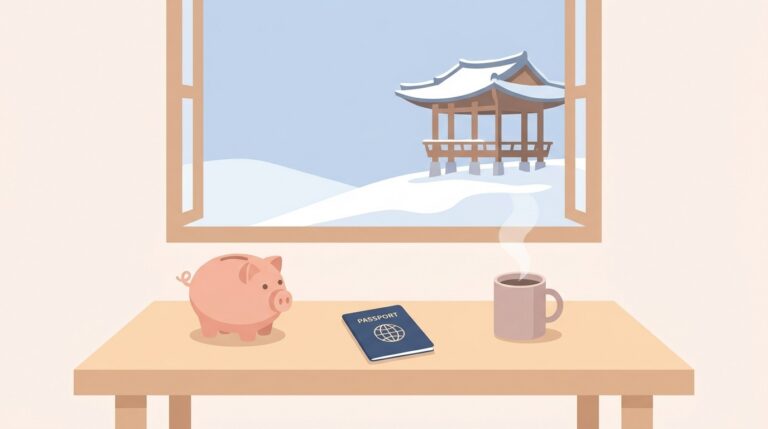
Talk About Trip Memories and Plan Your Next Winter Getaway in Korean
Phase 1: Empathy (Story Immersion Opening)
안녕하세요! 매일한글 에디터입니다.
Imagine this: It’s a chilly Monday morning. You’re sitting at your desk, staring blankly at your monitor with a half-empty mug of coffee. Your mind, however, isn’t on spreadsheets or emails—it’s wandering through the vibrant, neon-lit alleys of Myeongdong, where steam billowed from street cart tteokbokki, or on the snowy slopes of Pyeongchang where you laughed until your cheeks froze.
Every traveler knows the feeling of “post-travel blues.” You scroll through your camera roll, reminiscing about the crisp winter air and the warmth of a local soup shop. Suddenly, an overwhelming surge of motivation hits you: I need to go back. You want to tell your Korean friends, “I’m working hard and saving every penny so I can travel to Korea again this winter!”
Talking about past travel highlights and turning those memories into future travel motivation is one of the most natural, exciting conversation starters in Korean. Over the past decade, I’ve seen countless elementary learners freeze up because they know how to say “I worked” and “I travel,” but don’t know how to connect them into a natural, passionate story. This practical guide is built directly from real student experiences to give you the exact conversational tools you need to share your memories, announce your travel goals, and connect deeply with native speakers.
Phase 2: Core Expressions Deep Dive
Let’s master the three essential expressions you need to describe your travel motivation and unforgettable memories.
1. 열심히 일해서 돈 모으고 있어요 (Yeolsimhi ilhaeseo don moeugo isseoyo)
- Pronunciation: [Yeol-ssim-hi il-hae-seo don mo-eu-go it-sseo-yo] (Sounds like: “yull-seem-hee eel-hae-suh doan moh-oo-go ee-so-yo”)
- Meaning: Literal: “Working diligently, so I am gathering money.” | Real Nuance: “I’m working hard and saving up money right now.”
- K-Culture Moment: Think of young professionals in K-dramas like Fight for My Way or Start-Up telling their friends over a late-night convenience store drink how hard they are grinding toward their dream goal.
- Editor’s Insight: The connective suffix
-아서/어서(-aseo/eoseo) naturally links cause and effect (“working hard so saving up”). Pair this with-고 있어요(-go isseoyo) to show ongoing dedication.- Situation Spectrum: Casual: ⚠️ (drop
-요) / Semi-formal: ✅ / Formal: ✅ (모으고 있습니다)- 🤔 Think About It: In English, you might just say “I’m saving for a trip.” Why do you think Korean speakers explicitly mention 열심히 일해서 (working hard)? How does expressing personal effort build empathy in Korean culture?
2. 올겨울에 또 가고 싶어요 (Olgyeoure tto gago sipeoyo)
- Pronunciation: [Ol-gyeo-ul-e tto ga-go si-peo-yo] (Sounds like: “all-gyuh-ool-eh toh gah-go she-puh-yo”)
- Meaning: Literal: “This winter again go want.” | Real Nuance: “I really want to go again this winter!”
- K-Culture Moment: Commonly heard on travel variety shows like Battle Trip or Europe Outside Your Tent when celebrities look at a gorgeous winter landscape and make a promise to return.
- Editor’s Insight:
또(tto) means “again.” Placing it right before가고 싶어요(gago sipeoyo – “want to go”) gives a passionate, determined bounce to your wish.- Situation Spectrum: Casual: ⚠️ (
또 가고 싶어) / Semi-formal: ✅ / Formal: ✅ (또 가고 싶습니다)- 🤔 Think About It: Compare how you express repetitive desires in your native language versus the compact Korean adverb
또.3. 그때 추억이 아직도 생생해요 (Geuttae chueogi ajikdo saengsaenghaeyo)
- Pronunciation: [Geu-ttae chu-eok-i a-jik-do saeng-saeng-hae-yo] (Sounds like: “geu-tteh choo-uh-gee ah-jeek-doh sang-sang-hae-yo”)
- Meaning: Literal: “That time memories still vivid.” | Real Nuance: “Those memories are still so vivid / like it was yesterday.”
- K-Culture Moment: Used when reminiscing over nostalgic photos in lifestyle vlogs or reunions in healing dramas like Hospital Playlist.
- Editor’s Insight:
생생해요(saengsaenghaeyo) comes from생생하다(lively/vivid). It conveys that a memory isn’t just stored in your brain, but still breathing with fresh emotion.- Situation Spectrum: Casual: ⚠️ (
생생해) / Semi-formal: ✅ / Formal: ✅ (생생합니다)- 🤔 Think About It: How does saying a memory is “vivid” change the emotional atmosphere compared to simply stating “I remember that trip well”?
Phase 3: Textbook Korean vs. Real-Life Korean
Textbooks often give you stiff, robotic sentences. Here is how real Koreans talk about saving money and travel memories:
Situation 1: Talking about saving money for a trip
- 📖 Textbook Korean: 저는 여행을 위해 돈을 저축하고 있습니다. (Jeoneun yeoheangeul wihae doneul jeochukhago itseumnida.) — “I am depositing money into savings for travel.”
- 🗣️ Real-Life Korean: 열심히 돈 모아서 올겨울에 여행 가려고요! (Yeolsimhi don moaseo olgyeoure yeoheng garyeogoyo!) — “I’m saving up hard so I can head off on a trip this winter!”
- 💡 Why is it different?:
저축하다sounds like you are discussing financial planning with a bank teller. In everyday speech, natives prefer the colloquial phrase돈을 모으다(to gather money) and the friendly intention-ending-(으)려고요.
Situation 2: Describing a great trip experience
- 📖 Textbook Korean: 지난 여행은 매우 유익했습니다. (Jinan yeoheangeun maeu yuikhaesseumnida.) — “The last journey was very beneficial.”
- 🗣️ Real-Life Korean: 지난 여행 때 진짜 힐링 제대로 했어요! (Jinan yeoheng ttae jinjja hilling jedaero haesseoyo!) — “I truly got some real healing during my last trip!”
- 💡 Why is it different?: Unless you went on an academic study tour, calling a personal trip
유익했다(beneficial/instructive) sounds excessively formal. Koreans love adopting the loanword힐링(healing) with제대로(properly/thoroughly) to express complete rest and rejuvenation.
Phase 4: K-Culture Deep Dive & Non-verbal Manners
4-1. 눈치 (Nunchi) & Gestures
When sharing personal dreams about saving money and traveling, Korean speakers often show modesty balanced with passion.
* The Modest Fist Clasp: When saying “열심히 일하고 있어요” (I’m working hard), slightly clench both hands near your chest like a subtle “fighting!” pose to indicate cheerful grit rather than complaining about work.
* Soft Nostalgic Gaze: When bringing up memories (그때 추억이...), soften your gaze and tilt your head slightly. It signals to your conversation partner that you are genuinely lost in a fond memory, inviting them to ask, “어디 갔었는데요?” (Where did you go?).
4-2. Cultural Code: The “갓생” (Gat-saeng) & “힐링 여행” (Healing Travel) Balance
In contemporary Korea, there is a prominent cultural concept called 갓생 (Gat-saeng = “God-like diligent life”), where people wake up early, study hard, work efficiently, and manage their finances meticulously. But why do people live like this? Primarily for 힐링 (Healing)!
In K-dramas like Summer Strike and Welcome to Samdal-ri, characters burn themselves out in the city and find emotional restoration through scenic rural getaways. When you tell a Korean friend that you are working hard in order to travel to Korea in the winter, they instantly resonate with your lifestyle: working hard today to reward your soul tomorrow.
Phase 5: Real-Life Roleplay Scenario
Setting: You are sitting at a sunlit cafe in Seoul with your Korean coworker and friend, Minji (민지). You both just finished iced Americanos and are looking at photos from your last ski weekend in Gangwon-do.
- 민지: 지난번에 강원도 갔던 거 사진 보니까 진짜 좋았겠다! (Jinanbeone Gangwondo gatdeon geo sajin bonikka jinjja joatgetda!)
🎭 (Eyes lit up while scrolling on your phone)
“Looking at the photos from when you went to Gangwon-do, it must have been amazing!” - You: 네, 맞아요! 그때 추억이 아직도 생생해요. (Ne, majayo! Geuttae chueogi ajikdo saengsaenghaeyo.)
🎭 (Smiling wistfully with hands clasped together)
“Yes, exactly! Those memories are still so vivid.” - 민지: 겨울 바다랑 설경 진짜 예뻤지? 또 가고 싶지 않아? (Gyeoul badarang seolgyeong jinjja yeppeotji? Tto gago sipji ana?)
🎭 (Leaning in with curiosity)
“The winter sea and snow scenery were gorgeous, right? Don’t you want to go again?” - You: 너무 가고 싶어요. 그래서 요즘 열심히 일해서 돈 모으고 있어요! (Neomu gago sipeoyo. Geuraeseo yojeum yeolsimhi ilhaeseo don moeugo isseoyo!)
🎭 (Nodding determinedly with a proud smile)
“I want to go so badly. That’s why I’m working hard and saving money these days!” - 민지: 와, 멋지다! 이번 겨울에 구체적인 계획 있어? (Wa, meotjida! Ibeon gyeoure guchejeogin gyehoek isseo?)
🎭 (Clapping hands gently in encouragement)
“Wow, that’s awesome! Do you have specific plans for this winter?” - You: 올겨울에 제주도나 부산으로 또 여행 떠나고 싶어요. (Olgyeoure Jejudona Busaneuro tto yeoheng tteonago sipeoyo.)
🎭 (Speaking with warm enthusiasm)
“This winter, I want to head off on another trip to Jeju or Busan.” - 민지: 겨울 제주도 동백꽃 진짜 예쁜데! 꼭 가야겠네. (Gyeoul Jeju-do dongbaekkkot jinjja yeppeunde! Kkok gayagetne.)
🎭 (Giving a high-five gesture)
“The winter camellia flowers in Jeju are stunning! You definitely have to go.” - You: 네! 꼭 돈 모아서 갈 거예요. 같이 갈래요? (Ne! Kkok don moaseo gal geoyeyo. Gachi gallaeyo?)
🎭 (Laughing cheerfully)
“Yes! I’ll definitely save up and go. Want to come with me?”
🔀 Interactive Branch: What would you say if Minji asks how much you’ve saved?
- Choice A: “비밀이에요! 하지만 비행기 표는 살 수 있어요.” (Bimirieoyo! Hajiman bihaenggi pyoneun sal su isseoyo. / “It’s a secret! But I can buy the plane ticket.”)
- Feedback: [Best] 🌟 Playful, natural, and keeps the conversation fun without awkwardly disclosing numbers!
- Choice B: “제가 번 돈을 은행 계좌에 많이 넣었습니다.” (Jega beon doneul eunhaeng gyejwae mani neoeotseumnida. / “I put a lot of money I earned into the bank account.”)
- Feedback: [Risk] ⚠️ Grammatically correct, but sounds like an official financial declaration rather than friendly cafe banter.
- Choice C: “돈 없어요. 여행 못 가요.” (Don eopseoyo. Yeoheng mot gayo. / “I have no money. Can’t travel.”)
- Feedback: [Bad] 🚫 Kills the excitement of the conversation instantly and contradicts what you just said!
Phase 6: 10-Second Emotional Shadowing Drill
Practice these lines out loud! Focus on the rhythmic pauses (/) and embody the emotion tag:
[🔥 열정 가득 / Filled with determination]- 열심히 일해서 / 돈 모으고 있어요! (Yeolsimhi ilhaeseo / don moeugo isseoyo!)
- “I’m working hard / and saving up money!”
[🥺 아련하고 간절하게 / Longing and heartfelt]- 그때 추억이 / 아직도 생생해요. (Geuttae chueogi / ajikdo saengsaenghaeyo.)
- *”Those memories / are still so vivid.”
[✨ 설레고 신나게 / Excited and hopeful]- 올겨울에 / 꼭 다시 가고 싶어요! (Olgyeoure / kkok dasi gago sipeoyo!)
- “This winter / I definitely want to go again!”
Phase 7: K-Culture Mini Dictionary
- 힐링 (Hilling)
- Translation: Healing / Restful recharging
- Usage: Used constantly in travel and daily life. Going to a peaceful cafe, taking a stroll in the woods, or looking at the ocean are all described as
힐링 여행(healing trip).
- 갓생 (Gat-saeng)
- Translation: Exemplary, productive lifestyle (God + Saeng/Life)
- Usage: When someone works diligently, exercises, and saves money every day, people praise them saying,
완전 갓생 사네!(“You live such a productive life!”).
- 재충전 (Jaechungjeon)
- Translation: Recharging (literally recharging batteries)
- Usage: Used in personal and workplace settings. When asking for time off or taking a weekend trip:
이번 주말에 재충전하고 올게요(“I’ll go recharge my batteries this weekend”).
- N차 방문 (En-cha bangmun)
- Translation: N-th visit / Repeat visit
- Usage: When you love a city or restaurant so much that you return again and again:
이번이 속초 3차 방문이에요!(“This is my 3rd visit to Sokcho!”).
Phase 8: Survival Kit for Travelers
Survival Expressions TOP 3
- 추억이 새록새록 떠올라요. (Chueogi saerok-saerok tteoollayo.)
- Translation: Memories keep popping up freshly.
- Pro Tip: Use
새록새록(onomatopoeia for memories budding in your mind) when looking at past travel photos.
- 겨울 풍경이 정말 예술이에요. (Gyeoul punggyeongi jeongmal yesurieyo.)
- Translation: The winter landscape is truly a work of art.
- Pro Tip: In spoken Korean,
예술이다(it’s art) is a slangy, natural way to say something is jaw-droppingly gorgeous.
- 다음 여행을 위해 파이팅! (Daeum yeoheangeul wihae paiting!)
- Translation: Let’s fight on for the next trip!
- Pro Tip: A great cheer to wrap up a conversation with fellow traveler friends.
Editor’s Travel Note
- When planning a winter trip across South Korea, never rely on Google Maps alone for transit and walking times. You should check transit routes using the 네이버 지도 앱 다운로드 for pinpoint domestic bus and subway schedules.
- If you are visiting multiple regions this winter, consider picking up a Korea Tour Card or WOWPASS right at Incheon Airport to seamlessly pay for KTX bullet trains and subways without scrambling for cash.
Phase 9: A Step Deeper (Reflection Question)
In South Korea, rest and hard work exist in a symbiotic relationship. Because daily life in competitive metropolitan areas can be intensely demanding, travel is rarely viewed as mere leisure; it is culturally recognized as essential 재충전 (recharging). Working oneself to exhaustion without taking time to pause is frowned upon by the younger generation, making the dream of a reward trip an indispensable motivator. By telling someone you are saving diligently for an upcoming journey, you are participating in a cherished social cycle: working with focus so you can rest with freedom.
💬 Your Turn: What is one place in Korea you dream of visiting (or revisiting) this coming winter, and what is your favorite memory from your last trip? Leave a comment below using the phrase 올겨울에 꼭 가고 싶어요!
Phase 10: FAQ & Avoiding Misunderstandings
Q: Can I use “돈을 벌다” (don-eul beolda) instead of “돈을 모으다” (don-eul moeuda)?
A: Yes, but the meaning is slightly different! 돈을 벌다 means “to earn money” (the act of making an income), whereas 돈을 모으다 means “to save/accumulate money” (setting aside earnings for a specific purpose). To talk about funding a trip, 돈을 모으다 is much more natural.
Q: How do I say “winter vacation” instead of just “this winter”?
A: You can say 겨울 휴가 (gyeoul hyuga) for general work leave/vacation, or 겨울 방학 (gyeoul banghak) if you are a student attending school or university.
Q: Is “또 가고 싶어요” rude to say to elders or in formal settings?
A: Not at all! The polite ending -고 싶어요 (-go sipeoyo) is perfectly appropriate for everyday semi-formal conversations with seniors, colleagues, and teachers. If you are speaking in an ultra-formal interview, you can elevate it to 다시 가고 싶습니다 (dasi gago sipseumnida).
🚨 Common Mistakes (흔한 실수)
- Mistake: Saying “돈을 아껴요” when meaning “I’m saving for a trip.”
- Why it’s wrong:
돈을 아끼다means being frugal or pinching pennies (e.g., spending less on lunch). - Correct Action: Say
돈을 모으고 있어요(I am gathering/saving funds).
- Why it’s wrong:
- Mistake: Using
다음에instead of올겨울에when you already have a target season.- Why it’s wrong:
다음에is vague (“next time / someday”). - Correct Action: If you mean this upcoming winter, say
올겨울에(olgyeoure).
- Why it’s wrong:
- Mistake: Saying “기억이 아직 생생해요” exclusively for emotional travel memories.
- Why it’s better: While
기억(memory/cognition) is acceptable, Koreans strongly prefer추억(cherished, nostalgic memories) when discussing travel and personal milestones.
- Why it’s better: While
Phase 11: Action Missions
- 🥉 Bronze Mission (Solo Practice): Look at your favorite photo from a previous trip. Say aloud three times:
그때 추억이 아직도 생생해요! - 🥈 Silver Mission (Social Media): Post a throwback travel photo on Instagram or your social feed with the caption:
열심히 일하고 돈 모아서 올겨울에 또 갈 거예요! ❄️ - 🥇 Gold Mission (Real Life): In your next Korean language exchange or lesson, tell your partner about your budget goal using the pattern:
[목적지]에 가려고 돈 모으는 중이에요! - 🎮 K-Culture Mission: Watch an episode of a Korean travel vlog (search “겨울 브이로그” or “겨울 여행 vlog” on YouTube) and listen for how many times they say
추억or힐링!
Phase 12: Interactive Quiz Challenge
Test your understanding of today’s expressions and cultural nuances!
1. Situational Judgment: You want to tell your Korean friend that you plan to work hard and save money for a trip this winter. Which sentence is the most natural?
* (A) 저는 저축을 하여 겨울에 여행을 실행할 것입니다.
* (B) 열심히 일해서 돈 모아서 올겨울에 또 여행 갈 거예요.
* (C) 돈이 많아서 겨울에 여행 갈 수 있어요.
2. Fill-in-the-Blank: Choose the right word to express that your travel memories are still lively and fresh:
* “그때 ______이/가 아직도 생생해요!”
* (A) 추억 (Chueok)
* (B) 숙제 (Sukje)
* (C) 직장 (Jikjang)
3. True or False Culture Check:
* In Korean, 돈을 모으다 specifically emphasizes accumulating and setting aside money toward a goal, while 돈을 벌다 means simply earning income.
* (True / False)
👉 Click to view answers and explanations!
- Answer: (B)
- Explanation: (B) combines the natural spoken chain
일해서 돈 모아서with the goal-oriented phrase올겨울에 또 여행 갈 거예요. Option (A) is overly stiff and mechanical, while (C) means “I have lots of money so I can travel.”
- Explanation: (B) combines the natural spoken chain
- Answer: (A) 추억
- Explanation:
추억means warm, nostalgic memories. (B) means homework, and (C) means workplace!
- Explanation:
- Answer: True
- Explanation: Exactly right!
돈을 벌다is earning, whereas돈을 모으다refers to saving money for a specific goal like a dream trip.
- Explanation: Exactly right!
🎬 Watch Our Daily Videos! (Daily Hangul Official Instagram)
Review the expressions you learned in this article with our fun daily short videos! Check out native pronunciation and real-life nuances in action.
- Instagram @dailyhangul_en






