

Phase 1: Empathy (Real-Life Convenience Store Panic)
안녕하세요! 매일한글 에디터입니다. (Annyeonghaseyo! Daily Hangul Editor here.)
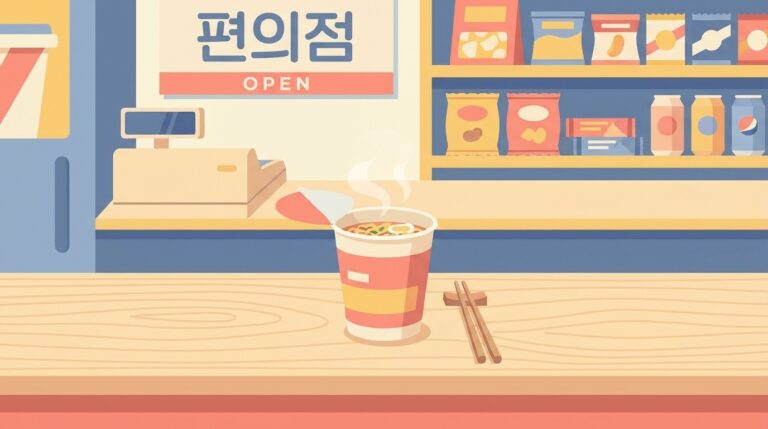
Picture this: It’s 11:30 PM in Seoul. You’ve just spent the day wandering through the glowing alleys of Hongdae, and your feet are aching. You step into a brightly lit CU or GS25 convenience store—the holy grail of late-night comfort food. Inspired by every K-drama you’ve ever watched, you grab a piping hot cup of Shin Ramyun, a tuna-mayo triangle kimbap (samgak kimbap), and a banana milk.
You proudly place your items on the counter. The clerk scans your ramen, looks up, and quickly asks:
“Namu-jeotgarak chaenggyeo deurilkkayo?”
Your brain freezes. The rapid stream of syllables catches you completely off guard. You didn’t study this in chapter one of your beginner textbook! You offer a nervous smile, nod frantically, and end up walking out with either five pairs of chopsticks or zero—meaning you have to eat hot ramen with your hands back at your hotel room.
Don’t worry! Every single Korean learner has been in this exact spot. Convenience stores (pyeon-ui-jeom) are the heartbeat of modern Korea, and this single question is the most common phrase you will hear at the register. Master this 30-second interaction today, and you’ll walk into any Korean convenience store feeling like a confident local.
Phase 2: Top 3 Core Expressions Deep Dive
1. 나무젓가락 챙겨 드릴까요? (Namu-jeotgarak chaenggyeo deurilkkayo?)
- Pronunciation: Nah-moo-jut-gah-rak cheng-gyuh deu-ril-kkah-yo? (Think of “namu” as a wooden tree, and “chaenggyeo” sounds like “change-gyuh”).
- Meaning: Literal: “Shall I pack wooden chopsticks for you?” | Real Nuance: “Do you need wooden chopsticks?”
- K-Culture Moment: You’ll see this in almost every college-romance K-drama where the leads eat late-night ramen outside a convenience store under a plastic parasol.
- Editor’s Insight: The verb 챙기다 (chaenggida) is uniquely Korean—it implies caring for someone by making sure they don’t forget an essential item.
- Situation Spectrum:
- Casual (Friends): 🚫 Too formal for friends
- Semi-formal (Polite everyday): ✅ Standard cashier phrase
- Formal (Official): ✅ Polite customer service honorific
- 🤔 Think About It: English cashiers ask, “Do you want chopsticks?” but Korean cashiers ask, “Shall I care-pack chopsticks for you?” How does this reflect Korean customer service etiquette?
2. 네, 하나만 주세요. (Ne, hana-man juseyo.)
- Pronunciation: Neh, ha-na-mahn joo-seh-yo. (Sounds like “Neh” + “Hannah” + “juice-say-yo”).
- Meaning: Literal: “Yes, please give only one.” | Real Nuance: “Yes, just one pair, please!”
- K-Culture Moment: Used whenever you are buying solo meals or eating a quick lunch between subway transfers.
- Editor’s Insight: Adding -만 (-man), meaning “only”, shows natural fluency. Cashiers will usually give you two pairs by default unless you specify!
- Situation Spectrum:
- Casual: ⚠️ Use ‘응, 하나만 줘’ instead
- Semi-formal: ✅ Perfect for cashiers and servers
- Formal: ✅ Respectful and clear
- 🤔 Think About It: In many Western stores, cutlery is self-serve. Why do you think Korean stores keep disposable utensils behind the counter?
3. 아니요, 괜찮아요. (Aniyo, gwaenchanayo.)
- Pronunciation: Ah-nee-yo, gwen-chahn-ah-yo. (Flows like “Ah-knee-yo, gwen-chana-yo”).
- Meaning: Literal: “No, it is okay.” | Real Nuance: “No thanks, I don’t need any!”
- K-Culture Moment: Said with a light hand wave when you already have reusable chopsticks in your backpack or are taking food home.
- Editor’s Insight: 괜찮아요 (Gwaenchanayo) is the ultimate polite refusal in Korea. Saying a blunt “아니요 (No)” sounds harsh, but pairing it with “괜찮아요” turns it into a warm decline.
- Situation Spectrum:
- Casual: ⚠️ Use ‘아니, 됐어’ with close buddies
- Semi-formal: ✅ The golden standard for daily life
- Formal: ✅ Safe in all public interactions
- 🤔 Think About It: Refusing directly can disrupt harmony in Korean communication. How does softening “No” with “I’m fine” preserve politeness?
Phase 3: Textbook Korean vs. Real Korean
Situation 1: Asking for chopsticks at the counter
- 📖 Textbook Korean: 젓가락을 주십시오. (Jeotgarakeul jusipsio. – “Please bestow chopsticks upon me.”)
- 🗣️ Real Korean: 젓가락 하나만 챙겨주세요. (Jeotgarak hanaman chaenggyeojuseyo. – “Could you pack one pair of chopsticks for me, please?”)
- 💡 Why is it different? The textbook phrase sounds like an announcement from a historic Joseon dynasty court. In real daily life, using “챙겨주세요” sounds friendly, natural, and contemporary.
Situation 2: Turning down extra items or plastic bags
- 📖 Textbook Korean: 그것은 필요하지 않습니다. (Geugeoseun piryohaji anseumnida. – “That thing is not necessary for me.”)
- 🗣️ Real Korean: 아니요, 됐어요! / 괜찮아요. (Aniyo, dwaesseoyo! / Gwaenchanayo. – “No, I’m all set! / I’m good.”)
- 💡 Why is it different? Saying “It is not necessary” creates an awkward, sterile barrier between you and the friendly part-timer (alba-saeng). A gentle smile and “괜찮아요” is how real Koreans speak.
Phase 4: K-Culture Deep Dive & Non-Verbal Manners
4-1. Nunchi (눈치) & Register Manners
When you interact at a Korean counter, non-verbal cues do half the talking:
* The Two-Hand Handover: When handing over your physical credit card or phone (for Apple Pay/Samsung Pay), always hold it with both hands or lightly touch your right wrist with your left hand. It signals deep respect.
* The Gentle Palm Wave: When saying “아니요, 괜찮아요” (No, I’m good), raise your hand to chest level and gently tilt your palm side-to-side. This visual cue prevents misunderstandings even in noisy stores.
4-2. The Convenience Store Code: 1+1 and Microwave Tables
- The 1+1 (Won Plus Won) Golden Rule: Korean convenience stores thrive on “1+1” and “2+1” promotional tags. If you bring one bottle of tea marked “1+1” to the counter, the cashier won’t just charge you for one—they will literally tell you to go back and grab your free one! If you don’t want the extra item, you can politely say, “하나만 가져갈게요” (Hanaman gajyeogalke-yo – I’ll take just one).
- The Noodle Prep Station: Wooden chopsticks are often kept in a small organizer right next to the hot water dispenser and microwaves. If the clerk forgets to ask, you can simply grab one pair from the prep table yourself without making a fuss.
Phase 5: Real-Life Roleplay Scenario
Setting: It’s 10:00 PM at a GS25 store near Hongdae Station. Min-ho, a friendly college student part-timer, is scanning your late-night snacks.
- Turn 1 (Min-ho): 어서 오세요! 계산 도와드릴게요.
(Eoseo oseyo! Gyesan dowadeurilgeyo.)
“Welcome! I can help you check out right here.”
🎭 Action: Scans your Shin Ramyun cup and tuna mayo kimbap. -
Turn 2 (You): 네, 안녕하세요!
(Ne, annyeonghaseyo!)
“Yes, hello!”
🎭 Action: Places items on the counter with a quick bow. -
Turn 3 (Min-ho): 라면 있으시네요. 나무젓가락 챙겨 드릴까요?
(Ramyeon itseusineyo. Namu-jeotgarak chaenggyeo deurilkkayo?)
“I see ramen here. Should I give you wooden chopsticks?”
🎭 Action: Reaches toward the utensil caddy under the register. -
Turn 4 (You): 네, 하나만 챙겨주세요!
(Ne, hanaman chaenggyeojuseyo!)
“Yes, please pack just one pair!”
🎭 Action: Raises one index finger politely. -
Turn 5 (Min-ho): 네, 여기 있습니다. 봉투 필요하세요?
(Ne, yeogi itseumnida. Bongtu piryohaseyo?)
“Sure, here you go. Do you need a plastic bag?”
🎭 Action: Sets the wooden chopsticks on top of your ramen. -
Turn 6 (You): 아니요, 가방 있어요. 괜찮아요!
(Aniyo, gabang isseoyo. Gwaenchanayo!)
“No, I have a tote bag. I’m okay!”
🎭 Action: Gently pats your canvas backpack with a smile. -
Turn 7 (Min-ho): 네, 4,500원 결제 도와드릴게요. 카드 꽂아주세요.
(Ne, sa-cheon-o-baek-won gyeolje dowadeurilgeyo. Kadeu kkojajuseyo.)
“Okay, total is 4,500 won. Please insert your card.”
🎭 Action: Points to the IC card chip terminal. -
Turn 8 (You): 감사합니다! 수고하세요!
(Gamsahamnida! Sugohaseyo!)
“Thank you! Have a great shift!”
🎭 Action: Takes card with both hands and bows slightly.
🔀 Interactive Choice Point
What if you already have chopsticks at your hotel and the cashier asks: “나무젓가락 챙겨 드릴까요?”
- Choice A: “No.” (Just saying “No” in English)
- Choice B: “아니요, 괜찮아요!” (Aniyo, gwaenchanayo!)
- Choice C: “젓가락 싫어요!” (Jeotgarak sireoyo! – “I hate chopsticks!”)
Feedback:
* Choice A (Risk): The cashier will probably understand, but it halts the interaction and feels a bit blunt.
* Choice B (Best!): ⭐ 100 points! Courteous, natural, and proves you understand everyday Korean.
* Choice C (Bad): Yikes! Saying you “hate” chopsticks sounds aggressively personal. Avoid this!
Phase 6: 10-Second Emotion Shadowing Drill
Practice these lines out loud with feeling! Pay attention to the pauses marked with /.
[😊 Bright & Friendly]
네, / 하나만 / 챙겨주세요!
(Ne, / hana-man / chaeng-gyeo-ju-se-yo!)
“Yes, please pack just one!”-
[👋 Polite Refusal with a warm smile]
아니요, / 집에서 먹어요. / 괜찮아요!
(A-ni-yo, / jib-e-seo meog-eo-yo. / Gwaen-chan-a-yo!)
“No, I’m eating at home. I’m good!” -
[👀 Quick Curiosity on Promotions]
이거, / 원 플러스 원 / 맞아요?
(I-geo, / won peul-leo-seu won / ma-ja-yo?)
“Is this item buy-one-get-one-free?”
Phase 7: K-Culture Mini Dictionary
- 나무젓가락 (Namu-jeotgarak) | Wooden chopsticks | The classic disposable wooden chopsticks split down the middle. Found at all food stalls and convenience stores.
- 원플러스원 (Won-peulleoseu-won) | 1+1 (Buy 1 Get 1 Free) | Korea’s favorite promo. You buy one, you get the second identical item completely free.
- 봉투 (Bongtu) | Plastic/Paper bag | Korean law requires convenience stores to charge 100~200 KRW for disposable bags, so cashiers will always ask: “봉투 필요하세요?” (Do you need a bag?)
- 전자레인지 (Jeonjareinji) | Microwave | Located near the counter for heating up samgak kimbap (usually 15-20 seconds) and ready-to-eat bento boxes (dosirak).
Phase 8: Traveler’s Survival Kit
Top 3 Survival Phrases
- 젓가락 두 개 주세요. (Jeotgarak du gae juseyo.)
→ “Two pairs of chopsticks, please.” (Pro Tip: Essential when grabbing late-night snacks with your travel buddy!) - 봉투는 안 주셔도 돼요. (Bongtuneun an jusyeodo dwaeyo.)
→ “You don’t need to give me a bag.” (Pro Tip: Saves you money and the environment). - 전자레인지 써도 돼요? (Jeonjareinji sseodo dwaeyo?)
→ “May I use the microwave?” (Pro Tip: The answer is almost always a resounding yes!)
Editor’s Travel Note
- Navigation: Never use standard Google Maps in Korea—walking routes are often inaccurate. Use the Naver Map navigation app for real-time convenience store locations and subway station exits.
- Payments: T-Money transit cards work at all major stores (CU, GS25, 7-Eleven, Emart24). Check out our T-Money card recharge guide to pay for ramen with a simple tap.
Phase 9: Step Deeper (Culture Thought)
Have you ever noticed how Korean service phrases center around community care? The verb 챙기다 (chaenggida) doesn’t just mean “to pack.” Parents use it when asking if their kids packed their lunchboxes (“도시락 챙겼니?”), and friends use it when ensuring everyone got home safely. When a convenience store clerk asks if they should chaenggyeo chopsticks for you, they are momentarily adopting that same spirit of communal hospitality. It’s a tiny reminder that even in a bustling city of ten million people, you are being looked after.
💬 Your Turn: Have you ever frozen up at a foreign register? What snack are you rushing to buy first at a Korean convenience store? Let me know in the comments below!
Phase 10: FAQ & Common Mistakes
Q: Why do cashiers ask about chopsticks if I didn’t buy ramen?
A: They might ask if you bought instant soup, tteokbokki, microwavable bento boxes (dosirak), or even pre-cut fruit cups! If your item requires utensils, they’ll proactively offer.
Q: Is there a fee for wooden chopsticks in Korea?
A: No! Chopsticks, plastic straws, and spoons provided for immediate food consumption are free. However, plastic shopping bags (bongtu) incur a mandatory government fee (usually 100~200 won).
Q: Can I grab extra chopsticks just in case?
A: While one or two extra pairs are generally fine if you ask politely (“하나 더 주실 수 있나요?”), hoarding handfuls of free utensils from the noodle bar is considered bad manners (jin-sang behavior).
🚨 Common Mistakes Alert
- Mistake: Shouting “No chopsticks!” in English with a panicked expression.
Correct Action: Smile, do a small head nod, and say, “괜찮아요” (Gwaenchanayo). - Mistake: Assuming promotional 1+1 items will automatically be bagged for you from the warehouse.
Correct Action: You must bring both items to the checkout counter yourself! - Mistake: Leaving your card in the chip reader and walking away before the receipt prints.
Correct Action: Wait for the chime, take your card with both hands, and say “수고하세요!” (Have a great shift).
Phase 11: Action Missions
- 🥉 Bronze Mission (Solo Practice): Stand in front of your bathroom mirror. Say “네, 하나만 챙겨주세요!” three times with a bright, friendly smile.
- 🥈 Silver Mission (Social Connection): Snap a photo of your favorite instant ramen and share it with the caption: “나무젓가락 챙겨 드릴까요? – Today I learned how to order chopsticks in Korean!”
- 🥇 Gold Mission (Real-Life Mastery): Walk into a Korean grocery store or local Asian market. When you check out, look the cashier in the eye and say “감사합니다, 수고하세요!” with two hands holding your receipt.
- 🎮 K-Culture Mission: Watch the first episode of any slice-of-life K-drama (like Hospital Playlist or Twenty-Five Twenty-One). Spot the convenience store scene and listen for the cashier’s checkout rhythm!
Phase 12: Interactive Quiz Challenge
1. Situational Judgment
You are buying a cup of ramen and a soft drink. The cashier asks: “나무젓가락 챙겨 드릴까요?” You already have cutlery back at your Airbnb. What should you say?
* A) 주세요! (Juseyo!)
* B) 아니요, 괜찮아요. (Aniyo, gwaenchanayo.)
* C) 봉투 주세요. (Bongtu juseyo.)
2. Fill-in-the-Blank
Fill in the missing syllable to ask for “just one” chopstick pair politely:
“네, 하나____ 주세요.” (Hint: The Korean particle for ‘only’)
3. Cultural True or False
True or False: At Korean convenience stores, if an item has a “1+1” sticker, the cashier will automatically retrieve the free second item from the back stockroom for you.
👉 Click to view Answers & Explanations!
- Answer: B) 아니요, 괜찮아요.
Explanation: “Aniyo, gwaenchanayo” is the polite, standard way to decline chopsticks you do not need. -
Answer: 만 (man)
Explanation: The sentence becomes “네, 하나만 주세요” (Ne, hanaman juseyo)—meaning “Yes, please give me only one.” -
Answer: False!
Explanation: In Korean convenience stores, you must grab both items from the shelves and place them on the counter together to get the deal!
🎬 Watch Our Daily Videos! (Daily Hangul Official Instagram)
Review the expressions you learned in this article with our fun daily short videos! Check out native pronunciation and real-life nuances in action.
- Instagram @dailyhangul_en







