

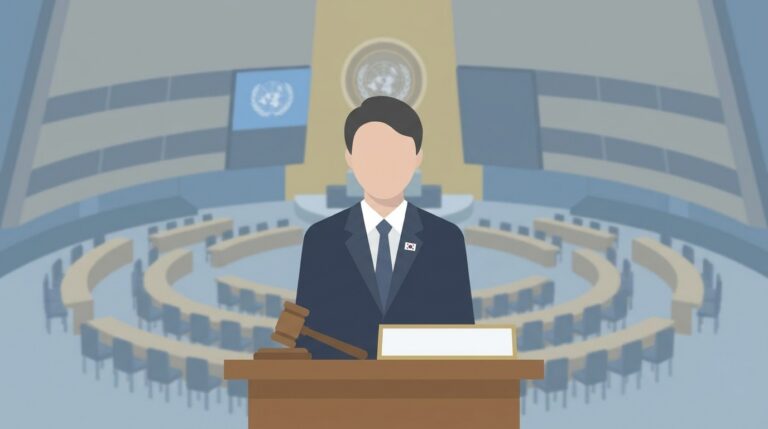
The Art of Multilateral Consensus: Mastering High-Level Diplomatic Korean at the UN
Phase 1: Empathy (Story-Driven Opening)
안녕하세요! 매일한글 에디터입니다.
Imagine stepping onto the marble floors of the UN General Assembly Hall or the bustling diplomatic corridors of the Ministry of Foreign Affairs (외교부) in Seoul. You are clutching a draft resolution that has undergone grueling, sleepless nights of negotiations. In tense political thrillers and K-Dramas like The Whirlwind (돌풍) or Designated Survivor: 60 Days (60일, 지정생존자), you often witness dramatic moments where ambassadors lock horns. But the pinnacle of real-world diplomatic artistry isn’t a dramatic shouting match or even a nail-biting roll-call vote. It is the tense, breathtaking silence that precedes a historic consensus.
For advanced learners operating at the C2 level, transitioning from everyday polite speech (haeyo-che) or standard business Korean into elite multilateral diplomacy (oegyogwan-eoui eoneo) is notoriously difficult. One misplaced honorific particle or an overly confrontational verb can inadvertently signal a bilateral crisis or breach diplomatic protocol. When an issue is passed through “consensus adoption” (컨센서스 채택)—passing an agenda item by general agreement without forcing a divisive vote—the language used must be impeccably calibrated, authoritative, yet profoundly inclusive.
This guide was forged directly from real-world debriefings with multilateral conference interpreters and diplomatic aides. By mastering these nuanced rhetorical formulas, you will not only understand the most complex UN proceedings and official presidential statements (의장 성명), but also wield the kind of linguistic prestige that commands respect in international relations, high-stakes trade negotiations, and global governance summits. Let us master the ultimate register of the Korean language together.
Phase 2: Core Expressions Deep Dive
1. 이의가 없으므로 본 안건은 표결 없이 총의로 채택되었음을 선포합니다.
- Pronunciation: [I-uiga eopseumeuro bon angeoneun pyogyeol eopsi chong-uiro chaetaekdoeeosseumeul seonpohamnida] (ee-ee-ga eop-seu-meu-ro bon ahn-geon-eun pyo-gyeol eop-shi chong-ui-ro chae-taek-dwae-eot-seu-meul seon-po-ham-ni-da)
- Meaning: “Hearing no objection, I declare that this agenda item has been adopted by consensus without a vote.”
- K-Culture Moment: The iconic climax of a diplomatic summit in a political K-Drama where the committee chair strikes the gavel (의사봉 3타) after delivering this exact phrase, cementing a fragile peace accord.
- Editor’s Insight: Notice the use of 총의 (chong-ui). While many learners rely on manjang-ilchi (만장일치 – full unanimity), multilateral diplomacy favors chong-ui (총의 – general will / consensus). It emphasizes collective accord without putting member states on the record with individual votes, providing vital diplomatic face-saving.
- Situation Spectrum: Casual 🚫 | Semi-formal ⚠️ | Formal ✅
- 🤔 Think About It: How does the passive-declarative ending
~되었음을 선포합니다depersonalize the authority, making the President merely the vessel of the collective chamber’s will?
2. 분열적인 표결 절차를 지양하고 막판 문안 조율을 통해 총의를 도출해 냈습니다.
- Pronunciation: [Bunyeoljeogin pyogyeol jeolchareul jiyanghago makpan munan joyureul tonghae chong-uireul dochulhae naesseumnida] (boon-yeol-jeok-in pyo-gyeol jeol-cha-reul ji-yang-ha-go mak-pan moo-nan jo-yul-eul tong-hae chong-ui-reul do-chool-hae naess-eum-ni-da)
- Meaning: “We avoided a divisive voting procedure and forged a consensus through last-minute text coordination.”
- K-Culture Moment: Used by a chief delegate in a post-plenary press briefing when explaining how a diplomatic breakthrough was made despite geopolitical gridlock.
- Editor’s Insight: Pay close attention to 지양하다 (jiyanghada), which means “to intentionally avoid/refrain from something unfavorable.” Do not confuse it with its homophone jiyanghada (지향하다 – to orient toward/aspire to). This single vowel distinction is a quintessential C2 assessment differentiator.
- Situation Spectrum: Casual 🚫 | Semi-formal ⚠️ | Formal ✅
- 🤔 Think About It: Contrast “avoiding division” (bunyeol-eul jiyanghada) with Western debate styles that frequently celebrate explicit, recorded voting as the essence of transparency.
3. 의장 성명 채택을 가로막는 핵심 쟁점에 대해 건설적인 타협안을 모색하고자 합니다.
- Pronunciation: [Uijang seongmyeong chaetaegeul garomangneun haeksim jaengjeome daehae geonseoljeogin tahyeobaneul mosaekhagoja hamnida] (ui-jang seong-myeong chae-taek-eul ga-ro-mang-neun haek-shim jaeng-jeom-e dae-hae geon-seol-jeok-in ta-hyeop-ahn-eul mo-saek-ha-go-ja ham-ni-da)
- Meaning: “We intend to explore a constructive compromise on the core points of contention impeding the adoption of the Presidential Statement.”
- K-Culture Moment: A tense bilateral side-room negotiation (makhu jeobsok) where seasoned diplomats negotiate bracketed text in a draft declaration.
- Editor’s Insight: The phrase 모색하고자 합니다 (~goja hamnida) represents diplomatic etiquette at its finest. Instead of saying “우리는 타협안을 찾겠습니다” (We will find a compromise), this structure conveys restrained determination while inviting reciprocal flexibility from counterpart delegations.
- Situation Spectrum: Casual 🚫 | Semi-formal ⚠️ | Formal ✅
- 🤔 Think About It: Notice the strategic modesty embedded in Korean formal rhetoric: suggesting joint exploration rather than asserting unilateral solutions.
Phase 3: Textbook Korean vs Real Korean
Scenario 1: Announcing an agreed decision without a vote
- 📖 교과서 한국어 (Textbook Korean): 모든 회원국이 찬성했으므로 이 결의안은 통과되었습니다. (Modeun hoewon-gugi chanseonghaesseumeuro i gyeorui-aneun tonggwadoeeosseumnida. – “Because all member states voted in favor, this resolution has passed.”)
- 🗣️ 진짜 한국어 (Real Multilateral Korean): 본 결의안은 회원국들의 확고한 지지를 바탕으로 전원일치 총의로 가결되었음을 밝힙니다. (Bon gyeorui-aneun hoewon-gukdeurui hwakkohan jijireul batang-euro jeon-won-ilchi chong-uiro gagyeoldoeeosseumeul balkimnida. – “I state that this resolution has been adopted by unanimous consensus on the foundation of the member states’ steadfast support.”)
- 💡 왜 다를까? (Why the difference?): In high-level multilateral forums, stating that everyone “voted in favor” is technically inaccurate if no roll-call vote occurred. Real diplomacy utilizes
전원일치 총의 (jeon-won-ilchi chong-ui)to praise unity without triggering formal reservation clauses.
Scenario 2: Checking if any delegation objects before slamming the gavel
- 📖 교과서 한국어 (Textbook Korean): 반대하거나 의견 있는 사람 지금 말해주세요. (Bandaeha-geona uigyeon inneun saram jigeum malhaejuseyo. – “Anyone who opposes or has an opinion, please speak now.”)
- 🗣️ 진짜 한국어 (Real Multilateral Korean): 본 문안에 대해 달리 구두 발언을 신청하실 대표단이 계시지 않다면, 원안대로 채택하도록 하겠습니다. (Bon munane daehae dalli gudu bareoneul sincheonghasil daepyodani gyesiji antamyeon, won-andaero chaetaekhadorok hagesseumnida. – “If there are no delegations requesting the floor to deliver oral remarks on this text, we shall adopt it as drafted.”)
- 💡 왜 다를까? (Why the difference?): High diplomatic parlance relies on procedural negative-conditions (
달리 ... 계시지 않다면) rather than demanding objections, tactfully establishing a pathway toward default consensus.
Phase 4: K-Culture Deep Dive & Non-Verbal Manners
4-1. 눈치 (Nunchi) & Diplomatic Gestures
In multilateral Korean meetings, 눈치 (Nunchi) operates at an institutional scale. When an agenda item moves toward a consensus adoption without a vote, absolute composure and silence signify acquiescence.
* Gavel Protocol (의사봉 예절): The President never rushes the strike. After uttering 이의가 없으므로..., the Chair pauses for precisely three to four seconds, sweeping eye contact across the assembly desks (명패 / nameplates). The gavel is struck cleanly three times (탕! 탕! 탕!) with a crisp, measured wrist movement.
* Micro-nod of Assent: Delegations signaling their readiness for consensus refrain from flamboyant gestures or loud cheering. Instead, the head of delegation will offer a deliberate, slow, single nod toward the podium while resting both hands flat upon the desk.
4-2. Cultural Code: The Heritage of Consensus
Korea’s modern aptitude for “middle power diplomacy” (중견국 외교) reflects deep-seated historical models. From the ancient Silla Kingdom’s Hwabaek (화백회의) system—an aristocratic council that required unanimous consensus before state policies could be implemented—to modern multilateral multilateral mediation, Korean institutional culture treats forced majority votes as a sign of failed dialogue. A consensus (총의) is perceived as a moral victory that honors every stakeholder’s standing.
Phase 5: Real-World Roleplay Scenario
- Setting: The UN Security Council Consultative Chamber in Geneva. The drafting committee is debating whether to advance a landmark draft declaration as a consensus Presidential Statement or push for a formal roll-call vote.
- Characters:
- Ambassador Park Jeong-min (박정민 대사): Veteran Korean Multilateral Envoy and Committee Chair.
- Learner (You): First Secretary and Chief Legal Advisor to the Mission.
Turn 1: Ambassador Park
🎭 [안경을 고쳐 쓰며 초안 문안의 각주를 가리킨다]
“1등서기관, 주요 이해당사국 간의 핵심 쟁점 조율이 마무리 단계에 접어들었습니다. 표결로 갈지, 총의 채택을 추진할지 결단을 내려야 할 시점입니다.”
(Il-deung-seogigwan, juyo ihaedangsaguk gan-ui haeksim jaengjeom joyuri mamuri dangyee jeobeodeureosseumnida. Pyogyeollo galji, chong-ui chaetaegeul chujinhalji gyeoldaneul naeryeoya hal sijeomimnida.)
“First Secretary, the harmonization of key points among primary stakeholders is nearing its final stage. It is time to decide whether to push for a vote or pursue consensus adoption.”
Turn 2: You (The Learner)
🎭 [차분하고 확신에 찬 어조로 브리핑 문건을 펼쳐 들며]
“대사님, 표결 부의 시 특정 진영의 거부권 행사나 기권표 속출로 외교적 파편화가 우려됩니다. 표결 없는 컨센서스 채택이 최선의 방책입니다.”
(Daesanim, pyogyeol bu-ui si teukjeong jin-yeong-ui geobugwon haengsana gigwonpyo sokchullo oegyojeok papyeonhwaga uryeodeomnida. Pyogyeol eomneun keonsenseoseu chaetaegi choeseon-ui bangchaegimnida.)
“Ambassador, if we put this to a vote, we risk diplomatic fragmentation through vetoes or an exodus of abstentions. Consensus adoption without a vote remains the optimal course.”
Turn 3: Ambassador Park
🎭 [고개를 끄덕이며 의장석 명패를 바라본다]
“동의합니다. 그렇다면 수정 문안에 대해 아직 유보적인 입장을 고수하는 대표단들을 어떻게 설득할 생각입니까?”
(Dong-uihamnida. Geureotamyeon sujeong munane daehae ajik yubojeogin ipjang-eul gosu-haneun daepyodandeureul eotteoke seoldeukhal saeng-gagimnikka?)
“Agreed. If so, how do you intend to persuade the delegations that maintain a reserved stance on the revised text?”
Turn 4: You (The Learner)
🎭 [펜을 들어 성명 문안의 특정 문구를 짚으며]
“구속력 있는 조항 대신 권고적 성격의 의장 성명 양식을 유지하되, 문안에 각국의 유려한 외교적 수사를 반영해 이견을 해소하겠습니다.”
(Gusongnyeok inneun johang daesin gwongojoek seong-gyeok-ui uijang seongmyeong yangsigeul yujihadae, munane gakguk-ui yuryeohan oegyojeok susareul banyeonghae igyeoneul haesohagesseumnida.)
“Instead of legally binding clauses, we will maintain the recommendatory nature of a Presidential Statement, accommodating their positions through nuanced diplomatic phrasing to resolve differences.”
Turn 5: Ambassador Park
🎭 [흡족한 미소를 띠며 의사봉을 가볍게 만지작거린다]
“탁월한 전략입니다. 총의를 이끌어내기 위한 의장 개회 발언 문안은 준비되었습니까?”
(Tagwolhan jeollyagimnida. Chong-uireul ikkeureonaegi wihan uijang gaehoe bareon munaneun junbidoeeosseumnikka?)
“An outstanding strategy. Have you prepared the draft opening remarks for the Chair to guide this consensus?”
Turn 6: You (The Learner)
🎭 [정갈하게 인쇄된 연설문 원고를 공손히 건네며]
“네, 대사님. ‘별도의 이의 제기가 없다면 표결 절차 없이 총의로 가결하겠다’는 취지를 명확히 수록했습니다.”
(Ne, daesanim. ‘Byeoldo-ui i-ui jegiga eopdamyeon pyogyeol jeolcha eopsi chong-uiro gagyeolhagetda’neun chwijireul myeonghwakhi surokhaesseumnida.)
“Yes, Ambassador. I have clearly articulated the procedural clause: ‘Hearing no separate objection, the draft shall be adopted by consensus without a vote.'”
Turn 7: Ambassador Park
🎭 [원고를 확인한 후 결연한 눈빛으로 회의장 문을 향해 걸어 나간다]
“좋습니다. 오늘 회의는 다자주의의 건재함을 전 세계에 각인시키는 자리가 될 것입니다. 들어갑시다.”
(Jotsumnida. Oneul hoe-uineun dajaju-ui-ui geonjaehameul jeon segye-e gagin-sikineun jariga doel geosimnida. Deureogapsida.)
“Excellent. Today’s meeting will demonstrate the vitality of multilateralism to the entire world. Let us proceed.”
Turn 8: You (The Learner)
🎭 [문서를 가슴에 단단히 안고 정중하게 뒤를 따른다]
“총의 채택이 원만히 선포될 수 있도록 의사 진행을 빈틈없이 보좌하겠습니다.”
(Chong-ui chaetaegi wonmanhi seonpodoel su itdorok uisa jinhaeng-eul binteumeopsi bozwahagesseumnida.)
“I will support the proceedings impeccably so that the consensus adoption may be proclaimed without a hitch.”
🔀 Interactive Decision Point
As the session convenes, a delegate suddenly taps their microphone to raise a point of order before the gavel drops. How do you whisper advice to Ambassador Park?
- Option A: “대사님, ‘발언권을 부여하되 문안의 총의 기조를 훼손하지 않는 선에서 구두 해명으로 정리하자’고 제안하십시오.”
- Option B: “대사님, 회의 진행이 지연되니 즉각 발언을 기각하고 표결에 부쳐 강행 돌파하시지요.”
- Option C: “대사님, 상황이 복잡해졌으니 모든 토론을 중단하고 다음 회기로 안건을 넘기시지요.”
Detailed Feedback:
* Choice A (Best): 🏆 Flawless diplomatic tact. Granting the floor while ring-fencing the core consensus preserves both procedural legitimacy and consensus momentum.
* Choice B (Bad): ❌ Catastrophic. Forcing a vote abruptly destroys the hard-won consensus and exposes the chamber to public diplomatic fractures.
* Choice C (Risk): ⚠️ Sub-optimal. Postponing (i-wol) exhibits weak presidency leadership and forfeits the political capital built during this session.
Phase 6: 10-Second Emotion Shadowing Drill
Sharpen your cadence using rhythmic pauses (/) and internalizing the affective states of global statecraft:
[🏛️ 장엄하고 공적인 억조로 (Solemn and Authoritative)]
“이의가 없으시면 / 본 결의안은 / 표결 없이 / 총의로 채택되었음을 / 선포합니다.”
(I-uiga eopseusimyeon / bon gyeorui-aneun / pyogyeol eopsi / chong-uiro chaetaekdoeeosseumeul / seonpohamnida.)-
[🤝 설득력 있고 포용적인 목소리로 (Persuasive and Inclusive)]
“우리는 갈등 대신 타협을, / 분열적인 표결 대신 / 지속 가능한 총의를 / 선택해야 합니다.”
(Urineun galdeung daesin tahyeobeul, / bunyeoljeogin pyogyeol daesin / jisok ganeunghan chong-uireul / seontaekhaeya hamnida.) -
[⚖️ 확고하고 차분한 어조로 (Resolute and Calm)]
“각국 대표단의 이견을 좁혀 / 의장 성명 문안에 대한 / 완전한 합의에 / 도달하였습니다.”
(Gakguk daepyodan-ui igyeoneul jophyeo / uijang seongmyeong munane daehan / wanjeonhan hab-uie / dodalhayeosseumnida.)
Phase 7: K-Culture Mini Dictionary
-
총의 (Chong-ui / Consensus)
- Meaning: General agreement; consensus without formal voting.
- Real-World Use: In diplomatic summits and executive corporate boards, achieving a chong-ui means reaching an aligned path forward where no party formally dissents.
- 의장 성명 (Uijang Seongmyeong / Presidential Statement)
- Meaning: An official statement issued by the President of a multilateral council (such as the UN Security Council), adopted strictly by consensus.
- Real-World Use: Carries immense political weight, functioning as a united moral declaration without the sanctions machinery of formal resolutions.
- 문안 조율 (Munan Joyul / Text Harmonization & Coordination)
- Meaning: The rigorous editorial back-and-forth between diplomatic delegations over specific clauses and terminology.
- Real-World Use: Used constantly by corporate legal teams negotiating multilateral joint ventures across borders.
- 표결 부의 (Pyogyeol Bu-ui / Putting to a Vote)
- Meaning: Formally submitting an agenda item to a recorded vote.
- Real-World Use: Regarded in diplomacy as the measure of last resort when all avenues of reaching a chong-ui have broken down.
Phase 8: Survival Kit for Travelers & Global Professionals
Top 3 Formal Survival Phrases for High-Level Events
- 원활한 합의 도출을 위해 양해를 구합니다.
(Wonhwalhan hab-ui dochureul wihae yanghaereul guhamnida.)
Pro Tip: Use this at banquets, conference check-ins, or multilateral working groups when asking a counterpart to adjust their schedule or expectations politely. - 배포된 공식 의사일정을 확인해 주시기 바랍니다.
(Baepodoen gongsik uisailjeong-eul hwaginhae jusigi baramnida.)
Pro Tip: Elegant phrasing when guiding foreign dignitaries or senior partners toward the day’s protocol itinerary. - 본 성명서 문안의 기본 취지에 전적으로 공감합니다.
(Bon seongmyeongseo munan-ui gibon chwijie jeonjeogeuro gong-gamhamnida.)
Pro Tip: The premier phrase to start any formal statement of support during plenary deliberations.
Editor’s Travel Note: Diplomatic Hubs in Korea
If you are attending international multilateral meetings in South Korea, events are often centered at the COEX Convention Center in Gangnam or the Songdo ConvensiA in Incheon’s international free-trade district.
* Ensure you download the official transportation application using the 카카오 T 앱 다운로드 guide to navigate inter-agency transit seamlessly.
* For researching ongoing treaties and official diplomatic statements released in both English and Korean, consult the 외교부 공식 누리집 확인하기 for authoritative bilateral transcripts.
Phase 9: “한 발 더 깊이” (One Step Deeper)
In traditional Western parliamentary assemblies, debate thrives upon adversarial dialectics and winning through simple numerical majorities. Korean political philosophy, historically nurtured through Confucian harmony and collective governance, evaluates the health of an assembly by its capacity to achieve shared cohesion. The modern UN doctrine of “adoption by consensus without a vote” (표결 없는 총의 채택) mirrors this indigenous Korean ethos: an insistence that enduring legitimacy is cultivated not through subjugating the minority, but through refining language until every voice is woven into the collective fabric.
💬 Your Turn: In your home country’s legal or professional culture, is consensus viewed as a sign of supreme strength or an unprincipled compromise? Share your thoughts below in Korean using the structure: ~에 대해 저는 ...라고 생각합니다!
Phase 10: FAQ & Common Mistakes
Q: Does adopting by “총의 (Chong-ui)” mean every single country loves every word of the resolution?
A: No. That is the genius of multilateral consensus! Unlike manjang-ilchi (literal 100% unanimity), chong-ui means no state finds the draft so objectionable that it officially demands a recorded vote. A country can register an interpretive declaration or reservation afterwards while allowing the consensus to stand intact.
Q: Why do diplomats avoid calling for a roll-call vote (기명 표결)?
A: A roll-call vote forces countries to draw hard battle lines. It produces clear “winners and losers,” which often hardens diplomatic impasses, alienates opposing blocs, and makes subsequent enforcement and compliance far more precarious.
Q: What is the grammatical difference between 채택하다 and 가결하다?
A: 채택하다 (chaetaekhada – to adopt) focuses on accepting and choosing the policy or resolution text. 가결하다 (gagyeolhada – to pass/approve) focuses on the formal legislative act of passage through established voting or procedural thresholds.
🚨 Common Mistakes Warning Board
- Mistake: Confusing 지양 (Jiyang – avoidance) with 지향 (Jihyang – aspiration).
- Incorrect: “우리는 평화를 지양합니다.” (We avoid peace! 😱)
- Correct Action: Use 지향하다 for positive ideals and 지양하다 for undesirable behaviors.
- Mistake: Saying “만장일치 표결” when consensus was reached without voting.
- Correct Action: Say “표결 없는 총의 채택” (adoption by consensus without a vote).
- Mistake: Using casual first-person pronouns like na (나) or uri (우리) during formal assembly addresses.
- Correct Action: Always employ self-effacing institutional designators like 본 대표단 (bon daepyodan – this delegation) or 저희 (jeohui).
Phase 11: Action Missions
- 🥉 Bronze Mission (Solo Practice): Stand before a mirror. Shadow the phrase:
"이의가 없으므로 본 안건은 표결 없이 총의로 채택되었음을 선포합니다"with measured gavel pauses. Aim for an authoritative, unhurried baritone. - 🥈 Silver Mission (Social Sharing): Record your pronunciation of
지양하다vs지향하다in a 15-second audio clip and share it on your study Instagram/X tagging#DailyHangulDiplomacy. - 🥇 Gold Mission (Real-World Application): Identify a recent UN Security Council Presidential Statement. Translate the first two sentences of its Korean press release into English, comparing how the Korean Ministry of Foreign Affairs translates consensus versus unanimity.
- 🎮 K-Culture Mission: Watch an episode of a political K-Drama (e.g., Chief of Staff 보좌관 or The Whirlwind 돌풍). Listen for when politicians debate inside closed-door committees and see if you can spot the words 쟁점 (point of contention), 합의 (agreement), or 가결 (passage)!
Phase 12: Interactive Quiz Challenge
1. Situation Judgment Quiz
You are serving as the Secretary-General of a model multilateral assembly. The room is quiet, no flags are raised, and you wish to declare the resolution adopted without dividing the house. Which statement should you deliver?
* (A) “찬성하는 국가가 많으므로 표결을 거쳐 통과시켰습니다.”
* (B) “별도의 이의가 없으므로 본 결의안은 표결 없이 총의로 채택되었음을 선포합니다.”
* (C) “반대하는 국가는 지금 즉시 퇴장해 주시기 바랍니다.”
정답 및 해설 보기 (Click to reveal)
Correct Answer: (B)
Explanation: Option (B) reflects the precise, standardized Korean UN protocol for consensus adoption. Option (A) erroneously claims a vote took place, while Option (C) violates all tenets of multilateral diplomacy.
2. Fill-in-the-Blank Quiz
Complete the sentence with the correct C2 diplomatic verb pair:
“우리는 불필요한 외교적 마찰을 ( )하고, 지속 가능한 평화를 ( )하는 차원에서 총의를 모았습니다.”
* (A) 지향 / 지양
* (B) 지양 / 지향
* (C) 지양 / 거부
정답 및 해설 보기 (Click to reveal)
Correct Answer: (B)
Explanation: The first blank requires 지양하다 (to avoid/refrain from unnecessary diplomatic friction), while the second blank requires 지향하다 (to orient toward/aspire to sustainable peace).
3. True or False Cultural Quiz
In international diplomacy, adopting an agenda item through “총의 (Chong-ui)” requires every member state to step up and cast an individual, recorded ballot.
* (True / False)
정답 및 해설 보기 (Click to reveal)
Correct Answer: False
Explanation: The defining virtue of consensus (총의) is that it adopts resolutions 표결 없이 (without a vote). It avoids the divisiveness of roll-call voting by establishing agreement through the absence of formal objections.
🎬 Watch Our Daily Videos! (Daily Hangul Official Instagram)
Review the expressions you learned in this article with our fun daily short videos! Check out native pronunciation and real-life nuances in action.
- Instagram @dailyhangul_en







