

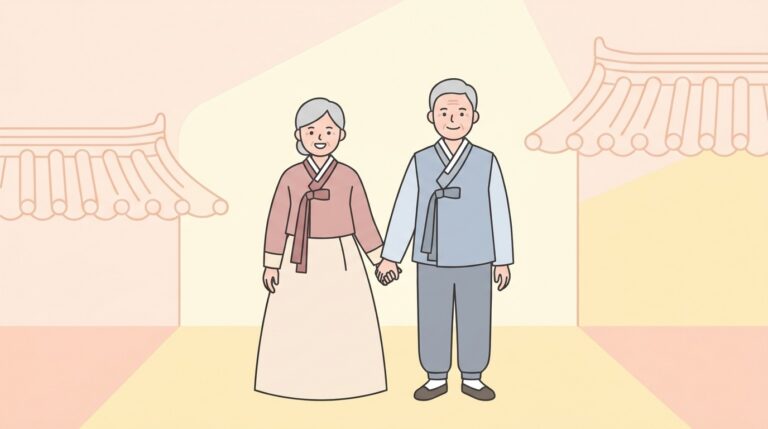
Phase 1: Empathy (Story Immersion Opening)
안녕하세요! 매일한글 에디터입니다. (Hello! I’m your Daily Hangul editor.)
Have you ever watched an episode of Reply 1988 or Hometown Cha-Cha-Cha and felt your heart melt whenever the neighborhood grandmothers handed out freshly steamed sweet potatoes or warmly pinched someone’s cheeks? Korean grandparents carry a deeply unique warmth—what Koreans call jeong (정). But for beginners, introducing family members or expressing love to elders in Korean can feel like walking through a linguistic minefield. You might wonder: Is saying 사랑해요 (Saranghaeyo) too casual for a grandfather? How do I introduce my sweet grandma without sounding like an emotionless robotic textbook?
Many of our global learners tell us: “I wanted to show a photo of my grandparents to my Korean host family, but I froze because I didn’t know the polite words!” Don’t worry. This guide was built directly from real learner struggles and authentic everyday Korean habits. By the end of this mini-guide, you will comfortably and respectfully introduce your grandparents, warm their hearts with genuine expressions of love, and build true cultural connection!
Phase 2: Top 3 Core Expressions Deep Dive
1. 할아버지 사랑해요 (Harabeoji saranghaeyo)
- Pronunciation: [Harabeoji saranghaeyo] (Sounds like: Hah-rah-buh-jee sah-rahng-hae-yo — imagine saying “harbor” with a soft “jee” at the end!)
- Meaning: “Grandfather, I love you.” (Direct & Nuanced: A respectful yet tender declaration of affection toward one’s grandfather).
- K-Culture Moment: Picture a holiday family gathering (Chuseok) where a child or grandchild gives a cute mini-finger heart to their grandpa, who pretends to be stern but grins ear-to-ear.
- Editor’s Insight: In Korean culture, speaking to elders requires honorific politeness. Adding -yo (-요) ensures you are respectful, while Harabeoji naturally creates an affectionate bond.
- Situation Spectrum:
- Casual (with friends): 🚫 (Too polite for close peers)
- Semi-formal (family / elders): ✅ (Perfect and warmly received)
- Strict Formal (broadcasting / speech): ⚠️ (Use 할아버지를 존경합니다 in formal speeches)
- 🤔 Think About It: In English, you might call your grandpa “Pops” or “Granddad” without grammar changes. Why do you think Korean changes sentence endings depending on the age of who you are talking to?
2. 할머니, 건강하세요 (Halmeoni, geonganghaseyo)
- Pronunciation: [Halmeoni, geonganghaseyo] (Hahl-muh-nee, gun-gahng-hah-seh-yo — “gun-gang” sounds like a sturdy, healthy bell ring!)
- Meaning: “Grandmother, please be healthy / stay healthy.” (Real nuance: The Korean cultural equivalent of saying “I love you and cherish you deeply.”)
- K-Culture Moment: Whenever characters in K-dramas leave their hometown village to go back to Seoul, they hold their grandma’s hand at the bus terminal and say this exact phrase.
- Editor’s Insight: In Korea, wishing health (건강) to grandparents is considered the purest form of love (효도, filial piety). Often, it feels even more heartfelt than a simple “I love you.”
- Situation Spectrum:
- Casual: 🚫
- Semi-formal (grandparents / elders): ✅ (The gold standard)
- Strict Formal: ⚠️ (더욱 건강하시기를 바랍니다 for formal letters)
- 🤔 Think About It: Why does wishing someone physical health carry the same emotional weight as saying “I love you” in Korean culture?
3. 이쪽은 저의 할머니예요 (Ijjogeun jeoui halmeoniyeyo)
- Pronunciation: [Ijjogeun jeoui halmeoniyeyo] (Ee-jjoh-geun juh-ee hahl-muh-nee-yeh-yo)
- Meaning: “This is my grandmother.” (Nuance: A polite introduction pointing toward family with dignity).
- K-Culture Moment: Showing your smartphone lock screen photo of your grandma to your Korean friends at a cafe.
- Editor’s Insight: Using 이쪽 (literally “this side / this direction”) is a remarkably polite way to introduce a person standing beside you or shown in a picture, avoiding blunt pointing.
- Situation Spectrum:
- Casual (among friends): ✅
- Semi-formal (colleagues / new acquaintances): ✅
- Strict Formal: ⚠️ (Use 이분은 저의 할머니이십니다 in formal presentations)
- 🤔 Think About It: How does introducing someone by saying “this side” soften the atmosphere compared to saying “this person”?
Phase 3: Textbook Korean vs. Real Korean
Situation 1: Calling out to your grandmother when arriving at her house
- 📖 교과서 한국어 (Textbook Korean): 조모님, 안녕하십니까? (Jomonim, annyeonghasipnikka? – Greetings, maternal/paternal grandmother.)
- 🗣️ 진짜 한국어 (Real Korean): 할머니, 저 왔어요! (Halmeoni, jeo wasseoyo! – Grandma, I’m here!)
- 💡 왜 다를까? (Why the difference?): Jomonim is an archaic Chinese-character root word reserved for legal documents or genealogy registries. Real Korean families always use the warm, tender title Halmeoni.
Situation 2: Expressing affection to your grandfather
- 📖 교과서 한국어 (Textbook Korean): 조부님을 사모합니다. (Jobunimeul samohamnida. – I harbor deep romantic/devout yearning for grandfather.)
- 🗣️ 진짜 한국어 (Real Korean): 할아버지, 사랑해요! (Harabeoji, saranghaeyo! – Grandpa, I love you!)
- 💡 왜 다를까? (Why the difference?): Words like samohada belong in historical sageuk dramas about kings and queens. Modern grandchildren use heartfelt everyday honorifics: Harabeoji, saranghaeyo!.
Phase 4: K-Culture Deep Dive & Non-Verbal Manners
4-1. 눈치 (Nunchi) & Gestures
When interacting with Korean grandparents, body language speaks louder than words:
* The Two-Handed Delivery (두 손): Whether handing a glass of water, a holiday gift, or showing a phone screen to a grandfather or grandmother, always hold the item with both hands—or support your right wrist/forearm with your left hand.
* Eye Contact & Modesty: Avoid intense, unblinking eye contact; in traditional Korean manners, staring boldly into an elder’s eyes can appear confrontational. Instead, keep a warm, soft gaze directed around their shoulder or mouth, nodding your head slightly (목례) as they speak.
4-2. Culture Code: The “Grandma Feasting” Phenomenon
If you visit a Korean grandmother, prepare your appetite. There is a famous meme in Korea: “Grandma’s scale has no limit.” In Korean culture, love is directly expressed through food. A grandmother will continuously serve banchan, saying: “밥 더 먹어 (Eat more rice).” Even if you are full, accepting one extra bite with a cheerful “감사합니다! (Thank you!)” is the fastest route to a Korean elder’s heart.
Phase 5: Real-Life Roleplay Scenario
Setting: You are visiting a cozy Hanok home in Jeonju with your Korean friend Minho. Minho’s sweet grandmother, Sunja (74), opens the sliding door wearing a floral apron and a warm smile.
- 할머니 (Grandma Sunja): 아이고, 친구가 왔네! 어서 와요. (Aigo, chinguga wanne! Eoseo wayo.)
- 🎭 Stage Direction: Grandmas wipes her hands on her apron and smiles warmly.
- Translation: Oh my, Minho’s friend is here! Welcome, come on in.
- Learner: 안녕하세요, 할머니! 처음 뵙겠습니다. (Annyeonghaseyo, halmeoni! Cheoeum boepgetseumnida.)
- 🎭 Stage Direction: Bowing at a 30-degree angle with two hands folded in front.
- Translation: Hello, Grandmother! Nice to meet you for the first time.
- 할머니 (Grandma Sunja): 아이고, 한국말 참 잘하네. 밥은 먹고 왔어요? (Aigo, hangukmal cham jalhane. Babeun meokgo wasseoyo?)
- 🎭 Stage Direction: Patting your arm gently.
- Translation: Oh my, your Korean is so good. Have you eaten yet?
- Learner: 네, 먹었어요! 할머니, 오늘 초대해 주셔서 감사해요. (Ne, meogeosseoyo! Halmeoni, oneul chodaehae jusyeoseo gamsahaeyo.)
- 🎭 Stage Direction: Smiling brightly.
- Translation: Yes, I ate! Grandmother, thank you for inviting me today.
- 할머니 (Grandma Sunja): 그래요, 먼 길 오느라 고생 많았어요. (Geuraeyo, meon gil oneura gosaeng manasseoyo.)
- 🎭 Stage Direction: Bringing a plate of freshly sliced Korean pears.
- Translation: Good, you worked hard traveling such a long way.
- Learner: 와, 배 맛있겠다! 할머니, 건강하세요. (Wa, bae masitgetda! Halmeoni, geonganghaseyo.)
- 🎭 Stage Direction: Receiving the fruit plate with both hands.
- Translation: Wow, the pears look delicious! Grandmother, please stay healthy.
- 할머니 (Grandma Sunja): 아이고 착해라. 많이 먹어요! (Aigo chakhaera. Mani meogeoyo!)
- 🎭 Stage Direction: Laughing with a happy sigh.
- Translation: Oh, what a sweet darling. Eat lots!
- Learner: 네! 할머니 사랑해요! (Ne! Halmeoni saranghaeyo!)
- 🎭 Stage Direction: Making a shy, cute mini-finger heart.
- Translation: Yes! Grandma, I love you!
🔀 Interactive Choice Point
At this moment, Grandma Sunja hands you a warm cup of roasted barley tea (boricha). What do you do?
- Option A: Take the cup with your right hand only while saying “땡큐 (Thank you)”.
- Feedback [Bad]: Using one hand with an elder and English slang feels dismissive. Grandma won’t get angry, but you’ll miss out on showing good manners.
- Option B: Take the cup with both hands, bow your head slightly, and say: “감사합니다, 할머니! (Gamsahamnida, halmeoni!)”
- Feedback [Best]: 100 points! Two hands show immense respect, and the polite phrase will make Grandma adore you instantly.
- Option C: Hug Grandma tightly around the neck and say: “사랑해 (Saranghae)”.
- Feedback [Risk]: While affectionate, dropping honorifics (반말) without permission is a faux pas, and unexpected physical contact can startle traditional Korean elders.
Phase 6: 10-Second Emotion Shadowing Drill
Practice these lines out loud! The slash (/) marks a natural pause point for breathing:
[😊 기쁘고 활기차게 - Cheerful & Bright]- 할아버지, / 사랑해요! (Harabeoji, / saranghaeyo!)
- “Grandpa, / I love you!”
[🥺 다정하고 애틋하게 - Tender & Warmhearted]- 할머니, / 건강하세요! (Halmeoni, / geonganghaseyo!)
- “Grandma, / please stay healthy!”
[🙇 정중하고 또박또박 - Respectful & Clear]- 이쪽은 / 저의 할머니예요. (Ijjogeun / jeoui halmeoniyeyo.)
- “This is / my grandmother.”
Phase 7: K-Culture Mini Dictionary
- 효도 (Hyodo / Filial Piety): The core Confucian virtue of showing respect, devotion, and care to parents and grandparents throughout life.
- 손주 (Sonju / Grandchild): A collective term for grandchildren (grandson is 손자/sonja, granddaughter is 손녀/sonnye). Hearing an elder call you “우리 손주 (Our grandchild)” is the ultimate sign of affection!
- 정 (Jeong / Deep Emotional Bond): A unique Korean concept describing unspoken empathy, warmth, and attachment built over shared time and care.
- 건강 (Geongang / Health): The single most prized blessing in Korean family culture; wishing elders good health is the highest compliment.
Phase 8: Traveler’s Survival Kit
Essential Survival Phrases TOP 3
- 할머니, 여기 앉으세요. (Halmeoni, yeogi anjeuseyo.)
- Romanization: Halmeoni, yeogi anjeuseyo.
- Meaning: “Grandmother, please sit here.”
- Pro Tip: Use this when offering your seat to an elder on the Seoul subway or bus.
- 할아버지, 제가 도와드릴까요? (Harabeoji, jega dowadeurilkkayo?)
- Romanization: Harabeoji, jega dowadeurilkkayo?
- Meaning: “Grandfather, may I help you?”
- Pro Tip: Use this if you see an elderly person carrying heavy groceries up metro stairs.
- 사진 같이 찍어요! (Sajin gachi jjigeoyo!)
- Romanization: Sajin gachi jjigeoyo!
- Meaning: “Let’s take a photo together!”
- Pro Tip: When visiting family or a traditional village, this is a heartwarming way to make a memory.
Editor’s Travel Note
- Subway & Bus Etiquette: Seoul buses and subways feature dedicated pink seats (for pregnant passengers) and red-trimmed seats at the ends of cars (reserved for elderly and disabled passengers). Even if the train is packed, avoid sitting in the elderly reserved seats (노약자석) unless you are prepared to stand up immediately when an elder boards.
- Essential Apps: For smooth travel, install the [Naver Map navigation mobile app] to check bus routes with accurate arrival times, and keep the [Papago voice translation download app] ready for quick two-way conversations with local market grandmothers!
Phase 9: “A Step Deeper”
In Western languages, love is frequently expressed as an emotion you state directly (“I love you”). In Korean society, love toward grandparents is fundamentally demonstrated through action, care, and respectful grammar. When you tell a Korean elder “건강하세요 (Please stay healthy)”, you are honoring their lifelong sacrifice for the family. Language in Korea is not just a tool for sharing information; it is a delicate mirror of community respect and generational gratitude.
💬 Your Turn: Does your native culture express love to grandparents through direct words, health wishes, or gifts of food? Drop a comment below and share your thoughts!
Phase 10: FAQ & Avoiding Misunderstandings
Q: Can I call an elderly woman on the street “할머니 (Halmeoni)”?
A: Yes! In Korea, calling an elderly lady at an open-air market or neighborhood shop 할머니 (Halmeoni) is very common and affectionate. However, if she is a middle-aged woman (50s or 60s), calling her Halmeoni might make her feel old! When in doubt, 어머님 (Eomeonim – mother) or 사장님 (Sajangnim – boss/owner) is safer.
Q: Is saying “사랑해 (Saranghae)” okay if I hug my grandfather?
A: Only if you are a very small child! Once you are an adult learner, always add -yo (사랑해요, Saranghaeyo). Dropping the honorific ending to an elder sounds too casual (반말), even if accompanied by a warm hug.
Q: What is the difference between “할머니 (Halmeoni)” and “외할머니 (Oehalmeoni)”?
A: 할머니 (Halmeoni) refers generally to grandmother or specifically your father’s mother (paternal). 외할머니 (Oehalmeoni) refers specifically to your mother’s mother (maternal). When speaking directly to either grandmother, however, you simply call both: 할머니!
🚨 Common Mistakes (Foreign Learners TOP 3)
- Mistake: Calling grandparents “너 (Neo – You)”
- Why it hurts: Neo is only used between close friends of the exact same age or to children. Using it with an elder is deeply disrespectful.
- Correct Action: Always use their title instead: “할아버지 (Grandfather)” or “할머니 (Grandmother)”.
- Mistake: Saying “안녕 (Annyeong)” as a quick greeting
- Why it hurts: Annyeong is casual speak (반말).
- Correct Action: Always say the full polite greeting: “안녕하세요 (Annyeonghaseyo)”.
- Mistake: Handing things with one hand
- Why it hurts: Giving or receiving items with one limp hand looks detached or indifferent.
- Correct Action: Support your arm or use both hands (두 손으로).
Phase 11: Action Mission & Engagement
Ready to put this into practice? Pick your level and start today!
- 🥉 Bronze Level (Solo Practice): Look into the mirror or pick up a photo of your grandparents. Practice saying: “할아버지, 할머니 사랑해요! 건강하세요!” 3 times out loud with clear pronunciation.
- 🥈 Silver Level (Social Share): Share a photo of your grandparents or a favorite K-drama grandparent on Instagram or X. Write the caption: “우리 할머니 사랑해요! (I love my grandma!)” and tag
@DailyHangul. - 🥇 Gold Level (Real-World Practice): The next time you visit a Korean restaurant or traditional market, politely greet the elderly owner with a warm two-handed bow and say: “안녕하세요, 할머니! (Hello, Grandmother!)”.
🎮 K-Culture Mission: Watch an episode of a family K-drama (like When the Camellia Blooms or Our Blues). Spot at least one moment where a character says 할머니 or 건강하세요. Write down the timestamp in the comments!
Phase 12: Interactive Quiz Challenge
Test what you’ve learned today!
- Situational Judgment: You are introducing your grandfather to your Korean friend. Which sentence is the most natural and polite?
- (A) 이 사람은 내 할아버지야.
- (B) 이쪽은 저의 할아버지예요.
- (C) 조부님이 오셨다.
- Fill-in-the-Blank: When wishing good health and long life to your grandmother, you say:
- “할머니, ________하세요!” (Hint: Starts with 건…)
- True / False Culture Quiz: In Korean culture, handing a cup of tea to a grandfather with only one hand is considered traditional and polite.
- True or False?
👉 Click to reveal answers & explanations!
- Answer: (B) 이쪽은 저의 할아버지예요.
- Explanation: (B) uses the respectful pointer 이쪽은 and the polite ending -예요. Option (A) is too blunt/informal (이 사람, -야), and Option (C) sounds like an old historical play.
- Answer: 건강 (Geongang)
- Explanation: The complete phrase is 할머니, 건강하세요! (Grandmother, please stay healthy!).
- Answer: False
- Explanation: Always hand drinks, food, or objects to elders using both hands (두 손) to demonstrate respect and warmth.
- Explanation: Always hand drinks, food, or objects to elders using both hands (두 손) to demonstrate respect and warmth.
🎬 Watch Our Daily Videos! (Daily Hangul Official Instagram)
Review the expressions you learned in this article with our fun daily short videos! Check out native pronunciation and real-life nuances in action.
- Instagram @dailyhangul_en






