

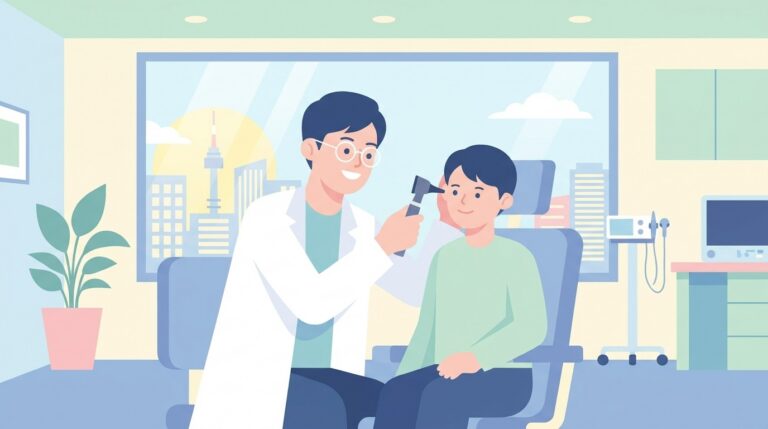
Maybe Water Got in My Ear: How to Explain Muffled, Echoing Ears at a Korean ENT Clinic
Phase 1: Empathy (A Watery Weekend Disaster)
안녕하세요! 매일한글 에디터입니다.
Imagine this: You spent a glorious Saturday soaking in an open-air hot tub at a Busan resort, or perhaps you tackled the epic water slides at Caribbean Bay. You felt refreshed, energized, and ready to take on Seoul the next morning. But when your alarm rings on Sunday, something is dreadfully wrong. One side of your head sounds like you are trapped inside an aquarium. Every footstep echoes with a hollow thump-thump, and voices sound like they are coming from the bottom of an empty well.
You tilt your head sideways, jump on one foot, and gently tap your temple, but nothing shifts. You know you need to visit an 이비인후과 (ENT – Ear, Nose, and Throat clinic), but anxiety hits. How do you explain that weird, hollow sensation to a doctor in Korean without sounding like a broken robot? Many beginner learners tell us they freeze up because textbook Korean only teaches stiff medical terms like “I have an auditory anomaly.”
Take a deep breath! Today, as your Korean best friend and cultural guide, I will give you the exact real-life phrases Korean locals use when water is trapped in their ears. With this guide, you will walk into any neighborhood clinic with confidence, get your ears cleared in five minutes flat, and walk out feeling like the world just switched back to high-definition audio.
Phase 2: Core Expressions (핵심 표현 3선)
1. 귀에 물이 들어간 것 같아요. (Gwie muri deureogan geot gat-ayo.)
- Pronunciation: Gwee-eh moo-ree deu-reo-gan geot gah-tah-yo (Think of “Gwee” like the start of “guwi”, followed by “moo-ree”).
- Meaning: Literal: “It seems water entered the ear.” / Real nuance: “I think I got water stuck in my ear.”
- K-Culture Moment: This is the iconic line shouted by celebrities on Korean outdoor variety shows like Running Man or 2 Days & 1 Night after losing a water-bomb game penalty!
- Editor’s Insight: Notice the ending -ㄴ 것 같아요 (-n geot gat-ayo). Koreans love softening statements into modest assumptions rather than absolute declarations. Even when you are 100% positive water went in, using this pattern makes you sound gentle and polite to medical staff.
- Situation Spectrum: Casual: ⚠️ (귀에 물 들어간 것 같아) / Semi-formal: ✅ (귀에 물이 들어간 것 같아요) / Formal: ✅ (귀에 물이 들어간 것 같습니다)
- 🤔 Think About It: In English, we often say firmly, “I have water in my ear.” Why do you think Korean culture favors phrasing physical symptoms as “It feels like / I think…”?
2. 소리가 웅웅거려요. (Soriga ung-ung-georyeoyo.)
- Pronunciation: So-ree-gah oong-oong-geo-ryeo-yo (The “ung” rhymes with the English word “boon” with a nasal “ng” at the end).
- Meaning: Literal: “Sound makes a booming/buzzing hum.” / Real nuance: “Sounds are echoing and humming hollowly.”
- K-Culture Moment: In K-dramas, whenever the main character experiences sudden sensory shock or stands next to a loud explosion, the audio switches to a muffled, ringing sound effect—that audio sensation is precisely 웅웅 (ung-ung).
- Editor’s Insight: Korean has hundreds of onomatopoeic words. 웅웅 (ung-ung) specifically mimics low-frequency vibration, reverberation, or the trapped sound of water echoing in the ear canal.
- Situation Spectrum: Casual: ⚠️ (소리가 웅웅거려) / Semi-formal: ✅ (소리가 웅웅거려요) / Formal: ✅ (소리가 웅웅거립니다)
- 🤔 Think About It: How does your native language describe a low, hollow vibration inside your ear? Does it use sound imitation or formal medical nouns?
3. 귀 안이 먹먹해요. (Gwi ani meongmeok-haeyo.)
- Pronunciation: Gwee ahn-ee mung-muck-hae-yo (“meong” rhymes with “sung”, and “meok” rhymes with “puck”).
- Meaning: Literal: “The inside of the ear is choked/clogged.” / Real nuance: “My ear feels completely muffled, stuffed, or plugged.”
- K-Culture Moment: Passengers often mutter this when taking the KTX high-speed train as it blasts through mountainous tunnels between Seoul and Busan, or inside the N Seoul Tower cable car!
- Editor’s Insight: 먹먹하다 (meongmeokhada) is one of the most uniquely expressive Korean adjectives. It describes that blocked sensation when air pressure changes or when swelling blocks sound. Poetically, Koreans also use it when their chest feels heavy with sorrow!
- Situation Spectrum: Casual: ⚠️ (귀 안이 먹먹해) / Semi-formal: ✅ (귀 안이 먹먹해요) / Formal: ✅ (귀 안이 먹먹합니다)
- 🤔 Think About It: Isn’t it fascinating that the same word for a blocked eardrum is used to express an emotionally overwhelmed, choked-up heart?
Phase 3: Textbook Korean vs Real Korean
Situation 1: Describing a blocked ear to the doctor
- 📖 교과서 한국어: 제 외이도가 막혀서 청력이 저하되었습니다. (Je oe-idoga makhyeoseo cheongryeogi jeohadoeeotseumnida.) — “My external auditory canal is obstructed, decreasing my auditory capability.”
- 🗣️ 진짜 한국어: 귀 안이 너무 먹먹해요. (Gwi ani neomu meongmeok-haeyo.) — “My ear feels so muffled and clogged.”
- 💡 왜 다를까?: Textbook sentences sound like a written forensic report! Korean doctors prefer intuitive sensory descriptions so they can immediately examine the physical condition without formal stiffness.
Situation 2: Explaining the buzzing noise
- 📖 교과서 한국어: 귀에서 지속적인 이명 증상이 발생하고 있습니다. (Gwieseo jisokjeogin imyeong jeungsangi balsaenghago itseumnida.) — “A continuous symptom of tinnitus is occurring in my ear.”
- 🗣️ 진짜 한국어: 소리가 자꾸 웅웅거려요. (Soriga jakku ung-ung-georyeoyo.) — “Sounds keep humming and echoing.”
- 💡 왜 다를까?: Jumping straight to medical terms like 이명 (tinnitus) might lead the doctor toward neurological tests, whereas 웅웅거려요 perfectly signals trapped moisture or swollen earwax.
Phase 4: K-Culture Deep Dive & Non-verbal Manners
4-1. Nunchi & Clinic Gestures
When stepping into a Korean clinic reception, queue etiquette is quiet and orderly.
* Two-Hand Rule: Hand over your ID card or Alien Registration Card (ARC) with both hands.
* Body Clues: When explaining your symptoms to the doctor, gently tilt your head toward the affected ear and point with two fingers (or a flat open palm) rather than poking your ear aggressively.
* Volume Modulation: Korean ENT consultation rooms are quiet sanctuaries. Doctors speak in calm, measured tones; matching their moderate volume displays respect and good 눈치 (nunchi).
4-2. The Lightning Speed of Korean ENT Clinics
If you have never visited an 이비인후과 in Korea, prepare for a cultural marvel! In many Western countries, seeing a specialist requires weeks of waiting. In Korea, you can walk into a neighborhood ENT clinic on a Tuesday morning without an appointment, wait ten minutes, and sit in a futuristic motorized chair.
The doctor will insert a micro-camera into your ear, projecting an ultra-clear live feed onto an LCD screen right before your eyes. You will see the culprit instantly—often earwax that expanded after absorbing pool water! With a swift, gentle suction tube (석션 – suction), the doctor clears it out within 60 seconds. Total bill? Usually between $10 to $25 USD even for travelers!
Phase 5: Real-Life Roleplay Scenario
Setting: Seoul Gangnam ENT Clinic (이비인후과). Dr. Min, an experienced and gentle physician, welcomes Alex, an exchange student with a clogged left ear.
- Dr. Min: 어디가 불편해서 오셨어요? (Eodiga bulpyeonhaeseo osyeosseoyo?) [🎭 Looking up with a welcoming smile]
- “What brings you in today? / Where does it feel uncomfortable?”
- Alex: 귀에 물이 들어간 것 같아요. (Gwie muri deureogan geot gat-ayo.) [🎭 Gently tilting head and pointing to the left ear]
- “I think some water got into my ear.”
- Dr. Min: 언제부터 그러셨어요? (Eonjebuteo geureosyeosseoyo?) [🎭 Picking up the digital ear otoscope]
- “Since when has it been like this?”
- Alex: 어제 수영한 후부터 소리가 웅웅거려요. (Eoje suyeonghan hubuteo soriga ung-ung-georyeoyo.) [🎭 Mimicking an echoing motion with hand]
- “Ever since I went swimming yesterday, sounds have been echoing and buzzing.”
- Dr. Min: 귀 안쪽이 찌르듯이 아프거나 가렵진 않으세요? (Gwi anjjogi jjireudeusi apeugeona garyeopjin aneuseyo?) [🎭 Adjusting the examination lamp]
- “Does the inside of your ear feel sharp pain or itching?”
- Alex: 아프지는 않은데, 귀 안이 너무 먹먹해요. (Apeujineun aneunde, gwi ani neomu meongmeok-haeyo.) [🎭 Frowning slightly to show the stuffy discomfort]
- “It doesn’t hurt, but the inside of my ear feels very muffled.”
- Dr. Min: 화면 보세요. 귀지가 물에 불어서 통로가 막혔네요. 바로 청소해 드릴게요. (Hwamyeon boseyo. Gwijiga mure bureoseo tongroga makyeonneyo. Baro cheongsohae deurilgeyo.) [🎭 Pointing at the monitor display]
- “Look at the screen. Your earwax absorbed water and swelled up, blocking the canal. I’ll clean it right away.”
- Alex: 아, 그렇군요! 잘 부탁드립니다. (A, geureokunyo! Jal butakdeurimnida.) [🎭 Nodding gratefully with hands rested on lap]
- “Ah, I see! Please take good care of it.”
🔀 Interactive Choice Point
During the suction treatment, Dr. Min says: “청소할 때 바람 소리가 크게 나는데 괜찮으세요?” (A loud vacuum sound will occur while cleaning, are you alright?) What do you reply?
- Option A: 네, 괜찮아요. 천천히 해주세요. (Ne, gwaenchanayo. Cheoncheonhi haejuseyo. – “Yes, I am okay. Please take your time.”)
- Outcome (Best): Polite, cooperative, and relaxed. The doctor will gently proceed while monitoring your reaction.
- Option B: 싫어요! 너무 무서워요! (Sireoyo! Neomu museowoyo! – “No! I’m so scared!”)
- Outcome (Bad): Overly dramatic and childish for an adult clinic setting. The clinical staff will become flustered.
- Option C: 그냥 빨리 끝내요. (Geunyang ppalli kkeunnaeyo. – “Just finish it fast.”)
- Outcome (Risk): Sounds abrupt, impatient, and demanding. It drops honorific warmth and could come across as rude.
Phase 6: 10-Second Emotion Shadowing Drill
Practice these lines with exaggerated rhythm and realistic vocal emotions. Breathe at the / marks!
[🥺 uncomfortable and helpless]
귀에 물이 들어갔는지 / 소리가 자꾸 웅웅거려요.
(Gwie muri deureogatneunji / soriga jakku ung-ung-georyeoyo.)-
[😣 stuffy and frustrated]
비행기 탄 것처럼 / 귀 안이 계속 먹먹해요.
(Bihaenggi tan geotcheoreom / gwi ani gyesok meongmeok-haeyo.) -
[😮 wide-eyed and relieved]
와, 귀지를 빼니까 / 소리가 진짜 잘 들려요!
(Wa, gwijireul ppaenikka / soriga jinjja jal deullyeoyo!)
Phase 7: K-Culture Mini Dictionary
- 이비인후과 (I-bi-in-hu-gwa): Ear, Nose, and Throat (ENT) clinic. Look for signs with “이비인후과의원” on commercial building facades near subway exits.
- 먹먹하다 (Meong-meok-ha-da): Blocked, stuffy, or muffled sensation in the ears. Widely used for altitude pressure, cold congestion, or water blockage.
- 웅웅거리다 (Ung-ung-geo-ri-da): To reverberate with a low, dull hum or buzz. Ideal for explaining ringing after concerts or trapped liquid.
- 처방전 (Cheo-bang-jeon): Prescription slip. After paying at the clinic desk, walk straight to the nearby 약국 (pharmacy) with this slip to receive ear drops or oral medicine.
Phase 8: Traveler’s Survival Kit
Survival Phrases TOP 3
- 왼쪽/오른쪽 귀가 막혔어요. (Oenjjok/oreunjjok gwiga makyeosseoyo.)
- “My left/right ear is blocked.”
- Pro Tip: Point to your ear while using this short sentence if your mind goes blank!
- 아프지는 않고 답답해요. (Apeujineun anko dapdaphaeyo.)
- *”It doesn’t hurt, but it feels suffocating/frustrating.”
- Pro Tip: Clears up whether there is an acute bacterial infection (중이염) or just mechanical blockage.
- 귀 청소 좀 해주실 수 있나요? (Gwi cheongso jom haejusil su innayo?)
- *”Could you please clean out my ear?”
- Pro Tip: Don’t feel shy! Getting ears cleaned by an ENT doctor is a standard, frequent service in Korea.
Editor’s Travel Note
- Find Clinics Quickly: Don’t search Google Maps in Korea; it lacks local medical updates. Instead, use the 네이버 지도 앱 다운로드 to search “이비인후과”. You will see operating hours, real-time reviews, and walking directions from your nearest subway station.
- Payment & Insurance: You do not need Korean National Health Insurance to be treated. Simply bring your passport. Expect the doctor fee to be approximately 20,000 to 35,000 KRW ($15–$25 USD), payable by international credit card.
Phase 9: “One Step Deeper”
Korean bodily expressions showcase how deeply physical sensation and emotional state are intertwined. While English relies heavily on anatomical references (“my Eustachian tube won’t equalize”), Korean embraces somatic sensory words like 먹먹하다 (muffled/choked) and 답답하다 (stuffy/suffocating). These words communicate human experience rather than clinical biology. When you tell a Korean doctor that your ear feels 먹먹해요, you are inviting them to understand your exact visceral discomfort, creating an instant empathetic connection.
💬 Your Turn: Have you ever tried to describe a physical ache or strange sound in another language? What is the funniest or most awkward translation mix-up you’ve experienced? Tell me in the comments below!
Phase 10: FAQ & Avoiding Misunderstandings
Q: Can I buy over-the-counter ear drops at a Korean pharmacy without seeing a doctor?
A: Mild ear drying solutions exist, but most medicated antibacterial or steroid ear drops in Korea require a doctor’s prescription (처방전). Given how fast and affordable clinic visits are, dropping by an ENT is much safer and faster.
Q: What if I don’t speak any other Korean? Will the doctor speak English?
A: Most Korean medical professionals studied English medical textbooks and can understand basic health terminology. If you speak slowly and use our key expressions (물이 들어갔어요, 먹먹해요), they will easily understand the context.
Q: Is it considered rude to ask the doctor to clean the other ear as well?
A: Not at all! You can politely say: “반대쪽 귀도 같이 봐주실 수 있나요?” (Could you check the other ear as well?) Doctors will happily examine both ears on the screen.
🚨 Common Mistakes Alert Board
- ❌ Mistake 1: Sticking a cotton swab (면봉) deep inside your wet ear.
- Correct Action: Never do this! It pushes the wet earwax deeper against the eardrum. Let an ENT doctor vacuum it.
- ❌ Mistake 2: Saying “귀가 고장 났어요” (My ear is broken like a machine).
- Correct Action: Say “귀가 불편해요” (My ear feels uncomfortable).
- ❌ Mistake 3: Waiting days in discomfort hoping the water evaporates.
- Correct Action: If earwax swells, water stays trapped for weeks. Visit a neighborhood clinic on day one.
Phase 11: Action Missions & Engagement
- 🥉 Bronze Mission: Stand in front of your bathroom mirror, gently tilt your head, and repeat 귀 안이 먹먹해요 three times out loud.
- 🥈 Silver Mission: Save the word 이비인후과 in your phone notepad or screenshot the survival kit phrases for your Korea travel folder.
- 🥇 Gold Mission: Next time you watch a Korean vlog or drama featuring a trip to the beach or pool, listen carefully for the words 물 (water) or 귀 (ear)!
- 🎮 K-Culture Mission: Search YouTube for “이비인후과 귀 청소” (ENT Ear Cleaning ASMR). Witness how smoothly Korean specialists clean ear canals on video monitors!
Phase 12: Interactive Quiz Challenge
Quiz 1. Situational Judgment
You wake up after swimming at a Han River pool and hear a dull, vibrating echo in your right ear. What is the most natural sentence to say to the doctor?
* (1) 제 청각 신경이 파괴되었습니다.
* (2) 오른쪽 귀에서 소리가 웅웅거려요.
* (3) 귀에 약국을 넣어주세요.
👉 Click to Reveal Answer & Feedback
Correct Answer: (2)
* Explanation: (2) “오른쪽 귀에서 소리가 웅웅거려요” (Sounds are echoing/humming in my right ear) is natural, clear, and accurate. (1) is overdramatically saying your auditory nerve is destroyed, and (3) asks the doctor to put a pharmacy inside your ear!
Quiz 2. Fill-in-the-Blank
Fill in the missing word describing the blocked, muffled sensation:
“비행기를 탔을 때처럼 귀 안이 너무 ( )해요.”
👉 Click to Reveal Answer & Feedback
Correct Answer: 먹먹 (meong-meok)
* Explanation: 먹먹해요 describes the stuffy, plugged sensation you experience during pressure changes or water blockage.
Quiz 3. True or False
In Korea, you must make a hospital appointment weeks in advance to see an ENT specialist for clogged ears. (True / False)
👉 Click to Reveal Answer & Feedback
Correct Answer: False
* Explanation: Korean neighborhood ENT clinics (이비인후과의원) accept walk-in patients every day with minimal wait times!
🎬 Watch Our Daily Videos! (Daily Hangul Official Instagram)
Review the expressions you learned in this article with our fun daily short videos! Check out native pronunciation and real-life nuances in action.
- Instagram @dailyhangul_en






