

Phase 1: Empathy (Story Opening)
안녕하세요! 매일한글 에디터입니다. (Hello! I’m your editor from Daily Hangul.)
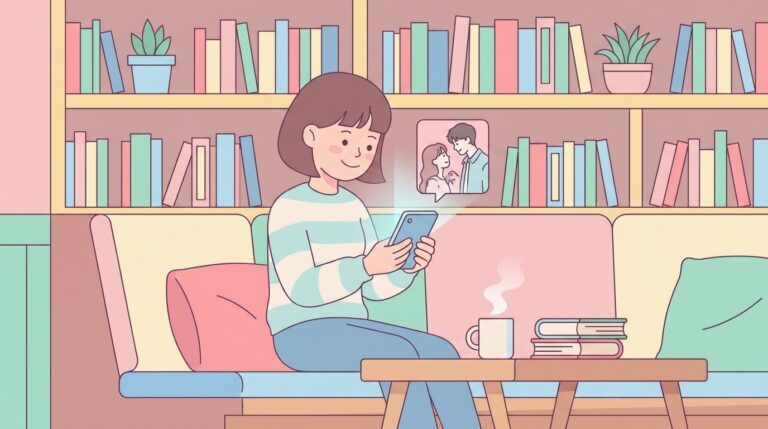
Picture this: It is 2:00 AM, your room is dark, and your smartphone screen illuminates your face as you scroll endlessly through a Korean webtoon. Suddenly, a glittering ballroom appears. A brooding, black-haired Duke with ruby-red eyes glares coldly at the ballroom crowd, yet blushes the second he looks at the clever female protagonist. You are officially hooked on Korean “Ro-Pan” (Romance Fantasy)!
Next day, you excitedly meet a Korean friend at a cozy cafe and want to ask: “Do you read romance fantasy webtoons? The male lead is so gorgeous!” But your tongue gets tied. How do Koreans actually say “Romance Fantasy”? Do you translate word-for-word as “로맨스 판타지 소설 만화 좋아하세요?” Wait, that sounds stiff like a 1990s grammar manual! Many of our beginner learners tell us: “I know what I love in English, but trying to talk about my favorite webtoons in Korean makes me sound like an encyclopedia robot.”
Don’t worry! This guide is built directly on real feedback from K-Culture fans just like you. By mastering just a few authentic, bite-sized A1 expressions, you will easily bond with native speakers over your favorite Webtoon couples, discover trending titles, and turn casual webtoon chats into genuine friendships.
Phase 2: Core Expressions Breakdown
1. 로판 좋아해요 (Ro-pan jo-a-hae-yo)
- Pronunciation: [Ro-pan jo-a-hae-yo] (Sounds like “Row-pahn” + “jaw-ah-hay-yo” — think of paddling a row boat to pan for gold!)
- Meaning: Literal: “I like Ro-Pan.” / Real Nuance: “I’m a huge fan of romance fantasy webtoons/novels!”
- K-Culture Moment: Used whenever you swap webtoon recommendations on Twitter (X), Instagram, or while relaxing in a Seoul comic book cafe.
- Editor’s Insight: Koreans love abbreviations! Instead of saying the tongue-twister 로맨스 판타지 (Ro-maen-seu pan-ta-ji), everyone simply shortens it to 로판 (Ro-pan). Combining it with the basic A1 verb 좋아해요 (jo-a-hae-yo / I like) instantly makes you sound like a local insider.
- Situation Spectrum: Casual (✅) | Semi-formal (✅) | Formal (⚠️ – slightly too casual for corporate presentations)
- 🤔 Think About It: English speakers often say “I love fantasy romance.” Why do you think Korean internet culture condenses 4-syllable compound words into snappy 2-syllable terms like “로판”?
2. 남주가 멋있어요 (Nam-ju-ga meot-i-sseo-yo)
- Pronunciation: [Nam-ju-ga meo-si-sseo-yo] (“Nahm-joo” + “gah” + “muh-shi-ssuh-yo” — Nam-ju rhymes with calm zoo!)
- Meaning: Literal: “The male main character is cool.” / Real Nuance: “The male lead is drop-dead gorgeous / such a heartthrob!”
- K-Culture Moment: The moment the tyrant Emperor sweeps the heroine into his arms to save her from a corrupt aristocrat.
- Editor’s Insight: 남주 (Nam-ju) is short for 남자 주인공 (Nam-ja ju-in-gong / Male protagonist). Its counterpart is 여주 (Yeo-ju / Female protagonist). Pair it with 멋있어요 (meot-i-sseo-yo / is cool, handsome) to praise any captivating hero!
- Situation Spectrum: Casual (✅) | Semi-formal (✅) | Formal (🚫)
- 🤔 Think About It: In your native language, do you have special nicknames for main characters, or do you always say “male lead”?
3. 정주행해요 (Jeong-ju-haeng-hae-yo)
- Pronunciation: [Jeong-ju-haeng-hae-yo] (“Juhng-joo-heng-hay-yo” — Jeong sounds like young with a soft J!)
- Meaning: Literal: “Driving in the correct direction.” / Real Nuance: “I’m binge-reading/binge-watching from episode 1!”
- K-Culture Moment: When your Friday night plan consists of reading 80 consecutive chapters of a completed webtoon until sunrise.
- Editor’s Insight: Originally a traffic term meaning “driving along the designated lane,” netizens repurposed it to mean reading a series in chronological order without skipping chapters. It is the Korean equivalent of “binge-reading!”
- Situation Spectrum: Casual (✅) | Semi-formal (✅) | Formal (⚠️)
- 🤔 Think About It: Contrast “binge-reading” (consuming excessively) with “정주행” (driving correctly straight through). What does this reveal about how different cultures frame marathon media consumption?
Phase 3: Textbook Korean vs. Real Korean
Situation 1: Telling someone your favorite genre
- 📖 Textbook Korean: 저는 로맨스 판타지 만화를 좋아합니다. (Jeo-neun ro-maen-seu pan-ta-ji man-hwa-reul jo-a-ham-ni-da.) — “I like romance fantasy comic books.”
- 🗣️ Real Korean: 저 로판 완전 좋아해요! (Jeo ro-pan wan-jeon jo-a-hae-yo!) — “I totally love Ro-Pan!”
- 💡 Why is it different?: Nobody says the full five-syllable genre title in casual conversation. Replacing long bookish terms with snappy slang like 완전 (wan-jeon / totally, completely) makes you sound warm, energetic, and natural.
Situation 2: Gushing over the handsome male protagonist
- 📖 Textbook Korean: 남자 주인공이 매우 잘생겼습니다. (Nam-ja ju-in-gong-i mae-u jal-saeng-gyeot-seum-ni-da.) — “The male protagonist is very handsome.”
- 🗣️ Real Korean: 남주 얼굴이 다 했어요! (Nam-ju eol-gur-i da haess-eo-yo!) — “The male lead’s visual did everything! (He carried the whole plot with his looks!)”
- 💡 Why is it different?: While beginner textbooks teach stiff adjectives, native fans humorously praise jaw-dropping webtoon art by saying someone’s handsome face “did all the work” (얼굴이 다 했다).
Phase 4: K-Culture Deep Dive & Non-Verbal Manners
4-1. Nunchi & Reaction Gestures
When discussing webtoons with Korean peers:
* The Two-Hand Phone Tilt: When sharing your phone screen to show a gorgeous webtoon panel, tilt your phone slightly toward them and hold it with both hands. Pointing at a screen with one finger while slouching feels dismissive; holding it gently with both hands signals: “Look how precious this panel is!”
* The Silent Gasp (입틀막 – Ip-teul-mak): In public spots like subway lines or quiet study cafes, K-fans do not scream when a romantic cliffhanger drops. Instead, they quickly cover their mouth with both hands (입을 틀어막다) with wide, sparkling eyes. It shows polite respect for quiet public environments while expressing peak excitement!
4-2. The Romance Fantasy (“Ro-Pan”) Phenomenon
Why is Ro-Pan so immensely popular in Korea? Modern Korean youths deal with intense daily competition (often dubbed N-po generation). Ro-Pan webtoons provide an empowering escape through popular tropes:
1. The Cold Duke of the North (북부 대공 – Buk-bu Dae-gong): Stern and unyielding to the world, but unconditionally devoted to the heroine.
2. Contract Marriage (계약 결혼 – Gye-yak Gyeol-hon): Strategic partnerships that blossom into true love where the female lead controls her own destiny.
3. Second Chances: Reincarnating or turning back time allows protagonists to outsmart their past bullies, giving readers pure psychological satisfaction.
Phase 5: Real Role-play Scenario
Setting: You are visiting Beoltoon (벌툰), a cozy honeycomb-themed comic book cafe in Hongdae, Seoul. You meet Minji, a friendly Korean college student sharing your seating booth area.
- Minji: 저기요, 혹시 웹툰 봐요? (Jeo-gi-yo, hok-si wept-tun bwa-yo?)
🎭 (Tilting head with a friendly smile, noticing your phone wallpaper)
“Excuse me, by any chance, do you read webtoons?” -
You: 네! 저 웹툰 진짜 좋아해요. (Ne! Jeo wept-tun jin-jja jo-a-hae-yo.)
🎭 (Nodding politely with an enthusiastic smile)
“Yes! I really like webtoons.” -
Minji: 오, 어떤 장르 좋아해요? (O, eo-tteon jang-neu jo-a-hae-yo?)
🎭 (Leaning forward with sparkling, curious eyes)
“Oh, what genre do you like?” -
You: 저 로판 좋아해요! (Jeo ro-pan jo-a-hae-yo!)
🎭 (Showing a proud grin and tapping your screen)
“I like Ro-Pan (Romance Fantasy)!” -
Minji: 대박! 저도 로판 덕후예요! 누구 좋아해요? (Dae-bak! Jeo-do ro-pan deok-hu-ye-yo! Nu-gu jo-a-hae-yo?)
🎭 (Clapping hands together lightly in delight)
“Awesome! I’m a huge Ro-Pan nerd too! Who is your favorite?” -
You: 이 웹툰 남주가 멋있어요. (I wept-tun nam-ju-ga meot-i-sseo-yo.)
🎭 (Showing your screen with both hands)
“This webtoon’s male lead is so cool.” -
Minji: 헐, 카셀 공작이잖아요! 이미 다 봤어요? (Heol, Ka-sel gong-jag-i-janh-a-yo! I-mi da bwa-sseo-yo?)
🎭 (Gasping playfully in recognition)
“OMG, that’s Duke Karsel! Have you read it all already?” -
You: 지금 1화부터 정주행해요! (Ji-geum il-hwa-bu-teo jeong-ju-haeng-hae-yo!)
🎭 (Giggling slightly and making a scrolling motion)
“I’m binge-reading it right now from chapter 1!”
🔀 Interactive Decision Point
Minji smiles and asks: “주말에 완결까지 다 볼 거예요? (Are you going to read until the final chapter this weekend?)” How will you reply?
- Option A: “네, 밤새워서 정주행할 거예요!” (Ne, bam-sae-wo-seo jeong-ju-haeng-hal geo-ye-yo!)
- Option B: “아니요, 저는 만화를 읽는 행위를 중단합니다.” (A-ni-yo, jeo-neun man-hwa-reul ilg-neun haeng-wi-reul jung-dan-ham-ni-da.)
- Option C: “야! 조용히 해!” (Ya! Jo-yong-hi hae!)
Feedback:
* Option A (Best!): “Yes, I will stay up all night and binge-read!” Perfect use of conversational enthusiasm! Minji will immediately invite you to swap recommendations.
* Option B (Bad): “No, I terminate the act of reading comics.” Far too mechanical and overly formal. It will confuse Minji.
* Option C (Risk – Do NOT choose!): “Hey! Shut up!” Extremely rude and offensive banmal (informal speech). You might get kicked out of the comic cafe!
Phase 6: 10-Second Emotional Shadowing Drill
Practice matching the exact rhythm and feeling! Pauses are marked with /.
[😊 Proud and enthusiastic]
저 / 로판 / 진짜 좋아해요!
(Jeo / ro-pan / jin-jja jo-a-hae-yo!)
“I / really love / Ro-Pan!”-
[😍 Swooning with heart eyes]
와, / 남주가 / 너무 멋있어요!
(Wa, / nam-ju-ga / neo-mu meot-i-sseo-yo!)
“Wow, / the male lead / is so cool!” -
[🔥 Determined and ambitious]
오늘 밤에 / 1화부터 / 정주행해요!
(O-neul bam-e / il-hwa-bu-teo / jeong-ju-haeng-hae-yo!)
“Tonight, / from episode 1, / I’m binge-reading!”
Phase 7: K-Culture Mini Dictionary
- 북부 대공 (Buk-bu Dae-gong) | Duke of the North
- Usage: A legendary Ro-Pan character archetype: brooding, jet-black hair, muscular build, ruling over freezing snowy lands, but utterly soft only for the female lead.
- 회빙환 (Hoe-bing-hwan) | Regression, Possession, Reincarnation
- Usage: Acronym for 회귀 (time-travel back), 빙의 (possessing a novel character’s body), and 환생 (reincarnation into another world). If a webtoon has magic, it usually belongs to 회빙환!
- 사이다 (Sa-i-da) | Cider (Refreshing satisfaction)
- Usage: Just like taking a crisp sip of lemon-lime soda on a sweltering day, 사이다 describes scenes where villains get swiftly punished without frustrating delays.
- 고구마 (Go-gu-ma) | Sweet Potato (Suffocating frustration)
- Usage: The opposite of 사이다. Eating baked sweet potatoes without water feels dry and choking; similarly, overly frustrating plot developments are called 고구마.
Phase 8: Traveler’s Survival Kit
Survival TOP 3 Webtoon Expressions
- 추천해 주세요! (Chu-cheon-hae ju-se-yo!)
- Pronunciation: [Chu-cheon-hae ju-se-yo]
- Pro Tip: Ask staff at comic cafes or bookshops: “인기 로판 추천해 주세요! (Please recommend popular Ro-Pan!)”
- 완결 났어요? (Wan-gyeol nass-eo-yo?)
- Pronunciation: [Wan-gyeol nass-eo-yo]
- Pro Tip: Means “Is it completed?” Essential before starting a binge-read so you don’t get trapped waiting weekly!
- 몇 화까지 있어요? (Myeot hwa-kka-ji iss-eo-yo?)
- Pronunciation: [Myeot hwa-kka-ji iss-eo-yo]
- Pro Tip: Means “Up to which chapter is available?”
Editor’s Travel Note
When traveling in Seoul, visit chain comic cafes like Beoltoon (벌툰) or Nolsoop (놀숲) in areas like Hongdae, Gangnam, or Sinchon. You can rent a private cozy cubby with blankets, order iced tea and tteokbokki, and read physical webtoon book editions for around 3,000 KRW per hour! Before you go, explore the 네이버 웹툰 공식 앱 다운로드 to check the daily Top 10 rankings in Korea and see what local readers are obsessing over.
Phase 9: “One Step Deeper” (Reflective Question)
In Korean society, where academic and professional expectations are famously high, the meteoric rise of Ro-Pan represents more than casual entertainment. Concepts like 회빙환 (starting life over with future knowledge) offer a safe, therapeutic playground where past regrets vanish and effort is always rewarded with justice and affection. When you read a Korean webtoon, you are peering into the shared emotional desires of a generation longing for rest, fairness, and true recognition.
💬 Your Turn: If you could possess or reincarnate into any Korean webtoon world as the main character, would you prefer living in a grand palace as an empress or running a cozy magic bakery? Tell us in the comments below! (Feel free to try writing: “저는 로판 좋아해요!”)
Phase 10: FAQ & Avoiding Misunderstandings
Q: Can I use “로판 (Ro-pan)” when talking to an elderly person or in formal meetings?
A: It is better to use the full phrase 로맨스 판타지 (romance fantasy) or simply 판타지 만화 (fantasy comic). “로판” is modern web slang well-known among people in their teens to 30s, but older generations might not immediately recognize the abbreviation.
Q: What is the difference between 만화 (Man-hwa) and 웹툰 (Wep-tun)?
A: 만화 (Man-hwa) is an umbrella term for comics or manga of any format (printed books, magazines, etc.). 웹툰 (Webtoon) specifically refers to digital, vertical-scrolling comics optimized for smartphone screens.
Q: How do I say “female lead” instead of “male lead”?
A: Simply replace 남 (Nam – male) with 여 (Yeo – female): say 여주 (Yeo-ju) for the female protagonist, or 여주가 멋있어요! (Yeo-ju-ga meot-i-sseo-yo! – The female lead is so cool!).
🚨 Common Mistakes Alert
- Mistake: Saying “저는 판타지 로맨스 사랑해요.”
- Why: Direct word-for-word translation from English. In Korea, the order is always Romance + Fantasy (로판), and beginners over-use 사랑해요 (reserved for deep personal love) instead of the natural verb 좋아해요 (I like).
- Correct Action: Say “로판 좋아해요! (Ro-pan jo-a-hae-yo!)”
- Mistake: Pronouncing 남주 as “Nam-jew”.
- Why: The Korean “ㅜ” sound is soft like “zoo”, not a hard English “jew”.
- Correct Action: Soften your lips: say Nam-ju gently.
- Mistake: Forgetting the polite ending “-요 (-yo)” with strangers in comic cafes.
- Why: Omitting “-yo” turns your sentence into banmal (casual/rude to strangers).
- Correct Action: Keep that ending attached: 정주행해요!
Phase 11: Action Missions
- 🥉 Bronze Mission (Solo Practice): Stand in front of a mirror, raise your phone with both hands, and say out loud three times with a bright smile: “저 로판 좋아해요!”
- 🥈 Silver Mission (Social Share): Screenshot the cover of your favorite Korean webtoon and post it on your Instagram Story or X (Twitter) with the caption: “남주가 멋있어요! #DailyHangul #Webtoon”
- 🥇 Gold Mission (Real Life / Interactive): Leave a comment under a Korean webtoon chapter or on our blog comment section: “오늘부터 1화 정주행해요! (Starting my binge-read from chapter 1 today!)”
🎮 K-Culture Mission: Open any Korean webtoon platform (like Webtoon or Kakao) and look at the comment section (댓글). Count how many times you spot the words 남주 (Nam-ju) or 사이다 (Sa-i-da)!
Phase 12: Interactive Quiz Challenge
1. Situational Judgment
You want to tell your Korean classmate that you are reading a 100-chapter romance fantasy webtoon non-stop from the very beginning. What is the most natural thing to say?
* (A) 저 지금 회빙환 해요.
* (B) 저 지금 정주행해요!
* (C) 남주가 고구마예요.
2. Fill in the Blank
Complete the sentence to say: “The male lead is really cool!”
“_____가 진짜 멋있어요!”
* Choices: [ 여주 / 남주 / 사이다 ]
3. Cultural True / False
In Korean internet culture, if a webtoon plot moves quickly, resolves conflicts immediately, and punishes villainous characters satisfyingly, readers praise the chapter as “사이다 (Cider)”.
* (True / False)
👉 Click to reveal answers & explanations!
- Answer: (B) 저 지금 정주행해요!
- Explanation: 정주행 (Jeong-ju-haeng) means binge-reading a series in chronological order! Option A makes no sense, and Option C means “the male lead is frustrating like a dry sweet potato.”
- Answer: 남주 (Nam-ju)
- Explanation: 남주 is the short abbreviation for male lead (남자 주인공). “여주” would mean female lead.
- Answer: True
- Explanation: Yes! Like a carbonated lemon-lime cider clearing your throat, crisp and satisfying plot developments are called 사이다 (Sa-i-da)!
- Explanation: Yes! Like a carbonated lemon-lime cider clearing your throat, crisp and satisfying plot developments are called 사이다 (Sa-i-da)!
🎬 Watch Our Daily Videos! (Daily Hangul Official Instagram)
Review the expressions you learned in this article with our fun daily short videos! Check out native pronunciation and real-life nuances in action.
- Instagram @dailyhangul_en






