

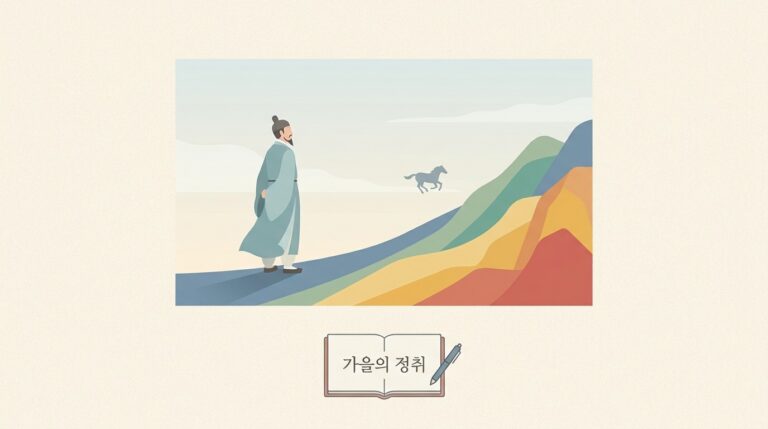
The Art of Staying Unshaken: Mastering ‘새옹지마’ and ‘전화위복’ in Korean Life
Phase 1: 공감 (Story-Driven Opening)
안녕하세요! 매일한글 에디터입니다. (Hello! I’m your editor from Daily Hangul.)
Picture this: You are sitting in an upscale café in Yeouido, the bustling financial heart of Seoul. Across the table, your Korean colleague is nursing an iced Americano with a stunned expression. Just last month, his startup team secured a coveted government innovation grant; overnight, they were celebrated as rising stars. Today, however, an unexpected regulatory policy shift wiped out their core monetization model in one swift blow. A junior team member breaks into a frantic panic, but your team lead calmly sets down his glass, takes a deep breath, and remarks with a slight, knowing smile: “인생사 새옹지마라더니… 그래도 이번 기회에 피보팅하면 전화위복이 될 수도 있어.” (They say life is Saeongjima… Still, if we pivot now, this might become Jeonhwawibok.)
Have you ever found yourself reaching for English expressions like “Every cloud has a silver lining” or “What goes around comes around,” only to realize they completely miss the melancholic yet deeply resolute flavor of Korean equanimity? At a C2 mastery level, conversation is no longer about simply conveying information; it is about articulating worldview. When corporate tides turn overnight or personal relationships run cold (염량세태 – Yeomnyangsetae), dropping a textbook phrase like “걱정 마세요, 다 잘 될 거예요” (Don’t worry, all will be well) can sound jarringly naive. Drawing from real consulting sessions with top multinational executives living in Seoul, this guide will equip you to navigate dramatic twists of fate with profound philosophical elegance.
Phase 2: 핵심 표현 3선 심층 분석 (Top 3 Idioms In-Depth)
1. 새옹지마 (塞翁之馬)
- Pronunciation: [Sae-ong-ji-ma] (Sounds like “seh-ong-jee-mah”, rhythmic like a horse trotting steadily over a mountain pass).
- Meaning: Literal: The frontier old man’s horse. Real Nuance: Fortune and misfortune are perpetually intertwined; today’s blessing could be tomorrow’s disaster, and vice versa. It commands absolute emotional composure.
- K-Culture Moment: Seen frequently in historical dramas (sageuk) or intense corporate boardroom thrillers like Reborn Rich, where a chaebol patriarch warns an arrogant heir not to celebrate prematurely after an acquisition.
- Editor’s Insight: It is almost always used as “인생사 새옹지마” (Human life is Saeongjima). The power of this phrase lies in its tranquil emotional restraint (초연함). It does not deny pain, nor does it dismiss success; it frames both as temporary illusions.
- Situation Spectrum: Casual ⚠️ | Semi-formal ✅ | Formal ✅
- 🤔 Think About It: Does Western culture treat success as personal merit and failure as bad luck, whereas Korean philosophy views them as an alternating, impersonal cycle of nature?
2. 전화위복 (轉禍爲福)
- Pronunciation: [Jeon-hwa-wi-bok] (Sounds like “juhn-hwah-wee-bohk”; punchy and resolute on the final bok).
- Meaning: Literal: Turning disaster into good fortune. Real Nuance: Actively transforming a devastating catastrophe into a breakthrough through sheer grit, strategy, and resilience.
- K-Culture Moment: Frequently cited by K-Pop idols in comeback interviews when recounting how severe vocal cord injuries or grueling trainee dropouts forced them into songwriting or debut in a legendary group.
- Editor’s Insight: While 새옹지마 is passive acceptance of destiny’s oscillation, 전화위복 is aggressively active. It requires human agency to flip the narrative.
- Situation Spectrum: Casual ✅ | Semi-formal ✅ | Formal ✅
- 🤔 Think About It: How does phrasing crisis as a catalyst for victory change how team leaders in your home country handle public setbacks compared to Korean corporate post-mortems?
3. 염량세태 (炎涼世態)
- Pronunciation: [Yeom-nyang-se-tae] (Sounds like “yuhm-nyang-seh-teh”; soft ‘l’ sound shifts to ‘n’ due to nasalization).
- Meaning: Literal: Hot and cool worldly conditions. Real Nuance: The fickleness of human connections—people fawn over you when you possess wealth and power, but turn icy and vanish the instant your influence fades.
- K-Culture Moment: Political legal thrillers (e.g., Stranger or The Devil Judge), where a disgraced chief prosecutor walks down an empty corridor while former subordinates deliberately avert their eyes.
- Editor’s Insight: Use this idiom sparingly and with high emotional precision. It carries poetic cynicism and world-weary intellectual sharpness.
- Situation Spectrum: Casual 🚫 | Semi-formal ⚠️ | Formal ✅
- 🤔 Think About It: Korean social dynamics often center on tight-knit networks (연줄). Why does the historical consciousness produce such razor-sharp satire when those same networks betray vulnerability?
Phase 3: 교과서 한국어 vs 진짜 한국어 (Textbook vs. Real Native C2)
Situation 1: Comforting a colleague whose high-profile project was abruptly scrubbed
- 📖 교과서 한국어 (Textbook): “너무 슬퍼하지 마세요. 나중에는 좋은 일이 생길 거예요.” (Neomu seulpeohaji maseyo. Najiungeneun joeun iri saenggil geoyeyo. / Don’t be too sad. Good things will happen later.)
- 🗣️ 진짜 한국어 (Real C2 Native): “이번 좌절이 뼈아프겠지만, 길게 보면 전화위복의 계기가 될 겁니다. 지나치게 낙담하지 마세요.” (Ibeon jwajeori ppyeoapeugetjiman, gilge bomyeon jeonhwawibogui gyegiga doel geomnida. Jinachige nakdamhaji maseyo. / This setback cuts to the bone, but in the long run, it will serve as the turning point for fortune. Do not fall into deep despair.)
- 💡 왜 다를까? Textbook Korean sounds like comfort addressed to a distressed child. C2 Korean validates the genuine agony (뼈아프다) while framing resilience as a professional virtue.
Situation 2: Warning a newly promoted executive against overconfidence
- 📖 교과서 한국어 (Textbook): “성공했다고 너무 자랑하지 마세요. 실패할 수도 있어요.” (Seonggonghaetdago neomu jaranghaji maseyo. Silpaehal sudo isseoyo. / Don’t brag too much about succeeding. You might fail.)
- 🗣️ 진짜 한국어 (Real C2 Native): “지금의 승리에 도취되어 일희일비하지 마십시오. 인생사 새옹지마라는 말을 곱씹을 때입니다.” (Jigeumui seungnie dochwideieo ilhuiilbihaji masipsio. Insaengsa saeongjimaraneun mareul gopssibeul ttaeimnida. / Do not let this victory intoxicate you into emotional volatility. Now is the exact moment to contemplate Saeongjima.)
- 💡 왜 다를까? Plain warnings sound condescending or abrasive. Evoking 새옹지마 anchors your counsel in ancient, objective wisdom rather than personal critique.
Phase 4: K-Culture 딥다이브 & 비언어적 매너 (Deep Dive & Non-Verbal Manners)
4-1. 눈치 (Nunchi) & Somatic Restraint
When discussing life’s volatile turns in Korean professional or academic settings, non-verbal delivery carries 70% of the message:
* The Equanimous Gaze (담담한 시선): Avoid dramatic eye-widening or exaggerated sighs. A measured, gentle nod paired with a two-second pause before speaking reflects profound inner emotional control (달관).
* The Palm Gesture: When introducing 새옹지마, turn your open hand slightly upward and then flat, mirroring the balanced scales of fate.
* Lowering Vocal Pitch: Never utter four-character idioms (사자성어) in an excited, high-pitched register. Drop your tone into your chest resonance to convey gravitas.
4-2. Cultural Code Analysis: The Dramaturgy of Reversals
In Korean entertainment and business lore, an unblemished path to victory is considered suspicious. Consider the cultural narrative surrounding BTS’s early career rejections, or the protagonist’s trajectory in Itaewon Class. The Korean psyche possesses a unique appreciation for 한 (Han)—a deep sorrow transformed through endurance—and its counter-concept, 흥 (Heung)—ecstatic resilience. Understanding 새옹지마 and 전화위복 allows you to comprehend why sudden misfortune in Korea is rarely seen as a dead end, but rather as an essential ritual passage before triumphant reinvention.
Phase 5: 실전 롤플레이 시나리오 (Real-World Roleplay Scenario)
Setting: A dimly lit, traditional Makgeolli house near Anguk Station in central Seoul. Rain pampers against the wooden eaves. You are sharing drinks with Managing Director Park (박 전무), a veteran executive who just experienced a stinging defeat in an internal factional restructuring.
- Turn 1 (Managing Director Park): “결국 이번 인사에서 우리 본부가 완전히 배제되었네. 세상인심 참 매정해…” (Gyeolguk ibeon insaeseo uri bonbuga wanjeonhi baejedoeeonne. Sesanginsim cham maejeonghae…)
🎭 Sips his drink slowly, staring at the condensation on the copper cup.
“In the end, our headquarters was completely sidelined in this personnel reshuffle. Human loyalty in this world is truly ruthless…” -
Turn 2 (You): “전무님, 염량세태라더니 권력의 무상함을 목도하는 것 같아 씁쓸합니다.” (Jeonmunim, yeomnyangsetaeradeoni gwonryeogui musanghameul mokdohaneun geot gata sseupsseulhamnida.)
🎭 Pouring Makgeolli with both hands supporting the bottle respectfully.
“Director Park, it feels bitter witnessing the fickleness of worldly power firsthand.” -
Turn 3 (Managing Director Park): “어제까지 내 사무실 앞에 줄을 서던 친구들이 오늘은 눈길조차 피하더군.” (Eojekkaji nae samusil ape jureul seodeon chingudeuri oneureun nungiljocha pihadeogun.)
🎭 Chuckles cynically with a quiet, dry cough.
“Folks who were queuing outside my office until yesterday averted their eyes altogether today.” -
Turn 4 (You): “하지만 인간만사 새옹지마라고 하지 않습니까. 이번 인사가 오히려 전무님께 새로운 돌파구가 될 수도 있습니다.” (Hajiman inganmansa saeongjimarago haji anseumnikka. Ibeon insaga ohiryeo jeonmunimkke saeroun dolpaguga doel sudo itseumnida.)
🎭 Maintaining a grounded, respectful eye level, speaking steadily.
“Yet, do they not say all human affairs are Saeongjima? This reshuffle might paradoxically become a breakthrough for you.” -
Turn 5 (Managing Director Park): “돌파구라… 이 나이에 허허벌판으로 밀려난 마당에 무슨 돌파구가 있겠나?” (Dolpagura… I naie heoheobeolpaneuro millyeonan madange museun dolpaguga itgenna?)
🎭 Tilts his head up, eyes reflecting self-doubt and weary defense.
“A breakthrough… pushed out into an empty wilderness at my age, what breakthrough could there be?” -
Turn 6 (You): “신사업 추진단으로 가신 것이 위기처럼 보여도, 실권에서 벗어나 독자적 성과를 증명할 절호의 기회입니다.” (Sinsaeop chujindaneuro gasin geosi wigicheoreom boyeodo, silkweoneseo beoseona dokjajeok seongkwareul jeungmyeonghal jeolhoui gihoeimnida.)
🎭 Placing both hands flat on the wooden table, leaning in slightly.
“Being shifted to the new venture task force looks like a crisis, yet free from political crossfire, it is a prime opportunity to prove independent results.” -
Turn 7 (Managing Director Park): “듣고 보니… 그 판을 우리가 새로 짤 수도 있겠구먼 그래.” (Deutgo boni… Geu paneul uriga saero jjal sudo itgetgumeon geurae.)
🎭 Softens his forehead wrinkles, showing a glimmer of returning focus.
“Now that you put it that way… we might actually be able to design that entire board ourselves.” -
Turn 8 (You): “네, 위기를 기회로 바꾸는 전화위복의 선례를 만들어 보시지요. 제가 곁에서 끝까지 보좌하겠습니다.” (Ne, wigireul gihoero bakkuneun jeonhwawibogui seonryereul mandeureo bosijiyo. Jega gyeoteseo kkeutkkaji bojwahagetseumnida.)
🎭 Lifting the brass cup with both hands for a toast.
“Yes, let us create a precedent of turning catastrophe into fortune. I will support you through the very end.”
🔀 인터랙티브 분기점 (Interactive Fork)
How would you handle Director Park at Turn 6 if he sinks into deeper self-pity?
- Option A (Best): “사기(史記)에도 이르길, 화(禍)란 복(福)이 깃드는 곳이라 했습니다. 이번 판을 전화위복의 기점으로 삼으시지요.” (Invoking classical philosophical precedent while honoring his agency).
- Option B (Bad): “에이 전무님, 회사가 다 그런 거죠 뭐. 그냥 잊고 한잔 드세요!” (Dismisses deep executive grief with juvenile flippancy; destroys emotional rapport).
- Option C (Risk): “저희가 그 임원진들에게 보복할 수 있는 계획을 당장 짜겠습니다.” (Aggressive, politically reckless escalation that reveals severe lack of situational awareness).
Phase 6: 10초 감정 섀도잉 드릴 (Emotional Shadowing Drill)
Practice these lines out loud, honoring the intonational pauses (/) and internalizing the exact emotional milestone indicated:
[😌 초연하고 깊은 호흡으로 / Measured, detached acceptance]
“인생사 / 새옹지마인데 / 지금의 실패에 / 너무 연연하지 마세요.”
(Insaengsa / saeongjimainde / jigeumui silpaee / neomu yeon-yeonhaji maseyo. / Life is Saeongjima; do not dwell incessantly on this current loss.)-
[🔥 단호하고 비장한 결의로 / Resolute, strategic determination]
“이 뼈아픈 시련을 / 반드시 / 전화위복의 발판으로 / 삼겠습니다.”
(I ppyeoapeun siryeoneul / bandeusi / jeonhwawibogui balpaneuro / samgetseumnida. / I will unyieldingly forge this excruciating ordeal into a springboard for triumph.) -
[🍷 씁쓸하지만 달관한 미소로 / Bitter yet enlightened composure]
“달면 삼키고 쓰면 뱉는 것이 / 세상인심이라지만, / 거기에 흔들릴 필요는 없지요.”
(Dalmyeon samkigo sseumyeon baenneun geosi / sesang-insimirajiman, / geogie heundeullil piryoneun eopjiyo. / Swallowing the sweet and spitting the bitter is the way of the fickle world, yet there is no need to be swayed by it.)
Phase 7: K-Culture 미니 사전 (Mini Dictionary)
-
일희일비 (一喜一悲 – Il-hui-il-bi)
Literal: One joy, one sorrow.
Usage: Alternating between manic euphoria and suicidal despair over trivial daily shifts. C2 professionals explicitly advise: “일희일비하지 말라” (Do not ride the emotional rollercoaster of daily volatility). -
권불십년 (權不十年 – Gwon-bul-sip-nyeon)
Literal: Power cannot endure for ten years.
Usage: Used to check tyrannical colleagues, corrupt executives, or political regimes. It warns that no status or authoritarian leverage lasts indefinitely. -
달관 (達觀 – Dalgwan)
Literal: Attaining a penetrating, comprehensive view.
Usage: A psychological state of enlightened detachment from petty worldly gains or losses; tranquil inner poise during external chaos. -
산전수전 (山戰水戰 – San-jeon-su-jeon)
Literal: Battles on the mountains and battles in the waters.
Usage: Having survived every conceivable ordeal imaginable. An individual who has weathered life’s storms is often venerated as a veteran who “산전수전 다 겪은 인물”.
Phase 8: 여행자 & 체류자를 위한 생존 키트 (Survival Kit for Expats & Travelers)
서바이벌 표현 TOP 3
- “지나고 나면 다 새옹지마일 겁니다.” (Jinago namyeon da saeongjimail geomnida.)
Pro Tip: Perfect when an expat friend loses their passport, misses a KTX train, or faces an unexpected apartment lease catastrophe. - “오히려 전화위복이네요!” (Ohiryeo jeonhwawibogineyone!)
Pro Tip: Use when a fully booked restaurant sends you to a hidden alleyway gem that turns out to serve the best Korean beef in the neighborhood. - “사람 일이란 모르는 법이죠.” (Saram iriran moreuneun beobijiyo.)
Pro Tip: A softer, everyday vernacular equivalent of 새옹지마, ideal for casual dinner conversations.
Editor’s Travel Note
When navigating Korean administrative systems or rapid transit hubs, train cancellations or weather delays can happen in a flash. Don’t waste energy on frustration. Simply launch the Naver Map app on Google Play to instantly reroute via alternative express commuter buses, or check the Korail Talk ticketing platform for real-time seat returns. Remember: missing the 2 PM train might place you next to a lifelong friend on the 3 PM carriage. In Korea, travel mishaps are just 새옹지마 waiting to unfold.
Phase 9: 한 발 더 깊이 (Critical Reflection)
Throughout Korea’s thousands of years of recorded history, the peninsula faced over nine hundred foreign invasions and rapid modern economic upheaval—from the rubble of war to hyper-industrialization. In such a compressed timeline, external conditions fluctuated with brutal velocity. Consequently, the Korean philosophical consciousness developed an acute defense mechanism: neither celebrating prosperity as permanent nor treating ruin as absolute. The widespread invocation of 새옹지마 and 전화위복 is not fatalism; it is an active cultural armor that preserves human dignity against unpredictable geopolitical and social typhoons.
💬 Your Turn: How does your native language characterize this delicate equilibrium between destiny and individual will? Have you witnessed an experience that felt like catastrophe but secretly set up your greatest triumph? Share your story in the comments below!
Phase 10: FAQ & 오해 방지 (FAQ Schema & Pitfalls)
Q: Can I use ‘새옹지마’ as an excuse for passive laziness or lack of effort?
A: Absolutely not. While 새옹지마 emphasizes that outcomes are outside total human control, invoking it to rationalize negligence is viewed as irresponsible escapism (자기합리화). It is intended to build equanimity after earnest labor, not to legitimize sloth.
Q: Is ‘전화위복’ appropriate to use during personal tragedies, like mourning a bereavement?
A: Exercise extreme caution. Never tell someone grieving the loss of a loved one that their sorrow is 전화위복. It should be applied to operational, systemic, career, or competitive crises, never to irreversible human mortality.
Q: What is the linguistic boundary between ‘새옹지마’ and ‘고진감래 (苦盡甘來)’?
A: 고진감래 (Sweetness comes after bitterness is exhausted) guarantees a linear reward for linear suffering. 새옹지마 is cyclical and non-linear: sweetness can spawn bitterness, which can spawn sweetness again.
🚨 흔한 실수 (Common Mistakes) 경고판
- Mistake 1: Saying 새옹지마 with a congratulatory, joyful party cheer.
Correct Action: Maintain a philosophical, reflective, and composed posture. - Mistake 2: Confusing 전화위복 with mere luck (행운).
Correct Action: Highlight the deliberate action that converted the crisis into fortune. - Mistake 3: Using 염량세태 directly to a senior person’s face to describe their behavior.
Correct Action: 염량세태 critiques external societal trends, not the direct person you are conversing with, unless you wish to permanently terminate the relationship.
Phase 11: 액션 미션 & 참여 유도 (Action Missions)
- 🥉 Bronze Mission (Solo Mastery): Record a 15-second voice memo reciting the Phase 6 Shadowing Drill with correct intonational pauses (
/). - 🥈 Silver Mission (Social Connection): Find a Korean news headline detailing an economic turnaround and share it on your social media with the caption: “진정한 전화위복의 현장!”
- 🥇 Gold Mission (Real-World Application): When a Korean colleague expresses irritation over a minor workplace complication this week, offer steady comfort by using: “새옹지마라잖아요. 이게 또 전화위복이 될지 누가 알겠어요?”
- 🎮 K-Culture Mission: Watch an episode of a high-stakes K-Drama (such as Misaeng or Vincenzo) and identify the precise scene where a protagonist turns a lethal crisis into strategic leverage. Note down the idiom that fits that moment.
Phase 12: 인터랙티브 퀴즈 챌린지 (Interactive Quiz)
1. Situational Judgment:
Your friend’s study abroad visa was unexpectedly rejected due to a paperwork error. Three weeks later, an incredible internship opens up in their home city that changes their entire trajectory for the better. Which idiom precisely captures this complete transformational sequence?
(A) 권불십년 (Gwon-bul-sip-nyeon)
(B) 전화위복 (Jeon-hwa-wi-bok)
(C) 염량세태 (Yeom-nyang-se-tae)
2. Fill-in-the-Blank:
“단 한 번의 성공과 실패에 지나치게 [ ]하지 말고, 장기적인 호흡으로 본업에 임해야 합니다.”
(Hint: Alternating erratically between emotional euphoria and utter grief).
3. True or False:
새옹지마 originates from a Chinese frontier tale about an old man whose lost horse returned with a magnificent steed, which subsequently caused his son to break his leg, which ultimately spared his son from military conscription and death in war. (True / False)
🔍 정답 및 해설 보기 (Click to view solutions)
- Answer: (B) 전화위복. While 새옹지마 explains the overall philosophical cycle, the active turning of a distinct catastrophe into a decisive blessing is specifically called 전화위복.
- Answer: 일희일비 (Il-hui-il-bi). Emotional volatility in the face of minor external outcomes is universally cautioned against with 일희일비하지 마라.
- Answer: True. This is the exact foundational parable recorded in the classical text Huainanzi (회남자).
🎬 Watch Our Daily Videos! (Daily Hangul Official Instagram)
Review the expressions you learned in this article with our fun daily short videos! Check out native pronunciation and real-life nuances in action.
- Instagram @dailyhangul_en







