

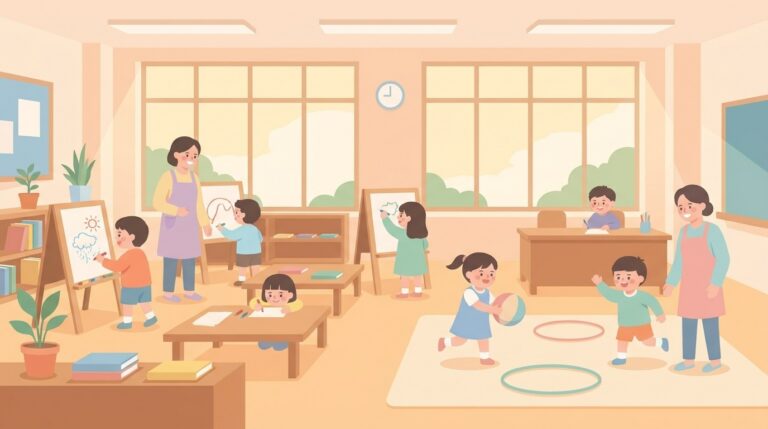
Phase 1: 공감 (Story Immersion Opening)
안녕하세요! 매일한글 에디터입니다.
Have you ever watched a K-drama like Crash Course in Romance (일타 스캔들) or Sky Castle (SKY 캐슬) and thought, “Are Korean parents really that obsessed with cram schools?” If you live in Korea or talk to Korean friends raising kids, you will quickly realize that the reality is just as intense. These days, there is even talk of “Elementary Med School Prep Tracks” (초등 의대반) and entry tests for 7-year-olds playfully dubbed the “7-year-old Civil Service Exam” (7세 고시).
For dual-income working parents (맞벌이 부부), this creates a painful dilemma. When classes finish at 1:00 PM for lower elementary grades, parents are still stuck at work until late afternoon or evening. Without family nearby, parents are often forced to enroll their seven-year-olds into a dizzying circuit of private academies—piano, taekwondo, English, math—just to keep them safe and supervised until mom or dad clocks out. That is where Korea’s newly expanded “Neulbom School” (늘봄학교) steps in, providing quality arts, sports, and after-school care right inside elementary schools until 8:00 PM.
In this guide, curated from real-life feedback from intermediate learners and working expat parents living in Seoul, you will master the cultural nuances and sophisticated B2-level Korean expressions surrounding childcare gaps, private education fever, and the ongoing public school reforms.
Phase 2: 핵심 표현 3선 심층 분석 (Core Expressions In-Depth)
1. 돌봄 공백을 채우다 (Dolbom gongbaegeul chaeuda)
- Pronunciation: [Dol-bom gong-baek-eul chae-u-da] (Think of ‘dol-bom’ like ‘doll-bomb’ with a soft ‘b’, meaning care)
- Meaning: Literal: “To fill the care vacuum” / Nuance: Bridging the critical childcare gap when parents are working and public supervision ends.
- K-Culture Moment: Seen in documentary programs and modern workplace dramas where working moms frantically check their smartwatches at 1:30 PM wondering who will watch their first-grader.
- Editor’s Insight: ‘돌봄’ refers to holistic physical and emotional care, while ‘공백’ means a blank space or vacuum. Using this phrase shows a deep appreciation of the systemic hurdles working couples face in Korea.
- Situation Spectrum: Casual: ⚠️ | Semi-formal: ✅ | Formal: ✅
- 🤔 Think About It: Does your native culture consider afternoon childcare a strictly private family duty, or a public community responsibility?
2. 학원 뺑뺑이를 돌리다 (Hagwon ppaengppaeng-ireul dollida)
- Pronunciation: [Hag-won ppaeng-ppaeng-i-reul dol-li-da] (Sound analogy: ‘Ppaeng-ppaeng’ sounds like a spinning top whizzing relentlessly in circles)
- Meaning: Literal: “To spin someone around the academy merry-go-round” / Nuance: Shuttling a child endlessly through a continuous relay of private cram schools.
- K-Culture Moment: Common in neighborhood talk shows and YouTube parenting vlogs when discussing the exhaustion of coordinating four different school shuttles every weekday.
- Editor’s Insight: The mimetic word ‘뺑뺑이’ implies dizzying, mechanical repetition. It carries a heavy touch of parental guilt and social critique rather than pride.
- Situation Spectrum: Casual: ✅ | Semi-formal: ✅ | Formal: 🚫
- 🤔 Think About It: How does language use playful or repetitive sounds (like 뺑뺑이) to cope with stressful cultural expectations?
3. 숨통이 트이다 (Sumtong-i teuida)
- Pronunciation: [Sum-tong-i teu-i-da] (Think: ‘Sum’ like ‘soom’, windpipe opening up)
- Meaning: Literal: “The windpipe opens up” / Nuance: To finally catch one’s breath; to feel tremendous relief from overwhelming pressure or financial/logistical burden.
- K-Culture Moment: The heartfelt sigh uttered by characters in family dramas when a neighborhood support network or government program relieves an urgent crisis.
- Editor’s Insight: While commonly translated as “to sigh with relief,” it specifically conveys transitioning from a state of near-suffocation to surviving. Perfect for discussing schedules or financial relief.
- Situation Spectrum: Casual: ✅ | Semi-formal: ✅ | Formal: ⚠️
- 🤔 Think About It: What physical sensations do native speakers in your language connect with sudden relief from stress?
Phase 3: 교과서 한국어 vs 진짜 한국어 (Textbook vs. Real Korean)
Situation 1: Explaining after-school schedules
- 📖 교과서 한국어: 방과 후에 여러 학원에 다닙니다. (Banggwa hue yeoreo hagwone danimnida. / “After school, the child attends multiple academies.”)
- 🗣️ 진짜 한국어: 맞벌이라 애를 학원 뺑뺑이 돌릴 수밖에 없었어요. (Mat-beol-ira aereul hagwon ppaengppaeng-i dollil subakke eopseosseoyo. / “Because we’re a dual-income couple, we had no choice but to run our kid through the hagwon circuit.”)
- 💡 왜 다를까?: Textbook Korean sounds neutral and robotic. Native parents use “맞벌이” (dual-income) and “학원 뺑뺑이” with “~ㄹ 수밖에 없다” to convey systemic inevitability and parental sympathy.
Situation 2: Expressing relief about Neulbom School
- 📖 교과서 한국어: 돌봄 프로그램 덕분에 걱정이 줄었습니다. (Dolbom peurogeuraem deokbune geokjeong-i jureosseumnida. / “Thanks to the care program, my worries decreased.”)
- 🗣️ 진짜 한국어: 늘봄학교 덕분에 이제야 숨통이 좀 트이네요. (Neulbomhakgyo deokbune ijeya sumtong-i jom teuineyo. / “Thanks to Neulbom School, we can finally catch our breath.”)
- 💡 왜 다를까?: Intermediate speakers elevate their emotional connection by substituting simple words like “걱정이 줄다” (worries decrease) with vivid somatic idioms like “숨통이 트이다”.
Phase 4: K-Culture 딥다이브 & 비언어적 매너 (Deep Dive & Non-Verbal Cues)
4-1. 눈치 (Nunchi) & Body Language
When discussing private education and Neulbom School with Korean parents or colleagues, sensitivity is paramount. Avoid boasting about elite academies or criticizing public initiatives outright.
* The Empathetic Sigh (공감의 한숨): When a colleague mentions picking up their child between meetings, let out a soft, sympathetic sigh and nod slowly (고개를 끄덕이며). This validates their exhaustion without prying.
* Open Palm Gesture: When mentioning governmental policies like 늘봄학교, use a flat, upward-tilted open hand rather than pointing fingers, signaling respect toward ongoing societal solutions.
4-2. Cultural Code Analysis: The “Neulbom” Evolution
The word “늘봄” is a poetic portmanteau of “늘” (always) and “봄” (spring), symbolizing a warm, spring-like environment available all day long. Historically, Korea’s elementary “돌봄교실” (care classes) had lottery systems with fierce competition, forcing parents toward private academies. By shifting to Neulbom School, the state aims to normalize public education and alleviate the notorious “초등 의대반” (elementary school medical school prep tracks) fever by keeping children engaged in robotics, violin, sports, and play on campus until dinner.
Phase 5: 실전 롤플레이 시나리오 (Interactive Roleplay Scenario)
Setting: A company coffee break area in Yeouido, Seoul.
Characters:
* Ji-won (이지원 과장): A senior manager and working mother with an 8-year-old entering first grade.
* Alex (알렉스 대리): A foreign colleague seeking to understand how Korean colleagues balance work and childrearing.
- Ji-won: 🎭 (Holding a lukewarm tumbler, massaging her temples)
알렉스 씨, 다음 달부터 초등학교 입학 시즌이라 머리가 너무 아파요.
(Alex-ssi, daeum dalbuteo chodeunghakgyo iphak sijeon-ira meoriga neomu apayo.)
“Alex, elementary school entrance season starts next month, and my head is pounding.” -
Alex: 🎭 (Offering a warm, attentive gaze)
아이 입학 준비 때문인가요? 무슨 일 있으세요?
(Ai iphak junbi ttaemun-ingayo? Museun il isseuseyo?)
“Is it because of school preparation? Is something going on?” -
Ji-won: 🎭 (Sighing quietly)
저희 부부 둘 다 맞벌이라 오후 1시 이후 돌봄 공백이 제일 걱정이었거든요.
(Jeohui bubu dul da mat-beol-ira ohu hansi ihu dolbom gongbaegeul jeil geokjeong-ieotgeodeunyo.)
“Since we’re both working, the childcare gap after 1:00 PM was our biggest worry.” -
Alex: 🎭 (Showing understanding with an inquisitive nod)
주변 분들은 보통 그 시간에 학원을 보낸다고 들었어요.
(Jubyeon bundeureun botong geu sigane hagwoneul bonaendago deureosseoyo.)
“I heard people around usually send their kids to academies at that time.” -
Ji-won: 🎭 (Frowning slightly with remorse)
맞아요. 다들 학원 뺑뺑이 돌린다는데, 일곱 살짜리한테 너무 가혹하잖아요.
(Majayo. Dadeul hagwon ppaengppaeng-i dollindaneunde, ilgop saljjarihante neomu gahokhajanayo.)
“Exactly. Everyone runs them through academy loops, but that’s too harsh for a seven-year-old.” -
Alex: 🎭 (Leaning in with a helpful tone)
이번에 학교에서 늘봄학교 신청하셨다고 하지 않으셨어요?
(Ibeone hakgyo-eseo neulbomhakgyo sincheonghasyeotdago haji aneusyeosseoyo?)
“Didn’t you say you applied for Neulbom School at the school this time?” -
Ji-won: 🎭 (Face brightening with palpable relief)
네! 다행히 선정돼서 저녁까지 질 높은 예체능 수업을 받게 됐어요.
(Ne! Dahaeanghi seonjeongdwaeseo jeonyeokkkaji jil nopeun yecheneung sueobeul batge dwaesseoyo.)
“Yes! Luckily we were selected, so my kid gets quality arts and sports classes until evening.” -
Alex: 🎭 (Smiling warmly with two thumbs up)
정말 다행이네요! 이제 한시름 놓고 숨통이 좀 트이시겠어요.
(Jeongmal dahaeng-ineyo! Ije hansireum noko sumtong-i jom teuisigesseoyo.)
“What a relief! Now you can put your worries aside and catch your breath.”
🔀 인터랙티브 분기점 (Interactive Branching Point)
Imagine Ji-won tells you: “늘봄학교 덕분에 학원비 부담도 많이 줄 것 같아요.” (Thanks to Neulbom School, the burden of academy fees will drop a lot.) How do you respond?
- Choice A: “그래도 남들처럼 초등 의대반 학원은 보내셔야 안 뒤처지지 않을까요?”
(Risk: Highly insensitive! It triggers peer anxiety and reinforces excessive competition.) - Choice B: “공교육에서 돌봄을 든든하게 받쳐주니 정말 다행이에요. 과장님도 부담 덜으셨네요!”
(Best: Empathic, supportive, highlights the normalization of public education smoothly!) - Choice C: “학원 안 보내면 아이가 공부를 아예 안 할 텐데요.”
(Bad: Blunt and dismissive of the child’s holistic wellbeing and extracurricular growth.)
Phase 6: 10초 감정 섀도잉 드릴 (10-Second Shadowing Drill)
Practice these emotional cadences out loud. Pause briefly at the slashes (/).
[😮💨 안도하며 차분하게 - Relieved & calm]
늘봄학교 덕분에 / 이제야 숨통이 좀 트여요.
(Neulbomhakgyo deokbune / ijeya sumtong-i jom teu-yeoyo.)
“Thanks to Neulbom School, / I can finally breathe a sigh of relief.”-
[🥺 공감하며 걱정스럽게 - Empathetic & concerned]
맞벌이 부부에게는 / 방과 후 돌봄 공백이 / 가장 큰 고민이죠.
(Mat-beol-i bubu-egeneun / bang-gwa hu dolbom gong-baek-i / gajang keun gomin-ijyo.)
“For working couples, / the after-school childcare gap / is the biggest dilemma.” -
[💪 확신을 담아 격려하듯 - Confident & encouraging]
학원 뺑뺑이 대신 / 학교에서 안전하게 배울 수 있어서 / 참 다행이에요.
(Hagwon ppaengppaeng-i daesin / hakgyo-eseo anjeonhage bae-ul su isseoseo / cham dahaeng-ieyo.)
“Instead of academy shuttles, / being able to learn safely at school / is such a blessing.”
Phase 7: K-Culture 미니 사전 (Mini Dictionary)
- 늘봄학교 (Neulbom-hakgyo) | Neulbom School (Extended Care & Education)
A comprehensive state-run elementary program providing integrated care, arts, physical education, and academic mentoring until 8:00 PM for working families. - 사교육비 (Sagyo-yuk-bi) | Private Education Expenses
The monthly household expenditure dedicated to private academies (hagwons), tutoring, and extracurricular prep. - 돌봄 공백 (Dolbom Gong-baek) | Care Gap / Childcare Void
The critical time window between when children are dismissed from school and when working parents return home. - 학원 뺑뺑이 (Hagwon Ppaeng-ppaeng-i) | Hagwon Circuit / Cram School Carousel
A colloquial term illustrating children being shuttled from one private academy to another throughout the afternoon without rest.
Phase 8: 여행자를 위한 생존 키트 (Living & Travel Survival Kit)
Top 3 Practical Expressions
- 늘봄학교 신청 기간이 언제인가요?
(Neulbomhakgyo sincheong gigani eonje-ingayo?)
Pro Tip: Use this at the school administrative office (행정실) when confirming application windows. - 저녁 돌봄 프로그램도 지원되나요?
(Jeonyeok dolbom peurogeuraemdo jiwondoenayo?)
Pro Tip: Essential for parents who work past 5:00 PM to verify dinner support and extended hours. - 하교 안심 알림 서비스 등록하고 싶어요.
(Hagyo ansim allim seobiseu deungnokhago sipeoyo.)
Pro Tip: Sets up automated SMS notifications sent to parents when their child swipes their ID card at school gates.
Editor’s Living Note
If you reside in Korea with school-age dependents, bookmark the 정부24 포털 사이트 바로가기 to manage family registrations and verify local educational district notices directly. Furthermore, download the Kakao T app to summon verified local taxis if you ever experience an emergency schedule clash before after-school pickup.
Phase 9: “한 발 더 깊이” (Deep Reflection Essay)
Korea’s relentless private education fever is often portrayed abroad merely as hyper-competitiveness, but beneath the surface lies a structural dilemma of urban working life. When both parents work long hours in competitive industries, private academies historically served as the only reliable social surrogate for childcare. Neulbom School represents an ambitious cultural pivot: attempting to shift childcare back into community-centered public spaces. By prioritizing high-quality play and creative arts over endless test preparation, society is actively questioning what a healthy childhood should look like.
💬 Your Turn: How does your home country balance long working hours with public childcare? Share your perspective in the comments below!
Phase 10: FAQ & 오해 방지 (FAQ Schema & Common Mistakes)
Q: Is Neulbom School only for low-income families?
A: No. Unlike previous welfare-restricted after-school programs, Neulbom School is designed universally for all elementary school students—especially first-graders—regardless of parental income, specifically to eliminate care gaps.
Q: Does Neulbom School focus purely on homework and cramming?
A: On the contrary. Neulbom emphasizes customized extracurriculars including coding, orchestra instruments, traditional percussion, sports, and developmental play rather than rote test prep.
Q: Can foreign residents in Korea enroll their children in Neulbom School?
A: Yes, foreign nationals whose children are officially registered and enrolled in Korean public elementary schools can apply through standard school notices.
🚨 흔한 실수 (Common Mistakes) Top 3
- Mistake: Confusing 사교육 (private education) with 공교육 (public education).
- Correct Action: Remember that “사” (私) stands for private/individual, while “공” (公) stands for public/community.
- Mistake: Pronouncing 숨통이 트이다 as separate disconnected sounds.
- Correct Action: Apply natural resyllabification: say [숨통이 트이다 -> sum-tong-i teu-i-da], ensuring smooth, uninterrupted breath.
- Mistake: Using 학원 뺑뺑이 in formal school interviews or formal emails to teachers.
- Correct Action: Keep “학원 뺑뺑이” for casual peers; in formal contexts, say “과도한 사교육 일정” (excessive private education schedule).
Phase 11: 액션 미션 & 참여 유도 (Action Missions)
- 🥉 Bronze Mission: Pronounce 돌봄 공백을 채우다 and 숨통이 트이다 five times each using the shadowing rhythm in Phase 6.
- 🥈 Silver Mission: Write a one-sentence Korean comment below describing your schedule using the grammar pattern “~ 덕분에 숨통이 트여요”.
- 🥇 Gold Mission: Mention 늘봄학교 or 사교육 부담 in your next Korean language exchange meetup when discussing work-life balance.
- 🎮 K-Culture Mission: Watch an episode of a modern family K-Drama (such as Green Mothers’ Club or Crash Course in Romance) and spot moments where parents rush between hagwon schedules.
Phase 12: 인터랙티브 퀴즈 챌린지 (Interactive Quiz)
Q1. 빈칸 채우기 (Fill in the blank):
맞벌이 부부의 퇴근 전 ( )을/를 해결하기 위해 늘봄학교가 확대되고 있다.
(To solve working couples’ [ ] before getting off work, Neulbom schools are expanding.)
① 사교육비
② 돌봄 공백
③ 7세 고시
👉 정답 및 해설 확인하기 (Click to reveal answer)
정답: ② 돌봄 공백 (Care gap)
해설: The primary operational objective of Neulbom School is to close the unsupervised afternoon care vacuum (돌봄 공백) for working parents.
Q2. 상황 판단 (Nuance Check):
Which phrase naturally expresses finding relief from financial or parenting stress?
① 숨통이 트이다
② 학원 뺑뺑이를 돌리다
③ 7세 고시를 치르다
👉 정답 및 해설 확인하기 (Click to reveal answer)
정답: ① 숨통이 트이다 (Catching one’s breath / finding relief)
해설: ‘숨통이 트이다’ literally means opening up the airway, figuratively describing relief from overwhelming pressure.
Q3. True or False 문화 퀴즈:
Neulbom School only accepts students until 3:00 PM and offers no dinner care options. (True / False)
👉 정답 및 해설 확인하기 (Click to reveal answer)
정답: False
해설: Neulbom School can extend services up to 8:00 PM, providing evening care and engaging programs to accommodate late-working parents.
🎬 Watch Our Daily Videos! (Daily Hangul Official Instagram)
Review the expressions you learned in this article with our fun daily short videos! Check out native pronunciation and real-life nuances in action.
- Instagram @dailyhangul_en







