

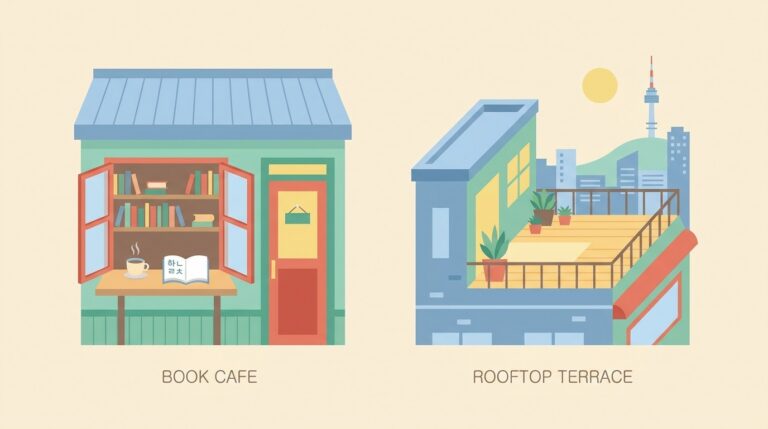
Korea’s Unique Cafe Culture: Finding Your Perfect Spot from Quiet Study Nooks to Scenic Rooftops
Phase 1: Empathy (A Warm Welcome from Your Seoul Bestie)
안녕하세요! 매일한글 에디터입니다. (Annyeonghaseyo! It’s your Daily Hangul editor.)
Picture this: You step out of Hongik University Station on a crisp Saturday afternoon. Your laptop is tucked into your bag, you’re craving an iced Americano, and you want to finish your Korean homework. But as you walk down the alleyway, you are greeted by an overwhelming lineup: a dimly lit 3-story quiet book cafe, a neon-lit 24-hour unmanned robot cafe, an aesthetic rooftop cafe overlooking the Han River, and a massive mega-bakery warehouse cafe bustling with families.
Many of my intermediate learners tell me: “I know how to order an Americano, but I have no idea how to explain what kind of cafe vibe I want to my Korean friends!” Or worse, they accidentally sit in a silent study cafe (kagong spot) and start chatting loudly with a friend, earning subtle sideways glances from university students cramming for midterms.
Korea boasts the highest number of cafes per capita in the world. Cafes here are not just places to grab coffee; they are our living rooms, study halls, meeting rooms, and scenic escapes. In this lesson, designed around real learner feedback, you will master the intermediate (B1) Korean expressions that allow you to express your mood, choose the ideal cafe atmosphere, and navigate Korea’s vibrant cafe terrain with effortless confidence.
Phase 2: Core Expressions for Cafe Explorers
1. 취향대로 골라 갈 수 있어서 좋아요 (Chwihyangdaero golla gal su isseoseo joayo)
- Pronunciation: chwee-hyang-dae-ro gol-la gal su ee-sseo-seo jo-ah-yo (Think of “chwee” whistling past, followed by “hyang” like herbal tea).
- Meaning: Literal: “Because we can pick according to our taste, it is good.” / Nuance: “It’s fantastic that we have so many options to match whatever mood or preference we have today.”
- K-Culture Moment: You’ll hear this in K-dramas when coworkers or friends debate where to hang out after work and marvel at the endless unique spots in Seongsu-dong or Yeonnam-dong.
- Editor’s Insight: The suffix
-대로(-daero) means “according to” or “as one wishes.” Pair it with취향(taste/preference) or기분(mood:기분대로) to instantly sound like a thoughtful speaker. - Situation Spectrum: Casual (✅ with friends:
취향대로 골라 갈 수 있어서 좋아), Semi-formal (✅취향대로 골라 갈 수 있어서 좋아요), Formal (⚠️취향에 맞춰 선택할 수 있어 좋습니다). - 🤔 Think About It: In English, we often say “There’s something for everyone.” How does the Korean focus on “choosing according to taste” emphasize personal agency within a shared social outing?
2. 분위기 좋은 루프탑으로 갈까요? (Bunwigi joeun rupeutabeuro galkkayo?)
- Pronunciation: boon-wee-gi jo-eun roo-peu-tap-eu-ro gal-kka-yo (Sounds like “boon” as in bonus + “wee-gi” as in weekend).
- Meaning: Literal: “Shall we go to a rooftop with a good atmosphere?” / Nuance: “How about heading up to a scenic rooftop cafe with great vibes?”
- K-Culture Moment: Seen in romantic variety shows like Single’s Inferno or Heart Signal when a couple transitions from daylight strolls to evening cafe dates overlooking Seoul’s sparkling skyline.
- Editor’s Insight:
분위기(bunwigi) translates to mood, atmosphere, or vibe. When combined with-(으)ㄹ까요?, it creates a gentle, polite suggestion that invites your companion’s opinion without pressuring them. - Situation Spectrum: Casual (✅
분위기 좋은 루프탑 갈래?), Semi-formal (✅분위기 좋은 루프탑으로 갈까요?), Formal (⚠️분위기 좋은 옥상 라운지로 이동하시겠습니까?). - 🤔 Think About It: Notice how the loanword
루프탑(rooftop) has completely integrated into daily Korean to describe trendy open-air cafes. Does your native language adopt loanwords to signal trendy youth lifestyle concepts?
3. 여기 카공하기 딱 좋아요 (Yeogi kagonghagi ttak joayo)
- Pronunciation: yeo-gi kah-gong-ha-gi ttahk jo-ah-yo (The word
딱has a crisp double “tt” snap, like a sharp finger snap). - Meaning: Literal: “This place is just right to do cafe-study.” / Nuance: “This spot is literally perfect for studying on your laptop.”
- K-Culture Moment: Used constantly by university students in Sinchon or Hyehwa when recommending quiet study cafes with plenty of electrical outlets and fast Wi-Fi.
- Editor’s Insight:
카공(kagong) is a portmanteau of카페(cafe) and공부(studying). The adverb딱(ttak) adds the punchy feeling of “hitting the bullseye” or being “exactly tailored.” - Situation Spectrum: Casual (✅
여기 카공하기 딱 좋아), Semi-formal (✅여기 카공하기 딱 좋아요), Formal (🚫 Avoid in formal academic essays; use카페에서 학습하기에 적합합니다). - 🤔 Think About It: Why do you think Korean society coined an entire compound noun (
카공족) for people who study in cafes? What does it reveal about living spaces and academic intensity in Korea?
Phase 3: Textbook Korean vs. Real Korean
Situation 1: Deciding on a study spot
- 📖 교과서 한국어 (Textbook Korean): 저는 오늘 공부를 하기 위해 조용한 카페에 가고 싶습니다. (Jeoneun oneul gongbureul hagi wihae joyonghan kape-e gago sipseumnida. / “I want to go to a quiet cafe to study today.”)
- 🗣️ 진짜 한국어 (Real Native Korean): 오늘 집중 좀 해야 해서 카공하기 좋은 북카페로 가려고요. (Oneul jipjung jom haeya haeseo kagonghagi joeun bukkapero garyeogoyo. / “I need to concentrate today, so I’m heading to a book cafe that’s great for studying.”)
- 💡 왜 다를까? (Why the difference?): Native speakers rarely say “I want to go to… in order to do study.” Instead, they state the condition (
집중 좀 해야 해서– needing focus) and use contemporary slang like카공하기 좋은coupled with the specific cafe genre (북카페).
Situation 2: Praising the cafe view
- 📖 교과서 한국어 (Textbook Korean): 이 카페는 창문 밖 풍경이 아주 아름답습니다. (I kapeneun changmun bakk punggyeongi aju areumdapseumnida. / “This cafe has a very beautiful scenery outside the window.”)
- 🗣️ 진짜 한국어 (Real Native Korean): 여기 통창 뷰 대박이다! 완전 뷰 맛집이네. (Yeogi tongchang byu daebagida! Wanjeon byu matjibine. / “The floor-to-ceiling window view is insane! It’s an absolute scenery hotspot.”)
- 💡 왜 다를까? (Why the difference?): In modern cafe culture,
풍경sounds poetic or old-fashioned. Koreans borrow “View” (뷰) and tag it onto맛집(restaurant famous for good food) to describe any spot with breathtaking vistas:뷰 맛집!
Phase 4: K-Culture Deep Dive & Non-Verbal Etiquette
4-1. 눈치 (Nunchi) & Cafe Etiquette
- Reading the Room (카페 분위기 파악): Before pulling out your laptop and three chargers, scan the space. If you see gentle jazz, soft seating without plugs, and people laughing enthusiastically, it is a social cafe. Forcing quiet or occupying a 4-person table solo here violates nunchi.
- The Laptop Leaving Ritual: You may see Koreans leave their MacBooks, phones, and leather bags on tables while ordering or visiting the restroom. While Korea has remarkable public safety, as a traveler, leave a notebook, coat, or umbrella to hold your seat (
자리 맡기) rather than enticing high-value electronics. - 1인 1음료 (One Drink Per Person): Almost all independent cafes require every seated customer to order at least one beverage. Ordering one latte and sharing a table between two people is considered bad cafe etiquette.
4-2. Cultural Code Analysis: The Evolution of Korea’s “Third Place”
In Ray Oldenburg’s sociological concept of the “Third Place” (spaces distinct from home and work), Korean cafes stand out in a fascinating way. Due to high-density apartment living and shared family homes, young adults historically lacked private leisure spaces. Enter the cafe revolution.
Today, cafes are segmented with surgical precision:
* 카공 카페 (Study Cafes): Equipped with individual carrels, desk lamps, and dual outlets per seat.
* 대형 베이커리 카페 (Mega Bakery Cafes): Suburban destination cafes spanning several floors with botanical gardens, art exhibits, and dozens of fresh pastries, designed for weekend road trips.
* 무인 카페 (Unmanned Cafes): Automated 24-hour spots with barista kiosks, offering cheap coffee with zero social pressure.
Phase 5: Real-Life Roleplay Scenario
Setting: Outside Mangwon Station on a sunny Sunday. You are meeting Minho (민호), your Korean language exchange partner.
- Characters:
- 민호 (Minho): Trendy Seoulite who loves hunting hidden rooftop spots.
- You (학습자): Intermediate Korean learner who wants to balance light study with aesthetic vibes.
[Dialogue]
1. 민호: 벌써 도착했네! 오늘 날씨 진짜 좋다. 어떤 카페 가고 싶어? (Beolsseo dochakhaenne! Oneul nalssi jinjja jota. Eotteon kape gago sipeo?)
🎭 Smiling brightly and checking his phone map.
“You’re already here! The weather is so nice today. What kind of cafe do you want to go to?”
- You: 날씨가 좋으니까 야외 테라스나 루프탑 카페로 갈까요? (Nalssiga joeunikka ya-oe teraseuna rupeutap kapero galkkayo?)
🎭 Pointing toward the sunny skyline with anticipation.
“Since the weather is lovely, shall we go to an outdoor terrace or rooftop cafe?” -
민호: 오, 좋은 생각이야! 근데 너 오늘 한국어 숙제도 조금 해야 한다고 하지 않았어? (O, joeun saenggagiya! Geunde neo oneul hangugeo sukjedo jogeum haeya handago haji anasseo?)
🎭 Tilting his head thoughtfully.
“Oh, great idea! But didn’t you mention you needed to do some Korean homework today too?” -
You: 맞아요. 그래서 너무 시끄럽지 않고 뷰도 예쁜 곳이면 좋겠어요. (Majayo. Geuraeseo neomu sikkeureopji anko byudo yeoppeun gosimyeon jokesseoyo.)
🎭 Showing a friendly smile while opening your backpack lightly.
“That’s right. So it would be great if it’s not too noisy and also has a pretty view.” -
민호: 아, 망원동 쪽에 한강 뷰 보이면서 조용한 루프탑 북카페가 딱 하나 있어! (A, Mangwon-dong jjoge Hangang byu bo-imyeonseo joyonghan rupeutap bukkapega ttak hana isseo!)
🎭 Eyes lighting up as he zooms in on his map.
“Ah, over by Mangwon-dong there’s exactly one quiet rooftop book cafe with a Han River view!” -
You: 와, 대박! 내 기분과 목적에 딱 맞는 곳이네요. 취향대로 골라 갈 수 있어서 정말 행복해요! (Wa, daebak! Nae gibungwa mokjeoge ttak manneun gosineyo. Chwihyangdaero golla gal su isseoseo jeongmal haengbokhaeyo!)
🎭 Clapping hands together gently in excitement.
“Wow, amazing! That fits my mood and purpose perfectly. It’s so nice that we can pick according to our taste!” -
민호: 주말이라 자리 없을 수도 있으니까 얼른 걸어가 보자. (Jumarira jari eopseul sudo isseunikka eolleun georeo-ga boja.)
🎭 Walking ahead with a brisk, cheerful step.
*”Since it’s the weekend, there might not be seats, so let’s walk fast.” -
You: 네, 좋아요! 시원한 아바라(아이스 바닐라 라떼) 마시면서 힐링해요. (Ne, joayo! Siwonhan abara masimyeonseo hillinghaeyo.)
🎭 Matching his pace with a bright grin.
“Yes, sounds great! Let’s heal while sipping an iced vanilla latte!”
🔀 Interactive Decision Point!
You arrive at the cafe, but every table on the rooftop terrace is full. There are only two desks left inside on the 2nd-floor quiet study zone where people are wearing headphones.
- Option A: “야, 그냥 옥상에 서서 마시자! 뷰가 아깝잖아.” (Hey, let’s just stand on the roof and drink! The view is too good to waste.)
- Option B: “2층 자리에 앉아서 숙제 먼저 하고, 루프탑에 자리 나면 옮길까요?” (Shall we sit on the 2nd floor, do homework first, and move to the rooftop if a seat opens up?)
- Option C: “여기 너무 조용해서 말도 못 하겠네. 그냥 아무 데나 다른 데 가자.” (It’s so quiet here we can’t even speak. Let’s just leave for anywhere else.)
Feedback:
* Option A [Risk]: Rooftop cafes with narrow railings usually prohibit standing drinks due to safety and wind regulations, and your study session will be ruined.
* Option B [Best]: Polite, highly practical, and shows great situational flexibility (nunchi). Korean cafes easily allow switching tables once someone leaves!
* Option C [Bad]: A bit abrupt and dismissive of Minho’s effort to research the cafe. Suggesting a compromise first is much better manners.
Phase 6: 10-Second Emotion Shadowing Drill
Train your musical intonation with slash marks (/) for breath breaks and emotion cues.
[😊 감탄하며 신나게 - Delighted and excited]
“취향대로 / 골라 갈 수 있어서 / 너무 좋아요!”
(Chwihyangdaero / golla gal su isseoseo / neomu joayo!
“Because we can choose according to our taste / I like it so much!”)-
[🤔 기분 좋게 제안하며 - Thoughtfully suggesting]
“오늘 날씨도 좋은데, / 뷰 맛집 루프탑으로 / 갈까요?”
(Oneul nalssido joeunde, / byu matjip rupeutabeuro / galkkayo?
“The weather is nice today too, / so shall we go / to a rooftop scenic hotspot?”) -
[💡 깨달음을 얻으며 확신에 차서 - Confident & satisfied discovery]
“콘센트도 많고 조용해서 / 여기 카공하기 / 딱 좋아요!”
(Konsenteudo manko joyonghaeseo / yeogi kagonghagi / ttak joayo!
“There are plenty of outlets and it’s quiet, / so it’s literally perfect / for studying here!”)
Phase 7: K-Culture Mini Dictionary
- 카공족 (Kagongjok) | Cafe Studier Tribe
- Combines 카페 (Cafe), 공부 (Study), and 족 (Clan/Tribe). Refers to students or remote workers who set up their workspace in cafes for hours.
- 물멍 / 숲멍 (Mulmeong / Supmeong) | Water-dazing / Forest-dazing
- Derives from
멍때리다(to space out peacefully). Many scenic Korean mega-cafes market themselves by the view: water views for물멍or lush greenery for숲멍.
- Derives from
- 뷰 맛집 (Byu Matjip) | View Hotspot
- Literally “delicious view restaurant.” Used metaphorically for cafes with panoramic oceans, mountain vistas, or city nightscapes.
- 1인 1음료 (Irin Il-eumryo) | One Drink Per Customer Rule
- The golden standard policy written at Korean cafe counters. Even if you buy an expensive dessert, you must still purchase one beverage per seated guest.
Phase 8: Traveler’s Survival Kit
Top 3 Survival Expressions
- 와이파이 비밀번호가 뭐예요? (Wa-i-pa-i bimilbeonhoga mwoyeyo?)
- Pro Tip: Before asking the barista, look at the bottom of your printed paper receipt or at the counter napkins. 90% of the time, the Wi-Fi ID and password (
PW) are printed right on your receipt!
- Pro Tip: Before asking the barista, look at the bottom of your printed paper receipt or at the counter napkins. 90% of the time, the Wi-Fi ID and password (
- 콘센트 있는 자리 있어요? (Konsenteu inneun jari isseoyo?)
- Pro Tip: In Korean, electrical wall plugs are called
콘센트(from concentric plug). Asking this helps you locate seats suited for laptops.
- Pro Tip: In Korean, electrical wall plugs are called
- 남은 음료 테이크아웃 잔에 담아주실 수 있나요? (Nameun eumryo teikeu-aut jane dam-ajusil su innayo?)
- Pro Tip: By Korean environmental law, you cannot drink from single-use plastic cups inside a cafe. But if you are leaving, they will happily transfer your remaining drink to a takeout cup for you!
Editor’s Travel Note
Always install the Naver Map app download for smart navigation. Unlike Google Maps, Naver Map lists cafe interior photos, indicates whether outlets are accessible, displays Instagram links, and even clarifies if pets or children are allowed (노키즈존 / No Kids Zone).
Phase 9: One Step Deeper (한 발 더 깊이)
In Western cafe traditions, the European salon was a birthplace for political debate and literature, while American cafe chains standardized grab-and-go espresso culture. In Korea, however, the cafe became a vital architectural extension of domestic space. When individual living quarters are compact, visiting a multi-story cafe with floor-to-ceiling windows offers psychological breathing room (kaesim). Choosing a cafe based on your specific mood today is not just about caffeine; it is a micro-vacation tailored to your emotional well-being.
💬 Your Turn: What does your ideal cafe vibe look like when you travel? Do you prefer a vibrant open-air rooftop, a quiet reading den, or a bustling bakery? Leave a comment below using the phrase 취향대로 골라 갈 수 있어서 좋아요!
Phase 10: FAQ & Common Mistakes
Q: Can I study at any cafe in Korea as long as I buy coffee?
A: Not necessarily! While franchise cafes (like Twosome Place or Hollys) welcome cafe studiers and provide charging hubs, many small designer cafes in neighborhoods like Seongsu or Hannam-dong have low tables with no electrical outlets and request a 1.5 or 2-hour maximum stay during peak weekend times.
Q: What is an unmanned cafe (무인 카페), and how do I use it?
A: An unmanned cafe operates 24/7 without on-site staff. You select your drink on a touchscreen kiosk, swipe your credit or debit card, grab a cup from the automated dispenser, place it under the ice maker, and then move it under the coffee spout. They are cheap, super clean, and perfect for undisturbed quiet time.
Q: Why did the barista ask if I am drinking here or taking it out?
A: Korea strictly enforces single-use plastic bans inside dine-in spaces. If you say 먹고 갈게요 (I will drink here), you will receive a glass or mug. If you say 테이크아웃이요 (Takeout), you must take the plastic cup out of the store immediately.
🚨 Common Mistakes Alert
- Mistake: Throwing away the printed receipt immediately.
- Correct Action: Keep the receipt! It often contains the door passcode to the restroom (
화장실 비번) and the Wi-Fi password.
- Correct Action: Keep the receipt! It often contains the door passcode to the restroom (
- Mistake: Leaving dirty trays and mugs on table tops when leaving.
- Correct Action: Return your cups and trays to the counter drop-off station labeled
반납대(Bannapdae) orReturn.
- Correct Action: Return your cups and trays to the counter drop-off station labeled
- Mistake: Speaking on speakerphone or watching videos without earphones in a quiet cafe.
- Correct Action: Keep personal audio private. In Korean cafes, personal volume etiquette is strictly observed.
Phase 11: Action Missions
- 🥉 Bronze Mission (Solo Practice): Say aloud 3 times with emotional inflection:
분위기 좋은 루프탑으로 갈까요? - 🥈 Silver Mission (Social Media): Post a photo of your local coffee spot on Instagram or Threads and caption it in Korean:
오늘 내 취향대로 고른 카페! 카공하기 딱 좋아요. - 🥇 Gold Mission (Real-world Challenge): Next time you visit a cafe or order in Korean, ask the barista:
남은 음료 테이크아웃 잔에 담아주실 수 있나요? - 🎮 K-Culture Mission: Watch an episode of a Seoul-based K-drama (like Record of Youth or Crash Landing on You) and spot which type of cafe the characters meet in. Is it a mega-bakery, a vintage hanok cafe, or a neighborhood study hub?
Phase 12: Interactive Quiz Challenge
1. Situational Judgment:
You want to spend 3 hours working on your laptop with your charger plugged in. Which cafe is the best fit?
* (A) A trendy hip cafe with tiny knee-height round tables and loud EDM music.
* (B) A book cafe (북카페) or a university branch cafe with individual desk outlets.
* (C) A crowded traditional tea house with floor cushions.
Click to reveal answer
Answer: (B)
Explanation: Book cafes and cafes near universities are intentionally tailored for 카공족 with high desks, stable Wi-Fi, and multiple outlets. Small trendy aesthetic cafes often design tables intentionally low to discourage long laptop sessions.
2. Fill-in-the-Blank:
Complete the sentence meaning: “This spot is literally perfect for studying at a cafe!”
* “여기 ________하기 ________ 좋아요!”
Click to reveal answer
Answer: 카공 / 딱
Full Sentence: 여기 카공하기 딱 좋아요! (Yeogi kagonghagi ttak joayo!)
3. True or False Cultural Quiz:
In Korea, it is culturally acceptable to purchase one beverage for a party of three people as long as you also order a small macaron dessert.
* [True / False]
Click to reveal answer
Answer: False
Explanation: The standard cafe etiquette across Korea is 1인 1음료 (1 drink per person). Desserts are considered additional sides rather than drink substitutes at most cafes unless specifically noted on the menu board.
🎬 Watch Our Daily Videos! (Daily Hangul Official Instagram)
Review the expressions you learned in this article with our fun daily short videos! Check out native pronunciation and real-life nuances in action.
- Instagram @dailyhangul_en







