

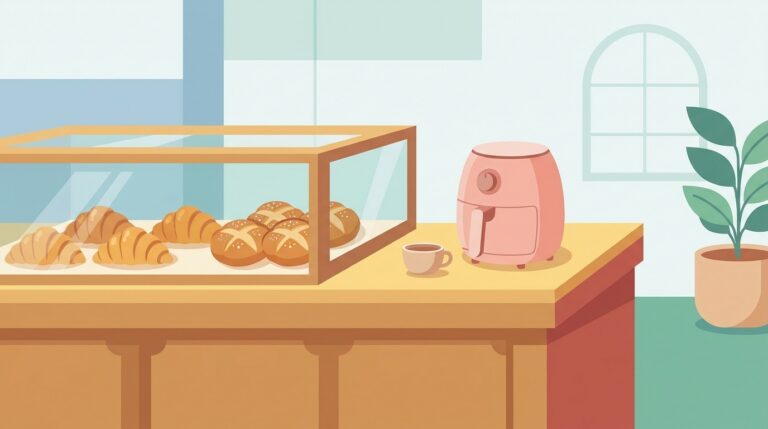
Don’t Let Good Bread Go Cold: The Korean Secret to Bakery Leftovers
Phase 1: Empathy (Story-Driven Opening)
안녕하세요! 매일한글 에디터입니다. (Hello! This is your Daily Hangul editor.)
Picture this: You are wandering through the aesthetic alleyways of Yeonnam-dong or Seongsu-dong on a crisp afternoon. The irresistible aroma of caramelized butter and warm yeast lures you straight into a trendy local bakery. Before you know it, your tray is piled high with famous Korean sogeum-ppang (salt bread), garlic cream cheese baguettes, and flaky red-bean pastries. But as you hand over your tray at the cash register, the friendly clerk smiles, wraps your pastries, and delivers a quick, polite piece of advice ending in “…eeopeurai-eo-e saljjak guwo deuseyo!”
You freeze for a second, nod politely, and leave wondering: Wait, did they just give me cooking instructions for bread I already bought?
You are definitely not alone! Many Korean learners feel confident saying basic greetings, but when a cashier starts giving spontaneous after-care advice for food, panic sets in. In Korea, visiting bakeries—a cultural phenomenon known as pangji-sunrye (bakery pilgrimage)—comes with its own warm rhythm of communication. Today, we are breaking down everything you need to understand friendly bakery staff, save your leftover treats, and talk about your favorite pastries like a seasoned local. This guide is crafted directly from real-life interactions and beginner learner queries, giving you instant confidence for your next cafe hop!
Phase 2: 3 Core Expressions Deep-Dive
1. 남은 빵은 집에서 에어프라이어에 살짝 구워 드세요 (Nameun ppangeun jibeseo eeopeurai-eoe saljjak guwo deuseyo)
- Pronunciation: [Na-meun ppang-eun ji-be-seo e-o-peu-ra-i-eo-e sal-jjak gu-wo deu-se-yo] (Sounds like: “Nah-moon ppahng-oon jee-beh-saw air-fryer-eh sahl-jjak goo-waw dew-seh-yo”)
- Meaning:
- Literal: Leftover bread, at home, in the air fryer, lightly bake and eat please.
- Real Nuance: “Be sure to lightly reheat any leftover bread in your air fryer at home for the best taste!”
- K-Culture Moment: You will hear this in trendy artisan bakeries in Seoul when purchasing buttery viennoiseries or croissants. Staff genuinely want you to experience the pastry’s intended crispiness rather than eating soggy bread tomorrow.
- Editor’s Insight: The word 살짝 (saljjak) means “lightly” or “briefly.” Koreans use it constantly in cooking tips (e.g., “살짝 데치세요” / blanch lightly). The verb ending -세요 (-seyo) makes this a gentle, polite recommendation rather than a stiff command.
- Situation Spectrum:
- Casual: ⚠️ (Sounds too formal for close friends)
- Semi-formal / Polite: ✅ (Standard customer service & polite advice)
- Formal: ✅ (Used in public announcements or cooking manuals)
- 🤔 Think About It: In many Western bakeries, once bread is bagged, the transaction ends. Why do Korean bakeries go out of their way to tell you how to store and reheat it at home? It reflects a deep culinary care: providing good food isn’t just about selling; it’s about making sure you enjoy it to the very last bite.
2. 포장해 드릴까요? (Pojanghae deurilkkayo?)
- Pronunciation: [Po-jang-hae deu-ril-kka-yo?] (Sounds like: “Po-jahng-hae dew-reel-kkah-yo?”)
- Meaning:
- Literal: Shall I pack/wrap it for you?
- Real Nuance: “Would you like this to go?” or “Shall I wrap this for takeout?”
- K-Culture Moment: Seen in countless slice-of-life K-Dramas where the protagonist drops by a neighborhood cafe before visiting a friend’s house.
- Editor’s Insight: 포장 (pojang) means packaging or takeout. The verb ending -드릴까요? (-deurilkkayo?) is the humble, polite form of offering help (Shall I do [something] for you?). If you want to eat inside the cafe, you can reply: “먹고 갈게요” (Meokgo galgeyo – I will eat here).
- Situation Spectrum:
- Casual: 🚫 (Do not say to your buddies)
- Semi-formal: ✅ (Everyday service standard)
- Formal: ✅ (Business and retail)
- 🤔 Think About It: In English, we simply say “To stay or to go?” Notice how the Korean expression frames the action as doing a courteous service for you (“Shall I wrap it for you?”).
3. 바로 드실 거예요? (Baro deusil geoyeyo?)
- Pronunciation: [Ba-ro deu-sil geo-ye-yo?] (Sounds like: “Bah-roh dew-sheel gaw-yeh-yo?”)
- Meaning:
- Literal: Are you going to eat it immediately?
- Real Nuance: “Are you planning to eat this right away?”
- K-Culture Moment: When buying warm garlic toast or cream-filled pastries, the clerk asks this to decide whether to cut the bread into bite-sized pieces or pack plastic cutlery and an ice pack.
- Editor’s Insight: 바로 (baro) means “right away” or “immediately.” 드시다 (deusida) is the honorific form of 먹다 (meokda), meaning “to eat.” If you plan to eat right away, just say: “네, 바로 먹을게요!” (Ne, baro meogeulgeyo! / Yes, I will eat it right away!).
- Situation Spectrum:
- Casual: 🚫 (Too formal for friends)
- Semi-formal: ✅ (Typical cafe question)
- Formal: ✅ (Hospitality industry standard)
- 🤔 Think About It: Honorific verbs like 드시다 (deusida) elevate the listener. By mastering this verb in A2, you instantly spot when service staff are honoring your choices!
Phase 3: Textbook Korean vs. Real Korean
Situation 1: Telling the clerk you want the leftovers wrapped to take home
- 📖 교과서 한국어 (Textbook): 남은 빵을 비닐봉지에 넣어 주십시오. (Nameun ppangeul binilbongjie neoeo jusipsio. / Please put the remaining bread into a plastic bag.)
- 🗣️ 진짜 한국어 (Real-world): 남은 거 포장해 주세요. (Nameun geo pojanghae juseyo. / Please wrap the leftovers to go.)
- 💡 왜 다를까? (Why the difference?): Nobody uses the stiff, military-style -십시오 (-sipsio) at a casual dessert bakery! Replacing complex vocabulary like 비닐봉지 (plastic bag) with the practical verb 포장하다 (to package/wrap) makes you sound natural, concise, and modern.
Situation 2: Asking if you can reheat the bread later
- 📖 교과서 한국어 (Textbook): 나중에 이것을 다시 가열해도 괜찮습니까? (Najunge igeoseul dasi gayeolhaedo gwaenchansseumnikka? / Is it acceptable if I reheat this later?)
- 🗣️ 진짜 한국어 (Real-world): 나중에 데워 먹어도 돼요? (Najunge deowo meogeodo dwaeyo? / Can I warm this up and eat it later?)
- 💡 왜 다를까? (Why the difference?): 가열하다 (gayeolhada) is a scientific term for heating substances. In everyday Korean culinary talk, locals use the cozy phrasal verb 데워 먹다 (deowo meokda), combining 데우다 (to warm up) and 먹다 (to eat).
Phase 4: K-Culture Deep Dive & Non-Verbal Manners
4-1. 눈치 (Nunchi) & Cafe Gestures
- The Tray & Tongs Ballet: When entering a Korean bakery, grab a clean plastic tray and sheet of parchment paper with tongs from the front counter. Never touch pastries with bare hands! If you change your mind about a pastry already placed on your tray, do not put it back onto the display rack—always ask the staff politely.
- Receiving with Both Hands: When the clerk hands you your wrapped bag of pastries or gives your receipt, accept it using both hands (or place your left hand lightly under your right wrist/forearm). A subtle slight bow of the head (15 degrees) instantly signals high cultural fluency and mutual respect.
4-2. Cultural Code: The Korean “Air Fryer Revolution”
In South Korea, almost every single-person household, studio apartment (원룸), and family home has an air fryer (affectionately nicknamed 에프 / e-peu). Due to limited apartment kitchen space, the air fryer has completely replaced conventional ovens!
Koreans have practically turned reviving bakery bread into a science. Salt bread (소금빵), sweet potato bread, and scones are famous for losing their signature crispiness within a few hours. The bakery staff offering advice on using the air fryer isn’t an unsolicited lecture—it is an authentic act of Korean culinary affection (정 / Jeong) ensuring you experience 겉바속촉 (Geot-ba-sok-chok: crispy on the outside, moist on the inside) in your own kitchen.
Phase 5: Real-World Roleplay Scenario
- Setting: A warm, boutique bakery in Ikseon-dong, Seoul. Soft acoustic K-indie music plays in the background. Freshly baked salt bread shines beneath warm amber spotlights.
- Characters:
- Alex: A pastry enthusiast visiting Seoul.
- Minji (민지): The warm and attentive baker behind the counter.
Turn 1
* Alex: 안녕하세요! 계산해 주세요.
(Annyeonghaseyo! Gyesanhae juseyo.)
“Hello! Check out please.”
🎭 Place your wooden tray smoothly onto the counter and greet Minji with a bright smile.
Turn 2
* Minji: 안녕하세요! 소금빵이랑 크루아상 맞으시죠? 포장해 드릴까요?
(Annyeonghaseyo! Sogeum-ppang-irang keuru-a-sang majeushijo? Pojanghae deurilkkayo?)
“Hello! Salt bread and a croissant, right? Shall I pack them to go?”
🎭 Minji punches the items into the POS machine and looks up warmly.
Turn 3
* Alex: 네, 포장해 주세요!
(Ne, pojanghae juseyo!)
“Yes, please wrap them to go!”
🎭 Nod politely.
Turn 4
* Minji: 혹시 바로 드실 거예요?
(Hoksi baro deusil geoyeyo?)
“By any chance, will you eat them right away?”
🎭 Minji holds a pair of clean tongs and a small paper bag, waiting for your answer.
Turn 5
* Alex: 아니요, 저녁에 집에서 먹을 거예요.
(Aniyo, jeonyeoge jibeseo meogeul geoyeyo.)
“No, I’m going to eat them at home this evening.”
🎭 Shake your head gently and speak clearly.
Turn 6
* Minji: 아, 그러시면 남은 빵은 집에서 에어프라이어에 살짝 구워 드세요! 180도에서 3분이요.
(A, geureoshimyeon nameun ppangeun jibeseo eeopeurai-eoe saljjak guwo deuseyo! Baek-pal-ship-do-eseo sam-bun-i-yo.)
“Ah, in that case, please lightly toast any leftover bread in your air fryer at home! 3 minutes at 180 degrees.”
🎭 Minji seals the pastry bag with a cute branded sticker and smiles.
Turn 7
* Alex: 와, 꿀팁 감사해요! 그렇게 해 볼게요.
(Wa, kkultip gamsahaeyo! Geureoke hae bolgeyo.)
“Wow, thank you for the pro-tip! I’ll try that.”
🎭 Receive the bakery bag with both hands.
Turn 8
* Minji: 맛있게 드세요! 또 오세요!
(Mas-itge deuseyo! Tto oseyo!)
“Enjoy your meal! Please come again!”
🎭 Minji bows slightly as you prepare to exit.
🔀 Interactive Choice Point
After Minji gives her advice in Turn 6 (“남은 빵은 집에서 에어프라이어에 살짝 구워 드세요!”), how would you respond?
- Option A: “싫어요. 전자레인지에 돌릴 거예요.” (Silheoyo. Jeonjare-inji-e dollil geoyeyo. / I don’t want to. I’ll spin it in the microwave.)
- Feedback: [Bad] Ouch! 싫어요 sounds blunt and rejecting to service staff. Furthermore, microwaving laminated pastries makes them unpleasantly rubbery!
- Option B: “네! 에어프라이어 몇 분 돌려요?” (Ne! Eeopeurai-eo myeot bun dollyeoyo? / Okay! How many minutes should I run the air fryer?)
- Feedback: [Best!] Super natural! You acknowledge her tip (네!) and actively ask for specific reheating time using the colloquial verb 돌리다 (to run/spin an appliance).
- Option C: “빵이 이미 차가워요?” (Ppangi imi chagawoyo? / Is the bread already cold?)
- Feedback: [Risk] This might sound like a complaint about fresh bakery quality, confusing the baker since she is merely giving home storage tips.
Phase 6: 10-Second Emotion Shadowing Drill
Practice matching natural cadence, rhythm, and pauses indicated by /.
- Sentence 1:
[😊 Warm and polite]
“남은 빵은 / 집에서 / 에어프라이어에 / 살짝 구워 드세요.”
(Nameun ppangeun / jibeseo / eeopeurai-eoe / saljjak guwo deuseyo.) -
Sentence 2:
[🤔 Thoughtful and inquiring]
“혹시 / 바로 드실 거예요?”
(Hoksi / baro deusil geoyeyo?) -
Sentence 3:
[😋 Delighted and eager]
“와, / 꿀팁 감사해요! / 집에서 / 꼭 해볼게요.”
(Wa, / kkultip gamsahaeyo! / Jibeseo / kkok haebolgeyo.)
Phase 7: K-Culture Mini Dictionary
- 빵지순례 (Pangji-sunrye)
- Literal translation: Bread pilgrimage
- Real usage: A trendy portmanteau of 빵 (bread) and 성지순례 (holy pilgrimage). Used by youth and influencers traveling across neighborhoods or cities just to hit famous artisanal bakeries.
- 겉바속촉 (Geot-ba-sok-chok)
- Literal translation: Crisp on the outside, moist on the inside
- Real usage: The ultimate gold standard for any baked good, fried chicken, or roasted dish in Korea. If a pastry is 겉바속촉, it gets instant viral status.
- 소금빵 (Sogeum-ppang)
- Literal translation: Salt bread
- Real usage: The reigning king of Korean cafe pastries! A buttery, roll-shaped bread with coarse sea salt crystals sprinkled on top and an airy, butter-soaked hollow inside.
- 에프 (E-peu)
- Literal translation: AF (Air Fryer)
- Real usage: Casual abbreviation for 에어프라이어 (Air fryer). You will see recipe titles on YouTube and Instagram like: “에프 5분 컷!” (Done in 5 minutes in the air fryer!).
Phase 8: Traveler’s Survival Kit
Top 3 Survival Expressions for Bakeries
- “포장해 주세요.” (Pojanghae juseyo.)
- Romanization: Po-jang-hae ju-se-yo.
- Pro Tip: Say this while pointing at your tray if you want everything to take home.
- “먹고 갈게요.” (Meokgo galgeyo.)
- Romanization: Meok-go gal-ge-yo.
- Pro Tip: Use this if you want to sit at a cafe table. Korean cafes have legal regulations where in-store dining requires washable plates and reusable glasses instead of single-use disposables!
- “데워 주실 수 있나요?” (Deowo jusil su innayo?)
- Romanization: De-wo ju-sil su in-na-yo?
- Pro Tip: If you are eating on the spot and want your savory bread warm, ask this! Many cafes have an on-site toaster or air fryer for customers.
Editor’s Travel Note
- Navigation Tip: In Korea, Google Maps frequently lacks walking routes and up-to-date cafe opening hours. Always verify bakery reviews and current menus via Naver Map app download. Search for keywords like 소금빵 맛집 (salt bread restaurant/bakery) or 베이커리 카페 (bakery cafe).
- Kiosk & Payment Etiquette: Many self-service bakeries have automated checkout kiosks. If your international credit card doesn’t register with a swipe, tap the IC chip side firmly into the bottom slot, or hand your tray directly to the counter clerk with: “카드 결제 되나요?” (Kadeu gyeolje doenayo? / Can I pay by card?).
Phase 9: “One Step Deeper” (Reflective Prompt)
In Korean culture, food is never treated as a mere commodity or isolated transaction. When a baker tells you how to warm up your bread at home using an air fryer, it reflects 정 (Jeong)—a communal warmth and collective care that extends beyond the cash register. In many languages, customer service ends once the item is bagged and paid for. In Korea, ensuring the recipient experiences the peak deliciousness of the meal is considered the final, hospitable responsibility of the host.
💬 Your Turn: How does customer service at food shops in your home country compare? Do bakers give you reheating tips, or is it strictly up to you once you leave the store? Share your stories in the comments below!
Phase 10: FAQ & Avoiding Misunderstandings
Q: What if I don’t own an air fryer in my Airbnb or hotel? Can I use a microwave?
A: You can, but use caution! In Korean, a microwave is 전자레인지 (jeonjare-inji). Microwaving pastries for even 20 seconds can make butter-layered bread soggy and chewy. If you only have a microwave, heat it for just 7–10 seconds with a small cup of water next to it, or use a dry frying pan (프라이팬 / peur-a-i-paen) on low heat without oil to crisp the bottom crust.
Q: Why did the clerk ask if I was eating right away before cutting my bread?
A: Bakeries in Korea frequently offer to slice (커팅 / keo-ting) baguettes or loaves. However, if you slice bread and leave it out for hours, the crumb dries out quickly! That’s why they ask: “바로 드실 거예요?” (Will you eat it right away?). If you plan to eat later, keep the loaf whole until you are ready to toast it.
Q: Is it okay to take leftover bread from a sit-down cafe table and ask to have it packed?
A: Yes, absolutely! It is standard practice in Korea. Just take your plate or tray to the pickup counter and say: “남은 빵 포장 부탁드려요” (Nameun ppang pojang butakdeuryeoyo / Please wrap the leftover bread). They will happily bag it for you.
🚨 Common Mistakes Alert
- Mistake 1: Saying “가열해 주세요” (Gayeolhae juseyo) when asking to warm bread.
- Correct Action: Say “데워 주세요” (Deowo juseyo). 가열 sounds like an industrial chemistry lab!
- Mistake 2: Putting bread back onto display shelves after changing your mind.
- Correct Action: Keep it on your tray and hand it to the clerk at checkout, explaining politely: “이거는 뺄게요” (Igeoneun bpaelgeyo / I’ll leave this one out).
- Mistake 3: Shouting “여기요!” (Yeogiyo!) loudly across a quiet aesthetic boutique bakery.
- Correct Action: Approach the counter or make gentle eye contact with a light nod before placing your tray on the designated rubber counter mat.
Phase 11: Action Missions & Engagement
- 🥉 Bronze Mission (Solo Drill): Stand in front of your kitchen mirror or phone camera. Practice saying: “남은 빵은 집에서 에어프라이어에 살짝 구워 드세요!” three times with a friendly shopkeeper smile.
- 🥈 Silver Mission (Social Share): Snap a photo of your favorite pastry or snack. Post it to your Instagram story with the caption: “오늘의 빵지순례! 겉바속촉 최고예요 ✨” and tag our community.
- 🥇 Gold Mission (Real Life / Immersion): Step into a local Korean bakery or cafe. When paying, clearly tell the staff: “포장해 주세요!” (Pojanghae juseyo) and thank them with “감사합니다!” (Gamsahamnida) while bowing slightly.
- 🎮 K-Culture Mission: Watch any Korean cafe vlog on YouTube (search: 카페 브이로그 or 빵집 브이로그). See if you can spot how many times the staff ask about packaging (포장) or hear customers marvel over pastries being 겉바속촉!
Phase 12: Interactive Quiz Challenge
Test your real-world Korean bakery skills!
1. Situational Judgment:
You bought three salt breads, but you are too full to finish them today. What is the most natural sentence to say to the staff?
* (A) 나중에 전자레인지에 오래 돌릴게요.
* (B) 남은 거 집에 가서 에어프라이어에 데워 먹을게요.
* (C) 빵을 가열하여 주십시오.
2. Fill in the Blank:
Complete the clerk’s reheating tip:
“남은 빵은 집에서 에어프라이어에 ______ 구워 드세요!” (Lightly)
3. True or False Cultural Quiz:
In Korean bakeries, it is standard practice to return an unwanted pastry from your tray directly back onto the display rack if you haven’t touched it with your fingers yet. (True / False)
Click to reveal answers & explanations!
- Answer: (B)
Explanation: (B) uses the natural conversational phrasing 데워 먹을게요 (I will warm it up and eat it). (A) mentions over-microwaving, which ruins pastries, and (C) is overly stiff and robotic. -
Answer: 살짝 (saljjak)
Explanation: 살짝 means “lightly” or “briefly,” creating the common cooking guideline 살짝 구워 드세요 (lightly toast and eat). -
Answer: False
Explanation: For hygiene and sanitation reasons, once a pastry is transferred to your tray using tongs, you should never place it back onto the public shelf. Simply ask the cashier at checkout to omit it (“이거는 뺄게요”).
🎬 Watch Our Daily Videos! (Daily Hangul Official Instagram)
Review the expressions you learned in this article with our fun daily short videos! Check out native pronunciation and real-life nuances in action.
- Instagram @dailyhangul_en







