

The Secret Code to Korean Friendships: How to Ask “What Year Were You Born?”
Phase 1: Empathy (Story-Driven Opening)
안녕하세요! 매일한글 에디터입니다. (Hello! I am your Daily Hangul editor.)
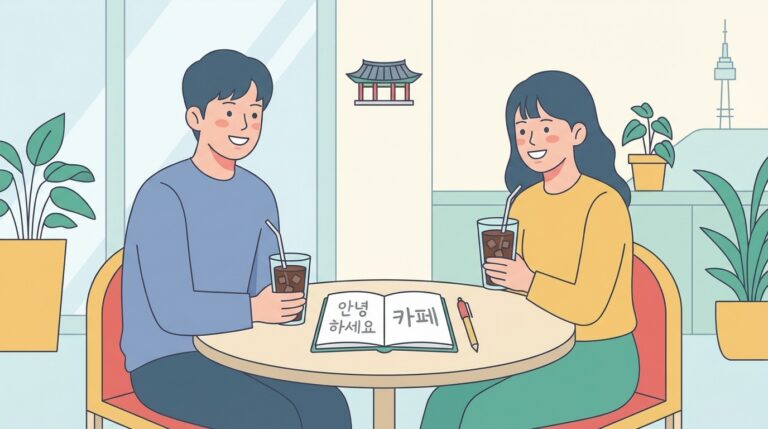
Picture this: You are sitting in a cozy, sunlit cafe in Hongdae with a new Korean acquaintance. The iced Americano glasses are sweating on the wooden table, and the playlist is humming soft acoustic K-Indie. You want to move past the polite “Nice to meet you” phase and really connect. You try asking, “몇 살이에요?” (Myeot sal-i-e-yo? / How old are you?). Suddenly, an awkward pause follows. Your companion hesitates, taps their chin, and starts doing mental math: “Wait, do you mean international age, or traditional Korean age, or academic school year age?”
If you have ever felt confused by how age works in Korea, you are not alone! Even after South Korea officially adopted the international age system in 2023, daily social life still revolves around birth cohorts. When locals meet someone who looks close to their age, they almost never ask about numerical age. Instead, they drop the ultimate game-changing phrase: “몇 년생이에요?” (Myeot nyeon-saeng-i-e-yo? / What year were you born?).
Over the past decade of coaching foreign learners, I have watched this single phrase break down communication walls faster than anything else. Learning this question spares you the awkward age math, helps you understand instant friend circles (like famous K-Pop ’97-liners’), and immediately makes you sound like an insider who truly gets Korean culture. Let us dive in together!
Phase 2: Core 3 Expressions Deep Dive
1. 몇 년생이에요? (Myeot nyeon-saeng-i-e-yo?)
- Pronunciation: [Myeot-nyeon-saeng-i-e-yo] (Sounds like Myut-nyun-seng-ee-eh-yo. Notice how “Myeot” flows softly into “nyeon” like “myun”).
- Meaning: Literal: “Which year-born are you?” | Real Nuance: “What birth year are you?”
- K-Culture Moment: Seen constantly in reality dating shows like Single’s Inferno (솔로지옥) when contestants sit across from each other on their first night and reveal their birth years to establish conversational rapport.
- Editor’s Insight: This is the most polite, natural, and low-pressure way to clarify age. It eliminates the confusion between calendar years and international age.
- Situation Spectrum: Casual: ⚠️ (too polite for best friends) | Semi-formal: ✅ (perfect for peers and new acquaintances) | Formal: ⚠️ (use “몇 년생이세요?” with elders or seniors)
- 🤔 Think About It: In English, asking someone’s birth year can sound like you are filling out an official government form. Why does Korean culture treat birth year as the primary key to friendship?
2. 저는 [Year]년생이에요. (Jeo-neun [Year]-nyeon-saeng-i-e-yo.)
- Pronunciation: [Jeo-neun … nyeon-saeng-i-e-yo] (Sounds like Juh-noon … nyun-seng-ee-eh-yo).
- Meaning: Literal: “As for me, I am a [Year]-born.” | Real Nuance: “I was born in [Year].”
- K-Culture Moment: In K-Pop introduction videos, idols often announce their cohort: “저는 00년생이에요!” (Jeo-neun gong-gong-nyeon-saeng-i-e-yo! / I was born in 2000!).
- Editor’s Insight: You only need the last two digits of your birth year! For example, 1998 is just “98년생” (Gu-sip-pal-nyeon-saeng) and 2002 is “02년생” (Gong-i-nyeon-saeng).
- Situation Spectrum: Casual: ⚠️ (drop the “Jeo-neun” and “-yo” to make it “나 98년생이야”) | Semi-formal: ✅ | Formal: ✅ (use “-입니다” for job interviews)
- 🤔 Think About It: Why do you think Koreans condense four-digit years into punchy two-digit numbers in everyday speech?
3. 우리 동갑이네요! (U-ri dong-gab-i-ne-yo!)
- Pronunciation: [U-ri dong-ga-bi-ne-yo] (Sounds like Oo-ree dong-gah-bee-neh-yo).
- Meaning: Literal: “We are of the exact same age!” | Real Nuance: “Hey, we’re the same age! We can be instant friends!”
- K-Culture Moment: When two characters in a youth K-Drama realize they were born in the same year, their eyes widen, and they immediately suggest dropping honorifics with this sentence.
- Editor’s Insight: In Korea, the word 동갑 (dong-gap) is pure magic. Sharing a birth year means you bypass complex age hierarchies and immediately enter equal footing.
- Situation Spectrum: Casual: ✅ | Semi-formal: ✅ | Formal: ⚠️ (best reserved for social conversations)
- 🤔 Think About It: In many Western countries, someone five years older can still be your “friend.” In Korea, the traditional definition of “친구 (chingu)” strictly meant someone of the exact same age. How does this shape social bonds?
Phase 3: Textbook Korean vs Real Korean
Situation 1: Inquiring About Age at a Meetup
- 📖 Textbook Korean: 몇 살입니까? (Myeot sal-im-ni-kka? / How old are you?)
- 🗣️ Real Korean: 몇 년생이에요? (Myeot nyeon-saeng-i-e-yo? / What year were you born?)
- 💡 Why is it different? Asking “몇 살입니까?” sounds like a military officer checking your ID. “몇 년생이에요?” feels soft, polite, and avoids the messy math of changing age laws.
Situation 2: Stating When You Were Born
- 📖 Textbook Korean: 저는 천구백구십칠년에 태어났습니다. (Jeo-neun cheon-gu-baek-gu-sip-chil-nyeon-e tae-eo-nass-seum-ni-da. / I was born in the year 1997.)
- 🗣️ Real Korean: 저 97년생이에요! (Jeo gu-sip-chil-nyeon-saeng-i-e-yo! / I’m a ’97-liner!)
- 💡 Why is it different? Nobody speaks the full four-digit calendar year in casual daily chats. Chopping it down to the last two digits is punchy, youthful, and native.
Phase 4: K-Culture Deep Dive & Non-Verbal Manners
4-1. Nunchi (눈치) & Gestures
When someone asks you your birth year in Korea, do not treat it like a private interrogation. Keep your shoulders relaxed and maintain a soft, friendly smile. Tilt your head slightly forward as you answer—this small, gentle head nod signals polite warmth.
If you discover you are the exact same age, it is common to clap your hands lightly together once or clasp your hands in front of your chest with a bright smile: “와, 동갑이에요!” (Wa, dong-gab-i-e-yo!). If the person turns out to be older or younger, maintain polite eye contact without making them feel awkward about seniority.
4-2. The “97-Liner” Squad Phenomenon
In K-Pop and youth culture, birth-year cohorts form legendary friendships. You might have heard of the famous “97-line” group chat featuring BTS’s Jungkook, Astro’s Cha Eun-woo, NCT’s Jaehyun, and SEVENTEEN’s Mingyu. Because they were all born in 1997, they can speak casually without worrying about honorifics (존댓말 vs 반말). In Korean society, knowing your peer group year (년생) is your passport to genuine comfort.
Phase 5: Real-World Roleplay Scenario
Setting: A vibrant university festival booth in Sinchon, Seoul. Music is blasting, food stalls smell like sweet butter corn, and you sit next to Minji, a friendly student volunteer.
Character Profile: Minji (2000-liner, outgoing, loves iced tea and K-dramas).
- Turn 1 (Minji): 안녕하세요! 페스티벌 처음 오셨어요? (An-nyeong-ha-se-yo! Pe-seu-ti-beol cheo-eum o-syeoss-eo-yo? / Hello! Is this your first time at the festival?)
🎭 Smiling warmly and handing you a paper fan. - Turn 2 (You): 네, 맞아요! 너무 신나요. (Ne, maj-a-yo! Neo-mu sin-na-yo. / Yes, that’s right! It’s so exciting.)
🎭 Looking around the lively crowd. - Turn 3 (Minji): 혹시 학생이세요? 몇 년생이에요? (Hok-si hak-saeng-i-se-yo? Myeot nyeon-saeng-i-e-yo? / Are you a student by any chance? What year were you born?)
🎭 Leaning in with friendly curiosity. - Turn 4 (You): 저는 00년생이에요! (Jeo-neun gong-gong-nyeon-saeng-i-e-yo! / I was born in 2000!)
🎭 Beaming with confidence. - Turn 5 (Minji): 진짜요? 대박! 저도 2000년생인데! (Jin-jja-yo? Dae-bak! Jeo-do i-cheon-nyeon-saeng-in-de! / Really? Wow! I am also a 2000-liner!)
🎭 Clapping hands in surprise. - Turn 6 (You): 와, 우리 동갑이네요! (Wa, u-ri dong-gab-i-ne-yo! / Wow, we are the same age!)
🎭 Smiling brightly with relief. - Turn 7 (Minji): 반가워요! 우리 말 편하게 할까요? (Ban-ga-wo-yo! U-ri mal pyeon-ha-ge hal-kka-yo? / Nice to meet you! Shall we speak comfortably/casually?)
🎭 Offering a warm handshake. - Turn 8 (You): 좋아요, 친구하자! (Joh-a-yo, chin-gu-ha-ja! / Sounds great, let’s be friends!)
🎭 Grinning and shaking her hand.
🔀 Interactive Decision Point
How would you respond to Minji when she asks: “몇 년생이에요?”
- Choice A: “나이가 왜 궁금해요?” (Na-i-ga wae gung-geum-hae-yo? / Why are you curious about my age?)
- Feedback (Bad): 🚫 Ouch! This sounds defensive and confrontational. Minji was only trying to see which speech level and friendship dynamic fits best.
- Choice B: “저는 00년생이에요! 민지 씨는요?” (Jeo-neun gong-gong-nyeon-saeng-i-e-yo! Min-ji ssi-neun-yo? / I’m a 2000-liner! What about you, Minji?)
- Feedback (Best): ✅ Perfect! You shared your birth year smoothly and tossed the conversation ball right back to her with politeness.
- Choice C: “저는 스물네 살입니다!” (Jeo-neun seu-mul-ne sal-im-ni-da! / I am 24 years old!)
- Feedback (Risk): ⚠️ Not grammatically wrong, but it forces Minji to calculate whether you mean Korean age or international age. Sticking to the birth year keeps it seamless!
Phase 6: 10-Second Emotion Shadowing Drill
Read these out loud! Follow the rhythm slashes / and mimic the emotion markers:
[😊 Friendly curiosity]
실례지만 / 몇 년생이에요?
(Sil-lye-ji-man / myeot nyeon-saeng-i-e-yo? / Excuse me, but / what year were you born?)-
[✨ Calm clarity]
저 / 98년생이에요.
(Jeo / gu-sip-pal-nyeon-saeng-i-e-yo. / Me / I was born in ’98.) -
[🎉 Pure excitement]
어? / 우리 / 동갑이네요!
(Eo? / u-ri / dong-gab-i-ne-yo! / Oh? / We / are the same age!)
Phase 7: K-Culture Mini Dictionary
- 년생 (Nyeon-saeng) | Birth year cohort
- Used directly after a two-digit year (e.g., 96년생 = born in 1996). Essential when introducing yourself in social groups.
- 동갑 (Dong-gap) | Same age person
- Specifically refers to someone born in the same calendar year. Finding a “dong-gap” in Korea is an instant icebreaker.
- 빠른 년생 (Ppa-reun nyeon-saeng) | Early birth year
- People born in January or February who used to enter elementary school a year early with kids born the previous year. A legendary source of friendly age debates in Korea!
- 말 놓다 (Mal no-ta) | To drop formal speech
- The act of switching from polite language (존댓말) to casual talk (반말), usually agreed upon after confirming you are the same age.
Phase 8: Traveler’s Survival Kit
Top 3 Survival Phrases
- 생일이 언제예요? (Saeng-il-i eon-je-ye-yo?)
- Pronunciation: [Seng-ee-ree un-jeh-yeh-yo?]
- Pro Tip: Use this when celebrating birthdays at guesthouses or cafes! “When is your birthday?”
- 몇 살이에요? (Myeot sal-i-e-yo?)
- Pronunciation: [Myut sal-ee-eh-yo?]
- Pro Tip: Useful when talking to young children who might not know their four-digit birth year yet.
- 생일 축하해요! (Saeng-il chuk-ha-hae-yo!)
- Pronunciation: [Seng-il chook-ha-heh-yo!]
- Pro Tip: The classic, warm “Happy Birthday!” shout every traveler needs.
Editor’s Travel Note
When navigating Korean social hangouts or meetup events, use the Naver Map app download to locate foreigner-friendly cultural exchanges and language cafes around Sinchon and Hongdae. If you ever attend a birthday party at a Korean restaurant, remember that sharing food and joining in on the clapping is the quickest way to make local friends!
Phase 9: One Step Deeper (Reflection)
In many Western cultures, asking an acquaintance their birth year right after exchanging names might feel intrusive. In Korea, however, this question is not an invasion of privacy—it is an act of consideration.
Korean grammar embeds social relationships into every verb ending. Until two people establish their relative ages, both speakers remain stranded in linguistic limbo, unsure whether to speak with high honorifics or casual warmth. By asking “몇 년생이에요?”, Koreans are not judging your worth; they are discovering how to address you with genuine respect and where to place the stepping stones of mutual comfort.
💬 Your Turn: *What year were you born in? Practice leaving your answer in the comments below using “저는 __년생이에요!” Let’s see who your same-age “dong-gap” buddy is!*
Phase 10: FAQ & Common Mistakes
Q: Is asking “몇 년생이에요?” rude to people older than me?
A: It is completely polite when speaking with peers or people around your age bracket. However, if you are speaking to an elderly person or a business executive, it is more polite to ask: “연세가 어떻게 되세요?” (Yeon-se-ga eo-tteoh-ge doe-se-yo? / How old are you? – honorific).
Q: What numbers do I use for the birth year: Native Korean or Sino-Korean?
A: Always use Sino-Korean numbers (일, 이, 삼, 사… / il, i, sam, sa…)! For example, 1995 is “구십오년생” (gu-sip-o-nyeon-saeng), never native counting words like “다섯”.
Q: Can I drop honorifics immediately if we are the same year?
A: No! Even if you are the exact same age (동갑), wait until one of you asks: “우리 말 편하게 할까요?” (Shall we speak comfortably?). Dropping honorifics without asking first can come off as slightly presumptuous.
🚨 Common Mistakes Alert
- Mistake: Saying “저는 1995 살이에요” (mixing year numbers with age counter).
- Correct Action: Say “저는 95년생이에요” (I’m a ’95-liner) or “저는 스물아홉 살이에요” (I am 29 years old).
- Mistake: Using Native Korean numbers for birth years (e.g., “스물두년생”).
- Correct Action: Use Sino-Korean numbers: “02년생” (Gong-i-nyeon-saeng).
- Mistake: Asking an elder “몇 년생이야?” with informal grammar.
- Correct Action: Keep polite endings (-이에요 / -이세요) for everyone you meet for the first time.
Phase 11: Action Missions
- 🥉 Bronze Level: Practice saying your own birth year out loud three times using two Sino-Korean digits (e.g., “저는 99년생이에요”).
- 🥈 Silver Level: Record a short voice memo or post a comment saying both your birth year and “우리 동갑이네요!” with native rhythm.
- 🥇 Gold Level: Next time you watch a Korean variety show or talk to a Korean language partner, identify how they ask each other about their birth cohort.
🎮 K-Culture Mission: Look up your favorite K-Pop bias or K-Drama star’s birth year on the web. Write out their birth year sentence in Korean (e.g., “아이유는 93년생이에요!” / IU is a ’93-liner!).
Phase 12: Interactive Quiz Challenge
1. Situation Challenge: You meet a new classmate in Korean class. You want to ask their birth year politely. Which sentence should you pick?
* A) 몇 살이야? (Myeot sal-i-ya?)
* B) 몇 년생이에요? (Myeot nyeon-saeng-i-e-yo?)
* C) 나이가 얼마예요? (Na-i-ga eol-ma-ye-yo?)
2. Fill-in-the-Blank: Complete the statement for someone born in 1998:
* “저는 [ ? ]년생이에요.”
3. True or False: In Korea, if two people are born in the same calendar year, they are considered 동갑 (dong-gap).
* True / False
👉 Click here for answers & explanations!
- Answer: B (몇 년생이에요?)
- Explanation: Option B is the most natural, polite, and standard way to ask a peer their birth year. Option A is overly informal (반말), and Option C sounds like asking “how much does your age cost?” which is unnatural!
- Answer: 98 (구십팔 / Gu-sip-pal)
- Explanation: You only need the last two digits using Sino-Korean numbers: “저는 98년생이에요.”
- Answer: True
- Explanation: Yes! Being born in the same year makes you “동갑” (same age), unlocking immediate peer-friendship potential!
- Explanation: Yes! Being born in the same year makes you “동갑” (same age), unlocking immediate peer-friendship potential!
🎬 Watch Our Daily Videos! (Daily Hangul Official Instagram)
Review the expressions you learned in this article with our fun daily short videos! Check out native pronunciation and real-life nuances in action.
- Instagram @dailyhangul_en







