

Clear the Way: How to Speak Like a Pro When the Korean Repair Technician Visits
Phase 1: Empathy (Story-Driven Opening)
안녕하세요! 매일한글 에디터입니다.
Picture this: It is the dead of winter in Seoul, -10°C outside, and your floor heating (난방) suddenly blinks a cold, red error code on the wall panel. Or maybe your bathroom drain decides to turn your bathroom floor into an Olympic swimming pool. Panic mode kicks in! You successfully manage to contact your landlord or call an official service center, and they say the magic words: “기사님 방문하실 거예요” (A technician will visit you).
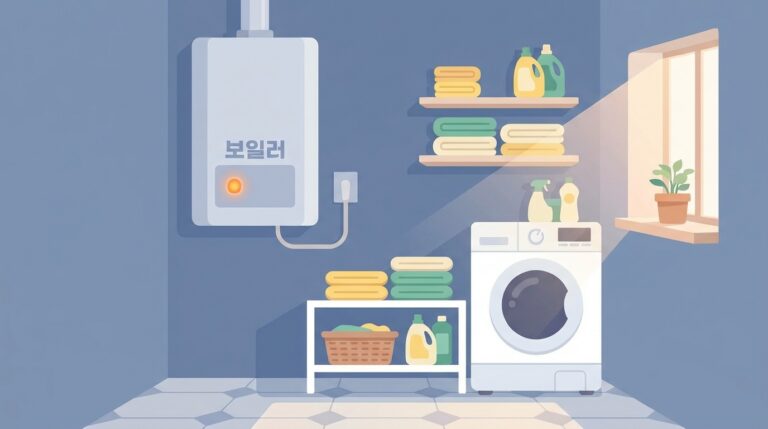
As you wait for the doorbell, you look at your utility area (다용도실) or under the sink. It is piled high with laundry baskets, extra toilet paper rolls, drying racks, and recycling bins. In typical Korean one-rooms and villas, workspace around pipes and boilers is notoriously tight. When the technician knocks, do you just stand there awkwardly while they struggle to squeeze past your clutter? Or can you welcome them smoothly and say, “수리 기사님이 오시기 전에 작업 공간 주변의 짐을 미리 치워 두었어요” (Before the technician arrived, I cleared away the items around the workspace in advance)?
Learning how to prepare the space and explain your actions beforehand transforms you from a stressed resident into an incredibly considerate neighbor in the eyes of any Korean professional. Today’s guide is packed with real learner feedback and cultural survival tricks so you will never feel helpless during home emergencies again!
Phase 2: Deep Dive into 3 Core Expressions
1. 짐을 미리 치워 두었어요 (Jim-eul mi-ri chi-wo du-eoss-eo-yo.)
- Pronunciation: [Jim-eul mi-ri chi-wo du-eot-eo-yo] (Think of ‘Jim’ like the English name ‘Jim’, ‘mi-ri’ like ‘me-re’, and ‘chi-wo’ like ‘chee-wo’)
- Meaning: Literal: “I moved the baggage/items away in advance.” | Actual Nuance: “I cleared the clutter beforehand so you have room to work.”
- K-Culture Moment: You often see this in Korean lifestyle vlogs or reality shows like I Live Alone (나 혼자 산다) where cast members scramble to fold clothes and stack boxes before a guest or handyman rings the bell.
- Editor’s Insight: The grammar pattern
-어/아 두다expresses doing an action in advance and maintaining that ready state. Combining it with the adverb미리(in advance) highlights your foresight and proactive consideration. - Situation Spectrum:
- Casual (to friends): 짐 미리 치워 뒀어! (✅)
- Semi-formal (Polite everyday): 짐을 미리 치워 두었어요. (✅ – Recommended!)
- Formal (Official business): 작업 공간의 물품을 미리 정리해 두었습니다. (✅)
- 🤔 Think About It: In many Western homes, technicians are expected to navigate personal clutter or move it themselves. Why does Korean culture place such value on having the space cleared before arrival?
2. 공간이 좁아서 작업하기 불편하시죠? (Gong-gan-i job-a-seo jag-eop-ha-gi bul-pyeon-ha-si-jyo?)
- Pronunciation: [Gong-gan-i job-a-seo jag-eob-ha-gi bool-pyeon-ha-shi-jyo]
- Meaning: Literal: “Because the space is narrow, working is uncomfortable, right?” | Actual Nuance: “I’m sorry the workspace is so cramped for you.”
- K-Culture Moment: Seen frequently in K-Dramas when humble characters apologize for their tiny rooftop rooms (옥탑방) or semi-basements (Parasite vibes) to someone offering assistance.
- Editor’s Insight: This isn’t just a question; it’s an empathetic Korean social grease called Baeryeo (배려, considerate thoughtfulness). Acknowledging the tight space immediately dissolves any tension.
- Situation Spectrum:
- Casual: 공간 좁아서 불편하지? (⚠️ Only to close friends)
- Semi-formal: 공간이 좁아서 작업하기 불편하시죠? (✅)
- Formal: 작업 환경이 협소하여 죄송합니다. (✅)
- 🤔 Think About It: Is acknowledging physical inconvenience seen as self-deprecation or polite empathy in your native culture?
3. 여기 편하게 쓰세요 (Yeo-gi pyeon-ha-ge sseu-se-yo.)
- Pronunciation: [Yeo-gi pyeon-ha-ge sseu-seh-yo] (Like ‘Yeo-gee pyun-ha-geh sseh-yo’)
- Meaning: Literal: “Use here comfortably.” | Actual Nuance: “Please feel free to make yourself at home / place your tools here.”
- K-Culture Moment: When homeowners gesture toward the floor or a small table in heartwarming slice-of-life dramas like Hospital Playlist or Our Blues.
- Editor’s Insight: Korean service visits move fast. Offering a clear corner with “여기 편하게 쓰세요” lets the technician lay down heavy tool bags without worrying about damaging your personal belongings.
- Situation Spectrum:
- Casual: 여기 편하게 써! (✅ Close friends)
- Semi-formal: 여기 편하게 쓰세요. (✅ Perfect for repair visits)
- Formal: 이 공간을 편히 사용하십시오. (⚠️ Too stiff for a home visit)
- 🤔 Think About It: Welcoming someone into your private living space requires setting implicit boundaries while maintaining warmth. Notice how this short phrase does both effortlessly.
Phase 3: Textbook Korean vs. Real Korean
Situation 1: Telling the technician you moved your personal belongings
- 📖 교과서 한국어 (Textbook): 제가 작업 영역에 있던 물건들을 다른 장소로 이동시켰습니다. (Je-ga jag-eop yeong-yeog-e it-deon mul-geon-deul-eul da-reun jang-so-ro i-dong-si-kyeoss-seum-ni-da.)
- 🗣️ 진짜 한국어 (Real-life): 기사님 편하게 일하시라고 짐 좀 미리 치워 놨어요! (Gi-sa-nim pyeon-ha-ge il-ha-si-ra-go jim jom mi-ri chi-wo nwas-seo-yo!)
- 💡 Why is it different? Textbook Korean sounds like an official incident report. Real Koreans use the contraction
-어 놨어요(from-어 놓다, synonymous with-어 두다) and front-load the technician’s comfort with “편하게 일하시라고” (so you can work comfortably).
Situation 2: Inviting them to keep their shoes on or step onto a mat
- 📖 교과서 한국어 (Textbook): 신발을 신고 들어오셔도 무방합니다. (Sin-bal-eul sin-go deul-eo-o-syeo-do mu-bang-ham-ni-da.)
- 🗣️ 진짜 한국어 (Real-life): 신발 안 벗으셔도 돼요, 그냥 들어오세요! (Sin-bal an beos-eu-syeo-do dwae-yo, geu-nyang deul-eo-o-se-yo!)
- 💡 Why is it different? Korean indoor shoe etiquette is sacred, but technicians carry heavy tools. Native speakers simply say “안 벗으셔도 돼요” (you don’t have to take them off) or lay down newspapers/mats to be quick and practical.
Phase 4: K-Culture Deep Dive & Non-Verbal Manners
4-1. Nunchi (눈치) & Body Language
When a repair technician visits your Korean apartment, silence can feel awkward, but hovering over their shoulder is worse! Here is the golden balance:
1. The Entrance Nod: Bow your head at roughly 15–30 degrees when opening the door, step to the side to give them clearance, and immediately point toward the boiler room or bathroom.
2. The Pathway Clearance: Keep the entryway (현관) completely free of your shoes so they can drop heavy toolbox kits without tripping.
3. The Discreet Distance: Stay within earshot in case they ask a question (“온수 밸브 어디 있어요?” – Where is the hot water valve?), but do not stare at their hands. Look at your phone or tidy up nearby.
4-2. The “Vita 500” Culture (K-Hospitality Code)
In Korea, it is an unspoken tradition to offer a small bottled beverage to delivery drivers or repair technicians. It is called 음료수 챙겨드리기 (offering a beverage). You don’t need a lavish spread—a chilled bottle of Vita 500, a can of iced Bacchus, or canned Maxim Mocha Gold coffee placed gently beside their toolset with a simple “목 마르실 텐데 드시면서 하세요” (You must be thirsty, please drink this while you work) earns you VIP service immediately. They might even check your drain seals for free!
Phase 5: Real-Life Roleplay Scenario
Setting: A 4th-floor villa in Mapo-gu. Outside is sub-zero winter. The floor is freezing because the boiler stopped circulating hot water.
Characters:
* You: Resident dealing with boiler breakdown.
* Master Kim (김 기사님): A seasoned 55-year-old boiler technician wearing a blue utility vest, carrying a metallic toolbox.
- Turn 1 (Master Kim): (🎭 Rings the bell, greets warmly at the door) 안녕하세요! 보일러 누수 접수 건으로 방문한 보일러 기사입니다. (An-nyeong-ha-se-yo! Bo-il-leo nu-su jeop-su geon-eu-ro bang-mun-han bo-il-leo gi-sa-im-ni-da. / Hello! I’m the boiler technician visiting regarding the reported leak.)
- Turn 2 (You): (🎭 Opens door wide, smiling politely) 안녕하세요, 기사님! 추운데 일찍 와주셔서 감사해요. (An-nyeong-ha-se-yo, gi-sa-nim! Chu-un-de il-jjik wa-ju-syeo-seo gam-sa-hae-yo. / Hello, technician! Thank you for coming so early in this cold weather.)
- Turn 3 (Master Kim): (🎭 Glances down at boots) 신발 벗고 들어갈까요, 아니면 덧신 신을까요? (Sin-bal beot-go deul-eo-gal-kka-yo, a-ni-myeon deot-sin sin-eul-kka-yo? / Should I take off my shoes, or wear shoe covers?)
- Turn 4 (You): (🎭 Points toward the utility nook) 보일러실까지 박스 깔아 놨어요. 그냥 들어오세요! (Bo-il-leo-sil-kka-ji bak-seu kkal-a nwas-seo-yo. Geu-nyang deul-eo-o-se-yo! / I laid down cardboard boxes up to the boiler room. Just come right in!)
- Turn 5 (Master Kim): (🎭 Enters the utility room and looks around surprised) 아이고, 공간이 좁았을 텐데 정리 잘해 두셨네요? (A-i-go, gong-gan-i job-ass-eul ten-de jeong-ri jal-hae du-syeot-ne-yo? / Oh my, the space must have been tight, but you cleared it so well!)
- Turn 6 (You): (🎭 Nods modestly with hands folded) 네, 수리 기사님이 오시기 전에 작업 공간 주변의 짐을 미리 치워 두었어요. 편하게 쓰세요. (Ne, su-ri gi-sa-nim-i o-si-gi jeon-e jag-eop gong-gan ju-byeon-ui jim-eul mi-ri chi-wo du-eoss-eo-yo. Pyeon-ha-ge sseu-se-yo. / Yes, before you arrived, I cleared away the items around the workspace in advance. Please use the area comfortably.)
- Turn 7 (Master Kim): (🎭 Chuckles, rolls up sleeves with renewed energy) 덕분에 작업이 훨씬 수월하겠어요! 어디 원인을 금방 찾아볼게요. (Deok-bun-e jag-eob-i hwol-ssin su-wol-ha-gess-eo-yo! Eo-di won-in-eul geum-bang cha-ja-bol-ge-yo. / Thanks to you, the work will be much easier! Let me quickly find the cause.)
- Turn 8 (You): (🎭 Places a warm canned coffee on the shelf) 감사합니다! 목 마르시면 이거 드시면서 천천히 봐주세요. (Gam-sa-ham-ni-da! Mok ma-reu-si-myeon i-geo deu-si-myeon-seo cheon-cheon-hi bwa-ju-se-yo. / Thank you! If you get thirsty, please have this and take your time.)
🔀 Interactive Decision Point
After Master Kim begins testing the pipes, he asks: “배수 밸브 쪽에 부품을 좀 교체해야 할 것 같은데, 집주인분 연락처 아세요?” (I think we need to replace a part near the drain valve; do you know the landlord’s contact?)
- Choice A: “네, 제가 집주인분께 바로 전화해서 비용 처리 여쭤볼게요!” (Ne, je-ga jip-ju-in-bun-kke ba-ro jeon-hwa-hae-seo bi-yong cheo-ri yeo-jjwo-bol-ge-yo!)
- Outcome (BEST): Highly proactive. Landlord approval is required for structural repairs in Korea, preventing dispute over who pays.
- Choice B: “그냥 기사님이 알아서 제일 싼 걸로 바꿔주세요.” (Geu-nyang gi-sa-nim-i al-a-seo je-il ssan geol-lo ba-kkwo-ju-se-yo!)
- Outcome (RISK): If you approve replacement without the landlord’s consent, the landlord may deduct the money from your deposit later or refuse reimbursement.
- Choice C: “저는 외국인이라 잘 모르니까 나중에 올게요.” (Jeo-neun oe-guk-in-i-ra jal mo-reu-ni-kka na-jung-e ol-ge-yo.)
- Outcome (BAD): Leaving the technician alone without solving the authorization can delay heating repairs during freezing weather!
Phase 6: 10-Second Emotional Shadowing Drill
Practice matching the exact rhythm (/ = brief pause) and authentic emotions:
[😊 Politeness and Warmth]
수리 기사님이 오시기 전에 / 작업 공간 주변의 짐을 / 미리 치워 두었어요.
(Su-ri gi-sa-nim-i o-si-gi jeon-e / jag-eop gong-gan ju-byeon-ui jim-eul / mi-ri chi-wo du-eoss-eo-yo.)-
[🥺 Slight Empathy and Apology]
공간이 많이 좁아서 / 작업하시기 불편하시죠?
(Gong-gan-i man-i job-a-seo / jag-eop-ha-si-gi bul-pyeon-ha-si-jyo?) -
[🤝 Generous and Welcoming]
여기 바닥에 / 공구 가방 편하게 내려놓으세요!
(Yeo-gi ba-dag-e / gong-gu ga-bang pyeon-ha-ge nae-ryeo-noh-eu-se-yo!)
Phase 7: K-Culture Mini Dictionary
- 기사님 (Gi-sa-nim) | Honorific Title for Technicians / Drivers
- Meaning: A respectful title used for skilled tradespeople, taxi drivers, or repair technicians. Never call them “아저씨” (Uncle/Mister) if you want attentive, professional service!
- 다용도실 (Da-yong-do-sil) | Utility / Multi-Purpose Balcony
- Meaning: The small enclosed balcony adjoining the kitchen or bathroom where washing machines, drying racks, and gas boilers are tucked away.
- 치워 두다 (Chi-wo du-da) | To Clear Away in Advance
- Meaning: Combining
치우다(to clear/clean) with-어 두다(to maintain a prepared state). Essential whenever welcoming guests, movers, or contractors.
- Meaning: Combining
- 온수 / 난방 (On-su / Nan-bang) | Hot Water / Floor Radiant Heating
- Meaning: Key settings on the wall-mounted thermostat. When a boiler breaks, you specify whether “온수가 안 나와요” (hot water won’t run) or “난방이 안 돼요” (the floor heating doesn’t work).
Phase 8: Survival Kit for Travelers & Residents
Top 3 Survival Phrases
- 보일러에서 에러 코드가 떠요. (Bo-il-leo-e-seo e-reo ko-deu-ga tteo-yo.)
- Pro Tip: Take a clear smartphone photo of the blinking numbers (e.g., 03, E1) and text it to your landlord or technician.
- 싱크대 밑에서 물이 새요. (Sing-keu-dae mit-e-seo mul-i sae-yo.)
- Pro Tip: Say this when you notice a leak under the kitchen sink before water damages the downstairs neighbor’s ceiling!
- 수리비는 집주인분께 청구하면 될까요? (Su-ri-bi-neun jip-ju-in-bun-kke cheong-gu-ha-myeon doel-kka-yo?)
- Pro Tip: Clarifies payment right away. In Korea, major fixture failures are legally the landlord’s responsibility.
Editor’s Travel Note
- Repair & Communication Apps: Bookmark and install the official apps for your boiler brand (such as Rinnai, Kiturami, or Navien) or use the search feature on Naver Map app download typing “보일러 수리” (boiler repair) near your neighborhood.
- Proof & Documentation: Always shoot a 5-second video showing the water leaking or panel beeping before the technician touches anything. This ensures full reimbursement from landlords.
Phase 9: A Step Deeper (Reflective Essay)
In Korean society, the boundary of one’s home (집) is deeply sacred, yet life in high-density villas and apartments means practical living spaces frequently overlap. When you invite a stranger into your private domain for essential maintenance, displaying Baeryeo (배려—active consideration) acts as a cultural handshake. Preparing your utility nook and moving obstacles beforehand shows respect for the technician’s time and physical labor in a culture driven by speed and high efficiency (Palli-Palli, 빨리빨리). It demonstrates that while language skills may be developing, your empathy is fluent.
💬 Your Turn: In your home country, do tenants clear out maintenance spaces completely before contractors visit, or is that considered part of the technician’s job? Share your cultural perspective in the comments below!
Phase 10: FAQ & Avoiding Misunderstandings
Q: Do technicians expect tips in Korea?
A: No! Tipping is non-existent in South Korea. Offering cash will cause confusion and embarrassment. If you want to show sincere appreciation, offering a cold canned drink or a polite bow with “수고 많으셨습니다!” (Thank you for your hard work!) is standard etiquette.
Q: What if the technician steps inside with outdoor work boots?
A: Technicians usually wear slip-on cloth covers (덧신) over their boots or ask permission. If you prefer them not to track dust onto your clean hardwood, lay down flattened delivery cardboard boxes from your entrance to the boiler prior to their arrival.
Q: Who pays the repair fee (수리비)?
A: Under Korean housing rental law, breakdowns due to age or structural wear-and-tear (boilers, main plumbing) are paid by the landlord (임대인). Daily consumable clogs caused by tenant negligence (e.g., wet wipes flushed down toilets) are paid by the tenant (임차인).
🚨 Common Mistakes Board
- ❌ Mistake 1: Waiting until the technician steps into your one-room before clearing drying racks and shoes.
- 👉 Correct Action: Clear a straight 1-meter walking path and empty the area directly under the boiler at least 15 minutes before arrival.
- ❌ Mistake 2: Calling the technician “아저씨” (Ah-jeo-ssi).
- 👉 Correct Action: Always address skilled workers respectfully as “기사님” (Gi-sa-nim).
- ❌ Mistake 3: Saying “청소했어요” (I cleaned up) instead of “짐을 치워 뒀어요” (I moved the items away).
- 👉 Correct Action: 치우다 specifies relocating clutter to create functional space, whereas 청소하다 means sweeping/wiping surfaces.
Phase 11: Action Missions & Community Engagement
- 🥉 Bronze Mission (Solo Practice): Stand in front of your bathroom sink or boiler cabinet and recite out loud 3 times: “기사님, 작업 공간 주변 짐을 미리 치워 두었어요!”
- 🥈 Silver Mission (Social Share): Snap a photo of a beverage you plan to keep in your fridge for delivery drivers or repair pros, and post it to Instagram or your study group tagging
#DailyHangul #KoreanLifeHacks. - 🥇 Gold Mission (Real-life Execution): The next time any delivery worker, internet installer, or repair person visits, greet them with “기사님, 이쪽으로 편하게 들어오세요!” and hand them a warm or chilled drink.
- 🎮 K-Culture Mission: Watch an episode of a Korean slice-of-life drama (like My Liberation Notes or Fight for My Way) and spot the small utility room (다용도실) or boiler balcony typical of Korean apartments.
Phase 12: Interactive Quiz Challenge
1. Situation Judgement: The repair technician arrives at your door carrying heavy diagnostic equipment. Which action is the most culturally natural?
* (A) Tell them to wait outside while you vacuum the floor.
* (B) Point to the pathway you cleared with cardboard and say: “신발 안 벗으셔도 돼요, 이쪽으로 오세요!”
* (C) Hand them a 50,000 KRW cash tip immediately.
🔍 Click to Reveal Answer & Explanation
Correct Answer: (B)
* Why: In Korea, technicians carrying heavy toolboxes appreciate quick access. Laying down a path and letting them keep their footwear on saves time. Tipping cash (C) is culturally awkward, and making them wait outside (A) contradicts Korean speed and hospitality.
2. Fill-in-the-Blank: Complete the sentence meaning: “Before the technician arrived, I cleared the items in advance.”
수리 기사님이 오시기 전에 작업 공간 주변의 짐을 ____ 치워 두었어요.
* (A) 벌써 (Beol-sseo)
* (B) 미리 (Mi-ri)
* (C) 아직 (A-jik)
🔍 Click to Reveal Answer & Explanation
Correct Answer: (B) 미리
* Why: 미리 means taking proactive action “in advance” before something happens. 벌써 means “already” (often with surprise that time passed), and 아직 means “yet/still.”
3. True or False Culture Check: In Korea, structural boiler breakdown repair costs in a rented apartment must always be paid out of the tenant’s personal pocket without informing the landlord.
* (True / False)
🔍 Click to Reveal Answer & Explanation
Correct Answer: False
* Why: Major boiler breakdowns and pipe leaks are the legal responsibility of the building owner/landlord. You must always consult the landlord prior to authorizing expensive repairs!
🎬 Watch Our Daily Videos! (Daily Hangul Official Instagram)
Review the expressions you learned in this article with our fun daily short videos! Check out native pronunciation and real-life nuances in action.
- Instagram @dailyhangul_en







