

Phase 1: Empathy (Story Immersion Opening)
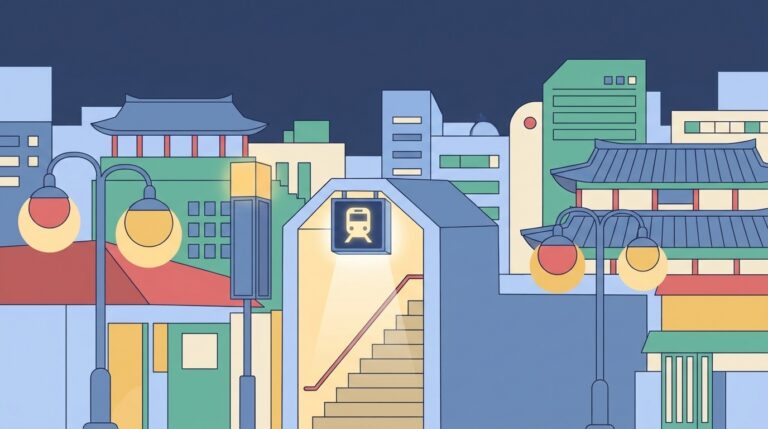
안녕하세요! 매일한글 에디터입니다. (Hello! I’m your Daily Hangul editor.) Picture this: you just spent an unforgettable evening in Hongdae. The savory scent of grilled pork belly still lingers, you sang your heart out at a coin noraebang, and the neon signs are glowing vibrant pink and blue against the midnight sky. Suddenly, you glance at your phone screen: 11:48 PM with 12% battery remaining. Your heart drops into your stomach. “Wait… when does the subway stop running? Am I stuck here? How much is a taxi to Myeongdong?”
Take a deep breath! You are not alone. As a Seoul native and language guide for over ten years, I have seen hundreds of bright-eyed travelers freeze in front of Korean ticket gates at midnight. Seoul’s subway system is legendary for being clean, punctual, and safe, but finding your way home when the clock is ticking down can feel terrifying if you do not speak the language. Today, we are learning the exact survival phrases that will save you time, cash, and late-night panic. Let’s make sure you never miss that final train home!
Phase 2: Core Expressions In-Depth Analysis
1. 막차가 몇 시에 있어요? (Makchaga myeot sie isseoyo?)
- Pronunciation: [Mak-cha-ga myeot si-e iss-eo-yo?] (Think: “MAHK-cha-ga” like “mock-car-gah”, “myut” rhymes with “cut”, “she-eh eess-oh-yo”)
- Meaning: Literal: “At what time does the last train exist?” | Practical Nuance: “What time is the last train?”
- K-Culture Moment: In countless K-Dramas like Business Proposal or My Liberation Notes, you see exhausted office workers or young couples on dates nervously glancing at their watches before asking, “우리 막차 몇 시예요?” (Uri makcha myeot siyeyo? / What time is our last train?).
- Editor’s Insight: The magic word here is 막차 (makcha), combining ‘막’ (last/final) and ‘차’ (vehicle/train). Even if your grammar falters, whispering “막차… 몇 시예요?” to an attendant will instantly convey your urgent situation.
- Situation Spectrum: Casual (막차 몇 시야?): ⚠️ Friends only | Semi-formal (막차가 몇 시에 있어요?): ✅ Recommended for station staff | Formal (막차가 몇 시입니까?): 🚫 Overly stiff for daily life
- 🤔 Think About It: In English, we often ask “When does the subway close?”, focusing on the system, whereas Korean focuses on the vehicle itself leaving (차). How does this change your mental image of catching a ride?
2. 어디서 갈아타요? (Eodiseo garatayo?)
- Pronunciation: [Eo-di-seo ga-ra-ta-yo?] (Think: “Uh-dee-suh” like “a deer saw”, “gah-rah-tah-yo”)
- Meaning: Literal: “Where do I switch and ride?” | Practical Nuance: “Where do I transfer?”
- K-Culture Moment: Heard constantly at mega-transfer hubs like Sindorim or Express Bus Terminal when confused commuters try to navigate the rush hour labyrinth.
- Editor’s Insight: ‘갈아타다’ comes from ‘갈다’ (to exchange) and ‘타다’ (to ride). Subway transfers in Seoul are color-coded, so you can pair this with a line number: “2호선, 어디서 갈아타요?” (Line 2, where do I transfer?).
- Situation Spectrum: Casual: ⚠️ (어디서 갈아타?) | Semi-formal: ✅ (어디서 갈아타요?) | Formal: ⚠️ (어디서 환승합니까?)
- 🤔 Think About It: Why do you think Korean uses a dynamic compound verb like “change-ride” instead of a static noun like “transfer”?
3. 이번 역이 어디예요? (Ibeon yeogi eodiyeyo?)
- Pronunciation: [I-beon yeog-i eo-di-ye-yo?] (Think: “Ee-bun yuh-ghee uh-dee-yay-yo”)
- Meaning: Literal: “This stop, where is it?” | Practical Nuance: “What station is this?”
- K-Culture Moment: You wake up from a quick nap on the heated subway seat, the automated announcement just finished playing the traditional Pungnyu xylophone chime, and you must urgently know if you missed your stop.
- Editor’s Insight: ‘이번’ means ‘this current time/turn’ and ‘역’ means station. Keep this phrase ready in crowded cars when doors block the platform signs.
- Situation Spectrum: Casual: ⚠️ (이번 역 어디야?) | Semi-formal: ✅ (이번 역이 어디예요?) | Formal: ⚠️ (이번 정차역이 어디입니까?)
- 🤔 Think About It: Notice how Korean uses polite questions ending in ‘-예요’ to show respect to strangers without sounding distant or cold.
Phase 3: Textbook Korean vs Real Korean
Situation 1: Asking Station Staff About the Final Run
- 📖 교과서 한국어 (Textbook Korean): 막차 시각을 알려주시겠습니까? (Makcha sigag-eul allyeojusigessseumnikka? / Would you be kind enough to inform me of the last train departure time?)
- 🗣️ 진짜 한국어 (Real Korean): 저기요, 막차 몇 시예요? (Jeogiyo, makcha myeot siyeyo? / Excuse me, what time is the last train?)
- 💡 왜 다를까? (Why is it different?): Textbook phrasing is written like an official announcement. In real life, staff members are busy and prefer concise, polite, natural questions.
Situation 2: Asking Which Platform to Switch Lines
- 📖 교과서 한국어 (Textbook Korean): 환승 구역의 위치가 어디입니까? (Hwanseung gu-yeog-ui wichiga eodiimnikka? / Where is the exact location of the transit zone?)
- 🗣️ 진짜 한국어 (Real Korean): 저기요, 2호선 어디서 타요? (Jeogiyo, i-hoseon eodiseo tayo? / Excuse me, where do I catch Line 2?)
- 💡 왜 다를까? (Why is it different?): Rather than saying “transit zone,” everyday Seoulites simply ask where the desired subway line is boarded.
Phase 4: K-Culture Deep Dive & Non-verbal Manners
4-1. 눈치 (Nunchi) & Gestures: Navigating the Station Politely
When approaching a station attendant (역무원) or a fellow passenger late at night, your non-verbal cues matter as much as your words:
* The Two-Hand Phone Tilt: If you have your destination open on your screen, hold your phone using both hands and tilt it slightly toward the person while slightly bowing your head. This shows humility and good manners.
* Point with an Open Palm: Never point your index finger directly at a person or platform map sign. Use a flat hand, palm facing slightly upward.
* Tone Down Your Voice: Korean subway cars and platform areas are relatively quiet late at night. Lower your speaking volume so you do not cause public disturbance (민폐 / minpye).
4-2. Culture Code Analysis: The Legend of the “Makcha Sprint”
In Korea, missing the makcha is a cultural phenomenon. Because hailing late-night taxis in busy districts like Gangnam, Hongdae, and Itaewon can be notoriously difficult on weekend nights, the 11:30 PM to midnight window witnesses the famous “Makcha Sprint” (막차 달리기). You will see office workers in tailored suits and college students in platform boots sprinting down stairs in unison before the iron station shutters slide down. Being part of this shared late-night race is a quintessential Seoul bonding experience!
Phase 5: Real-World Roleplay Scenario
- Location: Gangnam Station (강남역), near the Line 2 turnstiles, 11:52 PM.
- Characters: You (a traveler needing to reach Hongdae) & Min-jun (a friendly subway station attendant wearing a navy vest).
-
Dialogue:
- Traveler: 저기요! 실례합니다. (Jeogiyo! Sillyehamnida. / Excuse me! Pardon me.)
🎭 Rushing forward slightly out of breath, hands clasped politely - Min-jun: 네, 무슨 일이세요? (Ne, museun iriseyo? / Yes, what is the matter?)
🎭 Pausing his clipboard check, looking up attentively - Traveler: 홍대 가야 해요. 막차가 몇 시에 있어요? (Hongdae gaya haeyo. Makchaga myeot sie isseoyo? / I must go to Hongdae. What time is the last train?)
🎭 Pointing gently toward the Line 2 green sign - Min-jun: 홍대입구역이요? 12시 10분에 막차 있어요! (Hongdae-ipguyeog-iyo? Yeoldusi sibbune makcha isseoyo! / Hongik Univ. Station? The last train is at 12:10!)
🎭 Checking the station digital monitor and tapping his watch - Traveler: 다행이다! 어디서 타요? (Dahaeng-ida! Eodiseo tayo? / What a relief! Where do I board?)
🎭 Sighing with relief and smiling warmly - Min-jun: 2번 승강장으로 빨리 내려가세요. (I-beon seung-gangjang-euro ppalli naeryeogaseyo. / Head quickly down to platform number 2.)
🎭 Pointing toward the stairwell with an open hand - Traveler: 정말 감사합니다! 좋은 밤 되세요. (Jeongmal gamsahamnida! Joeun bam doeseyo. / Thank you so much! Have a good night.)
🎭 Giving a 30-degree respectful bow - Min-jun: 네, 조심히 가세요! 뛰지 마세요! (Ne, josimhi gaseyo! Ttwiji maseyo! / Yes, go safely! Don’t trip or run too fast!)
🎭 Smiling and waving gently
- Traveler: 저기요! 실례합니다. (Jeogiyo! Sillyehamnida. / Excuse me! Pardon me.)
🔀 Interactive Choice Point
You realize you need to transfer at another station to reach your guesthouse. What do you ask Min-jun?
* Option A: “야, 환승 어디야?” (Ya, hwanseung eodiya?)
* Option B: “어디서 갈아타요?” (Eodiseo garatayo?)
* Option C: “택시 타요.” (Taeksi tayo.)
- Feedback:
- Option A (Bad): ⚠️ Risk of offending! “야” (Hey) and casual drop-form verb endings sound disrespectful to someone older or in public service.
- Option B (Best): ✅ Perfect! Polite, natural A1 conversational level. Min-jun will happily point out the exact transfer station.
- Option C (Risk): ⚠️ Irrelevant! You are telling him “I take a taxi” rather than solving your transfer question.
Phase 6: 10-Second Emotion Shadowing Drill
Practice matching both the cadence and emotional urgency of these real-life subway moments!
- [😰 급하고 간절하게 / Urgent and anxious]
저기요! / 막차가 / 몇 시에 있어요? / (Jeogiyo! / Makchaga / myeot sie isseoyo?) - [😮 안도하며 확인하듯 / Relieved yet double-checking]
12시 10분이요? / 아직 탈 수 있어요? / (Yeoldusi sibbun-iyo? / Ajik tal su isseoyo?) - [😊 밝고 감사하게 / Cheerful and grateful]
감사합니다! / 지금 바로 갈게요! / (Gamsahamnida! / Jigeum baro galgeyo!)
Phase 7: K-Culture Mini Dictionary
- 막차 (Makcha) | The last train/bus
- Used everywhere in social life: “막차 놓쳤어!” (I missed the last train!). It marks the turning point between going home safely or heading for round three at a 24-hour hangover soup restaurant.
- 환승 (Hwanseung) | Transfer (between subway lines or buses)
- Essential everyday transit concept. In Korea, transferring within 30 minutes gives you a major fare discount via transit card.
- 출구 (Chulgu) | Station exit
- Korean rendezvous points are almost always organized by exit numbers, such as: “강남역 11번 출구에서 만나자!” (Let’s meet at Gangnam Station Exit 11!).
- 첫차 (Cheotcha) | The first train/bus of the morning
- The opposite of 막차. If you miss the midnight train, locals humorously accept their fate by saying, “그냥 첫차 타고 가자” (Let’s just party until the first train at 5:30 AM).
Phase 8: Survival Kit for Travelers
Top 3 Survival Phrases
- 1. 이 기차 홍대 가요? (I gicha Hongdae gayo?)
- Pronunciation: Ee ghee-cha Hong-dae gah-yo?
- Pro Tip: When boarding late trains, some terminate halfway down the line. Ask passengers on the platform to verify it reaches your stop.
- 2. 카드 충전 어디서 해요? (Kadeu chungjeon eodiseo haeyo?)
- Pronunciation: Kah-deu choong-jun uh-dee-suh hay-yo?
- Pro Tip: Means “Where do I top up my transit card?” Look for the multi-language kiosks near the gates.
- 3. 화장실이 개찰구 밖이에요? (Hwajangsil-i gaechalgu bakk-ieyo?)
- Pronunciation: Hwa-jang-sheel-ee gay-chal-goo bahk-ee-eh-yo?
- Pro Tip: Means “Is the restroom outside the ticket gate?” Saves you from accidentally swiping out and paying double.
Editor’s Travel Note
- Smart Navigation Tools: Never rely on Google Maps for Seoul public transit schedules as walking paths and train intervals are not updated in real time. Make sure to complete your Naver Map app download or consult the Kakao Metro subway map guide before stepping out for the night. Both apps have real-time live GPS tracking showing the exact arrival time of the final train.
- Transit Card Lifesaver: Always maintain at least ₩5,000 on your T-money card. If you run out of funds past midnight, convenience store staff inside stations may already be closed.
Phase 9: “One Step Deeper” (Reflective Essay)
In Seoul, the subway is more than just steel tracks and wheels; it is the shared circulatory system of a remarkably considerate society. The rush for the final train reflects the deep Korean respect for punctuality, public order, and the shared rhythm of modern life. Even at 11:59 PM when trains are packed wall-to-wall, passengers instinctively keep voices down, yield seats with pink badges to pregnant mothers, and respect fellow travelers heading home after a demanding day. Language is the key that invites you into this communal care.
💬 Your Turn: Have you ever experienced missing the last train in your hometown or while traveling abroad? How did you solve it? Share your late-night subway stories in the comments below!
Phase 10: FAQ & Misconception Prevention
Q: Does the Seoul subway close at exactly midnight everywhere?
A: No! While people casually say “midnight,” actual last trains depart anywhere from 11:45 PM to 12:40 AM depending on whether it is a weekday or weekend, and whether the train terminates at the line’s final station or an intermediate depot depot (차량기지). Always check your live transit app.
Q: Can I run through the turnstile if I have a negative balance on my card?
A: Never push through. Look for the small Emergency Gate (비상 게이트 / bisang geiteu). Press the call button and tell the speaker: “카드 오류예요” (Kadeu oryu-yeyo / Card error) or “도와주세요” (Dowajuseyo / Please help me). The attendant will buzz you through to the top-up machine.
Q: What if I lose something on the last train?
A: Don’t panic! Seoul Metro operates a unified Lost and Found center (유실물센터). Note the exact time you got off, the car number painted on the train door (e.g., 4-3), and your travel direction. Station staff can track the train down rapidly.
🚨 흔한 실수 (Common Mistakes) Warning Board
- Mistake: Assuming all trains on the same platform go to the very end of the line.
- Correct Action: Check the destination marquee! Trains labeled “청량리행” (Cheongnyangni-bound) turn around early, whereas “소요산행” (Soyosan-bound) goes all the way north.
- Mistake: Forgetting that weekend timetables finish earlier than weekday timetables.
- Correct Action: Seoul subways run roughly one hour shorter on Saturdays, Sundays, and public holidays. Start wrapping up your evening by 11:15 PM.
- Mistake: Using English station names with heavy non-Korean accent when asking elderly locals.
- Correct Action: Add the Korean word for station 역 (yeok) at the end (e.g., say “Hongdae-yeok” rather than “Hongik University”).
Phase 11: Action Mission & Engagement
Put your learning to the test right now with our 3-stage mission:
* 🥉 Bronze Mission: Stand in front of your mirror and practice saying “저기요, 막차가 몇 시에 있어요?” three times out loud until it rolls smoothly off your tongue.
* 🥈 Silver Mission: Open your favorite social media platform, post a photo of a train or city nightscape, and caption it with: 막차가 몇 시에 있어요? (What time is the last train? #DailyHangul).
* 🥇 Gold Mission: Next time you ride public transit or speak with your Korean tutor, ask them in Korean when the last train runs from their neighborhood to Seoul Station!
🎮 K-Culture Mission: Watch an episode of a slice-of-life K-Drama (like My Mister or Because This Is My First Life). Spot the scene where characters stand on a subway platform or run down stairs. Did you hear the word “막차” or the electronic chime of the arriving train?
Phase 12: Interactive Quiz Challenge
Test what you have mastered today! Click the dropdowns to check your answers.
1. Situational Judgment
You are standing at Itaewon Station at 11:55 PM. You want to ask the ticket attendant whether you can still catch a train to your hotel. What is the most polite and natural A1 sentence?
* A) 어디 가요? (Eodi gayo?)
* B) 막차가 몇 시에 있어요? (Makchaga myeot sie isseoyo?)
* C) 기차 빨리 와! (Gicha ppalli wa!)
2. Fill-in-the-Blank
Fill in the missing word meaning ‘to transfer’:
“2호선으로 어디서 ___________?” (Where do I transfer to Line 2?)
3. True / False Cultural Fact
Statement: In Seoul, all subway lines stop at the exact same minute on both weekdays and weekends.
👉 Click to view answers and explanations!
- Answer: B) 막차가 몇 시에 있어요?
- Explanation: Option A means “Where are you going?” and Option C is rude informal speech meaning “Train, come fast!”. Option B is the polite and correct phrase.
- Answer: 갈아타요 (garatayo)
- Explanation: ‘갈아타다’ is the everyday spoken verb for transferring between subway lines or buses.
- Answer: FALSE
- Explanation: Weekend schedules usually end roughly an hour earlier than weekday nights, and terminal destinations vary per line!
- Explanation: Weekend schedules usually end roughly an hour earlier than weekday nights, and terminal destinations vary per line!
🎬 Watch Our Daily Videos! (Daily Hangul Official Instagram)
Review the expressions you learned in this article with our fun daily short videos! Check out native pronunciation and real-life nuances in action.
- Instagram @dailyhangul_en







