

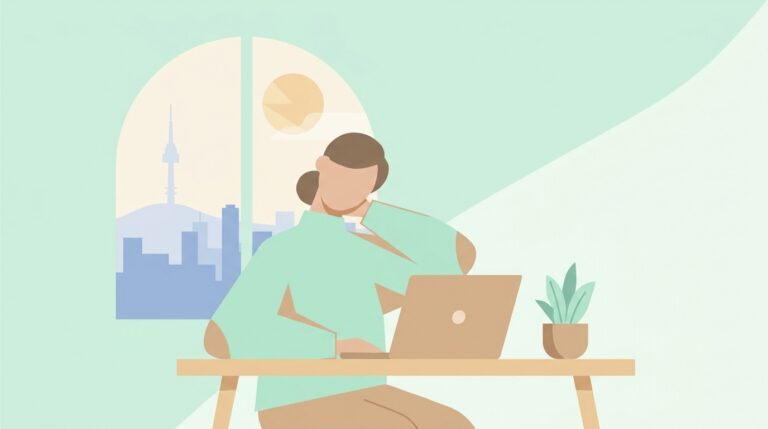
Sitting at Your Desk Too Long? How to Handle a Stiff Neck and Visit a Korean Clinic Like a Local
Phase 1: Empathy (Story Opening)
안녕하세요! 매일한글 에디터입니다. (Hello! I’m your Daily Hangul editor.)
Picture this: You just spent an intense five hours at a stylish cafe in Yeonnam-dong or an all-night PC bang in Hongdae, finishing an assignment or binge-watching your favorite new K-drama. You decide to stretch, try to rotate your head, and—freeze—a sharp, dull ache shoots right across your trapezius. Your neck and upper back feel as rigid as concrete. You try to look to the left, but your whole upper torso has to rotate like a robot.
In Korea, this happens so often that there is an exact cultural and medical word for it: “담에 걸리다” (dam-e geollida). Yet, walking into a local neighborhood 정형외과 (jeonghyeong-oegwa – orthopedic clinic) can feel terrifying when your Korean is at the elementary A2 level. Do you need an appointment? What if the doctor asks you technical questions? Will they think you broke a bone?
Take a deep breath! As your trusted Korean culture navigator with over a decade of teaching international learners, I have accompanied dozens of students to local clinics for this exact issue. This comprehensive guide will equip you with natural, authentic phrases to clearly describe neck stiffness, ask for physical therapy, and glide through a Korean medical visit with total confidence.
Phase 2: Top 3 Core Expressions (Deep Dive)
1. 담에 걸렸어요 (Dam-e geollyeosseoyo)
- Pronunciation: [Dam-e geol-lyeo-sseo-yo] (Think: “Tahm-eh gull-yuh-so-yo”)
- Meaning: Literal: “Caught in stagnant energy/phlegm” vs. Real Nuance: “I have a sudden muscle spasm / painful muscle knot.”
- K-Culture Moment: Seen in almost every office K-drama (like Misaeng), where an overworked salaryman turns his entire body stiffly to face his supervisor while muttering, “아, 목에 담 걸렸네…” (Ah, I got a cramp in my neck…).
- Editor’s Insight: Traditional Eastern medicine believed that stagnant fluids (“담”, dam) gathered in muscle layers due to stress or bad posture. Today, modern Koreans use this phrase daily to describe that sudden, sharp muscle knot that makes movement agonizing.
- Situation Spectrum: Casual (담 걸렸어) ✅ | Semi-formal (담에 걸렸어요) ✅ | Formal (담에 걸렸습니다) ✅
- 🤔 Think About It: In English, we say “I got a kink in my neck” or “My back locked up.” Notice how Korean conceptualizes this as something you “catch” (걸리다), similar to catching a cold (감기에 걸리다)!
2. 목이랑 어깨가 뻐근해요 (Mog-irang eokkae-ga ppeogeunhaeyo)
- Pronunciation: [Mog-i-rang eok-kae-ga ppeo-geun-hae-yo] (Think: “Moke-ee-rahng up-kay-gah puh-goon-hay-yo”)
- Meaning: Literal: “Neck and shoulders are stiff/heavy” vs. Real Nuance: “My neck and shoulders feel tight, achy, and congested.”
- K-Culture Moment: K-pop idols during behind-the-scenes dance practice vlogs rolling their shoulders and groaning that their muscles feel “뻐근하다” after ten hours of repetitive choreography.
- Editor’s Insight: “뻐근하다” (ppeogeunhada) is the ultimate desk-worker sensory adjective. It doesn’t mean sharp stabbing pain (which would be 찌릿하다) or bruised soreness (욱신거리다); it captures heavy, stubborn muscle fatigue.
- Situation Spectrum: Casual (뻐근해) ✅ | Semi-formal (뻐근해요) ✅ | Formal (뻐근합니다) ✅
- 🤔 Think About It: English often bundles muscle discomfort under generic terms like “sore” or “hurts.” Korean breaks down pain into tactile, expressive textures like 뻐근하다. How do you describe this specific heaviness in your native language?
3. 물리치료 받고 싶어요 (Mullichiryo batgo sipeoyo)
- Pronunciation: [Mul-li-chi-ryo bat-go sip-eo-yo] (Think: “Mool-lee-chee-ryo paht-go sheep-uh-yo”)
- Meaning: Literal: “I want to receive physical therapy” vs. Real Nuance: “I’d like to get routine physical therapy (hot pack, electrical stim, traction).”
- K-Culture Moment: Neighborhood halmeoni (grandmothers) and tired college students gathering peacefully in the warm physical therapy room on heated beds after a consultation.
- Editor’s Insight: In many Western countries, “physical therapy” implies a lengthy rehab process requiring physician referrals and weeks of scheduling. In Korea, you can walk into almost any neighborhood 정형외과, pay a modest fee, and receive 40 minutes of soothing heat, ultrasound, and TENS electrical treatment right away!
- Situation Spectrum: Casual (물리치료 받을래) ✅ | Semi-formal (물리치료 받고 싶어요) ✅ | Formal (물리치료를 희망합니다) ⚠️ (A bit too dramatic for spoken dialogue)
- 🤔 Think About It: Why is routine physical therapy so culturally normalized and accessible across neighborhood clinics in South Korea compared to other countries?
Phase 3: Textbook Korean vs. Real Korean
Situation 1: Describing the discomfort to the clinic receptionist
- 📖 교과서 한국어 (Textbook): “경추 부위에 극심한 통증이 발생했습니다.” (Gyeongchu buwie geuksimhan tongjeungi balsaenghaesseumnida. – Severe pain has occurred in the cervical spine area.)
- 🗣️ 진짜 한국어 (Real-life): “컴퓨터 앞에 오래 앉아 있었더니 뒷목이 담 걸린 것처럼 뻐근해요.” (Keompyuteo ape orae anja isseotdeoni dwinmogi dam geollin geotcheoreom ppeogeunhaeyo. – Sitting at the computer for so long made my neck and shoulders stiff like a cramp.)
- 💡 왜 다를까? (Why the difference?): Textbook phrasing uses heavy clinical jargon meant for medical journals. Real native speakers describe the context (“컴퓨터 앞에 오래 앉아서”) and sensory state (“담 걸린 것처럼 뻐근해요”).
Situation 2: Asking for treatment after the examination
- 📖 교과서 한국어 (Textbook): “의사 선생님, 치료 절차를 집행해 주십시오.” (Uisa seonsaengnim, chiryo jeolchareul jiphaenghae jusipsio. – Doctor, please execute the treatment procedure.)
- 🗣️ 진짜 한국어 (Real-life): “오늘 물리치료도 같이 받을 수 있을까요?” (Oneul mullichiryodo gachi badeul su isseulkkayo? – Could I also get physical therapy today?)
- 💡 왜 다를까? (Why the difference?): “집행하다” sounds like an official legal execution! Using “~받을 수 있을까요?” is polite, warm, and natural for A2 learners communicating with healthcare professionals.
Phase 4: K-Culture Deep Dive & Non-Verbal Manners
4-1. 눈치 (Nunchi) & Clinic Body Language
When speaking with a Korean doctor, non-verbal etiquette is just as important as words:
* The Gentle Point: When saying “뒷목” (back of neck) or “어깨” (shoulder), place one hand gently behind your neck and slowly rotate your head to illustrate restricted movement.
* Avoid Loud Agony: While you should never hide pain, excessive groaning or shouting can cause confusion. A controlled grimace with a quiet “아, 여기까지밖에 안 돌아가요” (Ah, it only turns up to here) communicates the problem clearly.
* Two-Handed Respect: When handing your Alien Registration Card, passport, or credit card to the receptionist, always use both hands (or support your right forearm with your left hand) to show polite respect.
4-2. Cultural Code: “거북목” (Geobungmok – Turtle Neck Syndrome)
Walk into any Korean office, cafe, or high school study room, and you will hear people talking about “거북목 증후군” (Turtle Neck Syndrome). Because South Korea is one of the most hyper-connected, tech-forward societies on Earth, forward-head posture is considered a modern lifestyle hazard. Korean orthopedic clinics excel specifically at treating this condition with specialized therapy beds, aqua-massage units, and ergonomic recommendations tailored to digital workers.
Phase 5: Real-Life Roleplay Scenario
Setting: Barun Orthopedic Clinic (바른정형외과) near Gangnam Station. The atmosphere is tidy and calm, with warm amber lighting and the gentle hum of therapy machines.
Characters: Dr. Min (a reassuring physician) and Alex (an A2 Korean learner with a frozen neck).
- Turn 1:
- Dr. Min: “알렉스 씨, 어디가 불편해서 오셨어요?”
- (Alex-ssi, eodiga bulpyeonhaeseo osyeosseoyo?)
- “Alex, what seems to be making you uncomfortable today?”
🎭 Adjusting his spectacles and listening attentively
- Turn 2:
- Alex: “선생님, 컴퓨터 앞에 오래 앉아 있었더니 뒷목이랑 어깨가 담 걸린 것처럼 뻐근해요.”
- (Seonsaengnim, keompyuteo ape orae anja isseotdeoni dwinmog-irang eokkae-ga dam geollin geotcheoreom ppeogeunhaeyo.)
- “Doctor, sitting at the computer for so long made my back neck and shoulders stiff like a cramp.”
🎭 Gently holding the back of the neck and wincing slightly
- Turn 3:
- Dr. Min: “아이고, 많이 불편하셨겠네요. 고개를 왼쪽으로 한번 돌려보실래요?”
- (Aigo, mani bulpyeonhasyeotgenneyo. Gogaereul oenjjogeuro hanbeon dollyeobosillaeyo?)
- “Oh dear, that must have been very uncomfortable. Could you try turning your head to the left?”
🎭 Making a slow demonstration gesture with his hands
- Turn 4:
- Alex: “왼쪽으로 돌릴 때 여기가 찌릿하면서 안 돌아가요.”
- (Oenjjogeuro dollil ttae yeogiga jjorithamyeonseo an doragayo.)
- “When I turn to the left, it stings right here and won’t turn any further.”
🎭 Halting movement halfway with a cautious expression
- Turn 5:
- Dr. Min: “근육이 심하게 뭉쳤네요. 디스크는 아니니까 너무 걱정하지 마세요.”
- (Geunyugi simhage mungchyeotneyo. Diseukeuneun aninikka neomu geokjeonghaji maseyo.)
- “Your muscles are severely knotted up. It’s not a herniated disc, so don’t worry too much.”
🎭 Palpating the trapezoid muscles with gentle thumbs
- Turn 6:
- Alex: “정말 다행이에요! 오늘 물리치료도 같이 받을 수 있나요?”
- (Jeongmal dahaengieyo! Oneul mullichiryodo gachi badeul su innayo?)
- “What a relief! Can I also get physical therapy today?”
🎭 Breathing a noticeable sigh of relief
- Turn 7:
- Dr. Min: “네, 온열 찜질이랑 전기 치료를 30분 정도 받고 가세요. 약도 처방해 드릴게요.”
- (Ne, onyeol jjimjirirang jeongi chiryoreul samsipbun jeongdo batgo gaseyo. Yakdo cheobanghae deurilgeyo.)
- “Yes, please receive hot packs and electrical therapy for about 30 minutes before leaving. I will also prescribe medication.”
🎭 Typing notes into the patient chart system
- Turn 8:
- Alex: “감사합니다, 선생님!”
- (Gamsahamnida, seonsaengnim!)
- “Thank you so much, doctor!”
🎭 Offering a polite, seated 15-degree bow
🔀 Interactive Choice Point
You are now lying on the therapy bed. The therapist attaches the suction cups of the electric stimulation unit and asks:
“자, 자극 시작합니다. 강도 괜찮으세요?” (Starting stimulation now. Is the intensity okay?)
- Choice A: “네, 딱 좋아요! 시원해요.” (Ne, ttak joayo! Siwonhaeyo.)
- Feedback [Best]: Natural and native! In Korea, feeling relieved by warmth or tension release is described as “시원하다” (refreshing/satisfying).
- Choice B: “너무 아파요! 이거 당장 멈추세요!” (Neomu apayo! Igeo dangjang meomchuseyo!)
- Feedback [Bad]: Overly aggressive. Sounds like you are ordering an emergency shutdown in panic.
- Choice C: “조금만 약하게 해주실 수 있나요?” (Jogeumman yak-hage haejusil su innayo?)
- Feedback [Best Alternative]: Polite and clear if the electrical pulses feel slightly too intense or pinch-like.
Phase 6: 10-Second Emotional Shadowing Drill
Practice speaking these phrases with real feelings. Pause at each slash (/):
[😣 뻐근하고 답답하게 - Frustrated & stiff]
“컴퓨터를 오래 했더니 / 뒷목이 너무 뻐근해요.”
(Keompyuteoreul orae haetdeoni / dwinmogi neomu ppeogeunhaeyo.)
— “I worked on the computer so long / my back neck feels so stiff.”-
[🥺 조심스럽고 걱정스럽게 - Worried & cautious]
“목에 담이 걸려서 / 고개가 잘 안 돌아가요.”
(Moge dami geollyeoseo / gogaega jal an doragayo.)
— “I got a cramp in my neck / and my head barely turns.” -
[🙏 정중하고 간절하게 - Polite & hopeful]
“오늘 물리치료 받고 싶은데 / 지금 가능할까요?”
(Oneul mullichiryo batgo sipeunde / jigeum ganeunghalkkayo?)
— “I would like physical therapy today / would that be possible now?”
Phase 7: K-Culture Mini Dictionary
- 정형외과 (Jeonghyeong-oegwa) | Orthopedic Clinic | The primary destination for bone, joint, ligament, and muscle issues. Look for this green medical sign when suffering from neck knots or ankle twists.
- 담 (Dam) | Muscle Knot / Spasm | A traditional linguistic concept representing sudden, sharp, localized muscle tension caused by bad posture or drafts.
- 뻐근하다 (Ppeogeunhada) | Heavily Stiff / Fatigued Ache | The standard descriptor for muscle tightness after desk work, intense studying, or awkward sleeping positions.
- 물리치료 (Mullichiryo) | Physical Therapy | Fast, highly accessible clinic treatment incorporating thermal pads (온열 찜질), electrical nerve stimulation (전기 치료), and water massage beds.
Phase 8: Traveler’s Survival Kit
Survival TOP 3 Phrases
- 1. 어깨가 많이 뭉쳤어요. (Eokkae-ga mani mungchyeosseoyo.)
- Meaning: My shoulders are heavily knotted.
- Pro Tip: Use the verb “뭉치다” (to form clumps/knots) to describe tight shoulder knots.
- 2. 파스 좀 추천해 주세요. (Paseu jom chucheonhae juseyo.)
- Meaning: Please recommend some pain relief patches.
- Pro Tip: Say this at any neighborhood pharmacy (약국) if you don’t have time for a full clinic visit.
- 3. 보험 서류 발급해 주세요. (Boheom seoryu balgeuphae juseyo.)
- Meaning: Please issue paperwork for insurance.
- Pro Tip: Essential for international travel insurance reimbursement claims.
Editor’s Travel Note
- Finding Clinics: Download the Naver Map App for clinics and transport and search “정형외과”. You will see dozens of clinics nearby with real customer reviews and operating hours.
- Walk-in Friendly: Almost zero neighborhood clinics require advance bookings. Simply bring your passport or Alien Registration Card.
- Cost Expectations: With Korean National Health Insurance, an exam plus physical therapy usually costs around 10,000–14,000 KRW. Without insurance, expect around 35,000–50,000 KRW ($25–$38 USD)—remarkably reasonable compared to Western outpatient rates!
Phase 9: “One Step Deeper” (Reflective Essay)
In Korean society, physical ailments are rarely viewed as isolated bodily malfunctions. Instead, acknowledging that someone has “담 걸렸다” (a cramp) or feels “뻐근하다” (heavy stiffness) is a shared social ritual that validates hard work. When colleagues or classmates notice someone rubbing their neck, it evokes immediate “정” (Jeong – mutual warmth and compassion), often prompting an offer of a pain patch (파스) or a hot herbal beverage. Experiencing and communicating these physical aches connects you straight to the everyday human rhythm of life in Korea.
💬 Your Turn: Have you ever experienced a stubborn muscle knot while traveling or working abroad? How do people in your culture treat neck stiffness? Share your story in the comments below!
Phase 10: FAQ & Mistake Prevention
Q: Can I visit a Korean orthopedic clinic as a foreign tourist without local insurance?
A: Absolutely! Walk directly to the reception desk, present your passport, and fill out the simple intake sheet (name, address, symptoms). You pay the uninsured rate at checkout with any major international credit card.
Q: What is the difference between 정형외과 (Orthopedics) and 한의원 (Oriental Medicine Clinic)?
A: 정형외과 focuses on Western medicine: X-rays, pharmaceutical muscle relaxants, and electrotherapy. 한의원 provides acupuncture (침), cupping (부항), and herbal medicine. Both are exceptionally popular for muscle tension!
Q: How long does a standard physical therapy session take?
A: The physical therapy portion usually lasts between 35 and 50 minutes, comprising warm heat pads (15 mins), electrical stimulation (15 mins), and a mechanical massage or laser treatment (10 mins).
🚨 Common Mistakes Alert
- Mistake: Saying “목이 부러졌어요!” (Mogi bureojyeosseoyo!) when your neck just hurts.
- Correct Action: “부러지다” means to break/fracture. Say “목이 뻐근해요” (My neck is stiff) or “담 걸렸어요” (I have a knot).
- Mistake: Rushing to a major university emergency room (응급실) for desk-related neck strain.
- Correct Action: Emergency rooms have expensive triage fees. Visit a local neighborhood “의원” (local clinic) during daytime hours instead.
- Mistake: Leaving the clinic without requesting diagnostic receipts for travel insurance.
- Correct Action: Always say: “진료비 영수증하고 세부내역서 주세요” (Please give me the itemized medical receipt and breakdown).
Phase 11: Action Missions & Engagement
- 🥉 Bronze Level: Stand in front of your mirror, touch your neck, and say clearly 3 times: “컴퓨터를 오래 앉아 있었더니 뒷목이 뻐근해요!”
- 🥈 Silver Level: Share this post or a photo of your desk setup with the Korean caption: “오늘 공부를 너무 열심히 해서 목에 담 걸렸어요! 💻” and tag our community.
- 🥇 Gold Level: Enter a Korean pharmacy (약국) or clinic and use the phrase: “목에 붙이는 시원한 파스 하나 주세요!” (Please give me one cooling pain patch for my neck!).
- 🎮 K-Culture Mission: Watch the next K-drama on your list and spot characters applying pain patches (파스) to their necks or shoulders. Notice how their friends react!
Phase 12: Interactive Quiz Challenge
Test what you learned today! Think about each question before revealing the answers below.
- Situation Judgment: You sit down with the doctor and want to explain that your upper back and neck feel heavy, tight, and fatigued from screen time. What is the most natural A2 phrase?
- A) 목이 완전히 부러졌어요.
- B) 뒷목이랑 어깨가 담 걸린 것처럼 뻐근해요.
- C) 수술을 지금 즉시 시작해 주세요.
- Fill in the Blank: “선생님, 오늘 치료 끝나고 [ ]도 같이 받을 수 있나요?” (Doctor, after treatment, can I also receive physical therapy?)
-
True / False Cultural Check: In South Korea, you must always visit a general practitioner first to get a referral before you can go to an orthopedic clinic (정형외과). (True / False)
👉 Click to view answers and explanations!
- Correct Answer: B
- Explanation: Choice A means “my neck is completely broken,” and Choice C means “please start surgery immediately.” Choice B is natural, polite, and descriptive!
- Correct Answer: 물리치료 (Mullichiryo)
- Explanation: “물리치료” specifically denotes physical therapy.
- Correct Answer: False
- Explanation: South Korea allows patients to directly access primary orthopedic specialty clinics (정형외과) as walk-ins without any general practitioner referral!
- Explanation: South Korea allows patients to directly access primary orthopedic specialty clinics (정형외과) as walk-ins without any general practitioner referral!
🎬 Watch Our Daily Videos! (Daily Hangul Official Instagram)
Review the expressions you learned in this article with our fun daily short videos! Check out native pronunciation and real-life nuances in action.
- Instagram @dailyhangul_en







