

Beyond Rules and Calculations: Mastering Virtue Ethics and Moral Dilemmas in C2 Korean
Phase 1: Empathy (Story-driven Opening)
안녕하세요! 매일한글 에디터입니다.
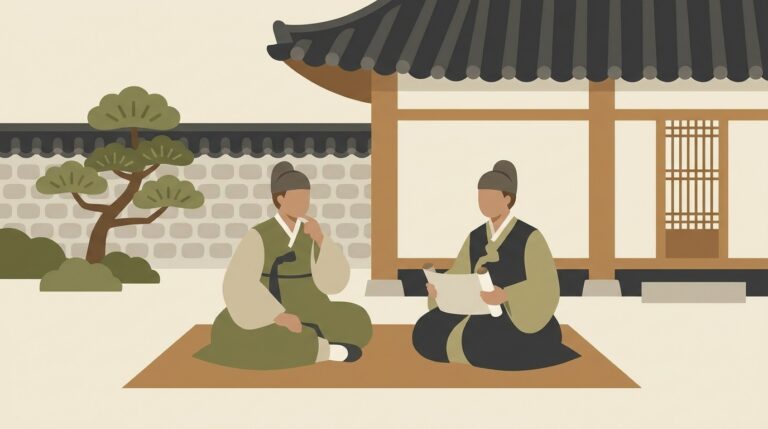
Have you ever sat through an intellectually charged discussion in Seoul—perhaps over a slow pour-over in a book café near Hyehwa or during an advanced seminar at a university—and felt that standard ethical vocabulary fell short? Many C2 learners master Kantian deontology (의무론) or utilitarian calculations (공리주의), only to freeze when a Korean colleague or professor remarks: “규칙도 규칙이지만, 그 사람의 됨됨이나 공동체적인 맥락을 봐야 하지 않을까요?” (Rules are rules, but shouldn’t we consider their character and the communal context?)
In contemporary Western philosophy, Alasdair MacIntyre famously revitalized Aristotelian virtue ethics (덕 윤리학). Rather than reducing morality to mechanical utility calculus or rigid, universal imperatives, MacIntyre argued that ethical maturity requires cultivating moral character (덕) and practical wisdom (phronesis, 실천적 지혜) within a living, relational community.
In South Korea, this philosophical shift is not an abstract academic exercise; it reflects the bedrock of social life. Korean culture has spent centuries weaving Confucian relational virtues with modern institutional democracy, creating an environment where an individual’s doemdoemi (됨됨이, moral fiber) and communal harmony weigh just as heavily as written codices. If you rely solely on rigid legalistic arguments, your Korean can sound cold, abrasive, or foreign. This guide, grounded in direct feedback from advanced learners and intellectual discourse in Korea, gives you the linguistic precision and cultural depth needed to navigate moral dilemmas with authentic eloquence.
Phase 2: Core Expressions (3 In-Depth Analyses)
1. 도덕적 품성 (Dodeokjeok pumseong)
- Pronunciation: [Dodeokjeok pumseong] (Think “doh-duck-juck poom-sung”, articulate the stops cleanly with a rounded nasal finish)
- Meaning: Literal: Moral character/nature | Actual Nuance: An ingrained disposition of virtue and integrity cultivated over time within a social community.
- K-Culture Moment: In the critically acclaimed legal thriller Secret Forest (Stranger), prosecutors constantly debate whether justice stems from institutional protocols or the personal moral character of the prosecutor.
- Editor’s Insight: While 성격 (seong-gyeok) means ordinary personality and 인성 (in-seong) refers to basic human decency, 품성 (pumseong) denotes a refined, tested ethical constitution.
- Situation Spectrum: Casual 🚫 | Semi-formal ⚠️ | Formal ✅
- 🤔 Think About It: Does your native language distinguish between an individual’s casual personality and their deeply cultivated moral character?
2. 실천적 지혜 (Silcheonjeok jihye)
- Pronunciation: [Silcheonjeok jihye] (Flows smoothly like “sheel-chun-juck jee-hyeh”)
- Meaning: Literal: Practical wisdom | Actual Nuance: The Korean translation of Aristotle and MacIntyre’s phronesis—the discernment to enact the right virtue at the right moment within an ambiguous situation.
- K-Culture Moment: In the masterpiece drama My Mister (나의 아저씨), Dong-hoon navigates corporate corruption not by quoting corporate bylaws, but by exercising compassionate, situational discernment.
- Editor’s Insight: This phrase opposes mere 이론적 지식 (theoretical knowledge). It demonstrates high intellectual pedigree when arguing against dogmatic rule-following.
- Situation Spectrum: Casual ⚠️ | Semi-formal ✅ | Formal ✅
- 🤔 Think About It: When rules produce an absurd outcome, what linguistic tools do you use in your mother tongue to advocate for situational judgment?
3. 공동체적 유대 (Gongdongchejeok yudae)
- Pronunciation: [Gongdongchejeok yudae] (Sounds like “gong-dong-cheh-juck yoo-deh”)
- Meaning: Literal: Communitarian bonds/solidarity | Actual Nuance: The living social and moral fabric that interconnects individuals, demanding mutual responsibility beyond legal contracts.
- K-Culture Moment: Seen frequently in historical documentaries analyzing how Korean civil society rallies during economic crises, such as the 1997 gold-collecting campaign.
- Editor’s Insight: MacIntyre argued that human beings cannot practice virtue in a vacuum. Using this phrase anchors your argument firmly in communitarian philosophy rather than hyper-individualism.
- Situation Spectrum: Casual 🚫 | Semi-formal ✅ | Formal ✅
- 🤔 Think About It: How does viewing oneself as part of an ongoing community narrative change one’s personal moral obligations?
Phase 3: Textbook Korean vs. Real Korean
Situation 1: Challenging dogmatic rule-enforcement
- 📖 교과서 한국어: 우리는 의무론적 규범에 따라 정언명령을 준수해야 합니다. (We must obey the categorical imperative according to deontological norms.)
- 🗣️ 진짜 한국어: 규칙만 맹목적으로 따지기보다, 사안의 맥락을 살피는 실천적 지혜를 발휘해야 해요. (Rather than blindly arguing over rules, we need to exercise practical wisdom that considers the context of the issue.)
- 💡 왜 다를까? Advanced native speakers rarely recite Western philosophy formulas directly in meetings; they soften the imperative while elevating situational wisdom.
Situation 2: Critiquing a cold cost-benefit decision
- 📖 교과서 한국어: 공리주의 관점에서 최대 다수의 최대 행복을 계산합시다. (Let us calculate the greatest happiness for the greatest number from a utilitarian perspective.)
- 🗣️ 진짜 한국어: 단순한 득실 계산을 떠나서, 이 결정이 우리 공동체의 신뢰와 품성에 미칠 영향을 헤아려야 합니다. (Setting aside simple profit-and-loss calculations, we must weigh the impact this decision will have on our community’s trust and moral character.)
- 💡 왜 다를까? The word 헤아리다 (to consider deeply/empathize) replaces sterile arithmetic verbs, signaling emotional maturity and philosophical weight.
Phase 4: K-Culture Deep Dive & Non-Verbal Manners
4-1. 눈치 (Nunchi) & Deliberative Gestures
In Korean intellectual debates, firing back an immediate retort makes one appear combative and shallow. When presenting a virtue-ethics critique:
* The Pause of Gravitas: Wait two full seconds before responding. A gentle downward tilt of the head accompanied by a quiet sigh indicates that you are genuinely wrestling with the dilemma.
* Eye Contact & Hands: Maintain a soft, reflective gaze (헤아리는 눈빛) rather than an intense stare. Rest your hands open on the table; never point index fingers when criticizing an ethical stance.
4-2. Cultural Code Analysis: The Echo of Confucian Virtues
Alasdair MacIntyre’s critique of post-Enlightenment moral philosophy finds a natural home in Korea because traditional Korean thought never separated ethics from human cultivation. The four Confucian virtues—In (인, benevolence), Ui (의, righteousness), Ye (예, propriety), and Ji (지, moral discernment)—are essentially virtue ethics. Modern Korean dramas that explore moral corruption, such as Stranger or The Devil Judge, resonate with audiences precisely because the ultimate failure of the antagonists is never a lack of legal knowledge, but an erosion of character (품성의 결여).
Phase 5: Real-World Roleplay Scenario
Setting: An editorial lounge at an academic publishing house in Sinchon. Senior editor Ji-hoon (지훈) is discussing how to handle an ambiguous plagiarism accusation against a respected elder researcher.
- 지훈: 민우 씨, 규정집만 놓고 보면 즉각 논문 철회와 징계가 맞지만, 이번 사안을 기계적으로 처리하기엔 너무 가혹하지 않나요?
(Min-woo, if we strictly look at the rulebook, an immediate retraction and disciplinary action is correct, but isn’t it too harsh to process this mechanically?)
🎭 한숨을 내쉬며 안경을 벗어 만지작거린다.(Sighs and fiddles with his glasses) - 민우: 저 역시 안타깝습니다. 하지만 학계의 원칙을 무너뜨리면 연구팀 전체의 도덕적 품성에 금이 가지 않을까요?
(I also feel regret. But if we tear down the scholarly principles, wouldn’t it fracture the moral character of the entire research team?)
🎭 차분하고 조심스럽게 고개를 끄덕인다.(Nods calmly and prudently) - 지훈: 물론입니다. 하지만 한 사람의 전 생애에 걸친 학문적 기여와 공동체적 유대를 규정 한 줄로 완전히 단절하는 건 의문입니다.
(Of course. But I question severing a person’s lifelong academic contribution and communal solidarity over a single line in a rulebook.)
🎭 눈을 마주치며 설득하듯 손바닥을 펼친다.(Makes eye contact and opens his palms persuasively) - 민우: 그렇다면 매킨타이어가 말한 ‘실천적 지혜’가 필요한 순간이군요.
(Then this is precisely the moment where the ‘practical wisdom’ MacIntyre spoke of is needed.)
🎭 지훈의 말에 진지하게 경청하며 몸을 앞으로 기울인다.(Listens attentively, leaning forward) - 지훈: 실천적 지혜라… 민우 씨는 구체적으로 어떤 해법을 생각하고 계신가요?
(Practical wisdom… What concrete solution do you have in mind, Min-woo?)
🎭 호기심과 기대가 섞인 표정으로 묻는다.(Asks with mixed curiosity and anticipation) - 민우: 흑백논리로 단죄하기보다, 본인이 직접 과오를 성찰하고 학계 공동체에 기여하며 바로잡을 기회를 주는 겁니다.
(Rather than condemning him through black-and-white logic, we give him the opportunity to reflect on his wrongdoing and rectify it while contributing to the academic community.)
🎭 단호하면서도 온화한 어조로 말한다.(Speaks in a firm yet gentle tone) - 지훈: 규칙 계산에만 갇혀 있던 제 시야가 트이는 것 같네요. 그게 바로 덕을 기르는 공동체의 모습이겠죠.
(It feels like my perspective, trapped only in rule calculations, is broadening. That must be what a community cultivating virtue looks like.)
🎭 미소를 띠며 안도하는 표정을 짓는다.(Smiles with a relieved expression) - 민우: 맞습니다. 제도적 정의와 인간적 성품이 조화를 이룰 때 비로소 진정한 윤리가 완성되니까요.
(Precisely. Because true ethics is completed only when institutional justice and human character achieve harmony.)
🎭 정중하게 목례하며 대화를 매듭짓는다.(Bows politely to conclude the dialogue)
🔀 Interactive Decision Point
How would you conclude your stance if pressed to choose between strict punitive action and communal restoration?
- Option A: “규범 위반은 절대 예외를 둬서는 안 됩니다. 정언명령에 따라 일벌백계해야 합니다.”
Feedback (Bad): Excessively rigid Kantian dogmatism. Shuts down dialogue and damages collegial solidarity. - Option B: “규칙만 앞세우기보다, 구성원의 성품 형성과 공동체적 신뢰를 회복할 실천적 해법을 모색합시다.”
Feedback (Best): Perfectly channels MacIntyrean virtue ethics, articulating phronesis with refined elegance. - Option C: “조직의 대외적 이미지가 우선이니 이번 일은 조용히 덮고 넘어가는 게 최대 다수를 위한 길입니다.”
Feedback (Risk): Cynical utilitarianism masquerading as harmony; obliterates moral integrity.
Phase 6: 10-Second Emotional Shadowing Drill
Practice these with natural emotional inflection, respecting the slash (/) pauses:
[🤔 깊이 고뇌하며 진중하게]
원칙의 기계적 적용보다는, / 그 상황에 걸맞은 / 실천적 지혜를 발휘해야 합니다.
(Wonchik-ui gigyejeok jeok-yong-bodaneun, / geu sanghwang-e geolmajeun / silcheonjeok jihye-reul balhwi-haeya hamnida.)
“Rather than the mechanical application of principles, we must exercise practical wisdom appropriate for that context.”-
[💡 확신을 담아 차분하게]
단순한 규칙 계산을 넘어, / 공동체의 도덕적 품성을 / 함께 일구는 과정이 본질입니다.
(Dansunhan gyuchik gyesan-eul neomeo, / gongdongche-ui dodeokjeok pumseong-eul / hamkke ilguneun gwajeong-i bonjil-imnida.)
“Beyond simple rule calculation, the process of cultivating our community’s moral character together is the essence.” -
[🤝 따뜻하고 단단한 어조로]
개인의 권리만큼이나 / 서로를 지탱하는 / 공동체적 유대 역시 소중합니다.
(Gaein-ui gwonrimankeumina / seororeul jitaenghaneun / gongdongchejeok yudae yeoksi sojunghamnida.)
“Just as much as individual rights, the communal bonds that support one another are equally precious.”
Phase 7: K-Culture Mini Dictionary
- 됨됨이 (Doemdoemi) | Human moral caliber / personal substance
Usage: Widely used in professional hiring evaluations, academic recommendations, and everyday judgments of integrity (e.g., “그 친구는 기본 됨됨이가 바르다”). - 공선사후 (Gongseonsahu) | Prioritizing public good before private concerns
Usage: Classical four-character idiom frequently cited in public policy debates and civil leadership. - 정언명령 (Jeongeonmyeongnyeong) | Categorical imperative (Kant)
Usage: Fundamental philosophical terminology used in academia, media criticism, and legal theory. - 덕목 (Deongmok) | Specific moral virtue (e.g., justice, prudence, courage)
Usage: Standard term in organizational culture and ethics education to describe cardinal values.
Phase 8: Traveler’s Survival Kit (For Cultural & Intellectual Explorations)
Top 3 Survival Phrases for Intellectual Discourse:
- 맥락을 헤아릴 필요가 있습니다. (Maengnakeul hearil piryoga itseumnida.)
Translation: “We need to take the broader context into account.”
Pro Tip: Use this to defuse extreme black-and-white arguments gracefully. - 공동체의 신뢰가 무엇보다 우선이지요. (Gongdongche-ui sinroega mueotboda useon-ijiyo.)
Translation: “The trust of the community comes before all else.” - 원칙과 현실 사이의 균형이 관건입니다. (Wonchikgwa hyeonsil sai-ui gyunhyeong-i gwangeon-imnida.)
Translation: “The balance between principles and reality is the critical factor.”
Editor’s Travel Note:
If you wish to experience real intellectual discourse in Seoul, visit the indie humanities bookshops and lecture spaces in Hyehwa (Daehangno) or near Sinchon. To navigate these tucked-away cultural salons effortlessly, utilize the Naver Map app download for navigation. When participating in an open seminar, arrive ten minutes early, grab a notebook, and wait for the moderated Q&A rather than speaking out of turn.
Phase 9: “One Step Deeper” (Reflective Essay)
Korean ethical sentiment has long operated on the bedrock of relational virtues rather than detached moral atomism. While modern Western ethics often pits individual Kantian duties against utilitarian cost-benefit analyses, Alasdair MacIntyre’s revival of virtue ethics strikes an instinctive chord in Korean culture. Here, concepts like Jeong (정) and Woori (우리) are not merely sentimental attachments; they represent an ongoing communal narrative where one’s moral character (doemdoemi) is co-authored by the community. When you engage with ethical dilemmas in Korean, remembering that morality is a shared, lived practice—not a mechanical formula—will instantly elevate your Korean from grammatically functional to culturally profound.
💬 Your Turn: What core virtue (덕목) do you think is most urgently needed in our modern digital society? Share your perspective in Korean below!
Phase 10: FAQ & Common Mistakes
Q: What is the exact difference between 도덕 (dodeok) and 윤리 (yunri)?
A: While often used interchangeably, 도덕 (morals) refers more to internalized personal virtues and conscience, whereas 윤리 (ethics) emphasizes systemic, professional, or social normative frameworks (e.g., 의사 윤리, 연구 윤리).
Q: Can I use the word 됨됨이 in a formal academic paper?
A: In strictly formal written papers, 도덕적 품성 (moral character) or 인품 (personal dignity) is preferred. However, in formal spoken debates, panels, and interviews, 됨됨이 is widely used and respected for its depth.
Q: How do I express Kant’s “deontology” versus “utilitarianism” naturally?
A: Use 의무론 (deontology) and 공리주의 (utilitarianism). When contrasting them with virtue ethics, frame it as: “의무론의 원칙주의와 공리주의의 결과주의를 넘어 덕 윤리학의 성품론에 주목해야 합니다.”
🚨 Common Mistakes Warning Board:
- Mistake 1: Translating “virtue” as 단순한 장점 (simple advantage).
Correct Action: Use 덕 (deok) or 덕목 (deongmok) when referring to moral virtues. - Mistake 2: Confusing 성격 (personality/temperament) with 품성 (moral character).
Correct Action: Say 품성이 훌륭하다 when evaluating moral character, not 성격이 훌륭하다. - Mistake 3: Translating phronesis merely as 지식 (intellectual knowledge).
Correct Action: Always use 실천적 지혜 (practical wisdom) to preserve the teleological meaning.
Phase 11: Action Mission & Engagement
- Bronze Mission: Record yourself reading the three Shadowing Drill sentences, focusing on the intonation of “실천적 지혜”.
- Silver Mission: Leave a two-sentence comment under a Korean news editorial or debate video assessing an ethical issue using the word “공동체적 유대”.
- Gold Mission: Engage in a 5-minute discussion with an advanced language partner or tutor, debating whether AI algorithms can ever develop “실천적 지혜”.
- 🎮 K-Culture Mission: Watch an episode of a legal drama like Secret Forest or The Devil Judge, and identify one scene where a protagonist resolves a conflict via character rather than bureaucratic rules.
Phase 12: Interactive Quiz Challenge
1. Situation Judgment:
A company leader faces a dilemma: report an unintentional regulatory violation that will destroy hundreds of jobs, or quietly remediate it internally without external reporting. Which statement best reflects modern virtue ethics?
(A) 규정 위반은 무조건 외부 고발을 통해 원칙대로 처벌받아야 합니다.
(B) 일자리를 지키는 것이 최대 다수의 최대 행복이므로 덮어두어야 합니다.
(C) 규정의 맹목적 적용이나 단순한 손익을 넘어, 조직의 도덕적 품성과 장기적 신뢰를 지킬 실천적 지혜를 발휘해야 합니다.
2. Fill-in-the-Blank:
매킨타이어의 덕 윤리학은 개별 행위의 규칙 계산을 넘어 공동체 안에서 [ ]와 도덕적 성품을 기르는 데 주목합니다.
(Hint: The Korean philosophical rendering of Aristotelian phronesis)
3. True or False:
In Korean intellectual discourse, discussing ‘됨됨이’ and ‘인품’ is viewed as superficial etiquette that has no bearing on serious philosophical debate. (True / False)
Click to reveal answers & explanations!
- Answer: (C)
Explanation: (C) transcends rigid deontology (A) and crude utilitarianism (B) by focusing on practical wisdom (실천적 지혜) and character. - Answer: 실천적 지혜 (or 실천적 지혜 / Phronesis)
Explanation: Silcheonjeok jihye is the definitive philosophical terminology for practical discernment in virtue ethics. - Answer: False
Explanation: 됨됨이 and 인품 are cornerstone concepts in Korean ethics, often viewed as the fundamental prerequisite for any meaningful justice.
🎬 Watch Our Daily Videos! (Daily Hangul Official Instagram)
Review the expressions you learned in this article with our fun daily short videos! Check out native pronunciation and real-life nuances in action.
- Instagram @dailyhangul_en







