

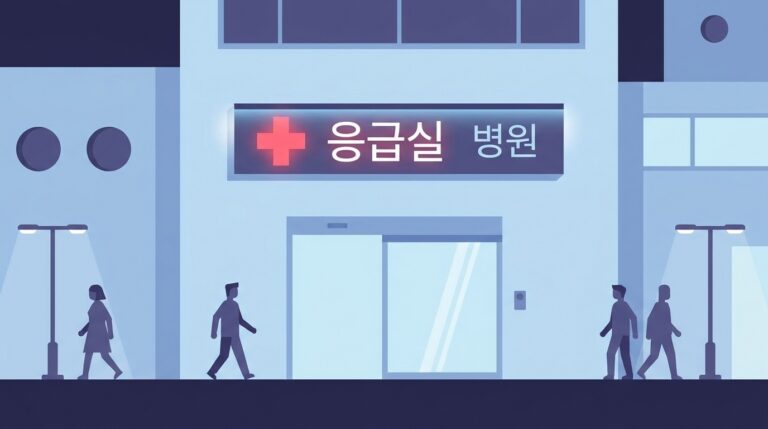
Visiting a Night ER in Korea: Managing Higher Co-Pays and Requesting Interpreters
Phase 1: Empathy & Story Opening
안녕하세요! 매일한글 에디터입니다. (Annyeonghaseyo! It’s your Daily Hangul editor here.)
Picture this: It is 2:15 AM on a chilly Tuesday in Seoul. After an unforgettable evening sharing spicy tteokbokki and crispy fried chicken along the Han River, your stomach suddenly feels like a battlefield. The sharp cramps will not go away. You grab your coat, stumble into a taxi, and manage to utter the word 응급실 (eung-geup-sil / emergency room).
Inside the brightly lit reception area, the nurse looks at you with concern, checks your ID, and gently explains:
“응급실 진료비는 일반 외래 진료보다 본인 부담금이 조금 더 비싸요.”
Your heart skips a beat. You know 비싸요 means expensive, but what on earth is a 본인 부담금? Are you about to pay a thousand dollars like back home? And how do you explain your exact symptoms in Korean when you are doubled over in pain?
Take a deep breath! You are in safe hands. South Korea boasts one of the most efficient emergency medical systems in the world. As an international traveler or resident, hearing medical terminology in the dead of night is scary, but this guide is your personal survival manual. Based on real-world experiences from hundreds of our students, this lesson will teach you how to understand night ER surcharges, ask for immediate medical interpretation, and speak with confidence when it matters most.
Phase 2: 3 Core Expressions Deep Dive
Here are the three must-know phrases you need when entering a Korean emergency room late at night.
1. 응급실 진료비는 조금 더 비싸요 (Eung-geup-sil jin-ryo-bi-neun jo-geum deo bi-ssa-yo)
- Pronunciation: [Eung-geup-sil jin-ryo-bi-neun jo-geum deo bi-ssa-yo] (Think: “Oong-geup-seal jin-ryo-bee-neun joh-geum duh bee-ssah-yo”)
- Meaning: “Emergency room medical fees are a little more expensive.” (Literal: ER medical fee – a bit more – is expensive)
- K-Culture Moment: You will hear triage desk staff say this right before processing your paperwork in dramas like Hospital Playlist (슬기로운 의사생활). It is standard medical protocol to inform patients before applying emergency triage surcharges.
- Editor’s Insight: Staff are not trying to scare you away! Korea has an “Emergency Care Management Fee” (응급의료관리료) to keep ER beds open for critical patients. The word 조금 (a little) softens the news, but the staff want to ensure you are not shocked when the receipt arrives.
- Situation Spectrum: Casual: ⚠️ (Too blunt) | Semi-formal: ✅ | Formal: ✅
- 🤔 Think About It: In many Western countries, prices are billed months later via mail. Why do you think Korean medical staff proactively explain extra fees upfront at 2 AM?
2. 의료 통역을 부탁해도 될까요? (Ui-ryo tong-yeo-geul bu-tak-hae-do doel-kka-yo?)
- Pronunciation: [Ui-ryo tong-yeo-geul bu-tak-hae-do doel-kka-yo] (Think: “Oo-ee-ryoh tong-yuh-geul boo-tahk-hae-doh dwel-kkah-yoh?”)
- Meaning: “Could I please request medical interpretation?”
- K-Culture Moment: Seen in international hospital wards in dramas like Descendants of the Sun, where bilingual coordinators link patients with specialists.
- Editor’s Insight: Using -해도 될까요? (May I…?) displays polite Korean etiquette (존댓말). In Korea, large university hospitals (대학병원) often provide professional medical interpreters, and staff can also dial the 24/7 government medical translation hotline (1339 or 1330) directly on speakerphone.
- Situation Spectrum: Casual: 🚫 | Semi-formal: ✅ | Formal: ✅
- 🤔 Think About It: Notice how the sentence ends in a soft question rather than a direct request (통역해 주세요). How does soft phrasing change the listener’s willingness to help in high-stress medical environments?
3. 본인 부담금이 얼마예요? (Bon-in bu-dam-geu-mi eol-ma-ye-yo?)
- Pronunciation: [Bon-in bu-dam-geu-mi eol-ma-ye-yo] (Think: “Bohn-een boo-dahm-geu-mee ul-mah-yay-yoh?”)
- Meaning: “How much is the out-of-pocket co-pay?”
- K-Culture Moment: A common phrase uttered by worried family members in slice-of-life K-dramas when receiving an unexpected hospital admission slip.
- Editor’s Insight: 본인 means “oneself” or “patient,” and 부담금 translates to “shared burden fee” (co-pay). Even without Korean National Health Insurance (NHI), basic ER consultations in Korea typically range between 70,000 to 150,000 KRW ($55–$115 USD)—far lower than in many Western countries, though higher than daytime clinic visits (which are usually under 15,000 KRW with NHI).
- Situation Spectrum: Casual: ⚠️ | Semi-formal: ✅ | Formal: ✅
- 🤔 Think About It: In Korean healthcare, costs are called “shared burdens” (부담금). What does this word choice tell you about the collective nature of Korean society?
Phase 3: Textbook Korean vs. Real Korean
Situation 1: Inquiring about the night surcharge
- 📖 Textbook Korean: 응급실 진료비가 주간 외래 진료보다 비쌉니까? (Eung-geup-sil jin-ryo-bi-ga ju-gan woe-rae jin-ryo-bo-da bi-ssam-ni-kka? / “Is the emergency room fee more expensive than daytime outpatient treatment?”)
- 🗣️ Real Korean: 응급실이라 많이 비싼가요? (Eung-geup-sil-i-ra man-i bi-ssan-ga-yo? / “Since it’s the ER, is it a lot more expensive?”)
- 💡 Why it is different: Native speakers use -이라 (because it is…) and -인가요? to create a softer, conversational rhythm instead of rigid, military-style grammatical endings.
Situation 2: Asking if anyone speaks English
- 📖 Textbook Korean: 여기에 영어 통역 서비스를 제공해 줄 수 있는 사람이 있습니까? (Yeo-gi-e yeong-eo tong-yeok seo-bi-seu-reul je-gong-hae jul su it-neun sa-ram-i it-seum-ni-kka? / “Is there a person here who can provide English translation services?”)
- 🗣️ Real Korean: 혹시 영어 통역 연결 가능할까요? (Hok-si yeong-eo tong-yeok yeon-gyeol ga-neung-hal-kka-yo? / “By any chance, is it possible to connect an English interpreter?”)
- 💡 Why it is different: Starting your sentence with 혹시 (by any chance) acts as a polite social buffer, dramatically increasing the helpfulness of busy hospital coordinators.
Phase 4: K-Culture Deep Dive & Non-Verbal Manners
4-1. Nunchi (눈치) & Body Language at Korean ER Counters
- Two-Handed Delivery: When handing over your passport, Alien Registration Card (ARC), or credit card at the reception counter, hold the item with both hands while giving a slight nod. This tiny gesture communicates respect and earns immediate goodwill from overwhelmed late-night staff.
- The Triage Scale (KTAS): Korea uses the Korean Triage and Acuity Scale (KTAS) from Level 1 (Critical) to Level 5 (Non-urgent). If a patient who arrived after you gets called first, do not raise your voice! In Korean emergency rooms, treatment order is strictly clinical, not first-come, first-served. Practicing 눈치 (situational awareness) by waiting calmly shows maturity and respect.
4-2. Cultural Code: The Midnight Clinic Alternative
Did you know that Koreans often avoid large hospital ERs unless it is a life-or-death emergency? Instead, they look for a 달빛어린이병원 (Moonlight Pediatric Clinic) or 야간진료의원 (Night Clinic). If your ailment is a moderate stomachache or cold, a local night clinic will cost a fraction of the university ER surcharge. Hospital clerks proactively tell you about higher co-pays (본인 부담금) precisely so you can decide whether you want full emergency triage or simple outpatient medication.
Phase 5: Real-Life Roleplay Scenario
Setting: 2:30 AM at the emergency intake desk of a university hospital in Mapo-gu, Seoul. Alex, a foreign resident clutching his stomach, approaches Nurse Minji.
- Turn 1 (Minji): 안녕하세요, 어디가 아파서 오셨어요? (Annyeonghaseyo, eodiga apaseo osyeosseoyo?)
🎭 Leaning forward, checking the patient registration clipboard.
“Hello, where does it hurt that brought you here?” - Turn 2 (Alex): 저녁부터 배가 너무 찌르듯이 아파요. (Jeonyeokbuteo baega neomu jjireudeusi apayo.)
🎭 Grimacing in pain, holding the lower right abdomen with both hands.
“My stomach has been hurting sharply like it’s being stabbed since this evening.” - Turn 3 (Minji): 열도 조금 있으시네요. 등록 도와드릴게요. 신분증 있으세요? (Yeoldo jogeum isseusineyo. Deungnok dowadeurilgeyo. Sinbunjeung isseuseyo?)
🎭 Placing an infrared thermometer against Alex’s temple.
“You have a slight fever as well. I’ll help you register. Do you have an ID?” - Turn 4 (Alex): 여기 여권 있어요. 혹시 영어 의료 통역을 부탁해도 될까요? (Yeogi yeogwon isseoyo. Hoksi yeong-eo uiryo tong-yeogeul butak-haedo doelkkayo?)
🎭 Handing over the passport with both hands nervously.
“Here is my passport. By any chance, could I request medical interpretation in English?” - Turn 5 (Minji): 네, 1339 통역 서비스 바로 연결해 드릴게요. 그런데 안내 말씀 드릴게요. (Ne, 1339 tong-yeok seobi-seu baro yeongyeol-hae deurilgeyo. Geureonde annae malsseum deurilgeyo.)
🎭 Typing details into the computer, maintaining a calm, reassuring tone.
“Yes, I will connect the 1339 interpretation service right away. However, I have an announcement to give you.” - Turn 6 (Minji): 야간 응급실 진료비는 일반 외래 진료보다 본인 부담금이 조금 더 비싸요. 괜찮으세요? (Yagan eung-geupsil jinlyobineun ilban oerae jinlyoboda bonin budamgeumi jogeum deo bissayo. Gwaenchaneuseyo?)
🎭 Pointing gently to the emergency care fee information sheet on the counter.
“Night emergency room fees have a slightly higher co-pay than regular daytime outpatient visits. Is that okay?” - Turn 7 (Alex): 본인 부담금이 대략 얼마예요? (Bon-in budamgeumi daeryak eolmayeyo?)
🎭 Tilting head slightly with a polite, attentive posture.
“Approximately how much is the co-pay?” - Turn 8 (Minji): 기본 응급 관리료가 약 6만 원 정도 추가돼요. 진료 진행할게요! (Gibon eung-geup gwanliryoga yak yuk-man-won jeongdo chugadwaeyo. Jinlyo jinhaenghalgeyo!)
🎭 Stamping the triage chart and pointing toward the examination room corridor.
“The basic emergency management fee is an extra ~60,000 KRW. Let’s proceed with your examination!”
🔀 Interactive Choice Point: How will you respond to Minji?
- Choice A: “왜 이렇게 비싸요? 할인 안 돼요?” (Wae ireoke bissayo? Harin an dwaeyo? / “Why is it so expensive? Can’t I get a discount?”)
- Outcome (Bad): Hospital fees in Korea are strictly regulated by the Ministry of Health and Welfare. Demanding discounts at an ER reception will only cause awkwardness and delay urgent clinical care.
- Choice B: “네, 괜찮아요. 통역과 함께 진료받고 싶어요.” (Ne, gwaenchannayo. Tong-yeok-gwa hamkke jinlyobatgo sipeoyo. / “Yes, that is fine. I would like to receive care with an interpreter.”)
- Outcome (Best): Calm, decisive, and polite. Staff will promptly prioritize your triage category and set up interpretation support.
- Choice C: “그럼 안 할래요. 아침까지 버텨볼게요.” (Geureom an hallaeyo. Achimkkaji beotyeobolgeyo. / “Then I won’t do it. I’ll endure until morning.”)
- Outcome (Risk): Dangerous! Sharp abdominal pain accompanied by a fever could indicate acute appendicitis (맹장염). Enduring until daytime clinics open at 9:00 AM could cause severe complications.
Phase 6: 10-Second Emotional Shadowing Drill
Practice reading these lines aloud with the emotional markings and rhythmic pauses (/).
[🥺 배를 부여잡고 아파하며 / Doubled over in pain]- “배가 너무 아파요… / 혹시 / 영어 통역 가능한가요?”
(Bae-ga neomu apayo… / hok-si / yeong-eo tong-yeok ga-neung-han-ga-yo?)
- “배가 너무 아파요… / 혹시 / 영어 통역 가능한가요?”
[🙏 조심스럽고 공손하게 / Polite, calm inquiry]- “응급실 진료비는 / 본인 부담금이 / 얼마나 더 나오나요?”
(Eung-geup-sil jin-ryo-bi-neun / bon-in bu-dam-geum-i / eol-ma-na deo na-o-na-yo?)
- “응급실 진료비는 / 본인 부담금이 / 얼마나 더 나오나요?”
[😌 안도하며 수락할 때 / Relieved and cooperative]- “네, / 괜찮습니다. / 바로 진료받을게요.”
(Ne, / gwaen-chan-seum-ni-da. / Ba-ro jin-ryo-ba-deul-ge-yo.)
- “네, / 괜찮습니다. / 바로 진료받을게요.”
Phase 7: K-Culture Mini Dictionary
| # | Term (한글 + Romanization) | Translation | Real-Life Application & Usage |
|---|---|---|---|
| 1 | 응급실 (Eung-geup-sil) | Emergency Room (ER) | Found marked with bright red neon signage on large hospital buildings across Korea 24/7. |
| 2 | 본인 부담금 (Bon-in bu-dam-geum) | Out-of-pocket co-pay | The specific portion of the medical bill that you, the patient, must pay at checkout. |
| 3 | 야간 할증 (Ya-gan hal-jeung) | Night surcharge | An extra operational fee (typically 20–50%) applied between 6:00 PM and 9:00 AM, and on weekends. |
| 4 | 의료 통역 (Ui-ryo tong-yeok) | Medical interpretation | Specialized translation assistance provided over the phone via 1339/1330 or through hospital coordinators. |
Phase 8: Survival Kit for Travelers
Survival Phrases TOP 3
- 도와주세요, 통증이 심해요. (Do-wa-ju-se-yo, tong-jeung-i sim-hae-yo.)
- Pro Tip: Use this phrase upon arrival. 통증 (pain/ache) sounds more clinical and urgent than standard 아파요.
- 여행자 보험 서류를 써 주세요. (Yeo-haeng-ja bo-heom seo-ryu-reul sseo ju-se-yo.)
- Pro Tip: Say this during payment to get your Medical Receipt (진료비 영수증) and Treatment Statement (진료확인서) for travel insurance reimbursement back home.
- 신용카드로 계산할게요. (Sin-yong-ka-deu-ro gye-san-hal-ge-yo.)
- Pro Tip: All Korean ERs accept foreign credit cards (Visa/Mastercard/Amex). Cash is never mandatory.
Editor’s Travel Note
- Essential App Setup: Before heading out at night, make sure to search and check the Emergency Medical Info App on Google Play (응급의료정보제공 / E-Gen) or save 1339 (Korea Disease Control and Prevention Agency Hotline) and 1330 (Korea Travel Helpline) on your smartphone. Both hotlines provide free, instantaneous English three-way interpretation.
- Night Taxi Protocol: If an ambulance (119) feels too intimidating for moderate issues, open the Kakao T app and set your destination to the nearest 대학병원 응급실 (University Hospital ER).
Phase 9: “한 발 더 깊이” (Cultural Reflection)
In many global healthcare environments, conversations about money feel cold, secretive, or clinical. However, in South Korea, clear upfront communication—termed 선안내 (pre-guidance)—is considered an essential courtesy. When hospital staff inform you that the ER co-pay is higher, they are demonstrating protective respect: ensuring that you, as an international guest, do not feel taken advantage of when the bill arrives. This transparent collective responsibility (공동체 의식) is what keeps Korea’s public services among the most trusted in the world.
💬 Your Turn: Have you ever experienced a medical emergency while traveling abroad? How did payment and language barriers compare to the upfront notification system in Korea? Share your story in the comments below!
Phase 10: FAQ & Avoiding Misunderstandings
Q: Will an ambulance ride in Korea cost me extra money?
A: No! In South Korea, dialing 119 for emergency transport by public ambulance is completely free for both Korean citizens and foreign visitors. Surcharges and co-pays only begin once you enter hospital triage.
Q: Can I use English medical interpretation services for free?
A: Yes! Dialing 1330 (Travel Hotline) or 1339 (Medical Emergency Hotline) provides free, immediate three-way phone interpretation connecting you, the operator, and the Korean hospital staff.
Q: How much should an uninsured tourist expect to pay at a night ER for minor issues?
A: Typically, uninsured emergency room entry and basic physician consultation fees range between 70,000 to 160,000 KRW ($55–$120 USD). Blood tests, CT scans, or IV drips will increase this cost, which you can claim via international travel insurance later.
🚨 Common Mistakes Warning Board
- Mistake: Panicking over the word 비싸요 and leaving the hospital without treatment.
- Correct Action: Ask 본인 부담금이 대략 얼마예요? The cost is almost always far lower than emergency fees in the US or other private systems.
- Mistake: Demanding a discount or arguing about the night surcharge.
- Correct Action: Accept the statutory government rate calmly, and ask for itemized receipts (진료비 세부내역서) for insurance reimbursement.
- Mistake: Relying solely on Google Translate for critical allergy warnings.
- Correct Action: Request official 1339 three-way medical translation (의료 통역) to avoid dangerous pharmacological misunderstandings.
Phase 11: Action Missions
- 🥉 Bronze Mission (Solo Practice): Stand before a mirror and pronounce 본인 부담금이 얼마예요? three times in under 10 seconds without hesitating.
- 🥈 Silver Mission (Mobile Prep): Save 1339 and 1330 in your mobile phone contacts under “Korea Medical Helpline” right now.
- 🥇 Gold Mission (Real Shadowing): Open a voice note on your phone and record yourself performing Dialogue Turn 4 and Turn 7 with natural intonation.
- 🎮 K-Culture Mission: Watch Episode 3 of Hospital Playlist Season 1 and spot the moment the intake desk explains hospital costs to a patient’s guardian!
Phase 12: Interactive Quiz Challenge
Test your real-world readiness with these three quick questions!
1. Situation Judgment
You arrive at the emergency desk at 3:00 AM with food poisoning. The clerk says: “응급실은 본인 부담금이 조금 더 비쌉니다.” What is the smartest response?
* (A) “깎아주세요!” (Give me a discount!)
* (B) “본인 부담금이 대략 얼마예요? 통역도 부탁드려요.” (Approximately how much is the co-pay? I’d also like an interpreter.)
* (C) Turn around and sleep on the park bench outside until 9:00 AM.
2. Fill-in-the-Blank
“Excuse me, by any chance, is English medical interpretation possible?”
“혹시 영어 의료 ___________ 부탁해도 될까요?”
* (A) 선물 (seon-mul)
* (B) 통역 (tong-yeok)
* (C) 요리 (yo-ri)
3. Cultural True or False
True or False: Calling a 119 emergency ambulance in South Korea will cost foreign tourists hundreds of dollars on the spot.
👉 Click to reveal answers & explanations!
- Answer: (B)
- Explanation: Asking about the specific estimate while requesting an interpreter keeps you safe and helps you budget accurately.
- Answer: (B) 통역 (tong-yeok / interpretation)
- Explanation: 의료 통역 means medical interpretation. (선물 = gift, 요리 = cooking).
- Answer: False
- Explanation: Public 119 ambulance transport in South Korea is a 100% free public service for everyone, regardless of nationality!
- Explanation: Public 119 ambulance transport in South Korea is a 100% free public service for everyone, regardless of nationality!
🎬 Watch Our Daily Videos! (Daily Hangul Official Instagram)
Review the expressions you learned in this article with our fun daily short videos! Check out native pronunciation and real-life nuances in action.
- Instagram @dailyhangul_en







