

Phase 1: Empathy (Story-Driven Opening)
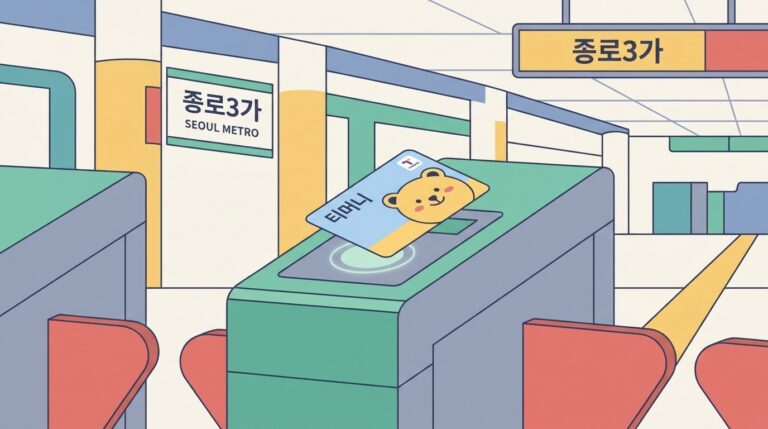
안녕하세요! 매일한글 에디터입니다. (Hello! I’m your Daily Hangul editor.) Picture this: You just landed at Incheon Airport, took the train to vibrant Hongdae, and bought a super cute Ryan the Lion T-Money transit card. You walk toward the subway turnstile, tap your card with pure excitement, and suddenly—BEEP-BEEP-BEEP! A harsh red light flashes, the gate bars slam shut, and fifty busy Seoul commuters pile up behind you during morning rush hour. Panic sets in! You step aside, walk into a nearby convenience store with a 10,000 won bill, but your mind goes completely blank. What do you say?
If you’ve ever felt that cold sweat in a foreign transit system, breathe easy. Every single Korean learner has been there! Today’s guide solves this exact pain point using simple, battle-tested phrases gathered from hundreds of beginner students. Master this single lesson, and you’ll reload like a seasoned local in under 10 seconds.
Phase 2: Top 3 Core Expressions Deep Dive
1. 만 원 충전해 주세요 (Man-won chungjeon-hae juseyo)
- Pronunciation: [Man-won chung-jeon-hae ju-se-yo] (Sounds like: “Mahn-one choong-jun-heh joo-say-yo”)
- Meaning: Literal: “10,000 won recharge please” | Nuance: “Please top up 10,000 won onto my transit card.”
- K-Culture Moment: In K-Dramas like Record of Youth, you often see college students dropping by the neighborhood GS25 or CU, dropping a bill on the counter, and saying this exact sentence with a bright smile.
- Editor’s Insight: ‘충전’ (chungjeon) means recharging anything from transit cards to your phone battery. Adding ‘해 주세요’ (hae juseyo) turns any verb into a polite, friendly request.
- Situation Spectrum: Casual: ⚠️ | Semi-formal: ✅ | Formal: ✅
- 🤔 Think About It: In English, we say “load” or “put money on.” In Korean, the concept is “charging energy/funds” (충전). How does this reflect Korea’s tech-forward lifestyle?
2. 현금만 돼요? (Hyeongeum-man dwaeyo?)
- Pronunciation: [Hyeon-geum-man dwae-yo?] (Sounds like: “Hyun-geum-mahn dway-yo?”)
- Meaning: Literal: “Only cash works?” | Nuance: “Is it cash only?”
- K-Culture Moment: When foreign tourists try to pay for transit reloads using Visa or Apple Pay at a subway kiosk, the polite staff will often remind them with this key word: 현금 (cash).
- Editor’s Insight: ‘만’ (man) means “only”, and ‘돼요?’ (dwaeyo?) is the magical phrase meaning “Does it work? / Is it okay?”
- Situation Spectrum: Casual: ✅ | Semi-formal: ✅ | Formal: ⚠️
- 🤔 Think About It: South Korea is almost completely cashless, except for reloading physical transit cards. Why do you think transit laws still require physical cash for reloads?
3. 카드를 대 주세요 (Kadeu-reul dae juseyo)
- Pronunciation: [Ka-deu-reul dae ju-se-yo] (Sounds like: “Kah-deu-reul deh joo-say-yo”)
- Meaning: Literal: “Please touch the card” | Nuance: “Please tap/place your card on the reader pad.”
- K-Culture Moment: Heard across every Seoul subway turnstile audio prompt and spoken by convenience store clerks when gesturing toward the small card terminal.
- Editor’s Insight: ‘대다’ (daeda) means to touch or hold a surface against something. At payment pads, it means “tap it and leave it there for a moment.”
- Situation Spectrum: Casual: 🚫 | Semi-formal: ✅ | Formal: ✅
- 🤔 Think About It: Notice how Korean subway turnstiles say “대 주세요” (please touch) rather than “swipe” or “insert”? Language evolves with transit hardware!
Phase 3: Textbook Korean vs. Real-Life Korean
Situation 1: Ordering a 10,000 won reload at the counter
* 📖 교과서 한국어 (Textbook Korean): 교통카드에 만 원을 충전해 주시겠습니까? (Gyotongkadeue man-woneul chungjeonhae jusigesseumnikka?) – “Would you be so kind as to recharge 10,000 won onto the transit card?”
* 🗣️ 진짜 한국어 (Real-Life Korean): 만 원 충전해 주세요. (Man-won chungjeon-hae juseyo.) or simply 만 원 충전이요! (Man-won chungjeon-iyo!)
* 💡 왜 다를까? (Why is it different?): Seoul convenience stores move at breakneck speed. Textbook grammar is overly stiff and slows down the transaction. Clear, polite, and short sentences are preferred.
Situation 2: Asking the clerk if card payment works for T-Money
* 📖 교과서 한국어 (Textbook Korean): 신용카드로 충전 금액을 결제하는 것이 가능합니까? (Sinyongkadeuro chungjeon geumaekeul gyeoljeh الكسور 것이 ganeunghamnikka?) – “Is it permissible to pay the recharge amount via credit card?”
* 🗣️ 진짜 한국어 (Real-Life Korean): 충전, 카드로도 돼요? (Chungjeon, kadeu-rodo dwaeyo?) – “Can I charge with a bank card too?”
* 💡 왜 다를까? (Why is it different?): Real spoken Korean drops unnecessary formal nouns and puts the topic (충전) first for immediate clarity.
Phase 4: K-Culture Deep Dive & Non-Verbal Manners
4-1. Nunchi (눈치) & Gestures
When handing over your T-Money card and your cash bill to the convenience store clerk or kiosk attendant, always use two hands (양손) or support your right wrist/forearm with your left hand. This subtle gesture shows immense respect and instantly earns warm hospitality from Korean elders.
When placing your card on the counter terminal, place it flat and do not pull it away until you hear the chirpy chime: “딩동! 충전이 완료되었습니다” (Ding-dong! Reload is complete).
4-2. The Sonic Culture of the Seoul Metro
Seoul’s subway is world-famous for its sensory design. When passing the turnstile gates (개찰구), listen closely! Single chirps mean adult fare, bird melodies signal a student card, and a cheerful chime means a successful transfer discount (환승). If you ever hear a loud three-tone buzz with a red LED light, stay calm—it just means your balance dropped below 1,400 won or you tapped twice by mistake.
Phase 5: Real-Life Roleplay Scenario
- Location: A cozy CU Convenience Store right next to Hongik University Station Exit 9.
- Characters:
- You: An excited traveler ready to explore Hongdae.
- Minho: A friendly, beanie-wearing college part-timer listening to K-Pop behind the counter.
Dialogue:
1. You: 🎭 (Walk up to the counter, holding your T-Money card and a 10,000 won bill with both hands) 안녕하세요! (Annyeonghaseyo!) — “Hello!”
2. Minho: 🎭 (Bows his head slightly with a smile) 네, 어서 오세요! (Ne, eoseo oseyo!) — “Yes, welcome!”
3. You: 🎭 (Pointing gently to the card pad) 이거, 교통카드 만 원 충전해 주세요. (Igeo, gyotong-kadeu man-won chungjeon-hae juseyo.) — “This, please recharge 10,000 won on the transit card.”
4. Minho: 🎭 (Tapping the register screen) 네! 카드를 단말기에 올려주세요. (Ne! Kadeu-reul danmalgie ollyeojuseyo.) — “Sure! Please place your card on the terminal.”
5. You: 🎭 (Gently placing the card on the reader and offering cash) 여기 현금 만 원이요. (Yeogi hyeongeum man-won-iyo.) — “Here is 10,000 won in cash.”
6. Minho: 🎭 (Receives cash with both hands and presses confirm) 삑! 충전 완료됐습니다. (Bbik! Chungjeon wanryo-dwaesseumnida.) — “Beep! Recharge is complete.”
7. You: 🎭 (Taking the card back with a bright nod) 감사합니다! 좋은 하루 보내세요! (Gamsahamnida! Joeun haru bonaeseyo!) — “Thank you! Have a great day!”
8. Minho: 🎭 (Waving warmly) 네, 안녕히 가세요! (Ne, annyeonghi gaseyo!) — “Yes, take care!”
🔀 Interactive Decision Point
Imagine Minho suddenly shakes his hands and says: “손님, 충전은 현금만 돼요!” (Customer, recharge is cash only!), but you only have an international debit card out.
- Option A: Say: “아, 죄송해요! 현금 뽑아 올게요!” (Ah, joesonghaeyo! Hyeongeum ppoba olgeyo! – Ah, sorry! I’ll go withdraw cash!)
- Feedback [BEST]: Perfect! Minho will appreciate your quick understanding, and there is usually an ATM right outside the door.
- Option B: Push your card forward again and say: “이거 비자 카드인데요?” (Igeo Visa kadeu-indeyo? – But this is a Visa card?)
- Feedback [BAD]: Convenience store systems physically cannot process card-to-card transit reloading. It will only cause awkward delays.
- Option C: Leave the card on the counter and run away silently.
- Feedback [RISK]: Minho will be worried thinking you lost your belongings! Always excuse yourself politely.
Phase 6: 10-Second Emotion Shadowing Drill
Read these out loud, pausing at the slashes / and matching the emotion in brackets!
[😊 Bright & Polite]
안녕하세요! / 교통카드 / 만 원 충전해 주세요!
(Annyeonghaseyo! / Gyotong-kadeu / man-won chungjeon-hae juseyo!)-
[🤔 Curious & Gentle]
저기요, / 충전은 / 현금만 돼요?
(Jeogiyo, / chungjeon-eun / hyeongeum-man dwaeyo?) -
[🎉 Confident & Cheerful]
감사합니다! / 카드 / 찍고 들어갈게요!
(Gamsahamnida! / Kadeu / jjikgo deureogalgeyo!)
Phase 7: K-Culture Mini Dictionary
- 티머니 (T-money / Ti-meoni): Korea’s universal smart transit card. Usable on subways, buses, taxis, and even for buying snacks at convenience stores.
- 현금 (Cash / Hyeon-geum): Literal “present gold/money.” Crucial to have in small bills (1,000, 5,000, 10,000 won) specifically for transit reloads.
- 개찰구 (Turnstile / Gae-chal-gu): The subway ticket barrier gate where you tap in and tap out.
- 환승 (Transfer / Hwan-seung): The world’s coolest transit discount system! Allows you to transfer between subway and bus within 30 minutes for free or negligible extra cost.
Phase 8: Survival Kit for Travelers
Top 3 Survival Phrases
- 1. 잔액이 부족합니다 (Janaegi bujokhamnida)
- Meaning: “Insufficient balance.” (If the gate says this, step back and find a reload station!)
- 2. 영수증 버려주세요 (Yeongsujeung beoryeojuseyo)
- Meaning: “Please discard the receipt.”
- 3. 반대편으로 찍었어요 (Bandaepyeoneuro jjigeosseoyo)
- Meaning: “I tapped on the opposite side / wrong platform.” (Subway station workers will open the emergency side gate for you free within 15 minutes!)
Editor’s Travel Note
- Download Essential Transit Apps: Skip Google Maps in Korea—it lacks live transit walking data! Instead, use the Naver Map app download or the Kakao T app download for real-time gate navigation and arrival countdowns.
- Always Carry Cash: Convenience stores cannot reload T-Money with foreign credit cards due to local financial regulations. Keep at least 20,000 KRW in paper bills tucked in your phone case.
Phase 9: Going One Step Deeper (Thought Piece)
In Seoul, the subway gate is not just a metal barrier; it is a shared rhythm of public consideration. Millions of people glide through stations daily without collisions because everyone naturally keeps to the right, prepares their card two steps before the gate, and steps aside immediately if their card fails to scan. Speaking clear, simple Korean like “만 원 충전해 주세요” honors this communal harmony. When you learn to reload smoothly, you are actively joining the collective flow of Korean city life.
💬 Your Turn: What is public transit etiquette like in your hometown compared to Seoul? Leave a comment below and let’s compare notes!
Phase 10: FAQ & Avoiding Misunderstandings
Q: Can I reload my T-money card using a foreign credit card at a subway machine?
A: Generally, no. Most station automated ticket vending machines and convenience stores only accept Korean won cash for physical transit card reloads. Always carry banknotes.
Q: What if I tap into the wrong subway direction?
A: Don’t panic! Seoul subway policy allows you to tap out and tap into the opposite platform within 15 minutes at the same station without being charged an extra base fare.
Q: Can one T-money card pay for two people?
A: On city buses, yes! Tell the driver “두 명이요” (Du myeong-iyo – Two people) before tapping. However, at subway gates, each passenger must tap their own individual card.
🚨 Common Mistakes Warning Board
- Mistake: Tapping the card too fast and pulling it away immediately.
- Correct Action: Rest the card flat against the reader for a full second until it chirps.
- Mistake: Handing the store clerk a credit card for a T-Money reload.
- Correct Action: Hand over cash directly while saying “만 원 충전해 주세요”.
- Mistake: Blocking the turnstile when your card balance is empty.
- Correct Action: Step to the side immediately to let the rush hour crowd through, then head to the reload kiosk.
Phase 11: Action Mission & Engagement
- 🥉 Bronze Mission: Say “만 원 충전해 주세요” aloud 5 times in front of your mirror while holding a card with two hands.
- 🥈 Silver Mission: Share this blog post on your Instagram Story or Twitter and tag a travel buddy who needs to know this transit tip!
- 🥇 Gold Mission: Next time you enter a Korean convenience store or order from a Korean friend, use “[Amount] 충전해 주세요” without checking your notes!
- 🎮 K-Culture Mission: Watch an episode of any slice-of-life K-drama (like Hospital Playlist or My Liberation Notes) and spot the sound effect when characters tap their cards on the green bus or subway!
Phase 12: Interactive Quiz Challenge
1. Situational Judgment Quiz
You are at a GS25 counter and want to put 20,000 won (이만 원) on your transit card with cash. What do you say?
* A) 교통카드 만 원 환불해 주세요 (Please refund 10,000 won)
* B) 교통카드 이만 원 충전해 주세요 (Please recharge 20,000 won on the transit card)
* C) 교통카드 어디 있어요? (Where is the transit card?)
2. Fill-in-the-Blank
“Is it cash only?” in natural Korean:
현금_______ 돼요? (Hyeon-geum-_______ dwae-yo?)
3. True or False
You can reload a standard physical T-Money card using an international Visa card at any convenience store counter. (True / False)
Click to view Answer & Explanation
- Answer: B (이만 원 충전해 주세요 = Please recharge 20,000 won. Option A means refund, and Option C asks where the card is.)
- Answer: 만 (man) (현금만 돼요? = Is it cash only? The particle ‘만’ means ‘only’.)
- Answer: False (Physical transit card reloads require physical Korean Won cash! Always keep cash handy when traveling on Korean transit.)
🎬 Watch Our Daily Videos! (Daily Hangul Official Instagram)
Review the expressions you learned in this article with our fun daily short videos! Check out native pronunciation and real-life nuances in action.
- Instagram @dailyhangul_en







