

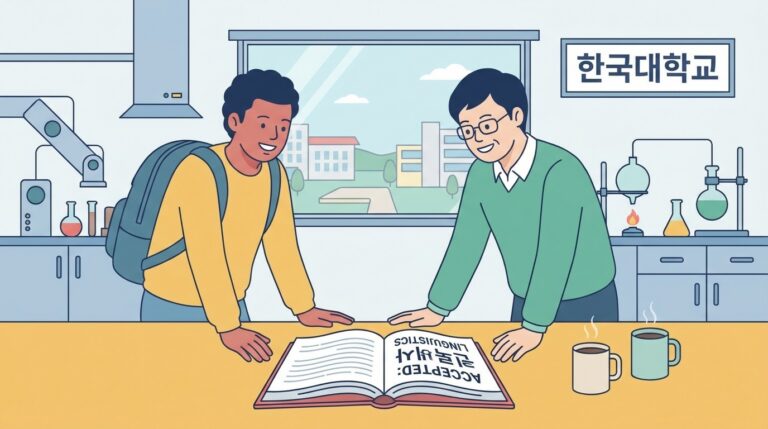
That Incredible Moment Reviewer 2 Gives Up: How to Celebrate Your Journal Acceptance in Flawless C1 Korean
Phase 1: Empathy (Story-Immersive Opening)
안녕하세요! 매일한글 (Daily Hangul) 에디터입니다.
Picture this: It’s 2:14 AM in an engineering lab in Sinchon, Seoul. Your desk is a battlefield of crumpled Megacoffee cups, half-eaten triangle kimbap from CU, and printouts filled with aggressive red ink from the notorious “Reviewer 2.” Anyone who has ever survived graduate school in South Korea knows the soul-crushing dread of opening an email that begins with “Major Revision Required.” You spent three straight weeks drafting a 20-page point-by-point rebuttal letter, calibrating every sentence to balance academic rigor with extreme Korean deference. And then… you hit Submit right before the deadline.
Fast forward two weeks: you open your portal, and there it is. “Unanimous Acceptance.” Every single reviewer signed off without further critique. Your heart skips a beat. You want to rush into your advising professor’s (지도교수님) office and share the triumphant news, but your brain freezes: How do I express this massive academic achievement in elegant, culturally nuanced, advanced Korean without sounding arrogant or overly casual?
If you have ever felt trapped between robotic dictionary phrases and the fear of disrespecting academic hierarchy, you are not alone. Our international scholars community regularly tells us that transitioning from conversational Korean to high-stakes academic communication is their steepest hurdle. In this C1 masterclass, we will unpack the exact professional phrasing, non-verbal etiquette, and lab dynamics you need to announce and celebrate your paper’s acceptance like a seasoned scholar.
Phase 2: In-Depth Analysis of 3 Key Core Expressions
1. 심사위원 전원의 만장일치로 최종 게재 확정 통보를 받았습니다.
- Pronunciation: [Simsawiwon jeonwon-ui manjang-ilchiro choejong gejae hwakjeong tongboreul badatsseumnida.] (Think: ‘Sheem-sa-wee-won jun-won-wee mahn-jahng-eel-chee-ro chweh-jong geh-jeh hwahk-jung tong-boh-reul bah-daht-seum-nee-dah’)
- Meaning:
- Literal: I received notification of final publication confirmation by the unanimous agreement of all reviewers.
- Nuance: Complete, undisputed academic validation. It carries immense prestige and implies that your revised arguments were bulletproof.
- K-Culture Moment: This sounds like the climactic scene in an academic or medical drama (like Hospital Playlist or Start-Up) when an elite researcher silences the board of directors with undeniable empirical data.
- Editor’s Insight: The keyword here is 만장일치 (萬場一致, manjang-ilchi)—meaning “every single hand raised in agreement.” Using this four-character idiom (사자성어) instantly elevates your Korean to an intellectual C1 tier.
- Situation Spectrum: Casual: 🚫 | Semi-formal: ⚠️ | Formal: ✅
- 🤔 Think About It: In English, you might casually slack your lab: “We got accepted unanimously!” In Korean, the passive-receptive structure (통보를 받았습니다 – received notification) demonstrates institutional respect and humility rather than self-centered boastfulness. How does your native language balance pride and deference?
2. 지적해 주신 사항을 충실히 반영하여 수정본과 조목별 답변서를 제출했습니다.
- Pronunciation: [Jijeokhae jusin sahang-eul chungsilhi banyeonghayeo sujeongbon-gwa jomokbyeol dapbyeonseoreul jechulhaesseumnida.] (Think: ‘Jee-juck-heh joo-sheen sah-hahng-eul choong-sheel-hee bahn-young-hah-yuh soo-jung-bohn-gwah joh-mohk-byul dahp-byun-suh-reul jeh-chool-het-seum-nee-dah’)
- Meaning:
- Literal: Faithfully reflecting the points pointed out, we submitted the revision and the item-by-item rebuttal.
- Nuance: “We did not just dismiss the critiques; we took every single reviewer comment seriously and methodically fixed everything.”
- K-Culture Moment: Imagine a tense boardroom scene in Queen of Tears where a legal counsel outlines how every potential regulatory audit finding was thoroughly addressed.
- Editor’s Insight: 조목별 (Jomokbyeol) means “clause-by-clause” or “point-by-point.” Pairing it with 충실히 반영하여 (faithfully reflecting) signals conscientiousness, which is one of the highest moral and professional virtues in Korean Confucian-rooted work environments.
- Situation Spectrum: Casual: 🚫 | Semi-formal: ⚠️ | Formal: ✅
- 🤔 Think About It: Why say “points pointed out” (지적해 주신 사항) with honorifics (-sin) instead of just “the critiques”? Because peer reviewers, even anonymous ones, are culturally treated as mentors who refine your thought.
3. 학술적 완성도를 한 단계 끌어올릴 수 있었던 값진 피드백이었습니다.
- Pronunciation: [Haksuljeok wanseongdoreul han dangye kkeureoollil su isseotdeon gapjin pideubaegieotseumnida.] (Think: ‘Hahk-sool-juck wahn-sung-doh-reul hahn dahn-gyeh kkoo-ruh-ohl-leel soo ee-ssuht-dun gahp-jeen pee-deu-beck-ee-uht-seum-nee-dah’)
- Meaning:
- Literal: It was valuable feedback that allowed us to elevate our academic level of completion by one stage.
- Nuance: Framing grueling, painful criticism as a transformative gift that made your research stronger.
- K-Culture Moment: Similar to how K-pop idol trainees in survival shows bow deeply and thank hardline judges after a harsh evaluation, saying it helped them discover their vocal limits.
- Editor’s Insight: Using 값진 (gapjin – priceless/valuable) instead of basic words like 좋은 (jo-eun – good) transforms mundane thanks into a dignified acknowledgment of intellectual growth.
- Situation Spectrum: Casual: ⚠️ | Semi-formal: ✅ | Formal: ✅
- 🤔 Think About It: Instead of feeling defensive, Korean academic discourse values “accepting critique with grace” (수용의 미덕). Can framing criticism as a growth catalyst change the emotional atmosphere of your lab?
Phase 3: Textbook Korean vs Real Korean
Situation 1: Reporting the Acceptance to Your Lab Advisor (지도교수님)
- 📖 교과서 한국어 (Textbook): 논문이 학술지에 통과되었습니다. 기쁩니다. (Nonmuni haksuljie tonggwadoeeotseumnida. Gippeumnida. – The paper passed the journal. I am happy.)
- 🗣️ 진짜 한국어 (Real C1 Academic): 교수님께서 세심하게 지도해 주신 덕분에, 심사위원 전원 동의로 최종 게재 승인을 받았습니다! (Gyosunimkkeseo sesimhage jidohae jusin deokbune, simsawiwon jeonwon dong-uiro choejong gejae seung-ineul badatsseumnida! – Thanks to your meticulous guidance, Professor, we have received final acceptance with unanimous reviewer consent!)
- 💡 왜 다를까? (Why the difference?): In Korean research culture, an accomplishment is never solo. Acknowledging your advisor’s guidance (지도해 주신 덕분에) before announcing the result is mandatory linguistic protocol.
Situation 2: Talking with Fellow Lab Mates (랩실 동료들)
- 📖 교과서 한국어 (Textbook): 우리 팀의 답변서가 성공적이었습니다. (Uri tim-ui dapbyeonseoga seonggongjeogieotseumnida. – Our team’s rebuttal letter was successful.)
- 🗣️ 진짜 한국어 (Real C1 Academic): 2번 리뷰어 요구사항 쳐내느라 진짜 피 말렸는데, 올 패스(All-pass)로 최종 통과됐어요! 오늘 쏩니다! (Ibeon ribyueo yogusahang cheonaeneura jinjja pi mallyeonneunde, ol paeseuro choejong tonggwadwaesseoyo! Oneul ssomnida! – Dealing with Reviewer 2’s demands literally dried up my blood, but we got an all-pass final acceptance! Drinks are on me tonight!)
- 💡 왜 다를까? (Why the difference?): Among colleagues who pulled all-nighters together, academic stiffness dissolves into visceral idioms like 피 말리다 (pi mallida – to be on tenterhooks / have one’s blood dry up) and the celebratory lab ritual 오늘 쏩니다 (oneul ssomnida – I treat today).
Phase 4: K-Culture Deep Dive & Non-Verbal Manners
4-1. 눈치 (Nunchi) & Gestures: Delivering Great News Up the Hierarchy
When you deliver historic news like unanimous publication to your Korean professor, your physical posture sets the tone:
* The Two-Handed Screen/Document Handover: If showing the acceptance email on an iPad or printout, hold it with both hands, thumbs lightly securing the top corners, bowing your head approximately 15 to 30 degrees.
* The Self-Effacing Deflection: When your professor says, “야, 이번에 네가 진짜 큰일 해냈다!” (Hey, you did something extraordinary!), do not say “네, 알아요” (Yes, I know) or pump your fist high in the air. Instead, gently wave one hand in front of your chest or touch the back of your neck with a bashful smile, saying: “아닙니다, 교수님과 선배님들이 도와주신 덕분입니다.” (Not at all, it was thanks to your help and my seniors.)
* Eye Contact: Maintain humble, attentive eye contact, but break it downwards momentarily when receiving grand compliments. Staring directly into a senior professor’s eyes with wide unblinking pride can inadvertently project defiance.
4-2. Cultural Code: The Lab Hoesik (회식) Protocol
In South Korea’s academic ecosystem, surviving a brutal rebuttal and securing acceptance always concludes with a communal ritual: 게재 턱 (Gejae-teok). A teok is a celebratory feast bought by the person who achieved good fortune.
* If you are a funded Ph.D. candidate or Post-doc, offering to buy coffee or craft beer for the junior researchers who ran statistical tests or formatted LaTeX files for you is cultural bedrock.
* At the dinner, people will toast with phrases like “그동안 고생 많으셨습니다!” (You endured immense hardship!) recognizing the mental agony of revision rounds.
Phase 5: Real-Life Roleplay Scenario
- Setting: The cozy office of Professor Han (한 교수님) at a top research institute in Daejeon. The scent of roasted drip coffee fills the air. Sunlight streams through half-drawn blinds onto stacks of research papers. You knock lightly on the frosted glass door.
- Characters:
- Alex (알렉스): You, a dedicated senior doctoral candidate.
- Prof. Han (한 교수님): A brilliant, meticulous advisor known for demanding perfection but fiercely backing his students.
- Turn 1 (Alex): (조심스럽게 문을 열고 고개를 숙이며 / Opening the door cautiously and bowing)
교수님, 잠시 말씀 나눌 시간 있으십니까? (Gyosunim, jamsi malsseum nanul sigan itsseusimnikka?)
“Professor, do you have a brief moment to talk?” -
Turn 2 (Prof. Han): (안경을 벗으며 따뜻하게 웃는다 / Removing his glasses and smiling warmly)
어, 알렉스. 마침 커피 내리던 참인데 들어와요. 리뷰어 코멘트 대응하느라 지난주에 고생 많았지? (Eo, Allikseu. Machim keopi naerideon cham-inde deureowayo. Ribyueo komenteu daeeunghaneura jinanju-e gosaeng manatji?)
“Ah, Alex. I was just brewing coffee; come on in. You went through a lot last week responding to those reviewer comments, right?” -
Turn 3 (Alex): (태블릿 화면을 두 손으로 공손히 보여드리며 / Respectfully showing the tablet screen with both hands)
교수님께서 논리 전개를 날카롭게 다듬어 주신 덕분에, 방금 심사위원 전원 일치로 최종 게재 승인 메일을 받았습니다! (Gyosunimkkeseo nolli jeongaereul nalkaropge dadeumeo jusin deokbune, banggeum simsawiwon jeonwon ilchiro choejong gejae seung-in me-ireul badatsseumnida!)
“Thanks to you sharpening our logical flow so incisively, Professor, we just received the final acceptance email with unanimous reviewer approval!” -
Turn 4 (Prof. Han): (화면을 확인하고 눈을 크게 뜨며 감탄한다 / Checks the screen, eyes widening in admiration)
전원 동의라고? 2번 리뷰어가 통계 방법론 가지고 엄청 까다롭게 굴었는데, 그걸 한 번에 납득시켰단 말이야? (Jeonwon dong-uirago? Ibeon ribyueoga tonggye bangbeobnon gajigo eomcheong kkadaropge gureonneunde, geugeol han beone napdeuksikyeotdan mariya?)
“Unanimous? Reviewer 2 was being so notoriously picky about our statistical methodology, and you convinced them in one shot?” -
Turn 5 (Alex): (겸손하게 미소 지으며 / Smiling humbly)
지적해 주신 사항을 조목별로 빠짐없이 소명하고, 추가 보완 실험 데이터를 상세히 첨부한 것이 주효했던 것 같습니다. (Jijeokhae jusin sahang-eul jomokbyeollo ppajimeopsi somyeonghago, chuga bowan silheom deiteoreul sangsehi cheombuhan geosi juhyohaetdeon geot gatseumnida.)
“I believe our success was due to comprehensively clarifying every single issue raised clause-by-clause and attaching detailed supplemental validation data.” -
Turn 6 (Prof. Han): (알렉스의 어깨를 든든하게 툭툭 치며 / Patting Alex firmly and proudly on the shoulder)
훌륭해. 우리 랩에 아주 경사스러운 날이네. 알렉스가 조목별 답변서를 논문 한 편 분량으로 성실하게 쓴 결실이야. (Hullyunghae. Uri raebe aju gyeongsaseureoun narine. Allikseuga jomokbyeol dapbyeonseoreul nonmun han pyeon bullyang-euro seongsilhage sseun gyeolsiriya.)
“Magnificent. It’s a day of grand celebration for our lab. This is the fruit of your diligence in drafting a rebuttal letter nearly the length of another manuscript.” -
Turn 7 (Alex): (허리를 숙여 감사 인사를 올린다 / Bows down to express sincere gratitude)
연구의 학술적 완성도를 끝까지 이끌어 주셔서 진심으로 감사드립니다, 교수님. (Yeongu-ui haksuljeok wanseongdoreul kkeutkkaji ikkeureo jusyeoseo jinsim-euro gamsadeurimnida, gyosunim.)
“Thank you sincerely from the bottom of my heart, Professor, for guiding the academic integrity and completion of this research to the finish line.” -
Turn 8 (Prof. Han): (연구실 단체 채팅방을 켜며 / Pulling up the lab group chat)
자, 오늘 저녁 랩미팅 취소하고 소고기 회식 가자. 내가 쏠 테니까 연구원들 전부 모이라고 해! (Ja, oneul jeonyeok raepmiting chwisohago sogogi hoesik gaja. Naega ssol tenikka yeonguwondeul jeonbu mo-irago hae!)
“Alright, let’s cancel tonight’s lab meeting and go out for Korean beef! It’s on me, so tell all the researchers to gather!”
🔀 Interactive Decision Point
How would you invite your junior co-researcher (후배 연구원) to celebrate, who spent 48 hours generating graphs for your rebuttal?
- Option A: 이번 논문 내 이름으로 나가는 거니까, 넌 조용히 연구실 청소나 해 둬. (Ibeon nonmun nae ireum-euro naganeun geonikka, neon joyonghi yeongusil cheongsona hae dwo. – Since this paper goes out under my name, you just quietly clean the lab.)
- ❌ Bad (Worst): Relational suicide. You violate basic communal research ethics and will quickly become isolated as an academic outcast (꼰대).
- Option B: 민수 씨, 지난번 데이터 정리 밤새 도와줘서 이번에 최종 통과됐어요! 오늘 저녁에 맛있는 거 먹으러 가요, 제가 쏠게요! (Minsu ssi, jinanbeon deiteo jeongni bamsae dowajwoseo ibeone choejong tonggwadwaesseoyo! Oneul jeonyeoge masinneun geo meogeureo gayo, jega ssolgeyo! – Minsu, thanks to you staying up all night helping organize the data, we finally got accepted! Let’s get something delicious for dinner tonight, my treat!)
- 🏆 Best: Exceptional C1 empathy. Acknowledges their specific labor, uses respectful honorifics (씨), and demonstrates collegial generosity (제가 쏠게요).
- Option C: 드디어 붙었네. 너도 다음엔 나처럼 똑똑하게 써 봐. (Deudieo buteonne. Neodo da-eumen nacheoreom ttokttokhage sseo bwa. – Finally accepted. You should try writing smartly like me next time.)
- ⚠️ Risk: Sounds patronizing and passive-aggressive. Even if meant as light banter, academic hierarchy makes this sound genuinely condescending.
Phase 6: 10-Second Emotional Shadowing Drill
Practice these cadence breaks (/) and embody the precise emotional tone before your next lab presentation:
[🎓 Proud yet humble - In front of your professor]
교수님의 세심한 지도 덕분에 / 심사위원 만장일치로 / 게재 확정을 이끌어낼 수 있었습니다.
(Gyosunim-ui sesimhan jido deokbune / simsawiwon manjang-ilchiro / gejae hwakjeong-eul ikkeureonael su isseotseumnida.)
Pause naturally after ‘덕분에’ and let ‘만장일치로’ land with firm, grounded weight.-
[⚡ Relieved and thrilled - In the lab breakout room]
진짜 리젝(Reject) 맞을 줄 알고 심장 쫄렸는데 / 한 번에 통과되다니 / 기적이 따로 없네요!
(Jinjja rijek majeul jul algo simjang jjollyeonneunde / han beone tonggwadoedani / gijeogi ttaro eomneyo!)
Deliver ‘심장 쫄렸는데’ with rapid tempo, then exhale with an ecstatic smile on ‘기적이 따로 없네요!’. -
[🤝 Professional collegiality - In a rebuttal response opening]
심사위원님의 통찰력 있는 지적은 / 본 연구의 타당성을 보완하는 데 / 결정적인 기여를 하였습니다.
(Simsawiwonnim-ui tongchallyeok inneun jijeog-eun / bon yeongu-ui tadangseong-eul bowanhaneun de / gyeoljeongjeogin giyeoreul hayeotseumnida.)
Maintain steady, authoritative pitch to project academic maturity and confidence.
Phase 7: K-Culture Mini Dictionary
- 만장일치 (萬場一致, Manjang-ilchi)
- Meaning: Unanimity; total agreement across the floor.
- Context: Vital in faculty votes, thesis defense decisions, and multi-reviewer journal decisions. Demonstrates zero lingering contention.
- 조목별 답변서 (條目別 答辯書, Jomokbyeol dapbyeonseo)
- Meaning: Point-by-point rebuttal letter / Itemized response sheet.
- Context: The formal academic artifact submitted alongside a revised manuscript where every single reviewer remark is numbered and rebutted systematically.
- 게재 확정 (揭載 確定, Gejae hwakjeong)
- Meaning: Final confirmation of publication / Acceptance.
- Context: The Holy Grail status of research submission. Once you reach this stage, editorial copyediting begins.
- 랩미팅 (Raepmiting)
- Meaning: Laboratory group progress meeting.
- Context: The quintessential weekly rite of Korean graduate life where research progress, papers, and setbacks are cross-examined before the advisor.
Phase 8: Expat Academic Survival Kit
Survival Phrases TOP 3
- 수정 기한을 철저히 준수하여 재제출을 완료했습니다.
- Romanization: Sujeong gihaneul cheoljeohi junsuhayeo jaejechureul wanryohaesseumnida.
- Pro Tip: Use this when emailing your co-authors and advisor right after uploading your package to the editorial system. It highlights punctuality and reliability.
- 심사위원들의 우려를 해소하기 위해 추가 검증을 거쳤습니다.
- Romanization: Simsawiwondeul-ui uryeoreul haesohagi wihae chuga geomjeung-eul geochyeotseumnida.
- Pro Tip: The golden defense phrase during an oral progress defense when explaining why you spent two weeks re-running your algorithms.
- 이번 연구 성과는 랩실 동료들의 전폭적인 협조 덕분입니다.
- Romanization: Ibeon yeongu seonggwaneun raepsil dongnyodeul-ui jeonpokjeogin hyeopjo deokbunimnida.
- Pro Tip: Drop this during a formal dinner toast. It secures goodwill and makes junior lab mates eager to support your next project.
Editor’s Academic Life Note
- Essential Research Platforms: Ensure you have verified university institutional logins set up on RISS (학술연구정보서비스) and DBpia for immediate access to Korean domestic theses and journals. When communicating complex email nuances to administrative deans, test your formal phrasing using the polite honorific filters in the Naver Papago translation app.
- Midnight Lab Transport: When finishing intense rebuttal sprints after the Seoul Metro closes at midnight, remember that regular taxis shift to a 20-40% late-night surcharge between 10 PM and 4 AM. Hail securely via the Kakao T taxi booking app rather than trying to flag down cars in university back alleys.
Phase 9: “한 발 더 깊이” (Step Deeper: Cultural Mindset)
In Western academia, a rebuttal letter is frequently conceived as a dialectical debate—an assertive intellectual arena where an author defends their original territory against misunderstanding. In Korean scholarly traditions, however, scholarly debate is deeply mediated by 수용의 미덕 (the virtue of receptive accommodation).
Even when a reviewer makes an objectively inaccurate observation, Korean academic rebuttal rhetoric almost never begins with “The reviewer is mistaken.” Instead, it opens with: “본 연구진의 서술이 명확하지 못하여 심사위원님께 혼선을 드린 점을 양해 바랍니다” (We ask for your understanding that our writing was not clear enough, which caused confusion for the reviewer). By politely taking responsibility for the ambiguity, the author saves the reviewer’s face (체면) while tactfully introducing the corrective empirical evidence. This is not intellectual weakness; it is the ultimate C1 mastery of institutional high-context diplomacy.
💬 Your Turn: Have you ever had to soften an assertive intellectual argument to match a polite cultural register? How do you reconcile standing your ground on facts while showing total respect to your evaluator in your home country? Share your stories below!
Phase 10: FAQ & Common Mistakes
Q: Can I use “답변서” (Dapbyeonseo) casually when talking to other students about my rebuttal?
A: Yes! While “수정 답변서” (Sujeong dapbyeonseo) is the full formal term, in daily lab parlance, students often say “리뷰어 답변서” (reviewer rebuttal) or simply “답변서 작성하느라 밤샜어” (I pulled an all-nighter writing the rebuttal).
Q: What is the most polite way to address an anonymous reviewer in Korean academic text?
A: Always refer to them as 심사위원님 (Simsawiwon-nim), incorporating the highest respectful title suffix -nim. In collective context, refer to them as 심사위원진 (Simsawiwon-jin – The Editorial Review Board).
Q: How should I congratulate a Korean colleague whose paper just got accepted?
A: Say: “논문 게재 확정 진심으로 축하드립니다! 그동안 마음고생 많으셨는데 정말 뿌듯하시겠어요!” (Congratulations sincerely on your paper acceptance! You went through so much emotional stress, you must feel so deeply proud!). Highlighting their emotional persistence (마음고생) resonates deeply with Korean researchers.
🚨 Common Mistakes (흔한 실수) Warning Board
- ❌ Saying “심사위원이 틀렸습니다” (The reviewer is wrong)
- 👉 Correct Action: Use “심사위원님의 지적을 바탕으로 해당 논의를 보다 명료하게 재기술하였습니다.” (Based on the reviewer’s comment, we restated the discussion with greater clarity.)
- ❌ Using 반말 (informal speech) or self-praising words to your advisor like “제가 잘 썼죠?” (I wrote it well, right?)
- 👉 Correct Action: Use humble deference: “교수님 지도 덕분에 좋은 결과로 마무리되었습니다.” (Thanks to your guidance, Professor, it concluded with a good outcome.)
- ❌ Forgetting to inform your lab seniors (선배) before broadcasting on social media
- 👉 Correct Action: In tight-knit Korean labs, let your immediate collaborators and direct lab seniors know in person or via the internal chat before posting public celebrations on LinkedIn or Instagram.
Phase 11: Action Missions & Engagement
- 🥉 Bronze Mission (Solo Shadowing): Record yourself reading Phase 6’s first emotional shadowing drill three times. Focus on executing the smooth transition between ‘덕분에’ and ‘만장일치로’. Listen back to check if you sounded natural and confident.
- 🥈 Silver Mission (SNS & Peer Community): Write a 2-sentence mock congratulatory comment on a friend’s academic milestone using the phrase “학술적 완성도” and “값진 결실”.
- 🥇 Gold Mission (Real-Life Application): The next time you finish any revised report or assignment for your Korean professor or manager, submit it using the phrase: “지적해 주신 사항들을 충실히 반영하여 보완본을 제출합니다.” Watch their eyes light up at your polished professionalism.
🎮 K-Culture Media Mission: Watch an episode of a workplace or university K-drama (such as Misaeng, Law School, or Hospital Playlist). Pay close attention to how junior professionals report successful audits or case results to their department directors. Note down two non-verbal gestures they use!
Phase 12: Interactive Quiz Challenge
Quiz 1. Situation Judgment (상황 판단)
Your paper just received “게재 확정” (acceptance) after a strenuous rebuttal. Your advising professor smiles and says: “이번 논문, 정말 고생 많았어. 완성도가 아주 높아.” Which response demonstrates the most sophisticated C1 academic etiquette?
- A) 당연하죠, 제가 답변서를 진짜 완벽하게 썼거든요.
- B) 교수님께서 방향을 명확하게 잡아주신 덕분에 끝까지 해낼 수 있었습니다. 감사드립니다.
- C) 네, 심사위원들이 드디어 제 실력을 인정했네요.
Quiz 2. Fill-in-the-Blank (빈칸 채우기)
Choose the correct idiom to fill in the blank below:
심사위원 세 분 모두가 수정본에 만족하여, _________로 게재가 승인되었습니다.
(All three reviewers were satisfied with the revision, so publication was approved _________.)
- [ 1 ] 일석이조 (Ilseok-ijo)
- [ 2 ] 만장일치 (Manjang-ilchi)
- [ 3 ] 동문서답 (Dongmun-seodap)
Quiz 3. True or False Cultural Protocol
In Korean academic correspondence, if a reviewer makes a critique based on a total misunderstanding of your experiment, it is standard polite protocol to state bluntly that the reviewer failed to read Section 3 properly. (True / False)
👉 Click to view answers and explanations!
Quiz Explanations
- Quiz 1: Correct Answer is B!
- Why: Option B perfectly synthesizes gratitude, academic humility, and credit-sharing (교수님께서 방향을 잡아주신 덕분에). Options A and C reek of unearned arrogance and disregard the collaborative ethos of Korean research labs.
- Quiz 2: Correct Answer is [ 2 ] 만장일치 (Manjang-ilchi)!
- Why: 만장일치 means unanimous consensus. (일석이조 = killing two birds with one stone; 동문서답 = giving an irrelevant answer to a question).
- Quiz 3: Correct Answer is FALSE!
- Why: Directly claiming a reviewer failed to read the text causes severe face-loss (체면 손상). The C1 approach is to state that your own text was insufficiently clear and that you have now highlighted and clarified the empirical explanation in Section 3 for their convenience.
🎬 Watch Our Daily Videos! (Daily Hangul Official Instagram)
Review the expressions you learned in this article with our fun daily short videos! Check out native pronunciation and real-life nuances in action.
- Instagram @dailyhangul_en







