

Phase 1: 공감 (Story Opening)
안녕하세요! 매일한글 (Daily Hangul) 에디터입니다.
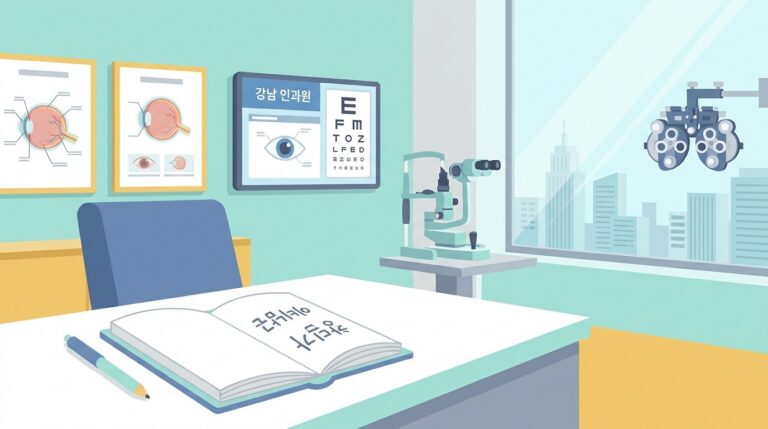
Picture this: You are seated in a high-tech, minimalist ophthalmology clinic in the heart of Gangnam, Seoul. Around you, sleek digital monitors display corneal heatmaps, and dozens of people are quietly sipping barley tea while waiting for their vision correction consults. You just spent the past two hours going through 50 specialized tests—corneal topography, pupil dilation, endothelial cell counts, and intraocular pressure checks.
You walk into the director’s office (원장실) expecting a simple “Yes, you can get LASIK!” Instead, the doctor looks closely at your chart and says:
“각막 두께가 평균보다 약간 얇으시고 안구건조증이 있으셔서, 각막 절편을 만드는 라식보다는 투데이 라섹이나 렌즈삽입술(ICL)이 훨씬 안전합니다.”
(Your corneas are slightly thinner than average and you tend to have dry eyes, so rather than LASIK which creates a corneal flap, Today LASEK or ICL would be much safer.)
Suddenly, your mind goes blank. You’ve prepared everyday conversational Korean, but specialized medical terms like corneal flap (각막 절편), dry eye syndrome (안구건조증), and lens implantation (렌즈삽입술) leave you second-guessing your options. You want to ask about recovery time, glare, and whether one method is truly safer for your lifestyle, but how do you express these nuanced clinical questions naturally in Korean without sounding like a textbook robot?
Don’t worry! Korean ophthalmology clinics are among the most advanced in the world, welcoming thousands of international patients each month. Having guided hundreds of intermediate learners through real-life medical appointments in Seoul, I have distilled the exact B2-level phrases and cultural nuances you need to advocate for your eye health with confidence.
Phase 2: 핵심 표현 3선 심층 분석
1. 제 각막 두께가 평균보다 얇은 편인가요? (Je gakmak dugkega pyeong-gyunboda yalbeun pyeon-ingayo?)
- Pronunciation: [Je gak-mak doo-kke-ga pyeong-gyoon-bo-da yal-beun pyeon-in-ga-yo?] (Think of ‘gak’ like ‘gawk’, ‘mak’ like ‘mock’, and ‘yalbeun’ sounding like ‘yahl-beun’ with a silent p-sound blend)
- Meaning: Literal: “Is my corneal thickness on the thin side compared to average?” | Real Nuance: “Are my corneas considered too thin for conventional procedures?”
- K-Culture Moment: You’ll hear this exact phrasing in Korean medical consultation vlogs (의료 브이로그) on YouTube when lifestyle influencers get their pre-op workups in Sinsa-dong or Gangnam.
- Editor’s Insight: Intermediate learners often ask blunt questions like “제 각막이 얇아요?” (Are my corneas thin?). Native speakers use
~는 편이다(to be on the side of…) to soften observations and allow the doctor to deliver nuanced diagnostic feedback.- Situation Spectrum: Casual ⚠️ | Semi-formal ✅ | Formal ✅
- 🤔 Think About It: In English, we might ask directly, “Am I disqualified from LASIK?” Korean medical culture prefers exploratory questions wrapped in softening grammatical hedges like
~편. How does this reflect the desire to maintain social harmony while discussing clinical boundaries?2. 각막 절편을 만들지 않는 수술이 더 안전할까요? (Gakmak jeolpyeoneul mandeulji anneun susuri deo anjeonhalkkayo?)
- Pronunciation: [Gak-mak jeol-pyeon-eul man-deul-ji an-neun soo-soo-ri deo an-jeon-hal-kka-yo?] (Sound analogy: ‘jeol-pyeon’ sounds like ‘chol-pyun’, identical in sound to traditional Korean patterned rice cakes!)
- Meaning: Literal: “Would a surgery that does not create a corneal flap be safer?” | Real Nuance: “Given my condition, is a flap-free procedure like LASEK or SMILE a better route?”
- K-Culture Moment: A line frequently adapted in hospital dramas like Hospital Playlist (슬기로운 의사생활) when patients cautiously verify alternative treatment plans.
- Editor’s Insight:
각막 절편(corneal flap) is the dividing line between standard LASIK and flapless techniques (LASEK, Trans-PRK, ICL). Using~ㄹ까요?presents your question as an invitation for medical guidance rather than questioning the physician’s expertise.- Situation Spectrum: Casual 🚫 | Semi-formal ✅ | Formal ✅
- 🤔 Think About It: Notice the negative modifier
만들지 않는(that doesn’t create). In Korean reasoning, focusing on what the procedure avoids helps clarify risk aversion.3. 안구건조증이나 빛 번짐 부작용이 생길 확률은 어느 정도인가요? (Angu-geonjojeung-ina bit beonjim bujagyongi saenggil hwangnyureun eoneu jeongdo-ingayo?)
- Pronunciation: [An-goo-geon-jo-jeung-ee-na beet beon-jeem boo-ja-gyong-ee saeng-gil hwang-nyoo-reun eo-neu jeong-do-in-ga-yo?]
- Meaning: Literal: “To what degree is the probability that side effects of dry eye syndrome or light smearing will occur?” | Real Nuance: “What are the realistic chances of dealing with chronic dry eyes or halos/glare post-surgery?”
- K-Culture Moment: Korean tech-forum users on DC Inside or Naver Cafe debating whether night driving glare (
야간 빛 번짐) will ruin their road trips.- Editor’s Insight: Koreans refer to optical halos and glare poetically as
빛 번짐(light spreading/smearing). Asking어느 정도인가요?(To what extent?) is far more natural than demanding rigid mathematical stats (“몇 퍼센트예요?”).- Situation Spectrum: Casual ⚠️ | Semi-formal ✅ | Formal ✅
- 🤔 Think About It: Why do you think Korean patients bundle
안구건조증and빛 번짐together as a single set-phrase? They are considered the twin post-op barometers of vision correction satisfaction.
Phase 3: 교과서 한국어 vs 진짜 한국어
Situation 1: Describing persistent eye dryness before surgery
- 📖 교과서 한국어: “저는 평소에 안구건조증 증상이 심각하게 발생합니다.” (I experience severe dry eye symptoms in daily life.)
- 🗣️ 진짜 한국어: “평소에 렌즈를 끼면 눈이 너무 뻑뻑하고 건조함이 심한 편이에요.” (When I wear contacts normally, my eyes feel super gritty and tend to get very dry.)
- 💡 왜 다를까?: Textbook Korean relies on rigid Sino-Korean nouns like
증상 발생(symptom occurrence). Native Korean speakers use vivid mimetic sensory adjectives like뻑뻑하다(gritty, stiff, scratchy) to describe ocular discomfort accurately to doctors.
Situation 2: Inquiring whether lens insertion (ICL) is preferable to laser shaving
- 📖 교과서 한국어: “각막 절삭이 위험하다면 렌즈삽입술을 시행해야 합니까?” (Must I execute lens implantation surgery if corneal ablation is hazardous?)
- 🗣️ 진짜 한국어: “각막을 많이 깎는 게 부담스러우면 렌즈삽입술(ICL) 쪽이 더 나을까요?” (If shaving off a lot of the cornea is risky, would lens implantation be a better bet?)
- 💡 왜 다를까?: Real patients rarely say
절삭(ablation); they use the native verb깎다(to shave/carve down). Adding~쪽이 더 나을까요?(Would that direction be better?) shows thoughtful deliberation rather than demands.
Phase 4: K-Culture 딥다이브 & 비언어적 매너
4-1. 눈치 (Nunchi) & Body Language in the Exam Room
Korean eye centers are miracles of organizational efficiency (Palli-Palli culture at its finest). However, inside the director’s consulting room (원장실), time slows down for critical medical decisions.
* Posture & Gestures: Sit straight and do not touch your eyes or face while speaking. If the doctor shows you your topography maps, lean in slightly and nod gently (끄덕끄덕) while murmuring appreciative acknowledgments such as “네, 원장님” (Yes, Doctor).
* Receiving Documents: When the coordinator or doctor hands you your surgical diagnostic profile, receive the folder with both hands (두 손으로 받기). This small gesture signals respect and attentiveness.
* Eye Contact: Maintain comfortable eye contact during explanations, but soften your gaze when discussing financial or personal hesitation.
4-2. Culture Code: The “Gangnam Vision Hub” Phenomenon
Why is vision correction so culturally ubiquitous in Korea? South Korea has one of the highest myopia rates in the world—over 80% among young urbanites—driven by intensive indoor study culture, early smartphone exposure, and widespread PC gaming culture.
Consequently, procedures like 투데이 라섹 (Today LASEK) and 스마일 라식 (SMILE LASIK) were refined here to match the dynamic pace of Korean society. “Today LASEK” uses advanced epithelial healing protocols allowing patients to take off their protective bandage contact lenses in just 48 hours (hence “투데이”), catering to office workers who take surgery on Friday afternoon and return to work on Monday morning!
Phase 5: 실전 롤플레이 시나리오
- Background: Consultation Room 3 at a premier eye clinic near Gangnam Station Exit 8.
- Characters:
- 원장님 (Dr. Min): Experienced refractive surgeon, calm, analytical, and reassuring.
- 학습자 (Alex): B2-level international patient looking for clarity on thin corneas.
1. 원장님: “알렉스 님, 정밀 검사 결과 보면서 설명드릴게요. 전체적인 망막 상태는 아주 깨끗한데, 각막 두께가 500㎛ 정도로 평균(530~550㎛)보다 약간 얇은 편이세요.”
(Alex, let me explain while looking at your detailed test results. Your retina is very healthy overall, but your corneal thickness is around 500㎛, which is slightly on the thinner side compared to the average of 530~550㎛.)
🎭 Pointing with a stylus pen to the blue and green curvature gradients on the screen.
2. 학습자: “아, 그렇군요… 그러면 잔여 각막 때문에 일반 라식 수술은 좀 어려울까요?”
(Ah, I see… In that case, would regular LASIK be difficult because of the remaining corneal bed?)
🎭 Leaning forward slightly, looking closely at the corneal numbers with focused attention.
3. 원장님: “네, 맞습니다. 라식은 각막 절편을 만들어 젖혀야 해서, 각막이 얇으면 안전 잔여량을 넉넉하게 남기기 부담스럽습니다. 게다가 눈물막 검사에서도 안구건조증 소견이 좀 보여요.”
(Yes, exactly. LASIK requires creating and folding back a corneal flap, so if your cornea is thin, leaving an ample safety margin is a concern. Furthermore, your tear film test shows signs of dry eyes.)
🎭 Adjusting glasses and bringing up the tear break-up time (TBUT) graph.
4. 학습자: “그렇다면 각막 절편을 만들지 않는 투데이 라섹이나 렌즈삽입술(ICL)이 저한테 더 적합한가요?”
(If so, would Today LASEK, which doesn’t create a corneal flap, or ICL be more suitable for me?)
🎭 Nodding understandingly and comparing the two terms clearly.
5. 원장님: “정확하게 짚으셨어요. 투데이 라섹은 상피만 레이저로 얇게 제거하므로 잔여 각막을 최대로 보존할 수 있습니다. 만약 각막 절삭 자체를 피하고 싶으시다면 안내렌즈삽입술도 훌륭한 선택지입니다.”
(You pinpointed it precisely. Today LASEK only removes the epithelium with a laser, preserving the maximum residual cornea. If you wish to avoid shaving the cornea entirely, ICL is also an excellent option.)
🎭 Drawing a quick comparative cross-section sketch on a consultation pad.
6. 학습자: “혹시 투데이 라섹을 하게 되면 회복 기간이나 야간 빛 번짐 부작용은 어느 정도 예상해야 할까요?”
(If I undergo Today LASEK, what should I expect regarding recovery time and night glare side effects?)
🎭 Inquiring in a calm, polite tone with hands resting on the lap.
7. 원장님: “보통 수술 후 이틀간 보호용 렌즈를 끼고 3일 차부터 일상생활이 가능해요. 빛 번짐은 초기 한두 달 동안 다소 있을 수 있지만, 점안액을 꾸준히 넣으시면 서서히 좋아집니다.”
(Usually, you wear protective lenses for two days and can resume daily activities on day three. Night glare can occur for the first month or two, but it gradually improves as you use prescribed eye drops.)
🎭 Reassuring with a confident, gentle smile.
8. 학습자: “자세하게 설명해 주셔서 안심이 되네요. 제 생활 패턴을 고려해서 두 방법 중 조금 더 고민해보고 결정하겠습니다.”
(Thank you for the detailed explanation; that really puts my mind at ease. I’ll consider my lifestyle routine and weigh the two options before deciding.)
🎭 Bowing slightly from the seat and placing both hands together politely.
🔀 인터랙티브 분기점 (What Would You Say Next?)
- Choice A: “라식 가격으로 투데이 라섹 해주시면 안 돼요? 깎아주세요!” (Can’t you do Today LASEK for the price of LASIK? Give me a discount!)
- 🚫 Feedback (Bad): Medical pricing in specialized Korean clinics is standardized based on equipment and laser royalty fees. Haggling like you’re at a traditional fish market undermines clinical trust.
- Choice B: “제 검사 결과지와 수술별 견적서를 상담 실장님께 받아볼 수 있을까요?” (Could I receive my test results and surgical quotations from the consultation manager?)
- ✅ Feedback (Best!): Professional, proactive, and perfectly aligned with Korean clinic protocol. Doctors handle the diagnosis; consultation managers (상담 실장님) finalize dates and pricing sheets.
- Choice C: “원장님 믿고 지금 바로 수술실 들어가서 누울게요!” (I trust you doctor, I’ll walk into the operating room and lie down right now!)
- ⚠️ Feedback (Risk): While doctors appreciate trust, refractive surgery requires signing detailed informed consent forms and discussing post-op drops with the counseling staff first.
Phase 6: 10초 감정 섀도잉 드릴
Read aloud matching the emotion marker and pausing at the slashes (/).
- [🧐 진지하고 신중하게 – Serious & Deliberate]
“제 각막 두께가 / 평균보다 얇은 편이라 / 라식은 어렵다고 들었어요.”
(Je gakmak dugkega / pyeong-gyunboda yalbeun pyeon-ira / rasigeun eoryeopdago deureosseoyo.) -
[💡 호기심을 갖고 명확하게 – Curious & Inquiring]
“각막 절편을 안 만들면 / 안구건조증이나 빛 번짐이 / 훨씬 덜 생기나요?”
(Gakmak jeolpyeoneul an mandeulmyeon / angu-geonjojeung-ina bit beonjimi / hwolssin deol saeng-ginayo?) -
[😌 안도하며 감사하는 톤으로 – Relieved & Grateful]
“자세히 설명해 주셔서 감사해요. / 투데이 라섹 쪽으로 / 조금 더 고민해 볼게요.”
(Jasehi seolmyeonghae jusyeoseo gamsahaeyo. / Tudeyi rasek jjogeuro / jogeum deo gominhae bolgeyo.)
Phase 7: K-Culture 미니 사전
- 각막 절편 (Gakmak Jeolpyeon) | Corneal Flap
- The paper-thin hinged circular tissue flap created during standard LASIK surgery. In Korean clinics, asking “절편을 만드나요?” (Does it create a flap?) is the fastest way to verify whether a procedure is LASIK or surface ablation.
- 안구건조증 (Angu-geonjojeung) | Dry Eye Syndrome
- Literally “eyeball dryness symptom.” Extremely common in Korea due to dust and monitor use. Clinics test this via tear-break-up tests (눈물막 검사).
- 투데이 라섹 (Today LASEK) | 2-Day All-Laser LASEK
- Korea’s signature all-laser trans-PRK technique using specialized amniotic membranes (양막) and cooling protocols to cut recovery time down to 48 hours.
- 렌즈삽입술 / ICL (Renjeusabipsul) | Implantable Collamer Lens Surgery
- Literally “lens insertion surgery.” The gold standard in Korea for patients with extreme myopia or paper-thin corneas where laser shaving is deemed unsafe.
Phase 8: 여행자를 위한 생존 키트
서바이벌 표현 TOP 3
- “검사 당일에 바로 수술까지 가능한 ‘원데이 수술’도 되나요?”
(Geomsa dang-ire baro susul-kkaji ganeunghan ‘wondeyi susul’do doenayo?)- Pro Tip: If you’re on a tight trip itinerary, ask for “One-Day Surgery” (원데이 수술). Clinics will waive testing fees if you operate the same afternoon!
- “수술 후 귀국 비행기는 며칠 뒤부터 타는 게 안전한가요?”
(Susul hu gwiguk bihaeng-gineun myeochil dwibuteo taneun ge anjeonhan-gayo?)- Pro Tip: Cabin pressure affects healing and exacerbates dry eyes. Always have the doctor stamp a fit-to-fly approval date on your chart.
- “인공눈물 처방전 좀 넉넉하게 끊어주실 수 있나요?”
(In-gong-nunmul cheobangjeon jom neongneokhage kkeuneojusil su itnayo?)- Pro Tip: Post-surgery artificial tears are significantly cheaper in Korea when bundled into an official clinic prescription (처방전) rather than buying over-the-counter.
Editor’s Travel Note
- Essential Navigation: To locate top eye hospitals and compare real visitor reviews without algorithmic bias, verify routes using the 네이버 지도 앱 다운로드.
- Deciphering Medical Sheets: Use the live OCR camera inside the 파파고 번역 앱 다운로드 to translate your printed corneal thickness and intraocular pressure printouts into English instantly.
- Financial Checklist: Most high-end clinics accept foreign Visa and Mastercard, but check whether the clinic participates in the immediate airport Tax Refund (택스 리펀) scheme to save up to 7-8% on vision correction costs.
Phase 9: “한 발 더 깊이” (Cultural Essay)
In many Western healthcare systems, medical consultations tend to be strictly transactional: a patient asks a direct question, the doctor states the risk percentage, and the decision rests solely on individual autonomy. In Korea, medical consultations reflect a delicate communal dance of guidance and responsibility (상담 문화). Doctors often act as protective mentors, phrasing recommendations around your future lifestyle—such as your screen hours, screen brightness, and athletic hobbies.
When a Korean surgeon says, “각막이 얇으셔서 라식보다는 라섹 쪽이 마음이 놓입니다” (Since your corneas are thin, LASEK gives me greater peace of mind), they are not just offering data; they are offering relational reassurance. Demonstrating that you appreciate this cautious ethic creates an immediate bond of trust.
💬 Your Turn: If you were choosing between a surgery that lets you work the next day vs. one that takes an extra weekend to heal but preserves more cornea, which would you pick? Leave a comment below with: “저는 [투데이 라섹 / 렌즈삽입술] 쪽이 더 끌려요!”
Phase 10: FAQ & 오해 방지
Q: Can I wear contact lenses right up until my pre-op consultation day?
A: Absolutely not! You must stop wearing soft contact lenses for at least 4 to 5 days, and hard/RGP lenses for at least 10 to 14 days before your consultation. Contact lenses temporarily compress your corneal surface, skewing your corneal thickness and astigmatism readings.
Q: What is the normal corneal thickness in Korea?
A: The average Korean corneal thickness is approximately 530㎛ to 550㎛. If your thickness is under 500㎛, most top clinics will advise against LASIK and recommend surface ablation (투데이 라섹) or implantable lenses (ICL) to guarantee a residual corneal bed of over 350㎛~400㎛.
Q: Does Today LASEK hurt as much as traditional LASEK?
A: Traditional LASEK used alcohol or manual scrapers to remove the epithelium, causing 4 to 5 days of tearing and pain. Modern Today LASEK uses an all-laser approach with rapid cooling irrigation, reducing acute discomfort to roughly 24 to 36 hours for most patients.
🚨 흔한 실수 (Common Mistakes) 경고판
- Mistake 1: Calling every vision correction surgery “라식” (LASIK).
- Correct Action: Use the umbrella term
시력교정술(vision correction surgery) until the doctor identifies whether you are a candidate for LASIK, LASEK, SMILE, or ICL.
- Correct Action: Use the umbrella term
- Mistake 2: Demanding a zero percent chance of dry eyes.
- Correct Action: Frame the question around management:
건조증 관리는 어떻게 하나요?(How do I manage dry eyes?) rather than expecting zero dryness.
- Correct Action: Frame the question around management:
- Mistake 3: Forgetting to ask for your residual cornea number.
- Correct Action: Always ask:
수술 후 잔여 각막은 얼마나 남나요?(How much residual cornea remains post-surgery?). Safe clinics will gladly show you the exact micron buffer.
- Correct Action: Always ask:
Phase 11: 액션 미션 & 참여 유도
- 🥉 Bronze Mission (Solo Shadowing): Read the 3 sentences in Phase 6 out loud three times each, timing yourself to stay under 10 seconds per sentence.
- 🥈 Silver Mission (Social Share): Tweet or post on Threads: “한국 안과에서는 각막이 얇으면 투데이 라섹이나 렌즈삽입술을 추천한대요! 👀 #매일한글 #DailyHangul”
- 🥇 Gold Mission (Real Application): Open your voice recorder and leave a 30-second audio memo introducing your eye condition using the grammar pattern:
제가 ~한 편이라서, ~쪽이 더 적합할 것 같아요. - 🎮 K-Culture Mission: Search YouTube for
강남 안과 검안 브이로그(Gangnam Eye Clinic Exam Vlog) and see if you can hear the coordinator mention각막 두께or안구건조증!
Phase 12: 인터랙티브 퀴즈 챌린지
Q1. (상황 판단) You are at an eye clinic in Seoul. The doctor mentions your corneas are 495㎛ (thinner than average). Which response is the most natural and safe?
* (A) “상관없으니까 제일 싼 라식으로 그냥 해주세요.”
* (B) “각막 두께가 얇은 편이면, 각막 절편을 안 만드는 라섹이나 렌즈삽입술이 더 안전할까요?”
* (C) “각막을 두껍게 만드는 약을 먼저 처방해 주세요.”
Q2. (빈칸 채우기) Complete the phrase with the natural Korean idiom for dry and scratchy eyes:
* “렌즈를 오래 끼면 눈이 너무 ( )하고 건조해요.”
* Hint: Starts with ‘뻑’.
Q3. (True / False) In Korea, “투데이 라섹” means that the entire surgery and your final full visual acuity recovery are 100% completed in exactly 2 hours.
* (True / False)
클릭하여 정답과 해설 확인하기 (Click to reveal answers)
- Q1 정답: (B)
- 해설: Option (B) demonstrates polite B2 consultative Korean and accurately prioritizes safety for thin corneas. Option (A) is recklessly unsafe, and Option (C) is medically impossible (corneal thickness cannot be grown with pills!).
- Q2 정답: 뻑뻑
- 해설: The mimetic adjective
뻑뻑하다describes stiff, gritty friction caused by lack of tears.
- 해설: The mimetic adjective
- Q3 정답: False
- 해설: “Today LASEK” means the corneal epithelium regenerates fast enough that the protective lens can be safely removed in 2 days (48 hours), but full microscopic vision stabilization takes several weeks.
- 해설: “Today LASEK” means the corneal epithelium regenerates fast enough that the protective lens can be safely removed in 2 days (48 hours), but full microscopic vision stabilization takes several weeks.
🎬 Watch Our Daily Videos! (Daily Hangul Official Instagram)
Review the expressions you learned in this article with our fun daily short videos! Check out native pronunciation and real-life nuances in action.
- Instagram @dailyhangul_en







