

Phase 1: Empathy (Storytelling Opening)
안녕하세요! (Annyeonghaseyo!) It is your Daily Hangul editor here, your 10-year Korean culture navigator.
Have you ever stood in the middle of Seoul’s Gangnam Station during morning rush hour? Commuters sprint between train doors, mobile orders ready before you even step foot into a cafe, and same-day delivery packages arrive on doorsteps at 6:00 AM. This is Korea’s legendary 빨리빨리 (ppalli-ppalli, hurry-hurry) mindset. It makes life miraculously convenient, but it also creates intense burnout.
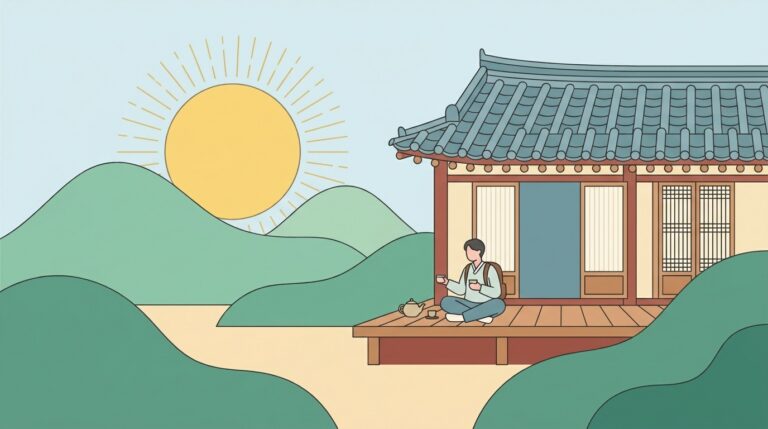
That is why an exciting counter-trend has taken South Korea by storm: 촌캉스 (chon-cance)—a clever mashup of chon (시골, countryside) and vacance (vacation). Young city dwellers are intentionally swapping high-tech apartments for creaky floorboards in rural Hanoks, wearing vibrant floral farming pants, listening to crickets, and seeking slow travel.
Many of our intermediate learners share this exact pain point: “I know how to order food quickly in Seoul, but I don’t know how to speak softly, express relaxation, or connect warmly with locals in the quiet countryside.” This guide uses real student feedback to teach you the natural, heartfelt Korean you need to unwind and embrace the beauty of slowing down.
Phase 2: Core Expressions Deep Dive
1. 힐링하러 왔어요 (Healing-hareo wasseoyo)
- Pronunciation: [Heel-ling-ha-reo wat-seo-yo] (Think of the English word “healing” blended into the Korean movement marker “-ha-reo”)
- Meaning: Literal: “I came to heal.” | Nuance: “I am here to take a mental break, de-stress, and recharge my batteries.”
- K-Culture Moment: Seen frequently on travel variety shows like Three Meals a Day (삼시세끼) when stressed actors arrive at a farm village, drop their bags on the porch, take a deep breath of fresh air, and sigh with relief.
- Editor’s Insight: In Korean, “힐링 (healing)” is not clinical medicine; it refers to emotional self-care, peaceful scenery, and comfort food.
- Situation Spectrum: Casual: ✅ (힐링하러 왔어) | Semi-formal: ✅ (힐링하러 왔어요) | Formal: ⚠️ (힐링을 목적으로 방문했습니다)
- 🤔 Think About It: Does your native culture borrow medical or therapeutic terms to describe a casual weekend holiday? Why do you think modern Koreans use “healing” so frequently?
2. 마음의 여유를 찾고 싶어요 (Maeum-ui yeoyureul chatgo sipeoyo)
- Pronunciation: [Ma-eum-ui yeo-yu-reul chat-go si-peo-yo] (Say “ma-eum” like “my-eum”, “yeo-yu” sounds like “yuh-you”)
- Meaning: Literal: “I want to find room/leeway in my mind.” | Nuance: “I want to regain my peace of mind and escape the mental rush.”
- K-Culture Moment: A classic line delivered by exhausted office workers in healing K-dramas like Summer Strike (아무것도 하고 싶지 않아) or Hometown Cha-Cha-Cha when asked why they quit their city jobs.
- Editor’s Insight: 여유 (yeoyu) is an essential Korean concept meaning inner spaciousness, composed calm, and lack of frantic hurry.
- Situation Spectrum: Casual: ✅ (여유를 좀 찾고 싶어) | Semi-formal: ✅ (여유를 찾고 싶어요) | Formal: ✅ (마음의 여유를 찾고자 합니다)
- 🤔 Think About It: Is “taking time for yourself” seen as productive or lazy in your home country? Notice how Korean frames this as actively “seeking leeway (여유를 찾다)”.
3. 느긋하게 쉬다 갈게요 (Neugeuthage swida galgeyo)
- Pronunciation: [Neu-geut-ha-ge swi-da gal-ge-yo] (The “neu” rhymes with “duh”, “geut” like “good” without the d)
- Meaning: Literal: “I will rest leisurely and then go.” | Nuance: “I am going to take my time and have an unhurried, peaceful stay.”
- K-Culture Moment: Guests saying goodbye for the afternoon to a Hanok guesthouse host as they head out to sit by the garden with a cup of traditional tea.
- Editor’s Insight: Using 느긋하게 (neugeuthage) sets a slow, polite tone. The ending -(으)ㄹ게요 shows your gentle personal intention without sounding demanding.
- Situation Spectrum: Casual: ✅ (느긋하게 쉴게) | Semi-formal: ✅ (느긋하게 쉬다 갈게요) | Formal: ⚠️ (느긋하게 휴식하도록 하겠습니다)
- 🤔 Think About It: How does deliberately informing someone that you will “rest slowly” change the interpersonal dynamic compared to simply saying “Goodbye”?
Phase 3: Textbook Korean vs. Real Korean
Situation 1: Describing that you are relaxing and doing nothing
- 📖 교과서 한국어 (Textbook): 저는 지금 휴식을 취하고 있습니다. (Jeoneun jigeum hyusigeul chwihago itseumnida.) — “I am currently taking a rest.”
- 🗣️ 진짜 한국어 (Real-World): 저 지금 멍때리면서 힐링 중이에요. (Jeo jigeum meong-ttaerimyeonseo healing jung-ieyo.) — “I am zoning out and totally healing right now.”
- 💡 Why the difference? Textbook phrases sound like corporate announcements. Koreans in their 20s and 30s love using 멍때리다 (meong-ttaerida) to describe the intentional, peaceful art of “spacing out” in nature.
Situation 2: Suggesting an unhurried walk in a village
- 📖 교과서 한국어 (Textbook): 천천히 걸어갑시다. (Cheoncheonhi georeogapsida.) — “Let us walk slowly.”
- 🗣️ 진짜 한국어 (Real-World): 우리 동네 한 바퀴 느긋하게 산책할까요? (Uri dongne han bakwi neugeuthage sanchaekhalkkayo?) — *”Shall we take an easy, slow stroll around the village?”
- 💡 Why the difference? Directly telling people to move slowly can sound like a physical command. Adding 느긋하게 (leisurely) and 한 바퀴 (one gentle loop) creates a shared feeling of warm serenity.
Phase 4: K-Culture Deep Dive & Non-Verbal Manners
4-1. Nunchi (눈치) & Body Language in the Countryside
In fast-moving Seoul convenience stores and cafes, speed is politeness. You hold your card ready, tap instantly, and grab your receipt. However, in rural villages (시골):
* The Gentle Pace: Rushing people or talking too fast feels abrasive. Match the host’s tempo. Speak at an unhurried pace and lower your volume.
* Two-Handed Warmth: When accepting herbal tea or homemade side dishes from a guesthouse owner, always use two hands with a soft nod.
* The Threshold Etiquette: When stepping onto a traditional wooden veranda (maru, 마루), remove your shoes neatly turned facing outward toward the yard, demonstrating mindfulness and respect.
4-2. Cultural Code: The Chon-cance Phenomenon
Chon-cance is not just a weekend getaway; it is a cultural rejection of hyper-connectivity. In Korean society, where apps calculate bus arrivals down to the second, urbanites crave sensory quiet. Travelers buy 몸뻬 바지 (mombbe baji)—colorful, baggy cotton pants worn by farming grandmothers—sit by fire pits for 불멍 (bul-meong, campfire spacing-out), and prepare simple meals using seasonal vegetables. It mirrors the philosophy of the movie Little Forest (리틀 포레스트): feeding the soul by moving at nature’s clock.
Phase 5: Real-Life Roleplay Scenario
Setting: Sun-hee’s Countryside Minbak (Sunhee Halmeoni’s Hanok stay in Yeongwol, Gangwon-do). Warm wood aromas, chirping birds, and an open vegetable garden.
Character: Sun-hee Halmeoni (순희 할머니), a hospitable 70-year-old guesthouse owner wearing an apron.
- Turn 1 (Sun-hee): 아이고, 서울에서 오느라 고생 많았어요! 짐 이리 줘요.
(Aigo, Seoureseo oneura gosaeng manasseoyo! Jim iri jwoyo.)
🎭 Smiles warmly, reaching both hands out to welcome you.
“Oh dear, you must be tired from traveling all the way from Seoul! Hand over your luggage here.” - Turn 2 (Learner): 할머니, 안녕하세요! 짐은 괜찮아요. 배려해 주셔서 감사합니다.
(Halmeoni, annyeonghaseyo! Jimeun gwaenchanayo. Baeryeohae jusyeoseo gamsahamnida.)
🎭 Bows 30 degrees with a polite smile, placing bags beside the porch.
“Hello grandmother! The luggage is fine. Thank you so much for your thoughtfulness.” - Turn 3 (Sun-hee): 젊은 친구가 여기까지 무슨 일로 혼자 왔누? 심심할 텐데.
(Jeolmeun chinguga yeogikkaji museun illo honja watnu? Simsimhal tende.)
🎭 Hands over a glass of iced barley tea with an inquisitive look.
“What brings a young person all the way out here all alone? Aren’t you afraid of getting bored?” - Turn 4 (Learner): 요즘 너무 바쁘게 살아서, 마음의 여유를 좀 찾고 싶어서 왔어요.
(Yojeum neomu bappeuge saraseo, maeum-ui yeoyureul jom chatgo sipeoseo wasseoyo.)
🎭 Sips the tea with both hands and breathes out gently.
“Life was moving too fast lately, so I came here wanting to find some peace of mind.” - Turn 5 (Sun-hee): 그래, 그래. 도시 생활이 참 숨 가쁘지. 여기선 아무것도 안 해도 돼요.
(Geurae, geurae. Dosi saenghwari cham sum gappeuji. Yeogiseon amugeotdo an haedo dwaeyo.)
🎭 Nods empathetically and gestures toward the quiet hills.
“Right, right. City life is truly breathless. Out here, you don’t have to do anything at all.” - Turn 6 (Learner): 네, 며칠 동안 푹 쉬면서 힐링하고 갈게요.
(Ne, myeochil dongan puk swimyeonseo healinghago galgeyo.)
🎭 Looks out toward the mountains with a calm expression.
“Yes, I plan to get a deep rest and recharge my batteries for a few days before I go.” - Turn 7 (Sun-hee): 저녁엔 텃밭에서 딴 채소로 된장찌개 끓여줄 테니 편하게 쉬어요.
(Jeonyeogen teotbateseo ttan chaesoro doenjangjjigae kkeullyeojul teni pyeonhage swieoyo.)
🎭 Pats the wooden floor gently with a grandmotherly grin.
*”For dinner, I will brew bean paste stew with fresh garden greens, so rest comfortably.” - Turn 8 (Learner): 정말 기대돼요! 방에서 마당 보면서 느긋하게 쉴게요.
(Jeongmal gidaedwaeyo! Bangeseo madang bomyeonseo neugeuthage swilgeyo.)
🎭 Smiles warmly and sits comfortably on the porch floorboard.
“I really look forward to it! I will relax leisurely in the room while watching the yard.”
🔀 Interactive Choice Point
Halmeoni asks: “What are your plans for tomorrow morning? (내일 아침엔 뭐 할 계획이야?)”
- Choice A: 아침 일찍 일어나서 모든 관광지를 빨리 다 돌아볼 거예요! (I will wake up early and tour all tourist spots super quickly!)
- Choice B: 알람 안 끄고 푹 자고, 툇마루에서 멍때릴 거예요. (I won’t set an alarm, sleep deeply, and just space out on the porch.)
- Choice C: 할머니, 왜 이렇게 시골에 아무것도 없어요? (Grandmother, why is there nothing to do out here in the countryside?)
Feedback on Your Choice:
- Choice A (Risk): While grammatically correct, this brings Seoul’s ppalli-ppalli panic directly into a rural haven! Halmeoni might sigh and worry you are exhausting yourself.
- Choice B (Best Choice): Perfectly embodies the chon-cance spirit! Halmeoni will love that you are taking care of your health and enjoying her quiet home.
- Choice C (Bad): Highly rude! Calling a host’s hometown barren hurts feelings and breaches basic countryside etiquette.
Phase 6: 10-Second Emotional Shadowing Drill
Practice these natural pacing pauses (/) and embody the matching emotional cues:
[🌿 편안하고 나긋나긋하게 / Calm, soft-spoken]
바쁜 도시를 벗어나서 / 마음의 여유를 / 찾고 싶었어요.
(Bappeun dosireul beoseonaseo / maeum-ui yeoyureul / chatgo sipeosseoyo.)
“Escaping the busy city / I wanted to find / peace of mind.”-
[☕ 여유롭고 행복한 한숨 / Relaxed sigh of relief]
아무 생각 없이 / 새소리 들으면서 / 멍때리는 중이에요.
(Amu saenggak eopsi / saesori deureumyeonseo / meong-ttaerineun jung-ieyo.)
“Without any thoughts / listening to birds singing / I am zoning out.” -
[🙏 진심 어린 감사의 톤 / Sincere and appreciative tone]
따뜻하게 맞아주셔서 감사해요. / 느긋하게 / 쉬다 갈게요.
(Ttatteuthage majajusyeoseo gamsahaeyo. / Neugeuthage / swida galgeyo.)
“Thank you for greeting me so warmly. / Leisurely / I will rest before leaving.”
Phase 7: K-Culture Mini Dictionary
- 촌캉스 (Chon-cance) | Noun
A compound of 촌 (countryside) and 바캉스 (vacation). Refers to holiday stays at authentic rural villages to enjoy rustic cooking, nature, and quietude. - 멍때리기 (Meong-ttearigi) | Noun / Verb
The conscious act of turning off your brain and spacing out. Subcategories include 불멍 (staring into a bonfire) and 물멍 (staring into ripples of water). - 힐링 (Healing) | Noun
K-Konglish concept denoting mental, spiritual, and emotional rejuvenation through wholesome activities, serene settings, and comforting foods. - 소확행 (Sohwakhaeng) | Noun (Acronym)
Stands for 소소하지만 확실한 행복 (Small but Certain Happiness). Finding immense joy in tiny pleasures, such as a cup of morning tea in a farm valley.
Phase 8: Traveler’s Survival Kit
Top 3 Slow-Travel Survival Expressions
- 여기서 천천히 둘러봐도 될까요? (Yeogiseo cheoncheonhi dulleobwado doelkkayo?)
Meaning: “May I look around here slowly?”
Pro Tip: Use this at small pottery workshops or quiet country markets so merchants know you are not in a rush. - 사진 한 장 여유 있게 찍고 가도 괜찮을까요? (Sajin han jang yeoyu itge jjikgo gado gwaenchaneulkkayo?)
Meaning: “Would it be alright if I take an unhurried photo before I move on?”
Pro Tip: Polite phrasing when admiring a private garden gate or scenic village alleyway. - 공기가 참 맑고 평화롭네요. (Gonggiga cham malgo pyeonghwaromneyo.)
Meaning: “The air is so clean and peaceful.”
Pro Tip: The ultimate icebreaker with elderly countryside residents. It immediately signals that you appreciate their hometown.
Editor’s Travel Note
- Navigation Guide: City transport apps may lack countryside footpath updates. Make sure you complete your 네이버 지도 앱 다운로드 before departing, as Naver Map provides accurate rural intercity bus schedules and walking trail outlines.
- Cash Readiness: While South Korea is practically cashless in cities, local farmers selling persimmons or seasonal corn along country roads often only accept bank transfers or physical cash. Carry 20,000 to 30,000 KRW in paper bills.
Phase 9: A Step Deeper (Reflection)
Korea built one of the world’s most advanced digital economies in under half a century, largely fueled by the relentless engine of Ppalli-Ppalli. Yet, Korean culture operates on a rhythmic pendulum. The faster life accelerates, the deeper the human longing for 정 (Jeong, relational warmth) and rooted stillness becomes. The popularity of chon-cance is not a rejection of progress, but a collective breath—a reminder that a society that knows how to sprint must also master the wisdom of sitting still on a wooden porch.
💬 Your Turn: Have you ever felt exhausted by fast urban travel? What does your ideal “slow day” look like in your hometown compared to a Korean countryside village? Let’s talk in the comments below!
Phase 10: FAQ & Avoiding Misunderstandings
Q: Can I use the word “촌캉스 (chon-cance)” in formal business conversation?
A: No, it is a playful modern slang term. In a business or professional presentation, use formal phrasing such as 농촌 힐링 관광 (rural healing tourism) or 체류형 농촌 여행 (stay-based rural travel).
Q: Is “멍때리다 (to space out)” considered rude to say to someone older?
A: Yes, if used toward an elder (e.g., “할머니 멍때리세요”). However, using it humbly to describe your own activity in casual conversation (e.g., “저 잠시 멍때리고 있었어요”) is accepted and often brings an affectionate laugh.
Q: Are rural minbaks safe for solo foreign travelers?
A: Extremely safe. Village guesthouses are typically operated by registered local families. However, English signage is scarce, so saving key phrases on your phone and having an offline translation tool handy is essential.
🚨 Common Mistakes Alert (흔한 실수)
- Over-using ‘바캉스 (vacance)’ alone: Koreans rarely say “바캉스 가요” today; it sounds dated from the 1990s. Use 휴가 (vacation), 여행 (travel), or compound trends like 호캉스 (hotel-cance) and 촌캉스 (chon-cance).
- Confusing ‘느리게’ and ‘느긋하게’: Saying “느리게 쉴게요” (I’ll rest slowly) sounds unnatural. Always use 느긋하게 (leisurely/unhurriedly) when describing a relaxed lifestyle or mindset.
- Expecting rapid service at rural eateries: Ringing service bells repeatedly or asking “빨리 나오나요? (Does this come out fast?)” will alienate warm village hosts. Relax and wait patiently.
Phase 11: Action Missions
- 🥉 Bronze Mission (Solo Shadowing): Stand by an open window, take three deep breaths, and recite: “오늘은 바쁜 일상을 잊고 느긋하게 쉴 거예요! (Today, I will forget my busy routine and rest leisurely!)”
- 🥈 Silver Mission (Social Journaling): Post a peaceful photo of nature, trees, or a cup of tea on your Instagram or language journal, tagging it with
#촌캉스 #마음의여유 #데일리한글. - 🥇 Gold Mission (Real-Life Application): Next time you enter a quiet cafe or countryside spot, resist the urge to glance at your phone instantly. Spend 5 minutes practicing 멍때리기 (spacing out) and greet the barista or host with: “분위기가 참 여유롭고 좋네요 (The atmosphere is so peaceful and nice).”
🎮 K-Culture Mission: Watch one episode of the Korean variety show Three Meals a Day (삼시세끼) or the movie Little Forest (리틀 포레스트). Write down every moment you spot someone saying “힐링” or enjoying “여유”!
Phase 12: Interactive Quiz Challenge
1. Situational Judgment
You are checking into a quiet countryside Hanok. Your host pours you hot tea. Which sentence sounds most natural, polite, and culturally fitting?
* A) 빨리 마시고 방에 들어가서 일할게요. (I will drink fast, go to the room, and work.)
* B) 공기도 좋고 너무 평화롭네요. 며칠 동안 푹 쉬면서 힐링하고 갈게요. (The air is nice and it’s so peaceful. I’ll get deep rest and recharge before I leave.)
* C) 여기는 배달 앱이 왜 안 돼요? (Why does the delivery app not work here?)
2. Fill-in-the-Blank
도시의 빠른 속도에서 벗어나 내 안의 쉼을 찾는 태도를 가리켜 “마음의 _______를 찾다”라고 합니다. (Finding room and unhurried peace in your mind is expressed as “seeking ______ in one’s heart”.)
3. True / False Cultural Check
True or False: When Koreans talk about “불멍 (bul-meong)”, they are talking about getting angry when travel plans fail.
👉 Click to Reveal Answers & Explanations
- Answer: B
Explanation: Choice B expresses gratitude, remarks on the rural environment, and appropriately uses the healing concept. Choice A brings stressful hurry into a guesthouse, while Choice C is culturally insensitive. -
Answer: 여유 (Yeoyu)
Explanation: 마음의 여유 (mindful leeway/peace of mind) is the essential intermediate collocation for mental calm. -
Answer: False
Explanation: 불멍 is a portmanteau of 불 (fire) and 멍때리기 (zoning out). It refers to the relaxing activity of peacefully gazing into a wood fire without thinking!
🎬 Watch Our Daily Videos! (Daily Hangul Official Instagram)
Review the expressions you learned in this article with our fun daily short videos! Check out native pronunciation and real-life nuances in action.
- Instagram @dailyhangul_en







