

Master Korean Housewarming Food Talk: Mille-feuille Nabe, Bossam, and Japchae
Phase 1: 공감 (Story-Driven Opening)
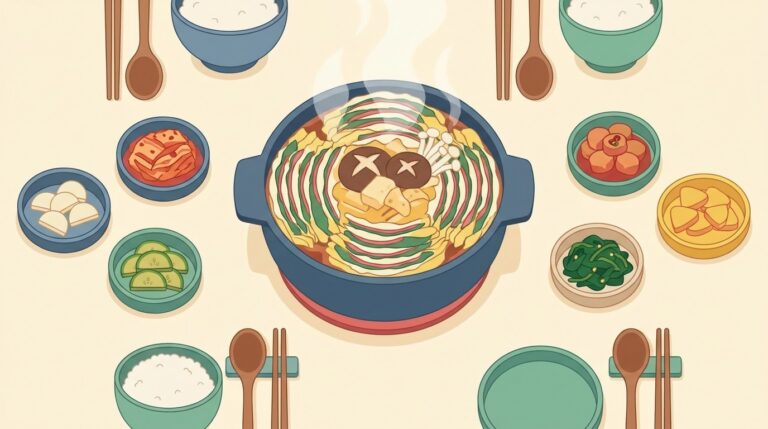
안녕하세요! 매일한글 에디터입니다. Have you ever been invited to a Korean housewarming party, known as a Jipdeuri (집들이)? Picture this: you take off your shoes at your Korean friend’s new apartment, and an intoxicating aroma of rich dashi broth, tender steamed pork, and nutty sesame oil hits you. As you walk toward the table, your jaw drops. In the center sits an artfully layered floral hot pot—mille-feuille nabe (밀푀유나베)—flanked by glossy bossam (보쌈) and colorful japchae (잡채). Your host smiles warmly and says, “집들이 음식으로 밀푀유나베랑 보쌈, 잡채를 직접 준비했어요! (Jipdeuri eumsigeuro milppeyunaberang bossam, japchaereul jikjeop junbihaesseoyo! – For housewarming food, I prepared mille-feuille nabe, bossam, and japchae myself!).” In that moment, do you freeze and just mutter a plain “Thank you”? Many of our A2 learners share that food-hosting situations make them nervous because textbook dialogues never prepare them for modern social dining. This step-by-step guide is built from real community stories to help you praise food, express deep gratitude, and speak naturally like a true Korean bestie!
Phase 2: 핵심 표현 3선 심층 분석 (Top 3 Key Expressions)
1. 집들이 음식으로 밀푀유나베랑 보쌈, 잡채를 직접 준비했어요. (한글)
- Pronunciation: [Jip-deu-ri eum-si-geu-ro mil-ppye-yu-na-be-rang bo-ssam, jap-chae-reul jik-jeop jun-bi-haess-eo-yo.] (Sounds like: “Jeep-deu-ree oom-sheeg-eu-ro meal-fey-you-nah-beh-rang bo-ssahm, jahp-cheh-reul jeek-juhp joon-bee-hehs-uh-yo”)
- Meaning: Literal: “As housewarming food, mille-feuille nabe and bossam, japchae I prepared directly.” / Real Nuance: “I personally cooked mille-feuille nabe, bossam, and japchae especially for our housewarming today!”
- K-Culture Moment: You will hear this exact modest brag in reality shows like I Live Alone (나 혼자 산다) whenever a celebrity invites their squad over and reveals a feast they slaved over for hours.
- Editor’s Insight: The magic word here is 직접 (jikjeop), meaning “in person” or “myself.” In Korean dining etiquette, mentioning 직접 highlights genuine hospitality and personal devotion.
- Situation Spectrum:
- Casual (Friends): ✅
- Semi-formal (Co-workers visiting): ✅
- Formal (In-laws / Boss): ⚠️ (Change ending to 준비했습니다 [junbihaessseumnida])
- 🤔 Think About It: In your culture, do hosts list the dishes they cooked when you sit down, or is it considered boasting? In Korea, listing the menu is an affectionate invitation to feast.
2. 손이 많이 갔을 텐데 정말 고마워요. (한글)
- Pronunciation: [Son-i ma-ni ga-sseul ten-de jeong-mal go-ma-wo-yo.] (Sounds like: “Sohn-ee mahn-ee gah-sseul ten-deh jung-mahl go-mah-wo-yo”)
- Meaning: Literal: “A lot of hands must have gone into this, so thank you truly.” / Real Nuance: “This must have taken so much effort to prepare! Thank you so much.”
- K-Culture Moment: Seen in heartfelt K-drama scenes where characters visit an elder or a diligent friend; saying this immediately recognizes the invisible labor behind peeling, slicing, and simmering.
- Editor’s Insight: Koreans measure kitchen effort through the idiom 손이 가다 (soni gada)—literally “hands go to it.” Acknowledging the host’s effort warms their heart far more than just saying “It tastes good!”
- Situation Spectrum:
- Casual (Close friends): ⚠️ (Drop ~요: 손이 많이 갔을 텐데 진짜 고마워!)
- Semi-formal (Acquaintances / Peers): ✅
- Formal (Elders / In-laws): ⚠️ (Upgrade to 손이 많이 가셨을 텐데 정말 감사드립니다)
- 🤔 Think About It: Notice how Korean compliments focus on the time and labor of love rather than just the final taste. What does this tell you about Korean relationship building?
3. 맛있게 드셔 주셔서 제가 더 뿌듯해요. (한글)
- Pronunciation: [Ma-sit-ge deu-syeo ju-syeo-seo je-ga deo ppu-deu-thae-yo.] (Sounds like: “Mah-shee-geh deu-syuh joo-syuh-suh jeh-gah duh ppoo-deut-heh-yo”)
- Meaning: Literal: “Because you ate deliciously for me, I am even more proud/fulfilled.” / Real Nuance: “Seeing you enjoy the food makes me so happy and fulfilled!”
- K-Culture Moment: Commonly spoken by mothers or warm hosts on culinary travel variety shows like Baek Jong-won’s Alley Restaurant when guests clear their plates.
- Editor’s Insight: The word 뿌듯하다 (ppudeuthada) describes a warm, swelling sense of personal satisfaction and accomplishment. It is the ultimate host emotion.
- Situation Spectrum:
- Casual: ✅ (맛있게 먹어줘서 내가 더 뿌듯해!)
- Semi-formal: ✅
- Formal: ✅ (맛있게 드셔 주셔서 제가 더 보람찹니다)
- 🤔 Think About It: Why does Korean culture place such immense spiritual value on watching other people eat heartily?
Phase 3: 교과서 한국어 vs 진짜 한국어 (Textbook vs. Real-Life Korean)
Situation 1: Telling your guests what you cooked
- 📖 교과서 한국어: 제가 집들이 음식을 요리했습니다. (Jega jipdeuri eumsigeul yorihaessseumnida. – I cooked housewarming food.)
- 🗣️ 진짜 한국어: 밀푀유나베랑 보쌈 직접 준비했어요! (Milppeyunaberang bossam jikjeop junbihaesseoyo! – I made mille-feuille nabe and bossam myself!)
- 💡 왜 다를까?: Textbook Korean sounds like an official military report. Real Koreans mention specific dish names and use the humble, friendly verb 준비했어요 (junbihaesseoyo) instead of the rigid 요리했습니다.
Situation 2: Complimenting the host on the extravagant spread
- 📖 교과서 한국어: 이 음식은 매우 훌륭합니다. (I eumsigeun maeu hullyunghamnida. – This food is very excellent.)
- 🗣️ 진짜 한국어: 와, 상다리 부러지겠어요! 잘 먹겠습니다! (Wa, sangdari bureojigesseoyo! Jal meokgetseumnida! – Wow, the table legs are going to break under all this food! Thank you for the meal!)
- 💡 왜 다를까?: Native Koreans love lively culinary idioms. Comparing a bountiful table to one heavy enough to break its own legs (상다리가 부러지다) is the highest praise you can offer.
Phase 4: K-Culture 딥다이브 & 비언어적 매너 (Deep Dive & Etiquette)
4-1. 눈치 (Nunchi) & Gestures at the Housewarming Table
- The Visual Gasp: When you first see the spread, do not just sit down silently. Offer a slight two-hand clap, lean forward, and utter an appreciative “우와~ (Oo-wah~)”.
- Two Hands for Shared Dishes: When passing plates or taking dipping sauce bowls, support your right wrist or forearm with your left hand. This subtle gesture shows politeness without feeling overly rigid.
- Photo Etiquette: Koreans love food aesthetics! Before touching chopsticks, ask politely: “사진 한 장만 찍어도 돼요? (Sajin han jangman jjigeodo dwaeyo? – May I take just one photo?)” Hosts love this because it validates their Instagram-worthy styling!
4-2. 문화 코드 분석 (Why These 3 Dishes Rule Modern Housewarmings)
- 밀푀유나베 (Mille-feuille Nabe): Why did a French-Japanese hot pot take over Korean housewarmings? Because of its visual perfection. Layers of napa cabbage, perilla leaves (깻잎), and thinly sliced marbled beef resemble a blooming flower. It looks like high-end restaurant culinary art while cooking peacefully in one pot.
- 보쌈 (Bossam): Steamed pork belly wrapped in fresh kimchi symbolizes festive generosity. Historically, meat was saved for monumental occasions like harvest feasts or building a home.
- 잡채 (Japchae): With its glossy glass noodles, vibrant spinach, carrots, and mushrooms, Japchae has represented celebration, longevity, and joy since the Joseon royal courts.
Phase 5: 실전 롤플레이 시나리오 (Real-Life Roleplay Scenario)
- Setting: A warm, beautifully lit apartment in Mapo-gu. The aroma of simmering kelp broth fills the air as Alex arrives holding a gift bag of scented candles and rolled toilet paper.
- Characters:
- 민지 (Minji): The proud host who spent four hours prepping the spread.
- 알렉스 (Alex): The observant, enthusiastic guest (Target Level: A2).
민지: 알렉스 씨, 어서 와요! 집 찾기 어렵지 않았어요?
(Alex-ssi, eoseo wayo! Jip chatgi eoreopji anatseoyo?)
“Alex, welcome! Was it hard to find the place?”
(🎭 Smiling brightly, gesturing him inside)
알렉스: 아니요, 금방 찾았어요! 초대해 줘서 고마워요. 이거 작은 선물이에요!
(Aniyo, geumbang chajatseoyo! Chodaehae jwoseo gomawoyo. Igeo jageun seonmurieyo!)
“No, I found it right away! Thank you for inviting me. Here is a small gift!”
(🎭 Handing over the gift bag with both hands)
민지: 어머, 휴지랑 캔들이네요! 센스 대박! 얼른 식탁으로 와요.
(Eomeo, hyujirang kaendeullineyeyo! Senseu daebak! Eolleun siktageuro wayo.)
“Oh my, toilet paper and candles! Such great taste! Come over to the table quickly.”
(🎭 Placing the gift aside and leading him to the dining table)
알렉스: 와… 대박! 상다리 부러지겠어요! 이거 다 뭐예요?
(Wa… daebak! Sangdari bureojigesseoyo! Igeo da mwoyeyo?)
“Wow… amazing! The table legs are going to break! What is all this?”
(🎭 Eyes wide open, looking at the colorful dishes in genuine awe)
민지: 집들이 음식으로 밀푀유나베랑 보쌈, 잡채를 직접 준비했어요.
(Jipdeuri eumsigeuro milppeyunaberang bossam, japchaereul jikjeop junbihaesseoyo.)
“For housewarming food, I prepared mille-feuille nabe, bossam, and japchae myself.”
(🎭 Slightly tilting head with proud, modest smile)
알렉스: 이걸 다 직접 만들었어요? 손이 진짜 많이 갔을 텐데 정말 고마워요!
(Igeol da jikjeop mandeureosseoyo? Soni jinjja mani gasseul tende jeongmal gomawoyo!)
“You made all of this yourself? It must have taken so much work, thank you so much!”
(🎭 Clapping hands together softly in admiration)
민지: 국물 식기 전에 따뜻할 때 얼른 드셔 보세요!
(Gungmul sikgi jeone ttatteut-hal ttae eolleun deusyeo boseyo!)
“Please hurry and try some while it is warm before the broth gets cold!”
(🎭 Handing him a pair of brass chopsticks)
알렉스: 네, 정말 맛있게 잘 먹겠습니다! 국물이 진짜 시원해요!
(Ne, jeongmal mas-itge jal meokgetseumnida! Gungmuri jinjja siwonhaeyo!)
“Yes, I will eat heartily and enjoy it! The broth is so refreshing and deep!”
(🎭 Taking a spoonful of warm nabe broth and nodding contentedly)
🔀 인터랙티브 분기점 (Interactive Choice Branching)
Minji looks over at you expectantly as you swallow your first bite of bossam. What do you say?
- Choice A: “음식이 달아요. 다음에는 배달시켜요! (Eumsigi darayo. Daeumeneun baedalsikyeoyo! – The food is sweet. Next time let’s order delivery!)”
- Choice B: “진짜 꿀맛이에요! 고기가 입에서 살살 녹아요. (Jinjja kkulmasieyo! Gogiga ibeseo salsal nogayo. – It is literally honey-sweet! The meat melts like butter in my mouth.)”
- Choice C: “음, 그냥 괜찮아요. 먹을 만해요. (Eum, geunyang gwaenchannayo. Meogeul manhaeyo. – Um, it is just okay. It is edible.)”
Detailed Feedback:
* Choice A (Risk – Avoid!): While you might think you are helping your friend save time next time, criticising homemade food right at their table will create instant, uncomfortable silence.
* Choice B (Best! ⭐): Using the popular slang 꿀맛 (kkulmat – honey taste/delicious) and complimenting the texture (살살 녹아요) will make Minji’s day and cement your status as an honorary family member.
* Choice C (Bad): In Korean culture, 먹을 만해요 (it is edible) is faint praise bordering on insult for home-cooked food. Avoid it when a host worked hard!
Phase 6: 10초 감정 섀도잉 드릴 (10-Second Emotion Shadowing)
Practice reading these out loud, pausing at the / marks, and channeling the emotion in brackets!
[😲 Genuine Astonishment]
와! / 상다리 부러지겠어요! / 이걸 다 / 직접 만드셨어요?
(Wa! / Sangdari bureojigesseoyo! / Igeol da / jikjeop mandeusyeosseoyo?)-
[💖 Heartfelt Appreciation]
손이 / 많이 갔을 텐데… / 준비해 줘서 / 정말 고마워요.
(Soni / mani gasseul tende… / junbihae jwoseo / jeongmal gomawoyo.) -
[😊 Welcoming Warmth]
따뜻할 때 / 얼른 드세요. / 맛있게 드셔 주셔서 / 제가 더 뿌듯해요!
(Ttatteut-hal ttae / eolleun deuseyo. / Mas-itge deusyeo ju-syeo-seo / jega deo ppudeuthaeyo!)
Phase 7: K-Culture 미니 사전 (Mini Dictionary)
- 집들이 (Jipdeuri): Housewarming party. Historically derived from “stepping into the house” to chase away evil spirits and welcome fortunes through friends’ laughter.
- 밀푀유나베 (Milppeyu-nabe): A hybrid culinary masterpiece composed of leafy greens and sliced beef layered like the French pastry mille-feuille, served in hot Japanese-style dashi.
- 손이 가다 (Soni gada): An idiom literally meaning “hands go to it,” referring to complex, labor-intensive tasks or recipes requiring careful multi-step preparation.
- 상다리가 부러지다 (Sangdariga bureojida): An idiom meaning “the table legs snap,” playfully describing a feast so lavish and heavily loaded with side dishes that the wooden furniture cannot bear the weight.
Phase 8: 여행자를 위한 생존 키트 (Traveler’s Survival Kit)
서바이벌 표현 TOP 3 (Survival Phrases)
- 초대해 주셔서 감사합니다! (Chodaehae jusyeoseo gamsahamnida!)
Pro Tip: Say this the second the front door opens before you even step across the foyer threshold. - 집이 너무 아늑하고 예뻐요! (Jibi neomu aneukhago yeppeoyo!)
Pro Tip: “Your home is so cozy and pretty!” Complimenting the interior decor brings instant joy to any new homeowner. - 배부른데 계속 들어가요! (Baeburende gyesok deureogayo!)
Pro Tip: “I am full, but it keeps going in!” The greatest compliment to a Korean cook when you cannot stop eating.
Editor’s Travel Note: Living Like a Local
Attending a Korean home party or hosting your own Airbnb dinner? Instead of struggling in grocery aisles, check the Market Kurly fresh grocery delivery guide to purchase pre-cut, pre-stacked Mille-feuille Nabe meal kits (밀키트). Also, use the Naver Map app house navigation to precisely locate residential apartment building complexes (동/호수), which can often be confusing for newcomers!
Phase 9: “한 발 더 깊이” (Cultural Essay)
In Korean society, food is never simply fuel; it is the physical manifestation of 정 (Jeong)—invisible bonds of affection, loyalty, and collective warmth. When someone opens their private home and spends hours boiling meat broth and meticulously layering vegetables, they are offering you vulnerability and welcome into their inner circle. Eating heartily and clearing the table is not just satisfying hunger—it is a reciprocal cultural ritual of acknowledging and honoring that host’s affection.
💬 Your Turn: What is the traditional housewarming meal in your country? If you hosted a dinner party in Korea, which dish from your home culture would you prepare alongside japchae? Share your thoughts below!
Phase 10: FAQ & 오해 방지 (FAQ Schema)
Q: What housewarming gift should I bring to a Korean Jipdeuri?
A: The classic traditional gifts are 두루마리 휴지 (toilet paper rolls), wishing the resident smooth success unrolling like paper, and 세제 (laundry detergent), wishing wealth to bubble up like foam. Nowadays, scented candles, wine, or indoor diffusers are also very popular.
Q: Can I use “맛있어” (Mas-isseo) when the host is an acquaintance?
A: No! Dropping honorifics can feel blunt or impolite. Always add “~요” at the A2 level: “정말 맛있어요! (Jeongmal mas-isseoyo!)” or “너무 맛있게 잘 먹었어요! (Neomu mas-itge jal meogeosseoyo!).”
Q: What if I have allergies or cannot eat beef or pork?
A: Let the host know in advance with a polite sentence: “죄송하지만 제가 소고기/돼지고기를 못 먹어요 (Joesonghajiman jega sogogi/dwaejigogireul mot meogeoyo).” Korean hosts are very accommodating and will gladly substitute seafood or tofu.
🚨 흔한 실수 (Common Mistakes) 경고판
- ❌ Mistake 1: Eating immediately before the host invites everyone to start.
➡️ Correct Action: Wait until the host says “맛있게 드세요! (Please eat!)” or sits down, then say “잘 먹겠습니다! (I will eat well!)”. - ❌ Mistake 2: Leaving without complimenting the labor behind the dishes.
➡️ Correct Action: Don’t just compliment the taste; always thank them for the hard work with “손이 많이 갔을 텐데 감사해요!” - ❌ Mistake 3: Refusing second helpings abruptly with a flat “No.”
➡️ Correct Action: Say “정말 배부른데 너무 맛있어요! (I am so full, but it is delicious!)” with a grateful smile.
Phase 11: 액션 미션 & 참여 유도 (Action Missions)
- 🥉 Bronze Mission (Solo Practice): Stand in front of your mirror and practice saying: “밀푀유나베랑 보쌈 직접 준비했어요!” three times with a bright, proud smile.
- 🥈 Silver Mission (Social Share): The next time you cook or eat food, take a photo and post a story with the caption: “손이 많이 갔을 텐데 정말 맛있어요!”
- 🥇 Gold Mission (Real-Life Mastery): When visiting a Korean friend or dining at a family-run restaurant, tell the cook: “정말 맛있게 잘 먹었습니다, 국물이 끝내줘요! (I ate so well, the broth is wonderful!)”.
- 🎮 K-Culture Mission: Watch an episode of a Korean reality show (like Omniscient Interfering View or Stars’ Top Recipe at Fun-Staurant) and spot which character mentions “직접 만들었어요!”.
Phase 12: 인터랙티브 퀴즈 챌린지 (Interactive Quiz)
Test your knowledge with these three practical questions!
- Situational Judgment: You arrive at your Korean friend’s new studio flat. What is the most culturally thoughtful compliment to give about the lavish meal?
- (A) “배달 음식이 참 빠르네요.” (Delivery food is really fast.)
- (B) “손이 많이 갔을 텐데 준비해 주셔서 감사해요!” (It must have taken so much work, thank you for preparing it!)
- (C) “다음에는 식당에 가서 사 먹어요.” (Next time let’s just go eat at a restaurant.)
- Fill-in-the-Blank: Complete the housewarming culinary idiom:
“와! 음식이 너무 많아서 ______ 부러지겠어요!”- (A) 상다리 (Table legs)
- (B) 젓가락 (Chopsticks)
- (C) 냉장고 (Refrigerator)
- True / False Culture Check: In modern Korea, mille-feuille nabe is popular for housewarmings because it looks fancy and appetizing, yet is relatively straightforward to prepare together in one pot.
- (A) True
- (B) False
👉 Click to reveal answers & explanations!
- Question 1 Answer: (B)
Explanation: Recognizing the host’s effort (손이 많이 가다) shows deep cultural understanding and emotional politeness. - Question 2 Answer: (A)
Explanation: The full idiom is “상다리가 부러지다 (the table legs break),” celebrating a lavishly set feast. - Question 3 Answer: (A) True
Explanation: Its layered, floral presentation makes it an Instagram-worthy centerpiece that guests adore, making it Korea’s modern housewarming staple!
🎬 Watch Our Daily Videos! (Daily Hangul Official Instagram)
Review the expressions you learned in this article with our fun daily short videos! Check out native pronunciation and real-life nuances in action.
- Instagram @dailyhangul_en







