

안녕하세요! 매일한글 에디터입니다.
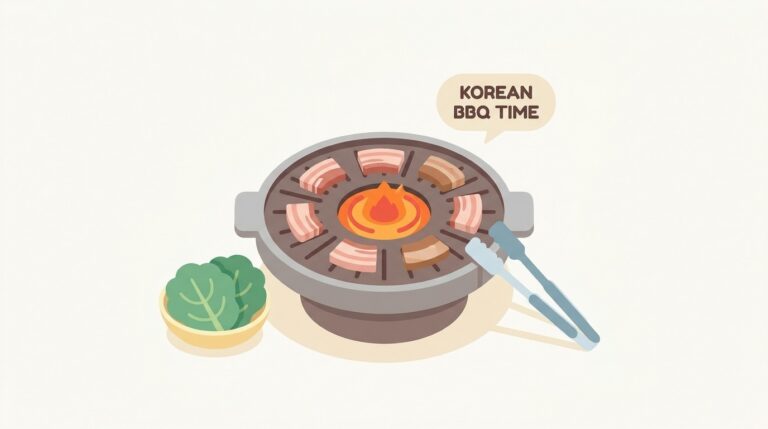
Imagine this: You are sitting at a bustling Korean BBQ restaurant in Hongdae on a Friday night. Sizzling sounds fill the air, the intoxicating aroma of grilled meat surrounds you, and your Korean friends are chatting enthusiastically. In the center of the table, thick slabs of pork belly (samgyeopsal) are searing on the hot grill plate. You pick up your chopsticks, ready to grab a mouthwatering slice, when suddenly someone stops your hand with wide eyes: “Wait! It’s pork!”
If you come from a country where medium-rare steaks or slightly pink meats are common, this moment can be downright confusing. In South Korea, when it comes to pork, there is one universal, unbroken rule: it must be thoroughly cooked right through to the center before you take a single bite. However, at A2 level, you might freeze when trying to ask the server if the meat is ready, or when telling your dinner companion that the pork needs a little more grilling time. You certainly don’t want to swallow raw meat, nor do you want to incinerate premium pork into dry charcoal!
This guide is crafted directly from real-life learner experiences and tested in genuine BBQ joints across Seoul. By the end of this lesson, you will master the essential expressions to check meat doneness, converse naturally with tablemates and restaurant staff, and enjoy K-BBQ with complete confidence and proper etiquette.
Phase 2: 3 Key Expressions Deep Dive
1. 완전히 익혀서 드세요 (Wanjeonhi ikhyeoseo deuseyo)
- Pronunciation: [wan-jeon-hi ik-hyeo-seo deu-se-yo] (Pronunciation clue: Sounds roughly like “one-john-hee eek-hyuh-suh dew-say-yo”)
- Meaning: Literal: “Cook completely and eat (it).” | Actual Nuance: “Please make sure this is cooked all the way through before you eat it.”
- K-Culture Moment: In food variety shows like Baek Jong-won’s Alley Restaurant, you constantly hear the culinary master remind guests: “돼지고기는 완전히 익혀서 드셔야 탈이 안 나요!” (Pork must be thoroughly cooked so you don’t get an upset stomach!)
- Editor’s Insight: The word 완전히 (completely/thoroughly) pairs with 익히다 (to cook/ripen). Unlike beef (sogogi), which Koreans happily eat medium-rare, pork (dwaejigogi) is almost religiously cooked until crisp on the outside and firm inside.
- Situation Spectrum:
- Casual (to friends): 완전히 익혀서 먹어 (Wanjeonhi ikhyeoseo meogeo) ✅
- Semi-formal (polite polite standard): 완전히 익혀서 드세요 (Wanjeonhi ikhyeoseo deuseyo) ✅
- Formal (business / announcements): 완전히 익혀서 드시기 바랍니다 (Wanjeonhi ikhyeoseo deusigi baramnida) ✅
- 🤔 Think About It: Why do you think Korean food culture treats beef and pork so differently on the grill? How does your own culture view the doneness of pork compared to beef?
2. 아직 안 익었어요 (Ajik an ikeosseoyo)
- Pronunciation: [a-jik an i-geot-seo-yo] (Pronunciation clue: Like “ah-jeek ahn ee-gut-suh-yo”)
- Meaning: Literal: “It has not ripened/cooked yet.” | Actual Nuance: “It’s still raw inside! Wait a bit longer.”
- K-Culture Moment: Seen in nearly every friendship K-Drama camping scene—someone gets impatient and reaches for meat with their chopsticks, prompting the group “grill master” to smack their tongs and yell: “아직 안 익었어! 기다려!” (It’s not cooked yet! Wait!)
- Editor’s Insight: Notice the verb 익다 (to be cooked / to ripen). It is the same word Koreans use for fruit ripening or kimchi fermenting. When you add 안 (not), you’re letting everyone know it needs more heat.
- Situation Spectrum:
- Casual: 아직 안 익었어 (Ajik an ikeosseo) ✅
- Semi-formal: 아직 안 익었어요 (Ajik an ikeosseoyo) ✅
- Formal: 아직 익지 않았습니다 (Ajik ikji anasseumnida) ✅
- 🤔 Think About It: English uses separate words like “cook”, “ripen”, and “mature”, but Korean encompasses them in 익다. What does this reveal about how Koreans perceive food transformation over time?
3. 이거 먹어도 돼요? (Igeo meogeodo dwaeyo?)
- Pronunciation: [i-geo meo-geo-do dwae-yo] (Pronunciation clue: Like “ee-guh muh-guh-doh dway-yo?”)
- Meaning: Literal: “Even if I eat this, is it okay?” | Actual Nuance: “Is this ready to eat? / Can I eat this now?”
- K-Culture Moment: When the server cuts the pork belly into neat golden pieces at an upscale BBQ spot in Gangnam, a hungry customer eagerly points with their chopsticks and politely asks: “사장님, 이거 지금 먹어도 돼요?” (Boss, can I eat this one now?)
- Editor’s Insight: -아/어도 돼요 is the holy grail pattern for beginner Korean learners wanting to ask permission. At a grill table, it’s the safest way to double-check without offending the person managing the tongs.
- Situation Spectrum:
- Casual: 이거 먹어도 돼? (Igeo meogeodo dwae?) ✅
- Semi-formal: 이거 먹어도 돼요? (Igeo meogeodo dwaeyo?) ✅
- Formal: 이것을 먹어도 되겠습니까? (Igeoseul meogeodo doegesseumnikka?) ⚠️ (A bit too stiff for a meal setting)
- 🤔 Think About It: In many Western dining contexts, everyone’s meal arrives cooked on individual plates. Why is “asking permission to eat” so natural when sharing a communal grill?
Phase 3: Textbook Korean vs. Real Korean
Situation 1: Telling someone the meat needs more time
- 📖 교과서 한국어 (Textbook):
- 돼지고기가 덜 조리되었습니다. (Dwaejigogiga deol joridoeeotseumnida.)
- “The pork is undercooked.”
- 🗣️ 진짜 한국어 (Real-life Korean):
- 아직 덜 익었어요. 조금 더 구워야 돼요. (Ajik deol ikeosseoyo. Jogeum deo guwoya dwaeyo.)
- *”It’s not fully done yet. We need to grill it a bit more.”
- 💡 왜 다를까? (Why the difference?): Real Koreans rarely use formal Sino-Korean culinary terms like 조리 (cooking/preparation) at the dinner table. Instead, everyday words like 익다 (to become cooked) and 굽다 (to grill/roast) sound far more natural and conversational.
Situation 2: Asking if a piece of meat is ready
- 📖 교과서 한국어 (Textbook):
- 이 고기의 조리가 완료되었습니까? (I gogiui joriga wanryodoeeotseumnikka?)
- “Has the preparation of this meat concluded?”
- 🗣️ 진짜 한국어 (Real-life Korean):
- 이거 다 익은 거예요? (Igeo da igeun geoyeyo?)
- *”Is this one all cooked?”
- 💡 왜 다를까? (Why the difference?): Using robotic textbook phrases will make servers chuckle. The short phrasing 다 익은 거예요? (Is it fully cooked?) is punchy, friendly, and instantly understood amid the noisy sizzle of a busy restaurant.
Phase 4: K-Culture Deep Dive & Non-Verbal Manners
4-1. 눈치 (Nunchi) & Grill Gestures
At a Korean BBQ restaurant, eating is a team sport. Here are non-verbal etiquette rules you must master:
* The Tongs Hierarchy (집게의 권한): In Korean dining, whoever holds the tongs (jipge) and kitchen shears (gawi) is steering the ship. Do not casually snatch meat off the grill while the designated griller is actively watching. If you want to check a piece, point gently with your chopsticks or ask first.
* The Pink-Check Flip: When pork is being grilled, don’t press down flat on the meat with your spatula (it squeezes out the tasty juices!). Instead, gently pick up a cut piece and inspect its side. If you spot even a tiny streak of pink (bunhongbit), flip it back onto the grate facing down. Your tablemates will silently admire your nunchi (social intuition)!
* Two-Handed Plate Holding: When the server or an elder moves a freshly grilled piece of pork directly onto your small dish or lettuce leaf, hold the edge of your dish with both hands as a sign of appreciation.
4-2. The Cultural Myth of the “Three Flips” (삼초의 미학)
In Korea, especially among older generations, there was an old historical health warning about parasites (yuchung) in pork feed from decades ago. While modern Korean domestic pork (Handon, 한돈) undergoes exceptionally strict sanitary processing and could technically be eaten slightly pink, the cultural mindset remains immovable: 돼지고기는 바짝 익혀야 제맛! (Pork must be thoroughly crisped to taste best!).
Koreans love the golden-brown crust called the Maillard reaction. In K-Dramas like Hospital Playlist or Weightlifting Fairy Kim Bok-joo, you will observe characters obsessing over cutting samgyeopsal into identical rectangular dominoes and standing them on their fatty rinds to render every side into golden, crunchy perfection.
Phase 5: Real-Life Roleplay Scenario
Setting: A vibrant, smoky K-BBQ joint in Mapo, Seoul. You are dining with your Korean friend Min-su (민수), who considers himself a certified grill master.
- Turn 1 (Min-su):
- 삼겹살 2인분 나왔다! 내가 맛있게 구워 줄게.
- [Samgyeopsal i-inbun nawatta! Naega masitge guwo julge.]
- *”The two servings of pork belly are here! I’ll grill them delicious for you.”
🎭 (Sets the thick pork slices onto the sizzling iron grill with a sharp hiss)
- Turn 2 (You):
- 와, 고기 진짜 두껍네요! 냄새 너무 좋아요.
- [Wa, gogi jinjja dukkeomneyo! Naemsae neomu joayo.]
- *”Wow, the meat is really thick! The smell is amazing.”
🎭 (Sniffs the air excitedly while pouring water for both of you)
- Turn 3 (Min-su):
- 돼지고기는 속까지 완전히 익혀서 먹어야 해.
- [Dwaejigogineun sokkkaji wanjeonhi ikhyeoseo meogeoya hae.]
- *”Pork has to be cooked all the way to the inside before eating.”
🎭 (Uses the steel scissors to slice the pork into bite-sized strips)
- Turn 4 (You):
- 겉은 노릇노릇한데, 속은 아직 분홍색이에요.
- [Geoteun noreutnoreuthande, sogeun ajik bunhongsaegieyo.]
- *”The outside is golden, but the inside is still pink.”
🎭 (Peeks closely at the cross-section of a sizzling piece)
- Turn 5 (Min-su):
- 맞아, 아직 안 익었어. 조금만 더 기다리자.
- [Maja, ajik an ikeosseo. Jogeumman deo gidarija.]
- *”Right, it’s not cooked yet. Let’s wait just a little longer.”
🎭 (Flips each piece onto its raw side with rapid tong clicks)
- Turn 6 (You):
- 이제 다 익은 것 같아요. 이거 먹어도 돼요?
- [Ije da igeun geot gatayo. Igeo meogeodo dwaeyo?]
- *”I think it’s all cooked now. Can I eat this one?”
🎭 (Points politely at a thoroughly browned piece on the edge)
- Turn 7 (Min-su):
- 응! 이제 완벽해. 상추에 싸서 먹어 봐.
- [Eung! Ije wanbyeokhae. Sangchue ssaseo meogeo bwa.]
- *”Yes! It’s perfect now. Try wrapping it in lettuce.”
🎭 (Piles a crispy piece of pork onto your personal side dish)
- Turn 8 (You):
- 잘 먹겠습니다! 진짜 맛있어요!
- [Jal meokgetseumnida! Jinjja masisseoyo!]
- *”Thank you for the meal! This is truly delicious!”
🎭 (Dips the meat in ssamjang paste and takes a massive, satisfied bite)
🔀 Interactive Decision Point
Min-su steps away to the restroom for two minutes. The pork belly pieces in the center of the grill are beginning to smoke heavily and turn dark brown. What do you do?
- Option A: Call the server immediately: “사장님! 불 좀 줄여 주세요, 고기 타요!” (Boss! Please turn down the fire, the meat is burning!)
- Option B: Pick up the tongs and quickly shovel all the dark meat directly into your mouth before it turns to ash.
- Option C: Turn off the gas valve completely, ignore the grill, and wait silently for Min-su to return.
Feedback on Your Choice:
- Option A (Best Choice!): 🌟 Excellent job! In Korean BBQ spots, calling the staff (Sajangnim!) to adjust gas canisters or moving the meat to the cooler perimeter wire rack (bulpan gajajari) prevents the pork from burning without offending anyone.
- Option B (Bad & Risky): 🚫 Ouch! If the pork is scorched on the surface, the center might still be raw or scorching hot, risking an upset stomach or a burned tongue!
- Option C (Awkward Risk): ⚠️ If you let it sit without moving it to the cooler edge, the residual heat from the thick cast iron will ruin the pork, making your hard-working friend mourn the ruined meal.
Phase 6: 10-Second Emotion Shadowing Drill
Practice reciting these phrases out loud. Follow the slashes / for brief breathing pauses and adopt the emotional mindset in brackets!
[🥢 Cautious & Alert]- 돼지고기는 / 속까지 / 완전히 익혀서 / 먹어야 해요.
- Dwaejigogineun / sokkkaji / wanjeonhi ikhyeoseo / meogeoya haeyo.
- (Pork must be / to the inside / completely cooked / before eating.)
[🛑 Firm & Protective]- 잠깐만요! / 아직 / 안 익었어요.
- Jamkkanmanyo! / ajik / an ikeosseoyo.
- (Hold on! / It is not / cooked yet.)
[😋 Hungry & Polite]- 사장님, / 이거 이제 / 먹어도 돼요?
- Sajangnim, / igeo ije / meogeodo dwaeyo?
- (Boss, / can I / eat this now?)
Phase 7: K-Culture Mini Dictionary
- 삼겹살 (Samgyeopsal)
- Meaning: Pork belly (literally “three-layered flesh”).
- Everyday Usage: The undisputed king of Korean working-class soul food. Often paired with soju on rainy days or during company gatherings (hoesik).
- 불판 (Bulpan)
- Meaning: The grill plate / roasting pan.
- Everyday Usage: You will frequently hear customers say: “불판 갈아 주세요!” (Please replace our grill plate!) when the iron surface becomes charred.
- 가위와 집게 (Gawi-wa Jipge)
- Meaning: Kitchen shears and tongs.
- Everyday Usage: While cutting cooked meat with scissors at the dining table might look shocking in some Western cultures, in Korea, high-grade stainless scissors are an indispensable kitchen wand.
- 쌈 (Ssam)
- Meaning: Leaf wrap (lettuce, perilla leaf, etc.).
- Everyday Usage: Putting meat, garlic, and fermented soybean paste inside a green leaf. Rule: The wrap must be eaten in a single mouthful—never bitten in half!
Phase 8: Traveler’s Survival Kit
Top 3 Meat Doneness Phrases
- 불판 좀 갈아 주세요. (Bulpan jom gara juseyo.)
- Pro Tip: Say this when your grill plate is black. Clean metal means your next batch won’t stick or burn!
- 불 좀 줄여 주세요. (Bul jom juryeo juseyo.)
- Pro Tip: If the grease drops cause tall flames to erupt (bul-syo), shout this phrase so the server can adjust the table regulator.
- 이거 다 익었어요? (Igeo da ikeosseoyo?)
- Pro Tip: Point with your finger (not chopsticks!) to ask the server whether a specific piece is safe to consume.
Editor’s Travel Note
When hunting for top-tier Korean BBQ in Seoul, avoid generic tourist spots and locate neighborhood favorites using the Naver Map app on mobile platforms. Look for spots boasting 100% domestic pork (국내산 한돈). Almost all K-BBQ tables feature a small service call bell (ding-dong button) tucked on the side edge of the wooden table. Never wave your arms wildly—just press the bell once, and the server will cheerfully respond with “Ne~!”
Phase 9: “한 발 더 깊이” (A Deeper Cultural Reflection)
In Western dining cultures, food is commonly prepared behind swinging kitchen doors and presented in its finalized state upon individual plates. However, sitting around a Korean BBQ grill transforms eating into a shared communal performance. The act of checking whether the pork is cooked through, slicing it evenly, and redistributing the pieces to your companions’ plates is the quintessential demonstration of 정 (Jeong)—warm communal affection. When someone tells you, “속까지 완전히 익혀서 먹어”, they aren’t merely giving culinary advice; they are actively nurturing and protecting your well-being.
💬 Your Turn: Have you ever experienced cooking food communally at the table in your culture? How would you feel if a friend monitored your food’s cooking temperature for you? Share your thoughts in the comments below!
Phase 10: FAQ & Common Mistakes
Q: Can I eat pork slightly pink in Korea since modern farming is cleaner?
A: While Korean domestic pork (Handon) meets elite sanitation benchmarks, Korean dining culture remains very conservative about pork doneness. Eating pink pork at a group table will cause your Korean companions noticeable distress. Always aim for a clean, non-pink center unless dining at an artisanal modern dry-aging restaurant where the chef explicitly directs you otherwise.
Q: How do I tell beef doneness apart from pork doneness in Korean?
A: For beef (sogogi), Koreans use familiar loanwords like 레어 (reeo / rare), 미디엄 (midieom / medium), or 웰던 (weldeon / well-done). However, for pork, doneness terms are not used—it is simply 다 익었다 (fully cooked) or 덜 익었다 (undercooked).
Q: Is it rude to touch the tongs if I am the youngest or a guest?
A: If you are dining with an older Korean host, they will often insist on grilling for you as hospitality. You can offer once by reaching out and saying: “제가 구울까요?” (Shall I grill?). If they wave you off, accept politely, keep your small plate ready, and compliment their grilling skills!
🚨 흔한 실수 (Common Mistakes) Warning Board
- Mistake: Cutting raw, thick pork belly immediately after putting it on the grill.
- Correct Action: Don’t fight the raw meat fibers! Wait until the bottom side is well-seared and stiff before slicing with scissors.
- Mistake: Using your personal eating chopsticks to flip raw pork on the grill.
- Correct Action: Cross-contamination risk! Always use the communal metal tongs (jipge) to flip raw or partially cooked meat.
- Mistake: Letting cooked pork sit in the center of the grill flame.
- Correct Action: Once fully cooked, immediately move pieces to the side wire rack (gajajari) or atop sliced mushrooms/onions so they stay warm without charring.
Phase 11: Action Missions
- 🥉 Bronze Level (Solo Practice): Stand in front of your mirror and practice the 3 key expressions 5 times each using clear hand gestures.
- 🥈 Silver Level (Social Sharing): Snap a photo of your next home meal or grilled dish, post it to your Instagram stories, and caption it: “돼지고기는 완전히 익혀서 드세요!” Tag us at
@DailyHangul! - 🥇 Gold Level (Real-World Test): Visit a local Korean restaurant or grocery counter, look at the grill, and confidently ask the server: “이거 지금 먹어도 돼요?”
🎮 K-Culture Mission: Watch an episode of any food-centric K-Drama (like Let’s Eat or Itaewon Class). Spot the exact moment someone cuts meat with scissors and shout the phrase “다 익었어요!” at the screen!
Phase 12: Interactive Quiz Challenge
Test your new BBQ mastery with these quick questions!
- Situational Check: You inspect a piece of pork belly on the grill and see bright pink liquid seeping from the middle. What should you say to your friend?
- A) 이거 다 익었어요. (Igeo da ikeosseoyo.)
- B) 아직 안 익었어요. (Ajik an ikeosseoyo.)
- C) 불판 갈아 주세요. (Bulpan gara juseyo.)
- Fill in the Blank: Fill in the missing word meaning ‘completely’:
- 돼지고기는 속까지 [ ________ ] 익혀서 드세요.
- Hint: Sounds like “wan-jeon-hi”.
- True or False Culture Quiz: In traditional Korean BBQ spots, it is expected that you request your pork belly cooked “medium rare”. (True / False)
👉 Click to reveal answers & explanations!
- Answer: B) 아직 안 익었어요. (It’s not cooked yet.) Pink meat means it requires more grill time before it is safe and delicious to eat!
- Answer: 완전히 (Wanjeonhi) (Completely / Thoroughly. This word is key to remembering proper pork doneness in Korea.)
- Answer: False! (Pork in Korea is virtually always cooked thoroughly until golden-brown, with zero pinkness remaining!)
🎬 Watch Our Daily Videos! (Daily Hangul Official Instagram)
Review the expressions you learned in this article with our fun daily short videos! Check out native pronunciation and real-life nuances in action.
- Instagram @dailyhangul_en







