

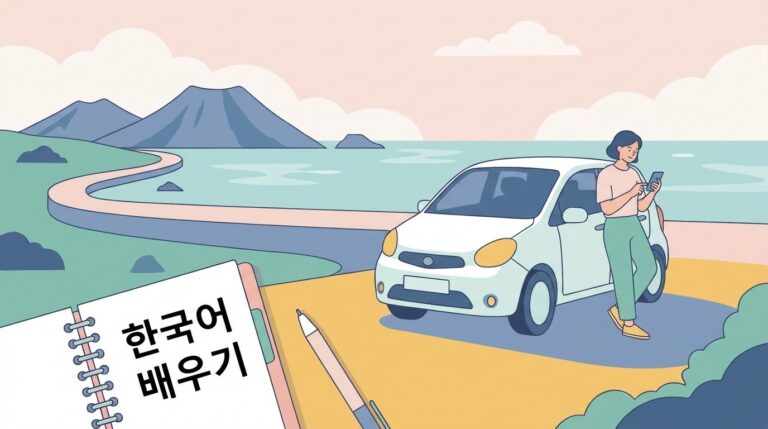
Minor Car Accident in Korea? How Zero-Deductible Insurance Saved My Trip
Reading Time: 8 min | Level: B1 (Intermediate) | Category: K-Travel & Real-life Korean
Phase 1: Empathy & Story Opening
안녕하세요! 매일한글 에디터입니다. (Hello! It is your Daily Hangul editor.)
Picture this: You are cruising along the emerald-blue coastal highway of Aewol in Jeju Island. Your rental car window is rolled down, the refreshing sea breeze fills the cabin, and your favorite K-Indie playlist is humming from the speakers. It feels like stepping right into an episode of Our Blues or Welcome to Samdal-ri.
You turn into a picturesque seaside café with volcanic stone walls to grab an iced Hallabong tea. But as you navigate the narrow parking space—SCREEECH! The right rear bumper grazes a low basalt stone pillar. You step out, your heart thumping against your chest, and see a stark grey scratch across the gleaming white bumper.
Instantly, your mind races with dread: “Am I going to be scammed? How thousands of won will this cost? What about the lost rental fees while the car sits in the repair shop? And how on earth do I explain this in Korean over the phone without sounding helpless?”
Take a deep breath and relax! Having spent over ten years helping foreign travelers navigate driving across South Korea, I have seen this exact scenario dozens of times. If you checked the magic box for 완전 자차 (Wanjeon jacha — Full Zero-Deductible Coverage) when booking, you will not have to pay a single won for repairs or lost operation time. In this intermediate (B1) guide, drawn directly from real feedback from our Daily Hangul learners, you will learn the exact practical phrases to call insurance dispatch, speak to the rental company calmly, and walk away with your wallet and vacation intact!
Phase 2: Core Expressions Deep Dive
Here are the three life-saving phrases you need to master before stepping behind the wheel in Korea.
1. 완전 자차로 가입해 두었어요 (Wanjeon jacharo gaiphae dueosseoyo)
- Pronunciation: Wanjeon jacharo gaiphae dueosseoyo (Sounds like: Wahn-jeon jah-chah-ro gah-eep-hae doo-uh-ssuh-yo — pronounce “wan” like “wand”, “jacha” like the dance “cha-cha”)
- Meaning: Literal: “I enrolled with complete own-vehicle insurance in advance.” / Actual Nuance: “I have full zero-deductible CDW, so all repair costs are covered 100%.”
- K-Culture Moment: On Korean travel shows like 2 Days & 1 Night (1박 2일), whenever the cast members rent cars for a wild regional mission, you will hear them chant “완전 자차 필수!” (Full zero-deductible is an absolute must!) to avoid losing their production budget.
- Editor’s Insight: “자차” (jacha) is short for 자기차량손해 (damage to one’s own vehicle). In Korea, rental insurance generally comes in three tiers: 일반 자차 (Standard with deductible), 완전 자차 (Zero deductible), and 슈퍼 자차 (Super coverage including tire/wheel protection). Adding the grammar pattern -아/어 두다 signifies you did something in advance to prevent future trouble.
- Situation Spectrum: Casual: ⚠️ (Use 완전 자차로 들었어) | Semi-formal: ✅ | Formal: ✅
- 🤔 Think About It: In many Western countries, car insurance policies involve confusing tiers like comprehensive versus collision with complex deductibles. Why do Koreans prefer the simplified “완전 자차” all-inclusive naming convention?
2. 보험사 현장 출동 좀 요청해 주세요 (Boheomsa hyeonjang chuldong jom yocheonghae juseyo)
- Pronunciation: Boheomsa hyeonjang chuldong jom yocheonghae juseyo (Sounds like: Boh-huhm-sah hyun-jahng chool-dong johm yoh-chuhng-hae joo-seh-yo)
- Meaning: Literal: “Please request insurance on-site dispatch.” / Actual Nuance: “Please send an insurance agent to the accident scene right away.”
- K-Culture Moment: In K-dramas, whenever an accidental fender bender occurs between two destined characters, nobody shouts or fights on the road. Instead, one character calmly takes photos of the tires and tells the other, “보험사 불렀으니 잠시만 기다리세요” (I called insurance dispatch, please wait a moment).
- Editor’s Insight: In Korea, drivers almost never negotiate damages by themselves at the scene. Instead, you call the insurance company’s 현장 출동 (on-site dispatch service). A specialized representative arrives on a motorcycle or car within 10 to 15 minutes to photograph the scene, spray tire chalk, and arbitrate fault ratios.
- Situation Spectrum: Casual: 🚫 | Semi-formal: ✅ | Formal: ✅
- 🤔 Think About It: Notice the polite word “요청하다” (to request) paired with “좀” (a little / please). In Korean business culture, pairing “좀” with requests softens your tone while maintaining clear authority.
3. 휴차 보상료도 면제되는 게 맞죠? (Hyucha bosangryodo myeonjedoeneun ge matjyo?)
- Pronunciation: Hyucha bosangryodo myeonjedoeneun ge matjyo? (Sounds like: Hyoo-chah boh-sahng-ryoh-doh myuhn-jeh-dweh-neun geh maht-jyoh?)
- Meaning: Literal: “Is it correct that the idle-car compensation fee is also exempt?” / Actual Nuance: “Does my insurance completely waive the lost rental revenue fee while the car is in the shop?”
- K-Culture Moment: Many YouTube travel vloggers share painful tales of getting a minor scratch on a Jeju rental car, thinking their insurance covered it, only to be charged a 200,000 KRW “휴차료” (loss of use fee) for three days of garage time.
- Editor’s Insight: “휴차 보상료” (often abbreviated as 휴차료) refers to the 50% daily rental fee you must pay the company for every day the car cannot be rented due to repairs. Standard CDW covers repairs but NOT 휴차료! Asking this question ensures you verify that your plan is truly 100% zero-out-of-pocket.
- Situation Spectrum: Casual: ⚠️ (Use 휴차료도 안 내도 되지?) | Semi-formal: ✅ | Formal: ✅
- 🤔 Think About It: Why is confirming the negative boundary (what you do not pay) such an essential communication skill in Korean customer service interactions?
Phase 3: Textbook Korean vs. Real Korean
Let us look at how textbook Korean compares to what native speakers actually say on the road.
Situation 1: Explaining that you accidentally scraped the bumper while parking
- 📖 교과서 한국어 (Textbook): 제가 차량 주차 중에 범퍼 부위를 긁는 사고를 유발했습니다. (Jega charyang jucha junge beompeo buwireul geulkneun sagoreul yubalhaessseumnida. – I induced an accident scraping the bumper section during vehicle parking.)
- 🗣️ 진짜 한국어 (Real Korean): 주차하다가 돌벽에 범퍼 쪽을 살짝 긁었어요. (Juchahadaga dolbyeoge beompeo jjogeul saljjak geulgeosseoyo. – While parking, I slightly scraped the bumper area against a stone wall.)
- 💡 왜 다를까? (Why is it different?): Textbook phrasing sounds like an official police confession. Real Koreans soften the incident using -다가 (while doing), add the filler/softener 살짝 (slightly/gently), and use conversational location words like ~쪽 (side/area).
Situation 2: Asking if you have any out-of-pocket expenses to pay
- 📖 교과서 한국어 (Textbook): 제가 변제해야 할 본인 부담금 잔액이 존재합니까? (Jega byeonjehaeya hal bonin budamgeum janaegi jonjaehamnikka? – Does a remainder of personal liability compensation that I must reimburse exist?)
- 🗣️ 진짜 한국어 (Real Korean): 제가 따로 결제하거나 내야 할 돈이 있나요? (Jega ttaro gyeoljehagona naeya hal doni innayo? – Is there any money I need to pay or settle separately?)
- 💡 왜 다를까? (Why is it different?): Heavy legal terms like “변제” (reimbursement) and “본인 부담금” (personal deductible) are stiff. Everyday spoken Korean uses the practical phrase 따로 내야 할 돈 (money to pay separately), which directly targets the financial outcome.
Phase 4: K-Culture Deep Dive & Non-verbal Manners
4-1. 눈치 (Nunchi) & Crisis Body Language
When an accident occurs in Korea, your physical attitude speaks louder than your words:
* Never Apologize Immediately to the Other Driver: While your instinct might be to say “죄송합니다” (I am sorry), doing so can be interpreted as an official admission of legal fault. Instead, greet them politely with a respectful 15-degree nod and say: “다치신 곳은 없으세요?” (Dachisin goseun eopseuseyo? — Is anyone hurt?).
* The Four-Point Photo Rule: Before moving the vehicle, take four critical smartphone photos: (1) 3 meters back showing the entire lane and road context, (2) the front wheel turning angle (proves direction of movement), (3) a close-up of the paint scratch, and (4) the dashboard black-box dashcam (블랙박스) blinking light.
* Respecting the Dispatch Driver (기사님): When the insurance agent arrives, address them as 기사님 (Gisanim). Hand over your rental contract and international driving permit with both hands (두 손) to show courteous cooperation.
4-2. Cultural Code Analysis: The “빨리빨리” (Palli-Palli) Dispatch Ecosystem
South Korea boasts one of the most technologically streamlined emergency dispatch ecosystems in the world. Major insurance providers (such as Samsung Fire, Hyundai Marine, and DB Insurance) utilize GPS tracking paired with local motorcycle dispatchers who can bypass gridlock traffic.
This is a direct product of Korea’s 빨리빨리 (hurry-hurry) cultural trait. Drivers expect an emergency responder on scene within 15 minutes regardless of whether you are in downtown Seoul or near a mandarin farm in Seogwipo. Because these agents mediate everything neutrally, road rage brawls are exceptionally rare in modern Korea.
Phase 5: Real-World Roleplay Scenario
Setting: Liam is parked on the roadside in Jeju after scraping a guardrail. He calls the rental car emergency line and speaks with Agent Park (박 대리).
- 박 대리 (Agent Park): 네, 탐라렌터카 사고접수센터 박지훈 대리입니다. 고객님, 다치신 데는 없으신가요? (Ne, Tamra renteoka sagojopsu-senteo Park Ji-hoon daeri-imnida. Gogaengnim, dachisin deneun eopseusingayo?)
🎭 Tone: Professional, calm, empathetic.
“Yes, this is Assistant Manager Park Ji-hoon at Tamra Rental Car Accident Reception. Valued customer, are you injured anywhere?” -
Liam: 네, 다친 사람은 없어요. 골목길 돌다가 가드레일에 범퍼를 살짝 긁었어요. (Ne, dachin sarameun eopseoyo. Golmokgil doldaga gadeureire beompeoreul saljjak geulgeosseoyo.)
🎭 Tone: Slightly nervous, but speaking clearly.
“Yes, nobody is hurt. While turning down an alleyway, I slightly scraped the bumper against a guardrail.” -
박 대리 (Agent Park): 인명 피해가 없어서 정말 다행입니다. 현재 계신 정확한 위치가 어디쯤이신가요? (Inmyeong pihaega eopseoseo jeongmal dahaeng-imnida. Hyeonjae gyesin jeonghwak-han wichiga eodijjeum-isingayo?)
🎭 Action: Typing rapidly on the keyboard.
“I am so glad there are no injuries. Approximately where is your current exact location?” -
Liam: 협재해수욕장 입구 GS25 편의점 바로 앞이에요. (Hyeopjae haesuyokjang ipgu GS25 pyeon-uijeom baro apieoyo.)
🎭 Action: Glancing at the nearby convenience store sign.
“It is right in front of the GS25 convenience store at the entrance of Hyeopjae Beach.” -
박 대리 (Agent Park): 확인 감사합니다. 저희 협력 보험사 현장 출동 기사님을 바로 보내드리겠습니다. (Hwag-in gamsahamnida. Jeohui hyeomnyeok boheomsa hyeonjang chuldong gisanim-eul baro bonaedeurigesseumnida.)
🎭 Tone: Reassuring and prompt.
“Thank you for confirming. I will immediately dispatch an on-site agent from our partner insurance company.” -
Liam: 저, 제가 예약할 때 완전 자차 보험에 가입해 두었는데요. (Jeo, jega yeyak-hal ttae wanjeon jacha boheome gaiphae dueonneundeyo.)
🎭 Tone: Inquiring carefully with hopeful anticipation.
“Um, I enrolled in the full zero-deductible insurance when I made the reservation.” -
박 대리 (Agent Park): 네, 확인해 보니 슈퍼 완전 자차 등록 차량이시네요! 면책금이랑 휴차 보상료 전액 면제 대상이십니다. (Ne, hwag-inhae boni syupeo wanjeon jacha deungnok charyang-isineyo! Myeonchaekgeum-irang hyucha bosangryo jeonaek myeonje daesang-isimnida.)
🎭 Action: Checking reservation details on screen.
“Yes, looking at your file, your vehicle is registered under Super Full CDW! Both your deductible and lost rental fees are 100% waived.” -
Liam: 정말 다행이네요! 출동 기사님 오실 때까지 차 안에서 대기할게요. (Jeongmal dahaeng-ineyo! Chuldong gisanim osil ttaekkaji cha aneseo daegihalgeyo.)
🎭 Tone: Deep sigh of relief, smiling.
“What a huge relief! I will wait inside the car until the dispatch agent arrives.”
🔀 Interactive Decision Point!
The dispatch driver arrives, takes photos of the scratch, and asks Liam to sign the accident confirmation report on a tablet. What should Liam say before signing?
- Choice A: “이거 서명하면 제가 오늘 추가로 지불해야 할 비용은 아예 없는 거죠?” (Igeosomyeonghamyeon jega oneul chugaro jibulhaeya hal biyongeun aye eomneun geojyo? — Once I sign this, there are absolutely no additional costs I have to pay today, right?)
- Choice B: “수리비 많이 나오면 제가 반만 물어낼게요.” (Suribi mani naomyeon jega banman mureonaelgeyo. — If repair costs are high, I will pay for half of it.)
- Choice C: “그냥 귀찮으니까 나중에 렌터카 반납할 때 한꺼번에 얘기할게요.” (Geunyang gwichaneunikka najunge renteoka bannaphal ttae hankkeobeone yaegihalgeyo. — It’s a hassle, so I’ll just discuss everything at once when I return the car.)
Feedback:
* Best Choice: Choice A! Outstanding! Always verbally double-check and get confirmation from the field technician before signing any digital document. This prevents any clerical errors.
* Bad Choice: Choice B! Never volunteer to split repair fees (반만 물어내다) when you already paid for full zero-deductible insurance! You are legally entitled to 0 KRW responsibility.
* Risk Choice: Choice C! Hazardous! If you dismiss the on-site agent without completing the official report (사고 접수), your insurance coverage can be voided for unverified or hit-and-run damages!
Phase 6: 10-Second Emotion Shadowing Drill
Practice reading these lines aloud with the indicated pause marks (/) and emotional coloring!
[😰 Anxious & Stressed]
주차하다가 / 돌벽에 긁혔는데 / 보험사 출동 좀 / 빨리 보내주시겠어요?
(Juchahadaga / dolbyeoge geulkhyeonneunde / boheomsa chuldong jom / ppalli bonaejusigesseoyo?)
“While parking / it scraped a stone wall / could you please send / insurance dispatch quickly?”-
[😌 Immense Relief]
완전 자차라 / 면책금도 없고 / 휴차 보상료도 / 하나도 안 냈어요!
(Wanjeon jachara / myeonchaekgeumdo eopgo / hyucha bosangryodo / hanado an naesseoyo!)
“Because it’s full zero-deductible / there’s no deductible / and for lost rental fees / I paid nothing at all!” -
[🙏 Polite Confirmation]
제가 따로 작성하거나 / 결제할 부분은 / 없는 게 맞나요?
(Jega ttaro jakseong-hageona / gyeoljehal bubuneun / eomneun ge mannayo?)
“Is it correct that / there is nothing separate / for me to fill out or pay?”
Phase 7: K-Culture Mini Dictionary
- 완전 자차 (Wanjeon Jacha)
- Meaning: Full Zero-Deductible Collision Damage Waiver (Super CDW).
- Practical Use: The essential rental car insurance option in Korea. Selecting this guarantees 0 KRW personal liability for repair damages.
- 면책금 (Myeonchaekgeum)
- Meaning: Insurance Deductible / Excess fee.
- Practical Use: Under standard insurance (일반 자차), you must pay between 100,000 to 500,000 KRW per accident before coverage kicks in. Under 완전 자차, 면책금 is 0 KRW.
- 휴차료 / 휴차 보상료 (Hyucharyo / Hyucha Bosangryo)
- Meaning: Loss-of-Use / Idle Vehicle Fee.
- Practical Use: Compensation paid to the rental business for financial losses while the car sits in a mechanic’s workshop. Standard insurance rarely covers this, making it a common hidden fee trap.
- 현장 출동 (Hyeonjang Chuldong)
- Meaning: Emergency On-Site Roadside Dispatch.
- Practical Use: The core emergency service provided by Korean insurance firms. The agent comes to your exact GPS coordinates to handle logistics and photograph damages.
Phase 8: Traveler’s Survival Kit
Top 3 On-the-Road Phrases
- 다친 곳은 없으세요? (Dachin goseun eopseuseyo?)
- Are you hurt anywhere?
- Pro Tip: Use this as your very first sentence to the other driver. It shows empathy and warmth while avoiding premature legal fault admissions.
- 블랙박스 영상 확인해 주세요. (Beullaekbakseu yeongsang hwag-inhae juseyo.)
- Please check the black-box dashcam footage.
- Pro Tip: Almost 100% of Korean rental vehicles feature dual-channel dashcams. Pointing to the dashcam stops unwarranted fault manipulation.
- 사고 접수 번호 나왔나요? (Sago jeopsu beonho nawannayo?)
- Has the official accident claim number been issued?
- Pro Tip: Once the dispatch agent registers the case, they provide an accident claim number (접수 번호). Keep this number until car drop-off.
Editor’s Travel Note
- Navigation Lifesavers: Before leaving on your road trip, ensure you have set up your destination using the Naver Map Navigation App. Unlike foreign map applications, Naver Map accurately alerts you to speed bumps, narrow country roads, and speed cameras throughout Korea.
- Emergency Hotlines: Save the 24-hour accident claim number written on your rental vehicle key fob. If language becomes a sudden barrier during an emergency, dial the Korea Tourism Organization Travel Hotline at
1330for free three-way phone interpretation.
Phase 9: One Step Deeper
In Korean traffic culture, there is a distinct tendency toward 합의 (Habi — amicable mutual settlement) rather than contentious legal litigation. Because Korean cities and rural corridors feature dense networks of CCTV cameras and mandatory two-way dashboard cameras (블랙박스), attempting to distort the facts of an accident is practically impossible.
Instead of raising voices, modern Korean drivers step outside, check on each other’s physical safety, exchange insurance dispatch information, and let professional claims adjusters determine the fault percentage (과실 비율). This reflects the broader cultural value of communal harmony (화합) and emotional composure in public settings.
💬 Your Turn: Have you ever experienced a minor accident or car rental hiccup abroad? How does the swift on-site dispatch system in Korea compare to handling roadside emergencies back home? Tell us in the comments below!
Phase 10: FAQ & Common Mistakes
Q: Does 완전 자차 (Full CDW) cover popped tires and drained batteries?
A: Not always! Basic 완전 자차 covers bodywork repairs and 휴차료. However, consumable parts like flat tires, lost smart keys, and towing over 10 km often require a special top-tier tier called 슈퍼 자차 (Super CDW) or a supplemental roadside assistance rider (특약). Always confirm tire coverage when picking up the keys.
Q: What happens if I have an accident without an International Driving Permit (IDP)?
A: If you drive without a valid IDP or a recognized reciprocal license, it is categorized as 무면허 운전 (unlicensed driving) under Korean law. In this case, all insurance policies—including full zero-deductible coverage—become completely invalid, and you will be held 100% personally liable in addition to criminal penalties.
Q: Can I settle minor paint scratches with cash directly with the other driver?
A: While some locals do “현금 합의” (cash settlements) for tiny scuffs, foreign travelers should never do this. Rental car agreements explicitly state that unreported damage forfeits insurance benefits. Always report the incident through the rental agency’s official dispatch line.
🚨 Common Mistakes Alert
- Mistake: Moving the car off the road immediately without taking photos.
- Correct Action: If safe, keep the hazard lights on (비상깜빡이) and snap photos of tire angles and street markings first.
- Mistake: Saying “I will pay for it” to the other driver out of nervousness.
- Correct Action: Simply say: “보험 처리할게요” (I will handle this through insurance) and wait for dispatch.
- Mistake: Forgetting to inspect preexisting scratches during pickup.
- Correct Action: Walk around the entire vehicle with your phone’s 4K video recording on before leaving the rental lot.
Phase 11: Action Missions & Engagement
- 🥉 Bronze Mission (Solo Shadowing): Read the 8-turn roleplay in Phase 5 out loud twice. Pay attention to how smoothly you can pronounce “완전 자차로 가입해 두었어요.”
- 🥈 Silver Mission (Social Share): Share this guide with a friend who is planning a trip to Jeju Island or Busan, and tell them why booking “완전 자차” is non-negotiable!
- 🥇 Gold Mission (Real-life Execution): Next time you rent a vehicle in Korea, walk up to the counter and confidently ask: “완전 자차에 휴차 보상료도 포함되어 있나요?” (Is the lost rental fee included in the full CDW?)
- 🎮 K-Culture Mission: Watch an episode of a Korean road-trip variety show (like House on Wheels or Campfire) and spot how drivers address roadside mechanics and tollbooth operators using the respectful title “기사님”.
Phase 12: Interactive Quiz Challenge
Test your knowledge with these three quick checks! Tap the spoiler tags to see the correct answers.
Quiz 1: Situational Judgment
You bumped into a stone wall while reversing. What is the most appropriate first step?
* (A) Drive quickly back to your hotel and pretend nothing happened.
* (B) Take photos of the bumper and call the rental car emergency dispatch number.
* (C) Visit a local hardware store, buy spray paint, and paint over the scratch.
👉 Click to view Answer & Explanation
Correct Answer: (B)
Explanation: Unreported damages void your insurance protection entirely! Always photograph the scene and notify the company’s emergency desk right away.
Quiz 2: Fill in the Blank
Complete the sentence to say: “I have full zero-deductible coverage, so I didn’t pay any repair costs.”
“______ 자차에 가입해서 수리비를 하나도 안 냈어요.”
👉 Click to view Answer & Explanation
Correct Answer: 완전 (Wanjeon)
Explanation: 완전 (Complete/Full) combines with 자차 (Own-vehicle damage insurance) to denote zero-deductible collision damage waiver.
Quiz 3: True or False (K-Culture)
In South Korea, it is customary for drivers involved in minor fender benders to argue fault percentages loudly in public before calling insurance.
* (A) True
* (B) False
👉 Click to view Answer & Explanation
Correct Answer: (B) False
Explanation: In modern Korean driving etiquette, drivers rely on fast insurance dispatch agents (현장 출동 기사님) and black-box dashcam footage to arbitrate fault ratios calmly and objectively.
🎬 Watch Our Daily Videos! (Daily Hangul Official Instagram)
Review the expressions you learned in this article with our fun daily short videos! Check out native pronunciation and real-life nuances in action.
- Instagram @dailyhangul_en







